Recognition: unknown
NK-GAD: Neighbor Knowledge-Enhanced Unsupervised Graph Anomaly Detection
Pith reviewed 2026-05-10 09:04 UTC · model grok-4.3
The pith
NK-GAD improves unsupervised graph anomaly detection on heterophilous graphs by jointly encoding similar and dissimilar neighbors and using dual reconstruction.
A machine-rendered reading of the paper's core claim, the machinery that carries it, and where it could break.
Core claim
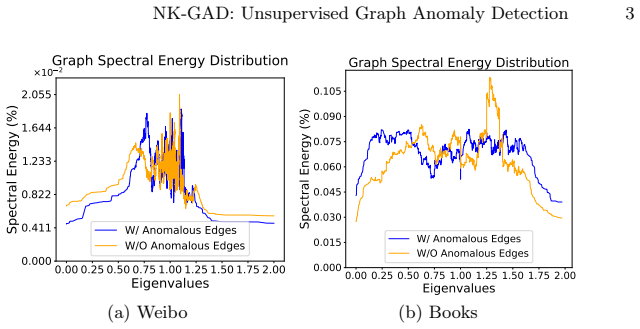
By observing that attribute similarities between connected nodes follow nearly identical distributions across pair types and that anomalies induce predictable variation trends in low- and high-frequency spectral components, the authors establish that a neighbor-knowledge framework consisting of a joint encoder, neighbor reconstruction module, center aggregation, and dual decoders can capture both homophilous and heterophilous signals to improve unsupervised anomaly detection.
What carries the argument
The NK-GAD framework, whose joint encoder captures both similar and dissimilar neighbor features, neighbor reconstruction module models normal distributions, center aggregation refines features, and dual decoders reconstruct attributes and structures.
If this is right
- The method yields consistent AUC gains across seven datasets without requiring anomaly labels.
- Dual reconstruction of attributes and structure allows separate modeling of content and connectivity anomalies.
- Center aggregation after joint encoding produces refined node representations that better separate normal and anomalous nodes.
- The approach remains fully unsupervised while explicitly handling the heterophily that defeats standard homophily-based GNN detectors.
Where Pith is reading between the lines
- The spectral variation observation could be turned into an explicit frequency-based anomaly score that operates independently of the reconstruction losses.
- If the uniform similarity distribution holds more broadly, many existing homophily-regularized GNNs may need similar dual-path encoders for other tasks such as node classification on heterophilous graphs.
- The neighbor reconstruction module could be adapted to detect anomalous edges rather than nodes by treating edge reconstruction error as the primary signal.
Load-bearing premise
The two observed patterns in attribute-level heterophily graphs are general properties that the joint encoder, neighbor reconstruction, center aggregation, and dual decoders reliably address.
What would settle it
Running the same experiments on additional heterophilous graphs where the similarity distributions or spectral energy trends deviate from the described patterns and finding no AUC improvement would falsify the claim.
Figures



read the original abstract
Graph anomaly detection aims to identify irregular patterns in graph-structured data. Most unsupervised GNN-based methods rely on the homophily assumption that connected nodes share similar attributes. However, real-world graphs often exhibit attribute-level heterophily, where connected nodes have dissimilar attributes. Our analysis of attribute-level heterophily graphs reveals two phenomena indicating that current approaches are not practical for unsupervised graph anomaly detection: 1) attribute similarities between connected nodes show nearly identical distributions across different connected node pair types, and 2) anomalies cause consistent variation trends between the graph with and without anomalous edges in the low- and high-frequency components of the spectral energy distributions, while the mid-part exhibits more erratic variations. Based on these observations, we propose NK-GAD, a neighbor knowledge-enhanced unsupervised graph anomaly detection framework. NK-GAD integrates a joint encoder capturing both similar and dissimilar neighbor features, a neighbor reconstruction module modeling normal distributions, a center aggregation module refining node features, and dual decoders for reconstructing attributes and structures. Experiments on seven datasets show NK-GAD achieves an average 3.29\% AUC improvement.
Editorial analysis
A structured set of objections, weighed in public.
Referee Report
Summary. The manuscript presents NK-GAD, a framework for unsupervised graph anomaly detection in attribute-level heterophily graphs. It first analyzes two phenomena: nearly identical attribute similarity distributions across node pair types and consistent low/high-frequency spectral energy variations caused by anomalies. Based on this, it introduces a joint encoder for similar and dissimilar neighbors, a neighbor reconstruction module, center aggregation, and dual decoders for attribute and structure reconstruction. Experiments on seven datasets demonstrate an average 3.29% AUC improvement over existing methods.
Significance. If the observed phenomena hold generally and the proposed modules effectively exploit them, NK-GAD could advance unsupervised GAD by relaxing the homophily assumption common in GNN methods. The multi-dataset evaluation is a positive aspect, providing some evidence of robustness. The contribution is primarily empirical and engineering-oriented, with potential impact in applications like fraud detection or network security where graphs are heterophilic.
major comments (2)
- §3 (Observations): The two phenomena are illustrated using the seven evaluation datasets, but the paper does not demonstrate that these are general properties of attribute-level heterophily graphs beyond these datasets. This is load-bearing for the motivation of the joint encoder and reconstruction modules in §4, as the design is directly derived from these observations.
- §5 (Experiments): The average 3.29% AUC improvement is reported without accompanying standard deviations, error bars, or statistical significance tests across the seven datasets. This makes it difficult to determine if the improvement is consistent and reliable or influenced by specific hyperparameter choices.
minor comments (2)
- The description of the dual decoders could benefit from clearer mathematical formulation to distinguish attribute and structure reconstruction losses.
- Additional references to recent work on heterophily-aware GNNs would help contextualize the contribution.
Simulated Author's Rebuttal
We thank the referee for the constructive comments on our manuscript. We address each major comment point by point below, outlining planned revisions where appropriate.
read point-by-point responses
-
Referee: §3 (Observations): The two phenomena are illustrated using the seven evaluation datasets, but the paper does not demonstrate that these are general properties of attribute-level heterophily graphs beyond these datasets. This is load-bearing for the motivation of the joint encoder and reconstruction modules in §4, as the design is directly derived from these observations.
Authors: We agree that the observations are derived from the seven evaluation datasets and that broader generality is not proven. These datasets are standard, diverse benchmarks spanning multiple domains with varying heterophily levels. In the revision, we will clarify in Section 3 that the phenomena motivate the design based on empirical patterns in representative heterophilic graphs, add references to related heterophily studies, and include a brief analysis on one additional synthetic heterophilic graph to illustrate the trends in a controlled setting. This strengthens the motivation section without overclaiming universality. revision: partial
-
Referee: §5 (Experiments): The average 3.29% AUC improvement is reported without accompanying standard deviations, error bars, or statistical significance tests across the seven datasets. This makes it difficult to determine if the improvement is consistent and reliable or influenced by specific hyperparameter choices.
Authors: We agree that variability measures and significance testing are necessary for assessing reliability. In the revised manuscript, we will report mean AUC scores with standard deviations from five independent runs using different random seeds, include error bars in the performance tables and figures, and add statistical significance tests (e.g., paired t-tests or Wilcoxon signed-rank tests) comparing NK-GAD against baselines. Hyperparameter sensitivity will also be briefly discussed. revision: yes
Circularity Check
No significant circularity; empirical method motivated by independent observations.
full rationale
The paper identifies two phenomena via analysis of heterophily graphs, then constructs NK-GAD (joint encoder, reconstruction module, center aggregation, dual decoders) to exploit them, and reports empirical AUC gains on seven datasets. No equations, self-definitional reductions, fitted inputs renamed as predictions, or load-bearing self-citations appear. The claimed improvement is presented as an experimental outcome rather than a derivation that collapses to its inputs by construction. The derivation chain remains self-contained against external benchmarks.
Axiom & Free-Parameter Ledger
axioms (2)
- domain assumption Real-world graphs frequently exhibit attribute-level heterophily where connected nodes have dissimilar attributes.
- domain assumption The two observed phenomena (identical similarity distributions across pair types and consistent low/high-frequency spectral shifts from anomalies) hold generally.
invented entities (4)
-
Joint encoder capturing both similar and dissimilar neighbor features
no independent evidence
-
Neighbor reconstruction module modeling normal distributions
no independent evidence
-
Center aggregation module refining node features
no independent evidence
-
Dual decoders for reconstructing attributes and structures
no independent evidence
Reference graph
Works this paper leans on
-
[1]
In: Proceedings of the 13th international conference on web search and data mining
Bandyopadhyay,S., N, L.,Vivek,S.V., Murty,M.N.: Outlier resistant unsupervised deep architectures for attributed network embedding. In: Proceedings of the 13th international conference on web search and data mining. pp. 25–33 (2020)
2020
-
[2]
In: The Twelfth International Conference on Learning Representations (2024)
Chen, J., Zhu, G., Yuan, C., Huang, Y.: Boosting graph anomaly detection with adaptive message passing. In: The Twelfth International Conference on Learning Representations (2024)
2024
-
[3]
In: Proceedings of the 29th ACM Interna- tionalConferenceonInformation&KnowledgeManagement.pp.1989–1992(2020)
Chen, Z., Liu, B., Wang, M., Dai, P., Lv, J., Bo, L.: Generative adversarial at- tributed network anomaly detection. In: Proceedings of the 29th ACM Interna- tionalConferenceonInformation&KnowledgeManagement.pp.1989–1992(2020)
1989
-
[4]
In: Proceedings of the 2019 SIAM international conference on data mining
Ding, K., Li, J., Bhanushali, R., Liu, H.: Deep anomaly detection on attributed net- works. In: Proceedings of the 2019 SIAM international conference on data mining. pp. 594–602. SIAM (2019)
2019
-
[5]
In: Proceedings of the ACM on Web Conference 2025
Dong, X., Zhang, X., Sun, Y., Chen, L., Yuan, M., Wang, S.: Smoothgnn: Smoothing-aware gnn for unsupervised node anomaly detection. In: Proceedings of the ACM on Web Conference 2025. pp. 1225–1236 (2025) NK-GAD: Unsupervised Graph Anomaly Detection 15
2025
-
[6]
IEEE Signal processing magazine37(6), 117–127 (2020)
Dong, X., Thanou, D., Toni, L., Bronstein, M., Frossard, P.: Graph signal process- ing for machine learning: A review and new perspectives. IEEE Signal processing magazine37(6), 117–127 (2020)
2020
-
[7]
In: ICASSP 2020-2020 IEEE International Conference on Acoustics, Speech and Signal Processing (ICASSP)
Fan, H., Zhang, F., Li, Z.: Anomalydae: Dual autoencoder for anomaly detection on attributed networks. In: ICASSP 2020-2020 IEEE International Conference on Acoustics, Speech and Signal Processing (ICASSP). pp. 5685–5689. IEEE (2020)
2020
-
[8]
In: Proceedings of the ACM Web Conference 2023
Gao, Y., Wang, X., He, X., Liu, Z., Feng, H., Zhang, Y.: Addressing heterophily in graph anomaly detection: A perspective of graph spectrum. In: Proceedings of the ACM Web Conference 2023. pp. 1528–1538 (2023)
2023
-
[9]
International Journal of Electrical Engineering & Education 60(1_suppl), 1736–1749 (2023)
HC, M.: Retracted: Bmadsn: Big data multi-community anomaly detection in social networks. International Journal of Electrical Engineering & Education 60(1_suppl), 1736–1749 (2023)
2023
-
[10]
In: Proceedings of the AAAI Conference on Artificial Intelligence
He, J., Xu, Q., Jiang, Y., Wang, Z., Huang, Q.: Ada-gad: Anomaly-denoised au- toencoders for graph anomaly detection. In: Proceedings of the AAAI Conference on Artificial Intelligence. vol. 38, pp. 8481–8489 (2024)
2024
-
[11]
In: Proceedings of the ACM Web Conference 2023
Huang, J., Du, L., Chen, X., Fu, Q., Han, S., Zhang, D.: Robust mid-pass filtering graph convolutional networks. In: Proceedings of the ACM Web Conference 2023. pp. 328–338 (2023)
2023
-
[12]
Advances in Neural Information Processing Systems35, 22765–22777 (2022)
Huang,X.,Yang,Y.,Wang,Y.,Wang,C.,Zhang,Z.,Xu,J.,Chen,L.,Vazirgiannis, M.: Dgraph: A large-scale financial dataset for graph anomaly detection. Advances in Neural Information Processing Systems35, 22765–22777 (2022)
2022
-
[13]
Semi-Supervised Classification with Graph Convolutional Networks
Kipf, T.N., Welling, M.: Semi-supervised classification with graph convolutional networks. arXiv preprint arXiv:1609.02907 (2016)
work page internal anchor Pith review arXiv 2016
-
[14]
Physica A: Statistical Mechanics and its Applications553, 124289 (2020)
Kumar, A., Singh, S.S., Singh, K., Biswas, B.: Link prediction techniques, ap- plications, and performance: A survey. Physica A: Statistical Mechanics and its Applications553, 124289 (2020)
2020
-
[15]
In: Proceedings of the 25th ACM SIGKDD inter- national conference on knowledge discovery & data mining
Kumar, S., Zhang, X., Leskovec, J.: Predicting dynamic embedding trajectory in temporal interaction networks. In: Proceedings of the 25th ACM SIGKDD inter- national conference on knowledge discovery & data mining. pp. 1269–1278 (2019)
2019
-
[16]
In: IJCAI
Li, J., Dani, H., Hu, X., Liu, H.: Radar: Residual analysis for anomaly detection in attributed networks. In: IJCAI. vol. 17, pp. 2152–2158 (2017)
2017
-
[17]
Advances in Neural Information Processing Systems35, 27021–27035 (2022)
Liu, K., Dou, Y., Zhao, Y., Ding, X., Hu, X., Zhang, R., Ding, K., Chen, C., Peng, H., Shu, K., et al.: Bond: Benchmarking unsupervised outlier node detection on static attributed graphs. Advances in Neural Information Processing Systems35, 27021–27035 (2022)
2022
-
[18]
In: Proceedings of the web conference 2021
Liu, Y., Ao, X., Qin, Z., Chi, J., Feng, J., Yang, H., He, Q.: Pick and choose: a gnn-based imbalanced learning approach for fraud detection. In: Proceedings of the web conference 2021. pp. 3168–3177 (2021)
2021
-
[19]
Advances in Neural Information Processing Systems36(2024)
Luan, S., Hua, C., Xu, M., Lu, Q., Zhu, J., Chang, X.W., Fu, J., Leskovec, J., Precup, D.: When do graph neural networks help with node classification? inves- tigating the homophily principle on node distinguishability. Advances in Neural Information Processing Systems36(2024)
2024
-
[20]
In: 2013 IEEE 29th international conference on data engi- neering workshops (ICDEW)
Müller, E., Sánchez, P.I., Mülle, Y., Böhm, K.: Ranking outlier nodes in subspaces of attributed graphs. In: 2013 IEEE 29th international conference on data engi- neering workshops (ICDEW). pp. 216–222. IEEE (2013)
2013
-
[21]
Deep graph anomaly detection: A survey and new perspectives,
Qiao, H., Tong, H., An, B., King, I., Aggarwal, C., Pang, G.: Deep graph anomaly detection: A survey and new perspectives. arXiv preprint arXiv:2409.09957 (2024)
-
[22]
In: Proceedings of the 17th ACM International Conference on Web Search and Data Mining
Roy, A., Shu, J., Li, J., Yang, C., Elshocht, O., Smeets, J., Li, P.: Gad-nr: Graph anomaly detection via neighborhood reconstruction. In: Proceedings of the 17th ACM International Conference on Web Search and Data Mining. pp. 576–585 (2024) 16 Zehao Wang and Lanjun Wang
2024
-
[23]
Sánchez, P.I., Müller, E., Laforet, F., Keller, F., Böhm, K.: Statistical selection of congruentsubspacesforminingattributedgraphs.In:2013IEEE13thinternational conference on data mining. pp. 647–656. IEEE (2013)
2013
-
[24]
Transportation research part C: emerging technologies145, 103921 (2022)
Shaygan, M., Meese, C., Li, W., Zhao, X.G., Nejad, M.: Traffic prediction us- ing artificial intelligence: Review of recent advances and emerging opportunities. Transportation research part C: emerging technologies145, 103921 (2022)
2022
-
[25]
Digital signal processing107, 102802 (2020)
Stanković, L., Mandic, D., Daković, M., Scalzo, B., Brajović, M., Sejdić, E., Con- stantinides, A.G.: Vertex-frequency graph signal processing: A comprehensive re- view. Digital signal processing107, 102802 (2020)
2020
-
[26]
In: International Conference on Machine Learning
Tang, J., Li, J., Gao, Z., Li, J.: Rethinking graph neural networks for anomaly detection. In: International Conference on Machine Learning. pp. 21076–21089. PMLR (2022)
2022
-
[27]
Signal, Image and Video Processing17(4), 1053–1059 (2023)
Tekin, S.F., Kozat, S.S.: Crime prediction with graph neural networks and multi- variate normal distributions. Signal, Image and Video Processing17(4), 1053–1059 (2023)
2023
-
[28]
In: 2024 International Conference on Science Technology Engineering and Management (ICSTEM)
Thilagavathi, M., Saranyadevi, R., Vijayakumar, N., Selvi, K., Anitha, L., Sud- harson, K.: Ai-driven fraud detection in financial transactions with graph neural networks and anomaly detection. In: 2024 International Conference on Science Technology Engineering and Management (ICSTEM). pp. 1–6. IEEE (2024)
2024
-
[29]
Veličković, P., Cucurull, G., Casanova, A., Romero, A., Lio, P., Bengio, Y.: Graph attention networks. arXiv preprint arXiv:1710.10903 (2017)
work page internal anchor Pith review arXiv 2017
-
[30]
In: Proceedings of the 41st International Conference on Machine Learn- ing
Wang, J., Guo, Y., Yang, L., Wang, Y.: Understanding heterophily for graph neural networks. In: Proceedings of the 41st International Conference on Machine Learn- ing. Proceedings of Machine Learning Research, vol. 235, pp. 50489–50529. PMLR (21–27 Jul 2024)
2024
-
[31]
In: ACM SIGKDD International Con- ference on Knowledge Discovery and Data Mining (2019)
Weber, M., Domeniconi, G., Chen, J., Weidele, D.K.I., Bellei, C., Robinson, T., Leiserson, C.: Anti-money laundering in bitcoin: Experimenting with graph con- volutional networks for financial forensics. In: ACM SIGKDD International Con- ference on Knowledge Discovery and Data Mining (2019)
2019
-
[32]
IEEE transactions on neural networks and learning systems32(1), 4–24 (2020)
Wu, Z., Pan, S., Chen, F., Long, G., Zhang, C., Philip, S.Y.: A comprehensive sur- vey on graph neural networks. IEEE transactions on neural networks and learning systems32(1), 4–24 (2020)
2020
-
[33]
Machine Vision and Applications33(1), 4 (2022)
Xiao, S., Wang, S., Dai, Y., Guo, W.: Graph neural networks in node classification: survey and evaluation. Machine Vision and Applications33(1), 4 (2022)
2022
-
[34]
International Journal of Advanced Computer Science and Applications14(4), 912–920 (2023)
Zardi, H., Alrajhi, H.: Anomaly discover: A new community-based approach for de- tecting anomalies in social networks. International Journal of Advanced Computer Science and Applications14(4), 912–920 (2023)
2023
-
[35]
In: Proceedings of the 27th ACM SIGKDD Conference on Knowledge Discovery & Data Mining
Zhang, N., Jia, Q., Deng, S., Chen, X., Ye, H., Chen, H., Tou, H., Huang, G., Wang, Z., Hua, N., et al.: Alicg: Fine-grained and evolvable conceptual graph construc- tion for semantic search at alibaba. In: Proceedings of the 27th ACM SIGKDD Conference on Knowledge Discovery & Data Mining. pp. 3895–3905 (2021)
2021
-
[36]
In: Proceedings of the 29th ACM International Conference on Information & Knowledge Management
Zhao, T., Deng, C., Yu, K., Jiang, T., Wang, D., Jiang, M.: Error-bounded graph anomaly loss for gnns. In: Proceedings of the 29th ACM International Conference on Information & Knowledge Management. pp. 1873–1882 (2020)
2020
discussion (0)
Sign in with ORCID, Apple, or X to comment. Anyone can read and Pith papers without signing in.