Recognition: unknown
Modern Structure-Aware Simplicial Spatiotemporal Neural Network
Pith reviewed 2026-05-10 08:19 UTC · model grok-4.3
The pith
ModernSASST is the first neural network to model spatiotemporal data with simplicial complexes instead of graphs.
A machine-rendered reading of the paper's core claim, the machinery that carries it, and where it could break.
Core claim
The central claim is that simplicial complexes, by representing higher-dimensional relationships, enable richer modeling of spatiotemporal networks than pairwise graphs allow. The method achieves this through spatiotemporal random walks on these complexes integrated with Temporal Convolutional Networks, delivering capture of high-order structures alongside computational efficiency suitable for large networks.
What carries the argument
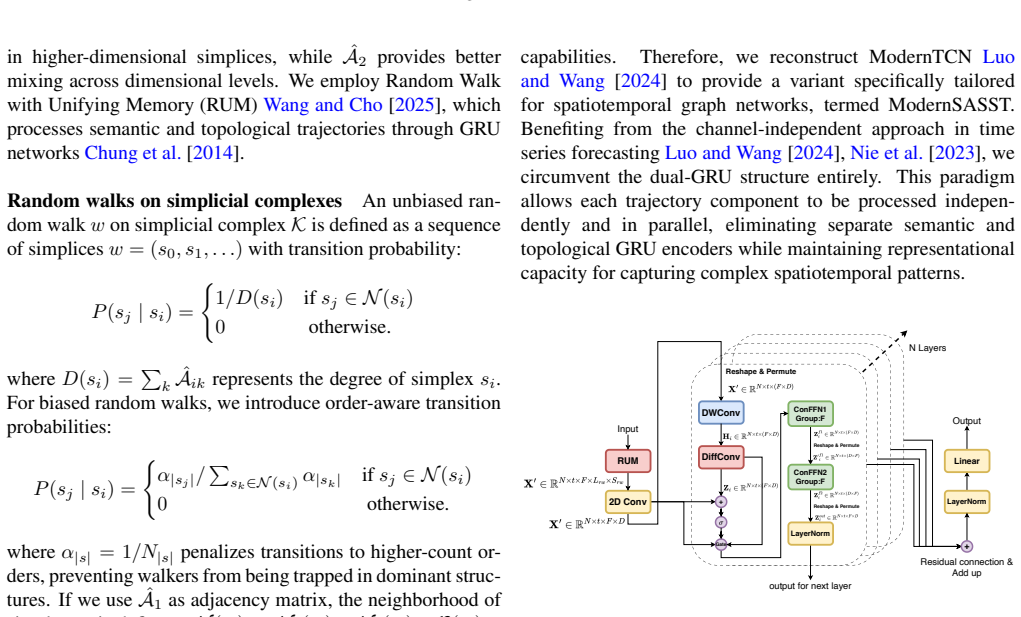
Spatiotemporal random walks on high-dimensional simplicial complexes integrated with parallelizable Temporal Convolutional Networks to extract high-order topological structures.
If this is right
- Spatiotemporal models gain the ability to represent multi-way interactions that graphs omit.
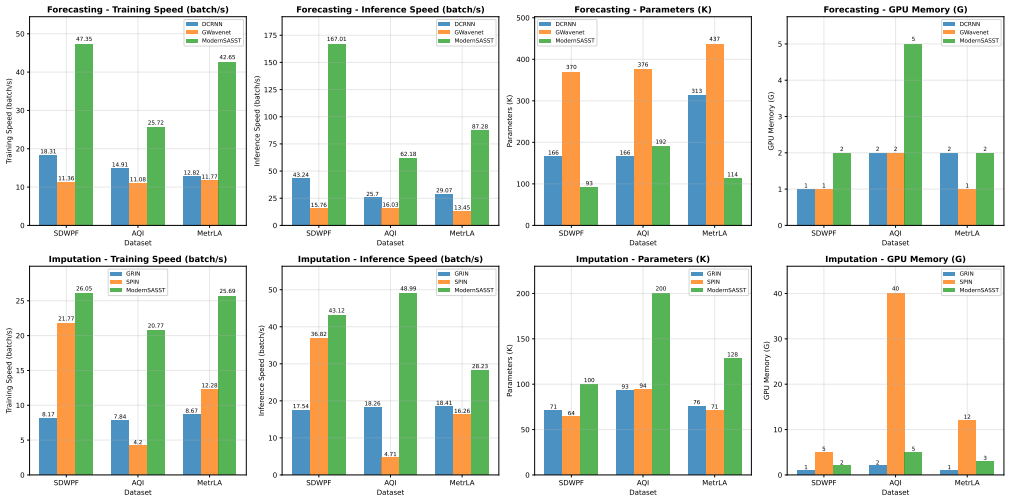
- Computational scaling improves for large networks due to the parallelizable temporal components.
- High-order topological features become accessible without the full cost of complex graph operations.
- A new class of structure-aware methods opens for data where simplicial representations fit naturally.
Where Pith is reading between the lines
- Similar random-walk techniques on simplicial complexes could extend to domains like molecular modeling where group interactions dominate.
- Testing whether the walks preserve topological invariants better than graph equivalents would clarify advantages on specific datasets.
- Combining this with other temporal architectures might address remaining efficiency bottlenecks in very high-dimensional cases.
Load-bearing premise
Real-world spatiotemporal networks contain richer topological relationships beyond pairwise connections that simplicial complexes can capture effectively, and the random walks combined with TCNs will produce both performance gains and efficiency on large data.
What would settle it
A head-to-head evaluation on standard large spatiotemporal benchmark datasets that shows no accuracy improvement or higher computational cost than existing graph neural network models would disprove the central claim.
Figures


read the original abstract
Spatiotemporal modeling has evolved beyond simple time series analysis to become fundamental in structural time series analysis. While current research extensively employs graph neural networks (GNNs) for spatial feature extraction with notable success, these networks are limited to capturing only pairwise relationships, despite real-world networks containing richer topological relationships. Additionally, GNN-based models face computational challenges that scale with graph complexity, limiting their applicability to large networks. To address these limitations, we present Modern Structure-Aware Simplicial SpatioTemporal neural network (ModernSASST), the first approach to leverage simplicial complex structures for spatiotemporal modeling. Our method employs spatiotemporal random walks on high-dimensional simplicial complexes and integrates parallelizable Temporal Convolutional Networks to capture high-order topological structures while maintaining computational efficiency. Our source code is publicly available on GitHub\footnote{Code is available at: https://github.com/ComplexNetTSP/ST_RUM.
Editorial analysis
A structured set of objections, weighed in public.
Axiom & Free-Parameter Ledger
axioms (1)
- domain assumption Simplicial complexes represent richer topological relationships in real-world networks than pairwise graphs.
Reference graph
Works this paper leans on
-
[1]
Jimmy Lei Ba, Jamie Ryan Kiros, and Geoffrey E Hinton. Layer normalization.arXiv preprint arXiv:1607.06450,
work page internal anchor Pith review Pith/arXiv arXiv
-
[2]
An Empirical Evaluation of Generic Convolutional and Recurrent Networks for Sequence Modeling
Shaojie Bai, J Zico Kolter, and Vladlen Koltun. An empirical evaluation of generic convolutional and recurrent networks for sequence modeling.arXiv preprint arXiv:1803.01271,
work page internal anchor Pith review arXiv
-
[3]
Jacob Charles Wright Billings et al. Simplex2vec embeddings for community detection in simplicial complexes.arXiv preprint arXiv:1906.09068,
-
[4]
Simplicial neural networks.arXiv preprint arXiv:2010.03633,
Stefania Ebli, Micha¨el Defferrard, and Gard Spreemann. Sim- plicial neural networks.arXiv preprint arXiv:2010.03633,
-
[5]
Jianfei Gao and Bruno Ribeiro. On the equivalence between temporal and static graph representations for observational predictions.arXiv preprint arXiv:2103.07016,
-
[6]
k-simplex2vec: a simplicial extension of node2vec.arXiv preprint arXiv:2010.05636,
Celia Hacker. k-simplex2vec: a simplicial extension of node2vec.arXiv preprint arXiv:2010.05636,
-
[7]
Semi-Supervised Classification with Graph Convolutional Networks
Thomas N Kipf and Max Welling. Semi-supervised classifi- cation with graph convolutional networks.arXiv preprint arXiv:1609.02907,
work page internal anchor Pith review arXiv
-
[8]
Deep graph library: A graph-centric, highly-performant package for graph neural networks,
9 Minjie Wang et al. Deep graph library: A graph-centric, highly-performant package for graph neural networks. arXiv preprint arXiv:1909.01315,
-
[9]
Graph wavenet for deep spatial-temporal graph model- ing.arXiv preprint arXiv:1906.00121,
Zonghan Wu, Shirui Pan, Guodong Long, Jing Jiang, and Chengqi Zhang. Graph wavenet for deep spatial-temporal graph modeling.arXiv preprint arXiv:1906.00121,
discussion (0)
Sign in with ORCID, Apple, or X to comment. Anyone can read and Pith papers without signing in.