Recognition: unknown
Comprehensive analyses of rare Λ_b rightarrow Λ ell^+ ell^-, Sigma_b rightarrow Sigma ell^+ ell^- and Xi_b rightarrow Xi ell^+ ell^- decays in 2HDM
Pith reviewed 2026-05-10 08:39 UTC · model grok-4.3
The pith
The work computes differential and total branching ratios plus forward-backward asymmetries for Λ_b → Λ ℓ⁺ℓ⁻, Σ_b → Σ ℓ⁺ℓ⁻ and Ξ_b → Ξ ℓ⁺ℓ⁻ in 2HDM Type III and contrasts them with SM predictions.
A machine-rendered reading of the paper's core claim, the machinery that carries it, and where it could break.
Core claim
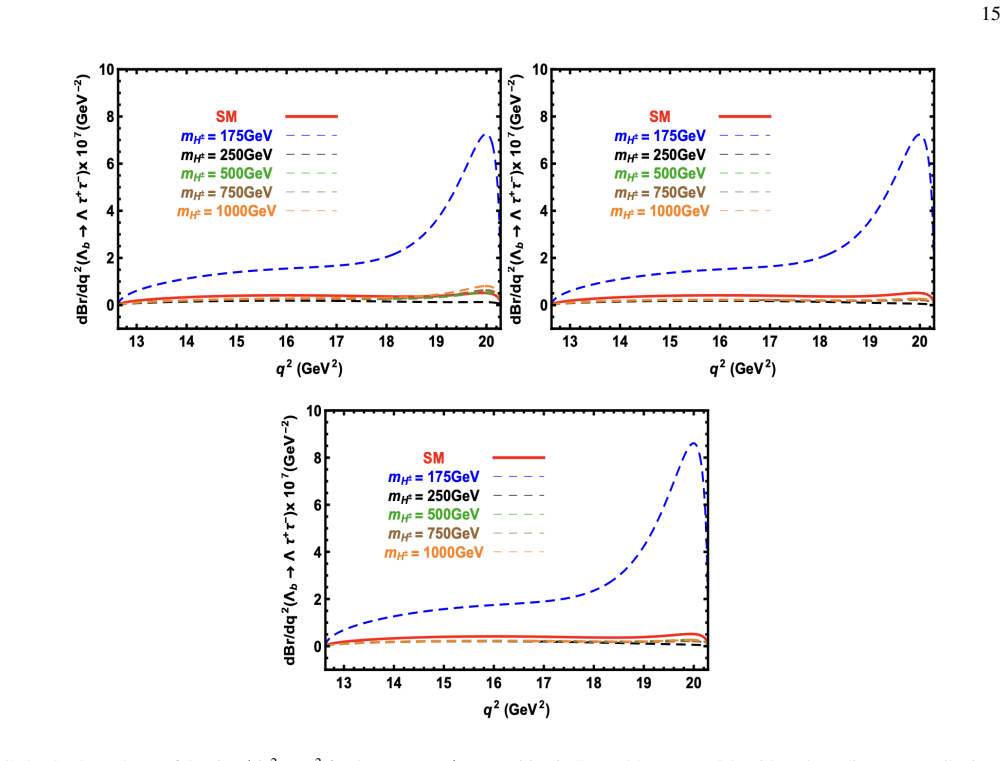
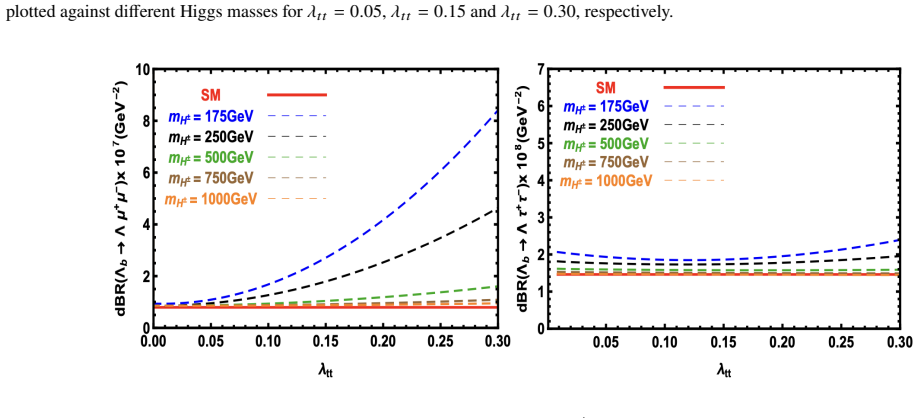
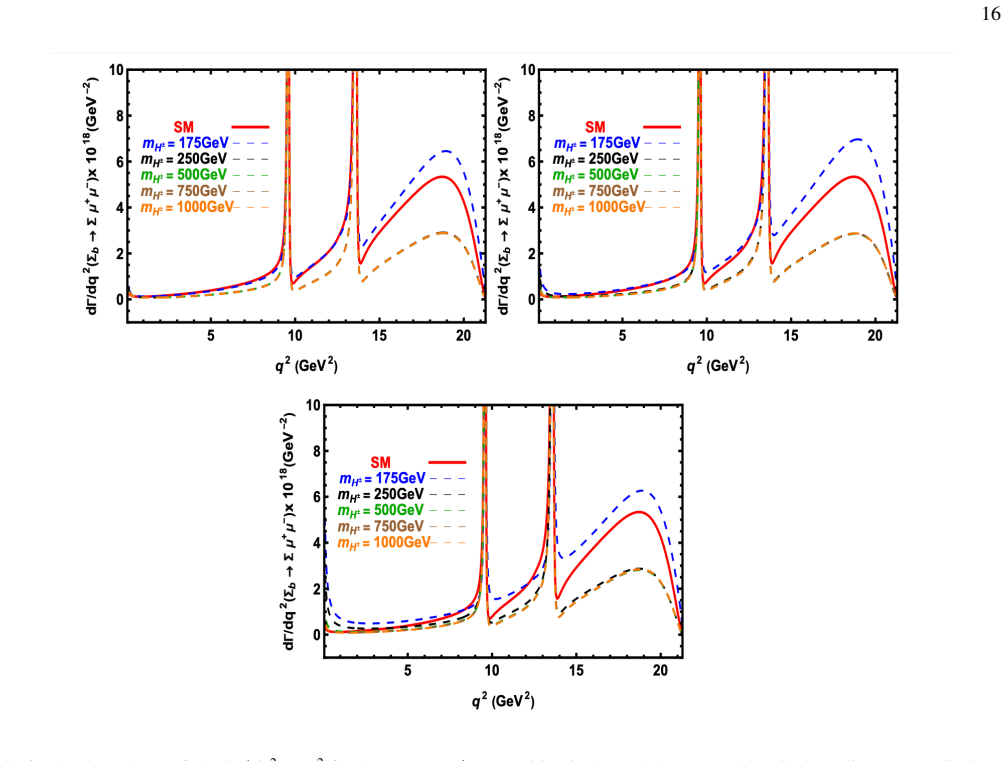
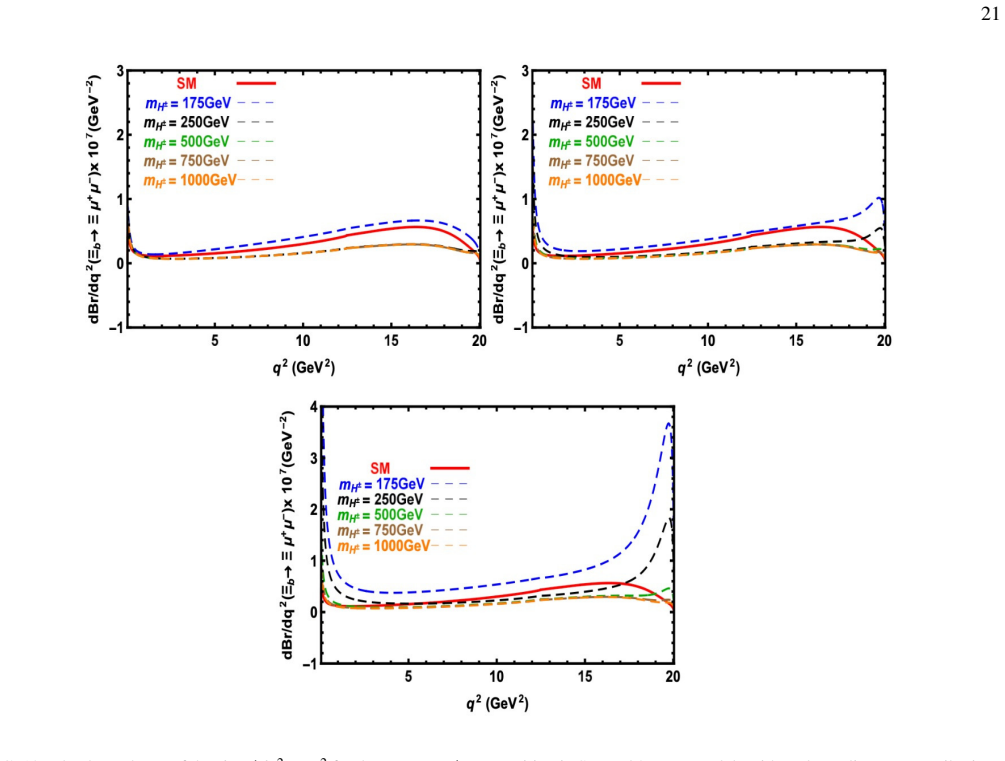
We aim to assess the impact of the Two-Higgs-Doublet Model with Type III on various observables, such as the differential branching ratio, total branching ratio, and lepton forward-backward asymmetries using the decay amplitude and the transition matrix elements in terms of form factors calculated via light cone QCD in full theory.
Load-bearing premise
The transition matrix elements are expressed in terms of form factors calculated via light-cone QCD sum rules in full theory; any systematic uncertainty or model dependence in those form factors directly propagates into the predicted observables.
Figures








read the original abstract
We investigate rare special dileptonic decays of $ \Lambda_b$, $\Sigma_b$ and $\Xi_b $ baryons in the Standard Model and context of the general Two-Higgs-Doublet Model with Type III. Specifically, we consider the decays $ \Lambda_b \rightarrow \Lambda \ell^+ \ell^-$, $\Sigma_b \rightarrow \Sigma \ell^+ \ell^-$ and $\Xi_b \rightarrow \Xi \ell^+ \ell^-$, where $\ell$ represents $\mu$ or $\tau$ lepton. By studying these rare decays, we aim to assess the impact of the Two-Higgs-Doublet Model with Type III on various observables, such as the differential branching ratio, total branching ratio, and lepton forward-backward asymmetries using the decay amplitude and the transition matrix elements in terms of form factors calculated via light cone QCD in full theory. We compare our results to those of the Standard Model, as well as existing lattice QCD predictions and experimental data, to assess the agreement and viability of the Two-Higgs-Doublet Model with Type III. Furthermore, we highlight the potential for experimental investigations of these decay channels in the near future. The soon-to-be updated LHCb and/or Belle II detectors, renowned for their capabilities in studying rare decays, present excellent opportunities for probing the predicted branching ratios.
Editorial analysis
A structured set of objections, weighed in public.
Axiom & Free-Parameter Ledger
free parameters (1)
- 2HDM Type-III Yukawa couplings or tan β
axioms (1)
- domain assumption Light-cone QCD sum rules provide reliable form factors for the baryon transitions
Reference graph
Works this paper leans on
-
[1]
1 𝑦−1 − 1 (𝑦−1) 2 ln𝑦 # −𝑦
A comprehensive discussion of these parameters and their explicit form can be found in Ref. [35]. Analogous to the mechanism of fermion mass generation in the SM, fermions in the 2HDM acquire mass through Yukawa interactions𝑦 𝑖 𝑗 with the scalar doublets. For the first Higgs doubletΦ 1, the Yukawa couplings are constrained to be diagonal both in flavor sp...
-
[2]
G. Aadet al.[ATLAS], “Observation of a new particle in the search for the Standard Model Higgs boson with the ATLAS detector at the LHC,” Phys. Lett. B716, 1-29 (2012) [arXiv:1207.7214 [hep-ex]]
work page internal anchor Pith review arXiv 2012
-
[3]
Observation of a new boson at a mass of 125 GeV with the CMS experiment at the LHC
S. Chatrchyanet al.[CMS], “Observation of a New Boson at a Mass of 125 GeV with the CMS Experiment at the LHC,” Phys. Lett. B 716, 30-61 (2012) [arXiv:1207.7235 [hep-ex]]
work page Pith review arXiv 2012
-
[4]
A. Hayrapetyanet al.[CMS], “Search for a standard model-like Higgs boson in the mass range between 70 and 110 GeV in the diphoton final state in proton-proton collisions at s=13TeV,” Phys. Lett. B860, 139067 (2025) [arXiv:2405.18149 [hep-ex]]
-
[5]
G. Aadet al.[ATLAS], “Search for diphoton resonances in the 66 to 110 GeV mass range using pp collisions at √𝑠= 13 TeV with the ATLAS detector,” JHEP01, 053 (2025) [arXiv:2407.07546 [hep-ex]]
-
[6]
CMS detector: Run 3 status and plans for Phase-2,
S. Morovi ´c [CMS], “CMS detector: Run 3 status and plans for Phase-2,” [arXiv:2309.02256 [hep-ex]]. 25 FIG. 17. The representation of the𝐴 𝐹 𝐵 without long-distance contributions as a function of𝑞 2 for theΛ 𝑏 →Λ𝜇 + 𝜇− transition within the SM and 2HDM frameworks, plotted against different charged Higgs masses for𝜆𝑡𝑡 =0.05,𝜆 𝑡𝑡 =0.15, and𝜆 𝑡𝑡 =0.30, resp...
-
[7]
J. F. Gunion, H. E. Haber, G. L. Kane and S. Dawson, “Errata for the Higgs hunter’s guide,” [arXiv:hep-ph/9302272 [hep-ph]]
work page internal anchor Pith review arXiv
-
[8]
Theory and phenomenology of two-Higgs-doublet models
G. C. Branco, P. M. Ferreira, L. Lavoura, M. N. Rebelo, M. Sher and J. P. Silva, “Theory and phenomenology of two-Higgs-doublet models,” Phys. Rept.516, 1-102 (2012) [arXiv:1106.0034 [hep-ph]]
work page Pith review arXiv 2012
-
[9]
Mass Matrix Ansatz and Flavor Nonconservation in Models with Multiple Higgs Doublets,
T. P. Cheng and M. Sher, “Mass Matrix Ansatz and Flavor Nonconservation in Models with Multiple Higgs Doublets,” Phys. Rev. D35, 3484 (1987)
1987
-
[11]
Observation of the Baryonic Flavor-Changing Neutral Current DecayΛ 𝑏 →Λ𝜇 + 𝜇−,
T. Aaltonenet al.[CDF], “Observation of the Baryonic Flavor-Changing Neutral Current DecayΛ 𝑏 →Λ𝜇 + 𝜇−,” Phys. Rev. Lett.107, 201802 (2011) [arXiv:1107.3753 [hep-ex]]
-
[12]
Differential branching fraction and angular analysis ofΛ 0 𝑏 →Λ𝜇 + 𝜇− decays,
R. Aaijet al.[LHCb], “Differential branching fraction and angular analysis ofΛ 0 𝑏 →Λ𝜇 + 𝜇− decays,” JHEP06, 115 (2015) [erratum: JHEP09, 145 (2018)] [arXiv:1503.07138 [hep-ex]]
-
[13]
Semileptonic Transition ofΣ 𝑏 →Σ𝜇 + 𝜇− in Family Non-universal𝑍 ′ Model,
N. Katirci and K. Azizi, “Semileptonic Transition ofΣ 𝑏 →Σ𝜇 + 𝜇− in Family Non-universal𝑍 ′ Model,” J. Phys. G40, 085005 (2013) [arXiv:1207.4053 [hep-ph]]
-
[14]
Light cone QCD sum rules study of the semileptonic heavyΞ𝑄 andΞ ′ 𝑄 transitions toΞandΣbaryons,
K. Azizi, Y. Sarac and H. Sundu, “Light cone QCD sum rules study of the semileptonic heavyΞ𝑄 andΞ ′ 𝑄 transitions toΞandΣbaryons,” Eur. Phys. J. A48, 2 (2012) [arXiv:1107.5925 [hep-ph]]
-
[15]
Analysis of the $\Lambda_{b}\rar \Lambda \ell^+\ell^- $ decay in QCD
T. M. Aliev, K. Azizi and M. Savci, “Analysis of theΛ 𝑏 →Λℓ +ℓ− decay in QCD,” Phys. Rev. D81, 056006 (2010) [arXiv:1001.0227 [hep-ph]]
work page Pith review arXiv 2010
-
[16]
Analysis of the semileptonicΛ 𝑏 →Λℓ +ℓ− transition in the topcolor-assisted technicolor model,
K. Azizi, S. Kartal, A. T. Olgun and Z. Tavukoglu, “Analysis of the semileptonicΛ 𝑏 →Λℓ +ℓ− transition in the topcolor-assisted technicolor model,” Phys. Rev. D88, no.7, 075007 (2013) [arXiv:1307.3101 [hep-ph]]
-
[17]
T. Gutsche, M. A. Ivanov, J. G. Korner, V. E. Lyubovitskij and P. Santorelli, “Rare baryon decaysΛ𝑏 →Λ𝑙 +𝑙 − (𝑙=𝑒, 𝜇, 𝜏)andΛ 𝑏 →Λ𝛾 : differential and total rates, lepton- and hadron-side forward-backward asymmetries,” Phys. Rev. D87, 074031 (2013) [arXiv:1301.3737 [hep-ph]]
-
[18]
Angular Analysis of the DecayΛ 𝑏 →Λ(→𝑁 𝜋)ℓ +ℓ−,
P. B ¨oer, T. Feldmann and D. van Dyk, “Angular Analysis of the DecayΛ 𝑏 →Λ(→𝑁 𝜋)ℓ +ℓ−,” JHEP01, 155 (2015) [arXiv:1410.2115 [hep-ph]]
-
[19]
W. Detmold and S. Meinel, “Λ 𝑏 →Λℓ +ℓ− form factors, differential branching fraction, and angular observables from lattice QCD with 26 FIG. 18. The representation of the𝐴 𝐹 𝐵 as a function of𝑞 2 for theΛ 𝑏 →Λ𝜏 +𝜏− transition in SM and 2HDM models with long-distance contributions plotted against different Higgs masses for𝜆 𝑡𝑡 =0.05,𝜆 𝑡𝑡 =0.15 and𝜆 𝑡𝑡 =0.30...
-
[20]
Semileptonic decays ofΛ 𝑏 baryons in the relativistic quark model,
R. N. Faustov and V. O. Galkin, “Semileptonic decays ofΛ 𝑏 baryons in the relativistic quark model,” Phys. Rev. D94, no.7, 073008 (2016) [arXiv:1609.00199 [hep-ph]]
-
[21]
On the angular distribution ofΛ 𝑏 →Λ(→𝑁 𝜋)𝜏 +𝜏− decay,
D. Das, “On the angular distribution ofΛ 𝑏 →Λ(→𝑁 𝜋)𝜏 +𝜏− decay,” JHEP07, 063 (2018) [arXiv:1804.08527 [hep-ph]]
-
[22]
Effects of scalar leptoquark on semileptonicΛ 𝑏 decays,
S. Sahoo and R. Mohanta, “Effects of scalar leptoquark on semileptonicΛ 𝑏 decays,” New J. Phys.18, no.9, 093051 (2016) [arXiv:1607.04449 [hep-ph]]
-
[23]
Asymmetries and observables forΛ 𝑏 →Λℓ +ℓ−,
G. Kumar and N. Mahajan, “Asymmetries and observables forΛ 𝑏 →Λℓ +ℓ−,” [arXiv:1511.00935 [hep-ph]]
-
[24]
R. M. Wang, Y. G. Xu, C. Hua and X. D. Cheng, “StudyingB 1 ( 1 2 + ) → B 2 ( 1 2 + )ℓ +ℓ− semileptonic weak baryon decays with the SU(3) flavor symmetry,” Phys. Rev. D103, no.1, 013007 (2021) [arXiv:2101.02421 [hep-ph]]
-
[25]
Predicted𝛯 𝑏 (6087)0 and further predictions,
W. H. Tan, H. M. Yang and H. X. Chen, “Predicted𝛯 𝑏 (6087)0 and further predictions,” Eur. Phys. J. C84, no.4, 382 (2024) [arXiv:2311.18380 [hep-ph]]
-
[26]
Impact of scalar leptoquarks on heavy baryonic decays,
K. Azizi, A. T. Olgun and Z. Tavukoglu, “Impact of scalar leptoquarks on heavy baryonic decays,” Adv. High Energy Phys.2017, 7435876 (2017) [arXiv:1609.09678 [hep-ph]]
-
[27]
Comparative analysis of theΛ𝑏 →Λℓ +ℓ− decay in the SM, SUSY and RS model with custodial protection,
K. Azizi, A. T. Olgun and Z. Tavuko˘glu, “Comparative analysis of theΛ𝑏 →Λℓ +ℓ− decay in the SM, SUSY and RS model with custodial protection,” Phys. Rev. D92, no.11, 115025 (2015) [arXiv:1508.03980 [hep-ph]]
-
[28]
K. Azizi, S. Kartal, A. T. Olgun and Z. Tavukoglu, “Comparative analysis of the semileptonicΛ𝑏 →Λℓ +ℓ− transition in SM and different SUSY scenarios using form factors from full QCD,” JHEP10, 118 (2012) [arXiv:1208.2203 [hep-ph]]
-
[29]
K. Azizi, S. Kartal, N. Katirci, A. T. Olgun and Z. Tavukoglu, “Constraint on compactification scale via recently observed baryonic Λ𝑏 →Λℓ +ℓ− channel and analysis of theΣ 𝑏 →Σℓ +ℓ− transition in SM and UED scenario,” JHEP05, 024 (2012) [arXiv:1203.4356 [hep-ph]]
-
[30]
Analysis ofΛ 𝑏 →Λℓ +ℓ− Transition in SM4 using Form Factors from Full QCD,
K. Azizi and N. Katirci, “Analysis ofΛ 𝑏 →Λℓ +ℓ− Transition in SM4 using Form Factors from Full QCD,” Eur. Phys. J. A48, 73 (2012) [arXiv:1112.5242 [hep-ph]]
-
[31]
Status of the semileptonicBdecays and muon g-2 in general 2HDMs with right-handed neutrinos,
S. Iguro and Y. Omura, “Status of the semileptonic𝐵decays and muon g-2 in general 2HDMs with right-handed neutrinos,” JHEP05, 173 (2018) [arXiv:1802.01732 [hep-ph]]
-
[32]
A. Crivellin, D. M¨ uller and C. Wiegand, “𝑏→𝑠ℓ+ℓ− transitions in two-Higgs-doublet models,” JHEP06, 119 (2019) [arXiv:1903.10440 [hep-ph]]. 27 FIG. 19. The representation of the𝐴 𝐹 𝐵 as a function of𝑞 2 for theΛ 𝑏 →Λ𝜏 +𝜏− transition in SM and 2HDM models without long-distance contributions plotted against different Higgs masses for𝜆 𝑡𝑡 =0.05,𝜆 𝑡𝑡 =0.15 a...
-
[33]
Conclusive probe of the charged Higgs solution of P5’ and RD(*) discrepancies,
S. Iguro, “Conclusive probe of the charged Higgs solution of P5’ and RD(*) discrepancies,” Phys. Rev. D107, no.9, 095004 (2023) [arXiv:2302.08935 [hep-ph]]
-
[34]
Accumulating hints for flavor-violating Higgs bosons at the electroweak scale,
A. Crivellin and S. Iguro, “Accumulating hints for flavor-violating Higgs bosons at the electroweak scale,” Phys. Rev. D110, no.1, 015014 (2024) [arXiv:2311.03430 [hep-ph]]
-
[35]
Searching for di-Higgs signatures of light charged scalars,
G. Coloretti, A. Crivellin and S. Iguro, “Searching for di-Higgs signatures of light charged scalars,” JHEP01, 016 (2026) [arXiv:2507.00121 [hep-ph]]
-
[36]
Are There Hidden Scalars in LHC Higgs Results?,
A. Arhrib, P. M. Ferreira and R. Santos, “Are There Hidden Scalars in LHC Higgs Results?,” JHEP03, 053 (2014) [arXiv:1311.1520 [hep-ph]]
-
[37]
Basis-independent methods for the two-Higgs-doublet model
S. Davidson and H. E. Haber, “Basis-independent methods for the two-Higgs-doublet model,” Phys. Rev. D72, 035004 (2005) [erratum: Phys. Rev. D72, 099902 (2005)] [arXiv:hep-ph/0504050 [hep-ph]]
work page Pith review arXiv 2005
-
[38]
Phenomenology of two Higgs doublet models with flavor changing neutral currents,
D. Atwood, L. Reina and A. Soni, “Phenomenology of two Higgs doublet models with flavor changing neutral currents,” Phys. Rev. D55, 3156-3176 (1997) [arXiv:hep-ph/9609279 [hep-ph]]
-
[39]
Exploring top quark FCNC within 2HDM type III in association with flavor physics,
C. S. Kim, Y. W. Yoon and X. B. Yuan, “Exploring top quark FCNC within 2HDM type III in association with flavor physics,” JHEP12, 038 (2015) [arXiv:1509.00491 [hep-ph]]
-
[40]
N. Ahmed, I. Ahmed and M. J. Aslam, “Analysis of forward–backward and lepton polarization asymmetries in𝐵→𝐾 1ℓ+ℓ− decays in the two-Higgs-doublet model,” PTEP2015, no.11, 113B06 (2015) [arXiv:1509.08113 [hep-ph]]
-
[41]
RareΛ 𝑏 →Λℓ +ℓ− decay in the two-Higgs doublet model of type-III,
R. F. Alnahdi, T. Barakat and H. A. Alhendi, “RareΛ 𝑏 →Λℓ +ℓ− decay in the two-Higgs doublet model of type-III,” PTEP2017, no.7, 073B04 (2017) [arXiv:1706.07361 [hep-ph]]
-
[42]
B –>X(s) tau+ tau- in a two Higgs doublet model,
Y. B. Dai, C. S. Huang and H. W. Huang, “B –>X(s) tau+ tau- in a two Higgs doublet model,” Phys. Lett. B390, 257-262 (1997) [erratum: Phys. Lett. B513, 429-430 (2001)] [arXiv:hep-ph/9607389 [hep-ph]]
-
[43]
Asymmetries in𝐵→𝐾 ∗ℓ+ℓ− Decays and Two Higgs Doublet Model,
I. Ahmed, M. J. Aslam and M. A. Paracha, “Asymmetries in𝐵→𝐾 ∗ℓ+ℓ− Decays and Two Higgs Doublet Model,” [arXiv:1602.02400 [hep-ph]]
-
[44]
Weak Decays Beyond Leading Logarithms
G. Buchalla, A. J. Buras and M. E. Lautenbacher, “Weak Decays beyond Leading Logarithms,” Rev. Mod. Phys.68, 1125-1144 (1996) [arXiv:hep-ph/9512380 [hep-ph]]
work page Pith review arXiv 1996
-
[45]
2HDMs predictions for anti-B —>X(s) gamma in NLO QCD,
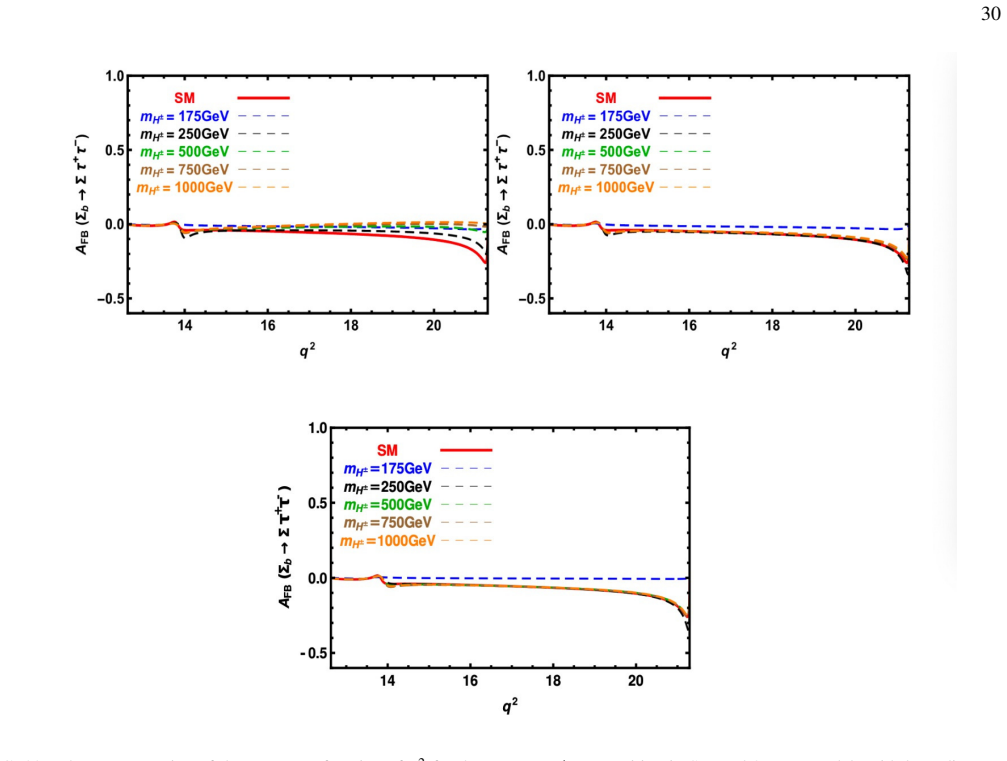
F. Borzumati and C. Greub, “2HDMs predictions for anti-B —>X(s) gamma in NLO QCD,” Phys. Rev. D58, 074004 (1998) [arXiv:hep- ph/9802391 [hep-ph]]. 28 FIG. 20. The representation of the𝐴 𝐹 𝐵 as a function of𝑞 2 for theΣ 𝑏 →Σ𝜇 + 𝜇− transition in SM and 2HDM models with long-distance contributions plotted against different Higgs masses for𝜆 𝑡𝑡 =0.05,𝜆 𝑡𝑡 =0....
-
[46]
Exclusive Lambda(b) —>Lambda lepton+ lepton- decay in two Higgs doublet model,
T. M. Aliev and M. Savci, “Exclusive Lambda(b) —>Lambda lepton+ lepton- decay in two Higgs doublet model,” J. Phys. G26, 997-1010 (2000) [arXiv:hep-ph/9906473 [hep-ph]]
-
[47]
Theoretical uncertainties and phenomenological aspects of B —>X(s) gamma decay,
A. J. Buras, M. Misiak, M. Munz and S. Pokorski, “Theoretical uncertainties and phenomenological aspects of B —>X(s) gamma decay,” Nucl. Phys. B424, 374-398 (1994) [arXiv:hep-ph/9311345 [hep-ph]]
-
[48]
Radiative B —>K* gamma transition in QCD,
P. Colangelo, C. A. Dominguez, G. Nardulli and N. Paver, “Radiative B —>K* gamma transition in QCD,” Phys. Lett. B317, 183-189 (1993) [arXiv:hep-ph/9308264 [hep-ph]]
-
[49]
Effective Hamiltonian for B —>X(s) e+ e- beyond leading logarithms in the NDR and HV schemes,
A. J. Buras and M. Munz, “Effective Hamiltonian for B —>X(s) e+ e- beyond leading logarithms in the NDR and HV schemes,” Phys. Rev. D52, 186-195 (1995) [arXiv:hep-ph/9501281 [hep-ph]]
-
[50]
Critical Reanalysis of CP Asymmetries in B0 Decays to CP Eigenstates,
B. Grinstein, “Critical Reanalysis of CP Asymmetries in B0 Decays to CP Eigenstates,” Phys. Lett. B229, 280-284 (1989)
1989
-
[51]
A New measurement of the rare decay K+ —>pi+ mu+ mu-,
H. Maet al.[e865], “A New measurement of the rare decay K+ —>pi+ mu+ mu-,” Phys. Rev. Lett.84, 2580-2583 (2000) [arXiv:hep- ex/9910047 [hep-ex]]
-
[52]
Semileptonic transition ofΣ𝑏 toΣin Light Cone QCD Sum Rules,
K. Azizi, M. Bayar, A. Ozpineci, Y. Sarac and H. Sundu, “Semileptonic transition ofΣ𝑏 toΣin Light Cone QCD Sum Rules,” Phys. Rev. D85, 016002 (2012) [arXiv:1112.5147 [hep-ph]]
-
[53]
Form factors forΛ 𝑏 →Λtransitions in the soft-collinear effective theory,
T. Feldmann and M. W. Y. Yip, “Form factors forΛ 𝑏 →Λtransitions in the soft-collinear effective theory,” Phys. Rev. D85, 014035 (2012) [erratum: Phys. Rev. D86, 079901 (2012)] [arXiv:1111.1844 [hep-ph]]
-
[54]
Perturbative Corrections toΛ𝑏 →ΛForm Factors from QCD Light-Cone Sum Rules,
Y. M. Wang and Y. L. Shen, “Perturbative Corrections toΛ𝑏 →ΛForm Factors from QCD Light-Cone Sum Rules,” JHEP02, 179 (2016) [arXiv:1511.09036 [hep-ph]]
-
[55]
C. Farrell and S. Meinel, “Ξ 𝑏 →Ξform factors from lattice QCD and Standard-Model predictions forΞ 𝑏 →Ξ𝜇 + 𝜇− andΞ 𝑏 →Ξ𝛾 decays,” [arXiv:2603.18438 [hep-lat]]
-
[56]
Review of particle physics,
S. Navaset al.[Particle Data Group], “Review of particle physics,” Phys. Rev. D110, no.3, 030001 (2024)
2024
-
[57]
Next-to-leading QCD corrections to𝐵→𝑋 𝑠𝛾: Standard model and two Higgs doublet model,
M. Ciuchini, G. Degrassi, P. Gambino and G. F. Giudice, “Next-to-leading QCD corrections to𝐵→𝑋 𝑠𝛾: Standard model and two Higgs doublet model,” Nucl. Phys. B527, 21-43 (1998) [arXiv:hep-ph/9710335 [hep-ph]]
-
[58]
Measurement of the differential branching fraction of the decayΛ 0 𝑏 →Λ𝜇 + 𝜇−,
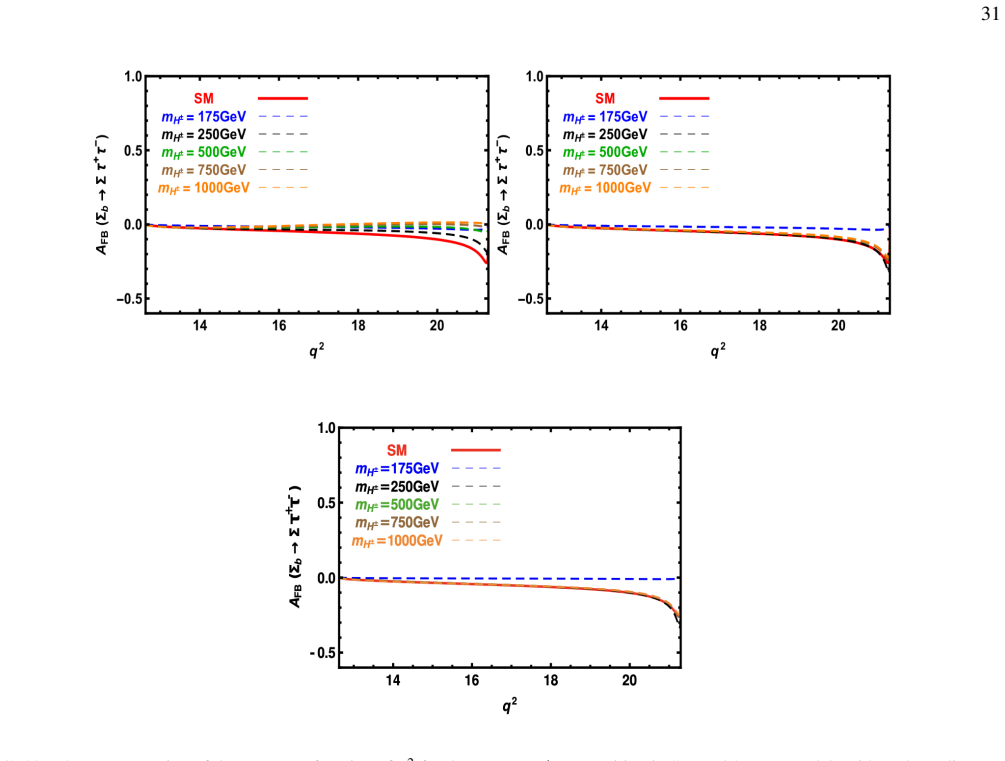
R. Aaijet al.[LHCb], “Measurement of the differential branching fraction of the decayΛ 0 𝑏 →Λ𝜇 + 𝜇−,” Phys. Lett. B725, 25-35 (2013) [arXiv:1306.2577 [hep-ex]]. 29 FIG. 21. The representation of the𝐴 𝐹 𝐵 as a function of𝑞 2 for theΣ 𝑏 →Σ𝜇 + 𝜇− transition in SM and 2HDM models without long-distance contributions plotted against different Higgs masses for𝜆 ...
discussion (0)
Sign in with ORCID, Apple, or X to comment. Anyone can read and Pith papers without signing in.