Recognition: unknown
Benchmarking Two Chemical Networks used in General Circulation Models of Hot Jupiters
Pith reviewed 2026-05-10 07:39 UTC · model grok-4.3
The pith
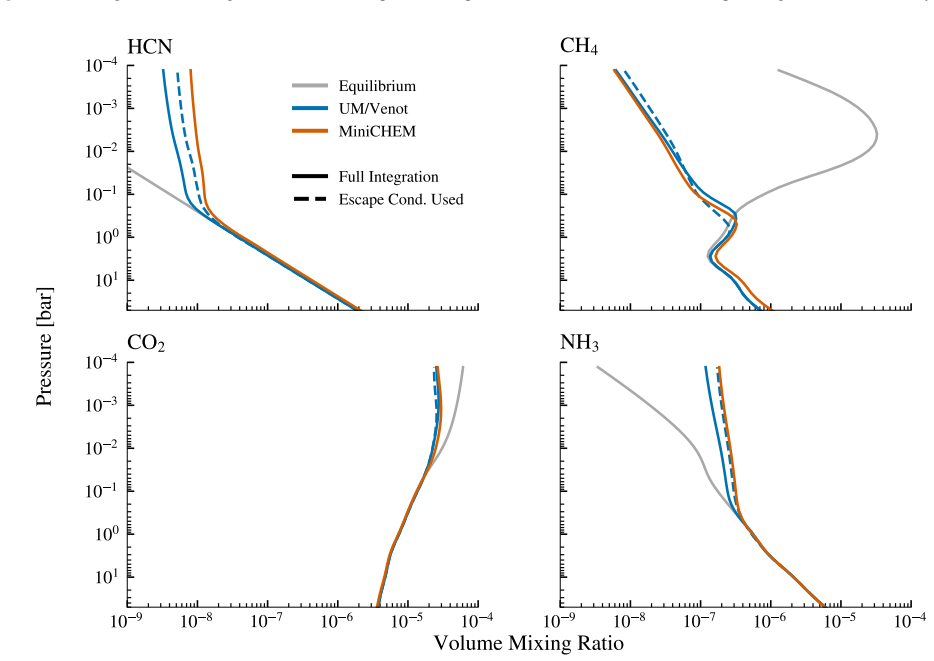
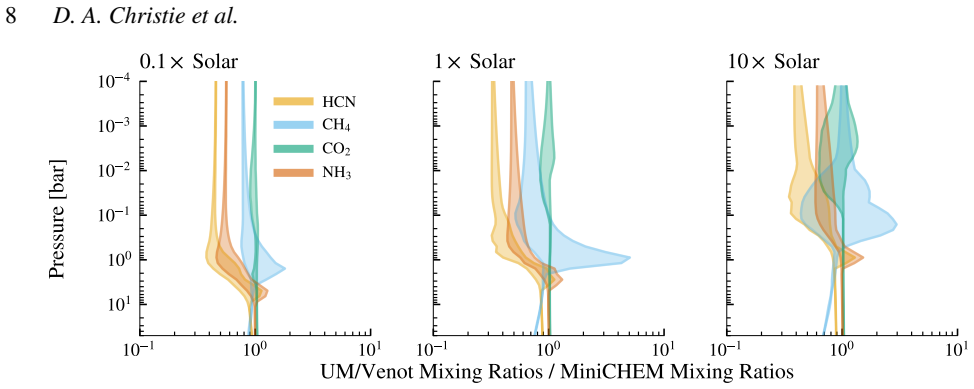
A numerical escape criterion in chemical kinetics solvers causes artificial quenching, overestimating HCN, CH4, and NH3 abundances by factors of 1.5 to 3 in hot Jupiter GCMs.
A machine-rendered reading of the paper's core claim, the machinery that carries it, and where it could break.
Core claim
The central claim is that the numerical escape criterion used by the Unified Model chemical kinetics solver to stop integration for the duration of the chemical timestep results in artificial quenching. This overestimates HCN, CH4, and NH3 abundances by factors of 1.5 to 3, independent of the chemical network. With the criterion disabled, agreement between the V19 and MiniCHEM networks improves except for HCN and NH3, where the V19 network yields lower abundances due to its choice of the NH2 + NH3 reaction rate and lack of CH2NH2. The paper concludes that improved experimental and theoretical reaction rates are needed to resolve remaining uncertainties in quenching behavior.
What carries the argument
The numerical escape criterion in the Unified Model chemical kinetics solver, which halts integration once a threshold is reached irrespective of ongoing chemical evolution.
If this is right
- Disabling the escape criterion reduces artificial quenching and brings network results into closer agreement for most species.
- The poorly constrained NH2 + NH3 to N2H3 + H2 reaction rate controls the quenched abundances of both NH3 and HCN.
- Absence of CH2NH2 in the V19 network further depresses HCN abundances relative to MiniCHEM.
- Hot Jupiter GCMs that employ similar chemical solvers may systematically overestimate quenched molecular abundances until the criterion is revised.
- Better laboratory and theoretical determination of key reaction rates is required to narrow uncertainties in the quenching behavior of HCN and NH3.
Where Pith is reading between the lines
- Similar escape criteria in other atmospheric chemistry codes may introduce comparable quenching artifacts outside the hot Jupiter context.
- Once the numerical issue is corrected, observational measurements of HCN and NH3 could help discriminate which network better captures the true quenched state.
- MiniCHEM-style net-reaction tables may allow more complete chemical networks in GCMs without prohibitive computational cost.
Load-bearing premise
The two chemical networks and shared GCM setup are assumed to isolate the effects of the escape criterion and specific rates without other unaccounted numerical or physical differences in the simulations.
What would settle it
Running the GCM simulations with the escape criterion both enabled and disabled for each network and comparing the resulting vertical abundance profiles of HCN, CH4, and NH3 against either high-resolution reference chemical calculations or direct observational constraints from transmission spectroscopy.
Figures




read the original abstract
Chemical kinetics is becoming an increasingly vital component of hot Jupiter general circulation models (GCMs). Here we simulate the hot Jupiter WASP-96b using two chemical networks, a reduced chemical network frequently used in the GCM literature (which we refer to as V19) and a more recent effective network making use of tables of net reactions (MiniCHEM), coupled to the same GCM in order to provide a robust benchmark. We find a numerical escape criterion used by the Unified Model chemical kinetics solver to stop integration for the duration of the chemical timestep, independent of the chemical network, results in artificial quenching, overestimating of HCN, CH$_4$, and NH$_3$ abundances by factors of 1.5 to 3. With this criterion disabled, agreement between the two networks is improved, except for HCN and NH$_3$, where different reaction rates and included species results in lower abundances in the V19 network. While many rates differ between the networks, the lower quenched NH$_3$ abundances in the V19 simulations are, in particular, due to the choice of NH$_2$ + NH$_3$ $\rightarrow$ N$_2$H$_3$ + H$_2$ reaction rate, which is poorly constrained in the literature. This reaction also impacts the quenching of HCN, which is additionally affected by the lack of CH$_2$NH$_2$ in the V19 network. While there are reasons to favour the MiniCHEM HCN and NH$_3$ abundances, ultimately, improved experimental and theoretical determination of reaction rates are needed to address the uncertainties and better characterize the quenching behaviour.
Editorial analysis
A structured set of objections, weighed in public.
Referee Report
Summary. The manuscript benchmarks two chemical networks (V19, a reduced network common in GCM literature, and MiniCHEM, an effective network using net-reaction tables) coupled to the same Unified Model GCM for the hot Jupiter WASP-96b. It reports that a numerical escape criterion in the chemical kinetics solver causes artificial quenching independent of network choice, overestimating HCN, CH4, and NH3 abundances by factors of 1.5–3. Disabling the criterion improves inter-network agreement except for HCN and NH3, where discrepancies are traced to specific rate differences (especially the NH2 + NH3 → N2H3 + H2 reaction) and missing species in V19.
Significance. If the isolation of the escape criterion holds, the result is significant because it identifies a solver-level numerical artifact that can systematically bias quenched abundances of key species in hot-Jupiter GCMs, affecting interpretations of atmospheric composition. The side-by-side use of two independent networks provides a useful control that attributes the bias to the solver rather than network choice, while the explicit identification of the poorly constrained NH2 + NH3 rate as a source of remaining uncertainty supplies a concrete target for future laboratory work.
major comments (2)
- [Results (enabled/disabled comparisons)] Results section (comparison of enabled vs. disabled escape criterion): the central claim that the 1.5–3× overestimation of HCN, CH4, and NH3 is caused solely by the numerical escape criterion and is independent of network requires explicit verification that disabling the criterion involved no compensatory changes to tolerances, adaptive timestep logic, residual norms, or termination conditions. The manuscript provides no solver diagnostics (e.g., number of sub-steps or convergence metrics) demonstrating that the only modification was removal of the premature-termination flag; without this, residual numerical differences between the two networks could be misattributed to the criterion.
- [Discussion (NH3/HCN quenching)] Discussion of NH3 and HCN quenching (paragraph on the NH2 + NH3 → N2H3 + H2 reaction): while the paper correctly notes that this rate is poorly constrained and drives lower NH3 (and indirectly HCN) in V19, the claim that MiniCHEM abundances are preferable would be strengthened by a quantitative sensitivity test varying the rate coefficient within its literature uncertainty range and showing the resulting spread in quenched abundances; the current attribution remains qualitative.
minor comments (2)
- [Abstract] Abstract: the phrase 'overestimating of HCN' is grammatically awkward and should be revised to 'overestimation of HCN' or 'overestimates HCN'.
- [Figures] Figure captions and axis labels: several panels comparing vertical profiles lack explicit indication of whether the escape criterion is enabled or disabled; adding this information would improve readability.
Simulated Author's Rebuttal
We thank the referee for their thorough and constructive review of our manuscript. We address each major comment in detail below and have revised the manuscript accordingly to strengthen the presentation of our results and discussion.
read point-by-point responses
-
Referee: Results section (comparison of enabled vs. disabled escape criterion): the central claim that the 1.5–3× overestimation of HCN, CH4, and NH3 is caused solely by the numerical escape criterion and is independent of network requires explicit verification that disabling the criterion involved no compensatory changes to tolerances, adaptive timestep logic, residual norms, or termination conditions. The manuscript provides no solver diagnostics (e.g., number of sub-steps or convergence metrics) demonstrating that the only modification was removal of the premature-termination flag; without this, residual numerical differences between the two networks could be misattributed to the criterion.
Authors: We agree that explicit verification of the solver configuration is essential to support the claim. In the revised manuscript we have added a new appendix containing full solver diagnostics for the enabled and disabled escape-criterion runs. These diagnostics report the number of sub-steps per chemical timestep, residual norms, convergence metrics, and termination conditions for both networks. The data confirm that no changes were made to tolerances, adaptive timestep logic, or any other solver parameters; the sole modification was removal of the premature-termination flag. The diagnostics are identical between the two networks when the flag is disabled, reinforcing that the overestimation is independent of network choice. revision: yes
-
Referee: Discussion of NH3 and HCN quenching (paragraph on the NH2 + NH3 → N2H3 + H2 reaction): while the paper correctly notes that this rate is poorly constrained and drives lower NH3 (and indirectly HCN) in V19, the claim that MiniCHEM abundances are preferable would be strengthened by a quantitative sensitivity test varying the rate coefficient within its literature uncertainty range and showing the resulting spread in quenched abundances; the current attribution remains qualitative.
Authors: We concur that a quantitative sensitivity test would make the preference for MiniCHEM abundances more robust. In the revised manuscript we have added such a test: the NH2 + NH3 → N2H3 + H2 rate coefficient was varied across the full range of literature uncertainties while holding all other parameters fixed. The resulting spread in quenched NH3 and HCN abundances is comparable in magnitude to the network-to-network differences and is now shown in a new figure and accompanying text. This quantitative demonstration supports our original qualitative attribution while underscoring the need for improved laboratory constraints on the rate. revision: yes
Circularity Check
No circularity: empirical benchmarking via direct numerical comparisons
full rationale
The paper's central result—that a numerical escape criterion in the Unified Model solver produces artificial quenching overestimating HCN, CH4, and NH3 by factors of 1.5–3—is obtained from side-by-side GCM integrations of two distinct chemical networks (V19 and MiniCHEM) with the criterion toggled on/off. No equations, parameters, or uniqueness theorems are derived or fitted within the manuscript; the overestimation is reported as an observed numerical outcome. The networks themselves are taken from prior literature without self-referential redefinition, and differences in quenched abundances are attributed to documented rate coefficients and species lists rather than any internal loop. This is a standard self-contained numerical experiment with no load-bearing self-citation or ansatz smuggling.
Axiom & Free-Parameter Ledger
free parameters (1)
- NH2 + NH3 → N2H3 + H2 reaction rate
axioms (2)
- domain assumption The chemical networks and GCM solver accurately represent the relevant physical and chemical processes when the escape criterion is disabled.
- domain assumption Differences in HCN and NH3 are attributable only to the cited rate and missing species rather than other unexamined network or numerical variations.
Reference graph
Works this paper leans on
-
[1]
Abián M., Benés M., Goñi A. d., Muñoz B., Alzueta M. U., 2021, Fuel, 300, 120979 Agúndez M., Venot O., Selsis F., Iro N., 2014, The Astrophysical Journal, 781, 68 AmundsenD.S.,BaraffeI.,TremblinP.,MannersJ.,HayekW.,MayneN.J., Acreman D. M., 2014, Astronomy & Astrophysics, 564, A59 Amundsen D. S., et al., 2016, Astronomy & Astrophysics, 595, A36 Amundsen D...
-
[2]
(2007), 𝑘1,V19 =1.66×10 −11 exp (−754 K/𝑇) cm3 s−1,(B1) whilevulcanadoptstheslightlymorerecentratefromKlippenstein et al
adopt the rate used in Coppens et al. (2007), 𝑘1,V19 =1.66×10 −11 exp (−754 K/𝑇) cm3 s−1,(B1) whilevulcanadoptstheslightlymorerecentratefromKlippenstein et al. (2009), 𝑘1,vulcan =9.717×10 −14 𝑇 300 K 1.02 exp (−5930 K/𝑇) cm3 s−1 . (B2) This rate is included in other recent networks (e.g., Glarborg et al. 2018; Veillet et al. 2024), and we take it to be th...
2007
-
[3]
use the rate from Konnov & Ruyck (2000), 𝑘2,V19 =2.88×10 −12 𝑇 300 K 0.5 exp (−10900 K/𝑇) cm3 s−1,(B3) whichistheratefromDove&Nip(1979)scaleddownbyafactorof eighttoimproveagreementwiththepyrolysisexperimentsofDavid- sonetal.(1990).vulcan,followingMosesetal.(2011),insteaduses the estimate from Dean et al. (1984), 𝑘2,vulcan =4×10 −9 exp (−34200 K/𝑇) cm3 s−1...
2000
-
[4]
improbably high
and express uncertainty as to whether it even occurs. Abiánetal.(2021),ontheotherhand,adopttheoriginalDove&Nip (1979)rate,unscaled,whileMannaetal.(2023)usetheDove&Nip (1979),increasedbyafactoroftwo,inmodellingexperimentalflow reactordata.Marshall&Glarborg(2023)provideansummaryofthe various rates used in the literature, and estimate an upper bound on the r...
2021
-
[5]
twosolver
examined in Appendix B. 10 8 10 7 10 6 10 4 10 3 10 2 10 1 100 101 Pressure [bar] HCN Equilibrium Unmodified V19 Change k1 Change k2 Change k1 and k2 Change k1, k2=0 10 7 10 6 10 5 NH3 Volume Mixing Ratio Figure B2.The results from 1Datmosimulations using the original V19 network as well as cases where individual rates are replaced with the rates used in ...
2026
discussion (0)
Sign in with ORCID, Apple, or X to comment. Anyone can read and Pith papers without signing in.