Recognition: unknown
Phase behavior of thermoresponsive colloids drives re-entrant plasmon coupling
Pith reviewed 2026-05-10 07:30 UTC · model grok-4.3
The pith
Plasmon coupling in thermoresponsive microgel-nanoparticle hybrids exhibits re-entrant behavior controlled by colloidal stability.
A machine-rendered reading of the paper's core claim, the machinery that carries it, and where it could break.
Core claim
Plasmon coupling is governed not only by the interparticle distance between NPs confined within individual microgels, but also by the colloidal stability of the hybrid complexes. At intermediate NP loadings, surface charge inhomogeneities induced by NP adsorption promote aggregation of microgel-NPs complexes, resulting in enhanced plasmon coupling. In contrast, when the complexes remain colloidally stable, coupling is dictated solely by NP organization within the corona of individual microgels. A quantitative relationship between plasmon coupling and interparticle distance reveals two distinct coupling regimes, rationalized through a phase diagram linking colloidal stability to optical re
What carries the argument
Colloidal stability of hybrid microgel-NP complexes, modulated by NP-induced surface charge inhomogeneities that trigger aggregation at intermediate loadings.
If this is right
- Enhanced plasmon coupling occurs when complexes aggregate at intermediate NP loadings due to charge inhomogeneities.
- Coupling reduces to intra-microgel NP spacing when complexes are colloidally stable at low or high loadings.
- Two distinct regimes of plasmon coupling exist depending on whether aggregation happens.
- The optical response can be mapped to a phase diagram of colloidal stability versus NP loading.
- Programmable optical properties arise from tuning NP-to-microgel ratio to exploit the re-entrant effect.
Where Pith is reading between the lines
- Controlling the surface charge distribution on microgels could allow independent tuning of the aggregation threshold without altering NP count.
- The re-entrant optical behavior might extend to other hybrid colloidal systems where particle adsorption creates patchy charges.
- These findings could guide the design of temperature-responsive optical switches or sensors that operate through stability transitions.
- Experimental tests varying temperature across the volume phase transition while holding NP loading fixed could separate the stability and spacing contributions more clearly.
Load-bearing premise
That the re-entrant plasmon coupling specifically results from aggregation caused by NP-induced surface charge inhomogeneities at intermediate loadings.
What would settle it
Measurements showing no aggregation of hybrid complexes at the NP loadings where plasmon coupling peaks, or finding that coupling strength does not correlate with signs of clustering in scattering data.
Figures




read the original abstract
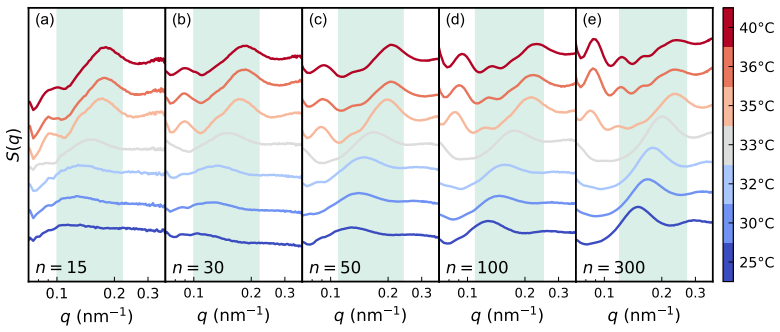
Plasmonic nanoparticles (NPs) integrated within thermoresponsive polymeric microgels provide a versatile platform for the realization of stimuli-responsive optical materials, where the microgel volume phase transition enables dynamic control of plasmon coupling. This study uncovers a counter-intuitive re-entrant behavior with increasing NP loading in which plasmon coupling initially strengthens and subsequently weakens beyond a critical NP-to-microgel number ratio. By combining light and X-ray scattering techniques with optical spectroscopy and electrophoretic mobility measurements, it is demonstrated that plasmon coupling is governed not only by the interparticle distance between NPs confined within individual microgels, but also by the colloidal stability of the hybrid complexes. At intermediate NP loadings, surface charge inhomogeneities induced by NP adsorption promote aggregation of microgel-NPs complexes, resulting in enhanced plasmon coupling. In contrast, when the complexes remain colloidally stable, coupling is dictated solely by NP organization within the corona of individual microgels. A quantitative relationship between plasmon coupling and interparticle distance reveals two distinct coupling regimes. This behavior is rationalized through a phase diagram linking colloidal stability to optical response. These findings identify colloidal stability as a key parameter for designing soft plasmonic systems with programmable optical properties.
Editorial analysis
A structured set of objections, weighed in public.
Referee Report
Summary. The manuscript reports a re-entrant plasmon coupling behavior in thermoresponsive microgel-nanoparticle hybrids as a function of NP loading. It claims that plasmon coupling is controlled by both intra-microgel NP spacing and overall colloidal stability of the complexes; at intermediate loadings, NP adsorption creates surface charge inhomogeneities that drive aggregation and thereby enhance coupling, while at higher loadings the complexes restabilize and coupling reverts to being dictated solely by organization within individual microgel coronas. The authors support this with a combination of light/X-ray scattering, optical spectroscopy, and electrophoretic mobility, culminating in a phase diagram that links stability to the observed optical response and identifies two distinct coupling regimes.
Significance. If the central claims hold, the work is significant for the design of stimuli-responsive plasmonic soft materials. It correctly identifies colloidal stability as an additional design handle beyond the conventional volume-phase-transition control of interparticle distance. The multi-technique experimental strategy is appropriate for the system and the re-entrant optical signature is a clear, falsifiable observation. The explicit linkage of stability to optical regimes via a phase diagram provides a useful conceptual framework, even if the mechanistic attribution requires further support.
major comments (2)
- [Abstract and electrophoretic mobility/scattering results] Abstract and the section presenting electrophoretic mobility and scattering results: the claim that surface charge inhomogeneities (rather than net charge reduction, NP bridging, or internal restructuring) are the dominant driver of aggregation at intermediate loadings is load-bearing for the re-entrant mechanism. Electrophoretic mobility yields only the average zeta potential and scattering reports aggregate formation; neither directly demonstrates patchiness. Without a control (e.g., uniformly charged microgels or fixed NP distribution) or direct spatial evidence, alternative explanations cannot be ruled out.
- [Quantitative relationship and phase diagram] Section describing the quantitative relationship between plasmon coupling and interparticle distance: the existence of two distinct coupling regimes is asserted, yet the manuscript provides no error bars on the extracted distances (from X-ray structure factors), no fitting details for the coupling strength, and no statistical test for the regime boundary. This gap prevents verification that the optical transition coincides with the stability crossover reported in the phase diagram.
minor comments (2)
- [Figures] Figure captions should explicitly state the NP-to-microgel number ratios, temperature ranges, and ionic strengths used for each data set to allow direct comparison with the phase diagram.
- [Introduction] All acronyms (NP, VPT, etc.) should be defined at first use in the main text.
Simulated Author's Rebuttal
We thank the referee for their constructive comments and for recognizing the potential significance of the re-entrant plasmon coupling behavior. We address each major comment below and have prepared revisions to improve clarity and rigor.
read point-by-point responses
-
Referee: [Abstract and electrophoretic mobility/scattering results] Abstract and the section presenting electrophoretic mobility and scattering results: the claim that surface charge inhomogeneities (rather than net charge reduction, NP bridging, or internal restructuring) are the dominant driver of aggregation at intermediate loadings is load-bearing for the re-entrant mechanism. Electrophoretic mobility yields only the average zeta potential and scattering reports aggregate formation; neither directly demonstrates patchiness. Without a control (e.g., uniformly charged microgels or fixed NP distribution) or direct spatial evidence, alternative explanations cannot be ruled out.
Authors: We agree that electrophoretic mobility reports only the average zeta potential and that scattering confirms aggregate formation without directly visualizing charge patchiness. However, the re-entrant stability trend—destabilization at intermediate loadings followed by restabilization at high loadings—cannot be accounted for by monotonic net-charge reduction alone, as higher NP coverage would further decrease net charge if adsorption were uniform. Our temperature-dependent scattering and spectroscopy data show that internal NP restructuring is minimal below the VPT, and NP bridging is inconsistent with the observed recovery of stability. We will revise the manuscript to explicitly discuss these alternatives, weaken the mechanistic claim to a correlation-based interpretation supported by the phase diagram, and add a limitations paragraph noting the absence of direct spatial evidence or uniform-charge controls. This is a partial revision. revision: partial
-
Referee: [Quantitative relationship and phase diagram] Section describing the quantitative relationship between plasmon coupling and interparticle distance: the existence of two distinct coupling regimes is asserted, yet the manuscript provides no error bars on the extracted distances (from X-ray structure factors), no fitting details for the coupling strength, and no statistical test for the regime boundary. This gap prevents verification that the optical transition coincides with the stability crossover reported in the phase diagram.
Authors: We accept this criticism. In the revised version we will (i) add error bars to all interparticle distances extracted from X-ray structure factors, (ii) move the full fitting procedure, model equations, and parameter values for the plasmon coupling strength to the SI, and (iii) include a statistical analysis (piecewise linear regression with change-point detection) to identify the regime boundary and test its coincidence with the stability crossover. These additions will enable independent verification of the two-regime claim. revision: yes
Circularity Check
No circularity: experimental claims rest on direct measurements
full rationale
The manuscript is an experimental study combining light/X-ray scattering, optical spectroscopy, and electrophoretic mobility data to observe re-entrant plasmon coupling and link it to colloidal stability. No mathematical derivation, first-principles prediction, or fitted parameter is presented whose output is forced by construction to equal its input. Central claims (two coupling regimes, stability-driven aggregation at intermediate loadings) are interpretations of measured quantities rather than self-referential equations or self-citation chains. Any self-citations present are not load-bearing for the primary results, which remain falsifiable against external benchmarks.
Axiom & Free-Parameter Ledger
axioms (1)
- domain assumption Colloidal stability of microgel-NP complexes is governed by surface charge inhomogeneities and interparticle interactions.
Reference graph
Works this paper leans on
-
[1]
M. Karg, T. Hellweg, New “smart” poly(NIPAM) microgels and nanoparticle microgel hybrids: Properties and advances in characterisa- tion, Current Opinion in Colloid & Interface Science 14 (2009) 438–450. doi:10.1016/j.cocis.2009.08.002
-
[2]
M. Arif, Z. H. Farooqi, A. Irfan, R. Begum, Gold nanoparticles and polymer microgels: Last five years of their happy and suc- cessful marriage, Journal of Molecular Liquids 336 (2021) 116270. doi:10.1016/j.molliq.2021.116270
-
[3]
F. Diehl, S. Hageneder, S. Fossati, S. K. Auer, J. Dostalek, U. Jonas, Plasmonic nanomaterials with responsive polymer hydrogels for sens- ing and actuation, Chemical Society Reviews 51 (2022) 3926–3963. doi:10.1039/d1cs01083b
-
[4]
Fernandez-Nieves, H
A. Fernandez-Nieves, H. Wyss, J. Mattsson, D. A. Weitz, Microgel Sus- pensions: Fundamentals and Applications, John Wiley & Sons, 2011
2011
-
[5]
Suzuki, Nanogel/microgel science and beyond, Langmuir 39 (2023) 7525–7529
D. Suzuki, Nanogel/microgel science and beyond, Langmuir 39 (2023) 7525–7529. doi:10.1021/acs.langmuir.3c00560
-
[6]
N. J. Halas, S. Lal, W.-S. Chang, S. Link, P. Nordlander, Plasmons in strongly coupled metallic nanostructures, Chemical reviews 111 (2011) 3913–3961. doi:10.1021/cr200061k
-
[7]
V. Amendola, R. Pilot, M. Frasconi, O. M. Maragò, M. A. Iatì, Surface plasmon resonance in gold nanoparticles: a review, Journal of Physics: Condensed Matter 29 (2017) 203002. doi:10.1088/1361-648X/aa60f3
-
[8]
L. Wang, M. Hasanzadeh Kafshgari, M. Meunier, Optical properties andapplicationsofplasmonic-metalnanoparticles, AdvancedFunctional Materials 30 (2020) 2005400. doi:10.1002/adfm.202005400
-
[9]
D. Biswasray, C. E. Petoukhoff, B. M. K. Mariserla, Unified model for plasmon coupling in metal nanoparticles and effect of the polymer 18 shell, The Journal of Physical Chemistry C 129 (2025) 10633–10642. doi:10.1021/acs.jpcc.4c08778
-
[10]
I. Gorelikov, L. M. Field, E. Kumacheva, Hybrid microgels photore- sponsive in the near-infrared spectral range, Journal of the American Chemical Society 126 (2004) 15938–15939. doi:10.1021/ja0448869
-
[11]
H. Lange, B. H. Juarez, A. Carl, M. Richter, N. G. Bastus, H. Weller, C. Thomsen, R. von Klitzing, A. Knorr, Tunable plasmon coupling in distance-controlled gold nanoparticles, Langmuir 28 (2012) 8862–8866. doi:10.1021/la3001575
-
[12]
K. Gawlitza, S. T. Turner, F. Polzer, S. Wellert, M. Karg, P. Mulvaney, R. von Klitzing, Interaction of gold nanoparticles with thermorespon- sive microgels: Influence of the cross-linker density on optical prop- erties, Physical Chemistry Chemical Physics 15 (2013) 15623–15631. doi:10.1039/c3cp51578h
-
[13]
T. Honold, K. Volk, A. Rauh, J. Fitzgerald, M. Karg, Tunable plasmonic surfaces via colloid assembly, Journal of Materials Chemistry C 3 (2015) 11449–11457. doi:10.1039/c5tc02115d
-
[14]
Z. Ye, C. Chen, L. Cao, Z. Cai, C. Xu, H.-I. Kim, J. P. Giraldo, A. G. Kanaras, Y. Yin, Reversible modulation of plasmonic cou- pling of gold nanoparticles confined within swellable polymer colloidal spheres, Angewandte Chemie International Edition (2024) e202408020. doi:10.1002/anie.202408020
-
[15]
F. Brasili, A. Capocefalo, G. Del Monte, R. Rivas-Barbosa, J. Pérez, E. Chauveau, F. Bordi, C. Rizza, D. Truzzolillo, E. Zaccarelli, S. Sen- nato, Linking structure and optical properties of plasmonic nanoparti- cles on tunable spherical surfaces, ACS Applied Materials & Interfaces 17 (2025) 47385–47395. doi:10.1021/acsami.5c11151
-
[16]
A. Choe, J. Yeom, R. Shanker, M. P. Kim, S. Kang, H. Ko, Stretchable and wearable colorimetric patches based on thermoresponsive plasmonic microgels embedded in a hydrogel film, NPG Asia Materials 10 (2018) 912–922. doi:10.1038/s41427-018-0086-6. 19
-
[17]
S. Sershen, S. Westcott, N. Halas, J. West, Temperature-sensitive polymer–nanoshell composites for photothermally modulated drug de- livery, Journal of Biomedical Materials Research 51 (2000) 293–298. doi:10.1002/1097-4636(20000905)51:3<293::AID-JBM1>3.0.CO;2-T
-
[18]
M. Das, N. Sanson, D. Fava, E. Kumacheva, Microgels loaded with gold nanorods: Photothermally triggered volume transitions under physio- logical conditions, Langmuir 23 (2007) 196–201. doi:10.1021/la061596s
-
[19]
K. Chang, Y. Yan, D. Zhang, Y. Xia, X. Chen, L. Lei, S. Shi, Syn- ergistic bonding of poly(N-isopropylacrylamide)-based hybrid micro- gels and gold nanoparticles used for temperature-responsive controllable catalysis of p-nitrophenol reduction, Langmuir 39 (2023) 2408–2421. doi:10.1021/acs.langmuir.2c03236
-
[20]
I. Sajid, A. Hassan, W. Wu, J. Zhang, K. S. Munawar, A. Irfan, A. R. Chaudhry, Z. H. Farooqi, R. Begum, Synthesis, characteriza- tion, and catalytic applications of gold nanoparticles endowed in poly(N- isopropylmethacrylamide)nanogels, JournalofMolecularLiquids(2025) 127890. doi:10.1016/j.molliq.2025.127890
-
[21]
Y. Chen, B. Ai, Z. J. Wong, Soft optical metamaterials, Nano Conver- gence 7 (2020) 18. doi:10.1186/s40580-020-00226-7
-
[22]
L.-L. Ma, Y. Wei, N. Wang, W. Chen, Y.-Q. Lu, Soft matter photonics: Interplay of soft matter and light, ACS nano 19 (2025) 11501–11516. doi:10.1021/acsnano.5c02465
-
[23]
R. Regmi, S. R. Bhattarai, C. Sudakar, A. S. Wani, R. Cunning- ham, P. P. Vaishnava, R. Naik, D. Oupicky, G. Lawes, Hyper- thermia controlled rapid drug release from thermosensitive magnetic microgels, Journal of Materials Chemistry 20 (2010) 6158–6163. doi:10.1039/c0jm00844c
-
[24]
P. T. Davies, B. Vincent, Uptake of anionic gold nanoparticles by cationic microgel particles in dispersion: the effect of pH, Colloids and Surfaces A: Physicochemical and Engineering Aspects 354 (2010) 99–
2010
-
[25]
doi:10.1016/j.colsurfa.2009.07.011
-
[26]
M. Bradley, B. S. Garcia-Risueño, Symmetric and asymmetric adsorp- tion of pH–responsive gold nanoparticles onto microgel particles and 20 dispersion characterisation, Journal of colloid and interface science 355 (2011) 321–327. doi:10.1016/j.jcis.2010.12.027
-
[27]
F. Brasili, G. Del Monte, A. Capocefalo, E. Chauveau, E. Buratti, S. Casciardi, D. Truzzolillo, S. Sennato, E. Zaccarelli, Toward a uni- fied description of the electrostatic assembly of microgels and nanopar- ticles, ACS Applied Materials & Interfaces 15 (2023) 58770–58783. doi:10.1021/acsami.3c14608
-
[29]
D. Truzzolillo, S. Sennato, S. Sarti, S. Casciardi, C. Bazzoni, F. Bordi, Overcharging and reentrant condensation of thermoresponsive ionic mi- crogels, Soft Matter 14 (2018) 4110–4125. doi:10.1039/c7sm02357j
-
[30]
S. Sennato, E. Chauveau, S. Casciardi, F. Bordi, D. Truzzolillo, The double-faced electrostatic behavior of PNIPAm microgels, Polymers 13 (2021) 1153. doi:10.3390/polym13071153
-
[31]
F. Brasili, A. Capocefalo, D. Palmieri, F. Capitani, E. Chiessi, G. Paradossi, F. Bordi, F. Domenici, Assembling patchy plas- monic nanoparticles with aggregation-dependent antibacterial activ- ity, Journal of Colloid and Interface Science 580 (2020) 419–428. doi:10.1016/j.jcis.2020.07.006
-
[32]
A. Capocefalo, T. Bizien, S. Sennato, N. Ghofraniha, F. Bordi, F. Brasili, Responsivity of fractal nanoparticle assemblies to multiple stimuli: Structural insights on the modulation of the optical properties, Nanomaterials 12 (2022) 1529. doi:10.3390/nano12091529
-
[33]
D. Palmieri, F. Brasili, A. Capocefalo, T. Bizien, I. Angelini, L. Oddo, Y. Toumia, G. Paradossi, F. Domenici, Improved hybrid-shelled perfluo- rocarbon microdroplets as ultrasound-and laser-activated phase-change platform, Colloids and Surfaces A: Physicochemical and Engineering Aspects 641 (2022) 128522. doi:10.1016/j.colsurfa.2022.128522
-
[34]
D. Suzuki, Y. Nagase, T. Kureha, T. Sato, Internal structures of ther- mosensitive hybrid microgels investigated by means of small-angle x-ray 21 scattering, The Journal of Physical Chemistry B 118 (2014) 2194–2204. doi:10.1021/jp410983x
-
[35]
S. W. Provencher, A constrained regularization method for invert- ing data represented by linear algebraic or integral equations, Com- puter Physics Communications 27 (1982) 213–227. doi:10.1016/0010- 4655(82)90173-4
-
[36]
W. W. Tscharnuter, Mobility measurements by phase analysis, Applied optics 40 (2001) 3995–4003. doi:10.1364/ao.40.003995
-
[37]
P. K. Jain, W. Huang, M. A. El-Sayed, On the universal scaling be- havior of the distance decay of plasmon coupling in metal nanoparti- cle pairs: a plasmon ruler equation, Nano letters 7 (2007) 2080–2088. doi:10.1021/nl071008a
-
[38]
R. Esteban, R. W. Taylor, J. J. Baumberg, J. Aizpurua, How chain plas- mons govern the optical response in strongly interacting self-assembled metallic clusters of nanoparticles, Langmuir 28 (2012) 8881–8890. doi:10.1021/la300198r
-
[39]
R. W. Taylor, T.-C. Lee, O. A. Scherman, R. Esteban, J. Aizpu- rua, F. M. Huang, J. J. Baumberg, S. Mahajan, Precise subnanome- ter plasmonic junctions for SERS within gold nanoparticle assem- blies using cucurbit[n]uril “glue”, ACS nano 5 (2011) 3878–3887. doi:10.1021/nn200250v
-
[40]
A. Y. Grosberg, T. Nguyen, B. Shklovskii, Colloquium: The physics of charge inversion in chemical and biological systems, Reviews of modern physics 74 (2002) 329. doi:10.1103/RevModPhys.74.329
-
[41]
QUANTUM ESPRESSO: A modular and open -source software project for quantum simulations of materials
D. Truzzolillo, V. Roger, C. Dupas, S. Mora, L. Cipelletti, Bulk and interfacial stresses in suspensions of soft and hard colloids, Journal of Physics: Condensed Matter 27 (2015) 194103. doi:10.1088/0953- 8984/27/19/194103
-
[42]
C. Fasolato, F. Domenici, S. Sennato, F. Mura, L. De Angelis, F. Lu- ongo, F. Costantini, F. Bordi, P. Postorino, Dimensional scale ef- fects on surface enhanced raman scattering efficiency of self-assembled silver nanoparticle clusters, Applied Physics Letters 105 (2014). doi:10.1063/1.4893373. 22
-
[43]
T. Ung, L. M. Liz-Marzán, P. Mulvaney, Optical properties of thin films of Au@SiO2 particles, The Journal of Physical Chemistry B 105 (2001) 3441–3452. doi:10.1021/jp003500n. 23
discussion (0)
Sign in with ORCID, Apple, or X to comment. Anyone can read and Pith papers without signing in.