Recognition: unknown
Electroluminescence Yield Measurements in Xenon Gas with the NEXT-DEMO++ Detector
Pith reviewed 2026-05-10 07:23 UTC · model grok-4.3
The pith
Xenon gas electroluminescence yield slope changes by about 5% with pressure above 5 bar.
A machine-rendered reading of the paper's core claim, the machinery that carries it, and where it could break.
Core claim
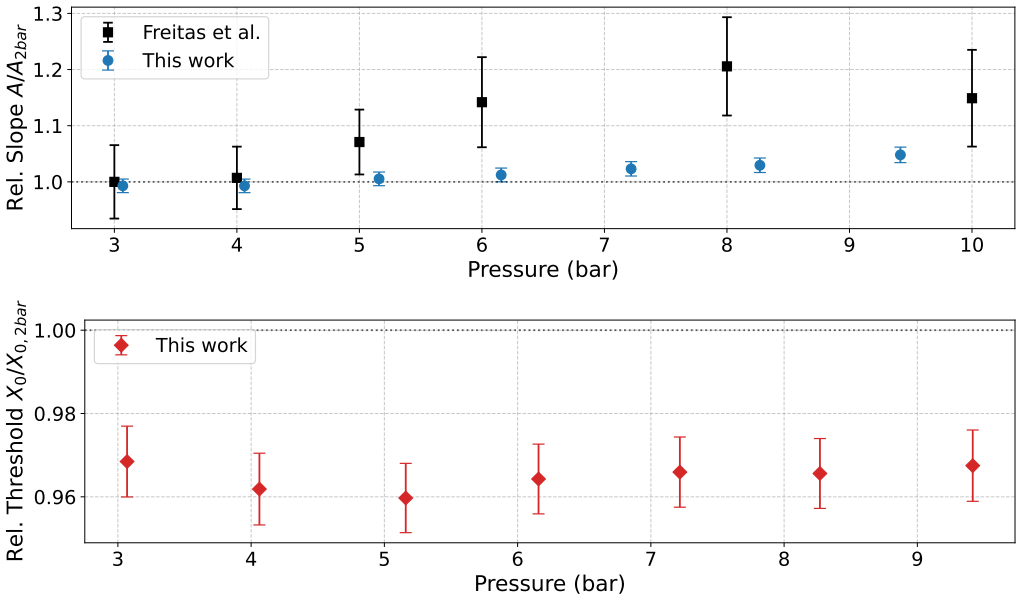
The reduced electroluminescence yield Y/p was measured as a function of reduced electric field E/p at pressures from 2.0 to 9.4 bar in the NEXT-DEMO++ detector using the 41.5 keV de-excitation peak of 83mKr. Linear fits to these data show a modest approximately 5 percent change in slope, with the change beginning around 5 bar and increasing as pressure rises to 9.4 bar.
What carries the argument
The linear fit to the reduced electroluminescence yield Y/p versus reduced field E/p, with the pressure variation of its slope as the measured quantity.
If this is right
- Electroluminescence models for xenon must incorporate a small pressure-dependent term above 5 bar.
- Energy reconstruction in high-pressure xenon time projection chambers will need updated parameters to maintain accuracy.
- The size of the slope shift increases steadily with pressure up to at least 9.4 bar.
- Some earlier disagreements in published electroluminescence data may be explained by this pressure effect.
Where Pith is reading between the lines
- At the 10-15 bar pressures planned for next-generation xenon detectors the effect could become larger and require dedicated calibration.
- The change may originate in pressure effects on electron transport or excitation rates, suggesting targeted microscopic simulations.
- Repeating the study with controlled variations in gas purity would test whether the dependence is intrinsic to xenon itself.
Load-bearing premise
The observed change in slope arises from a real physical dependence of the electroluminescence process on pressure rather than from unaccounted detector effects or analysis choices.
What would settle it
An independent measurement at 7 bar using a different light sensor geometry or analysis method that finds the slope exactly matches the value measured below 5 bar.
Figures



read the original abstract
The NEXT-DEMO++ detector, a high-pressure xenon gas time projection chamber serving as a prototype for the NEXT-100 experiment, was used to measure the electroluminescence (EL) yield as a function of reduced electric field ($E/p$) across pressures from 2.0 to 9.4 bar, utilizing the 41.5 keV de-excitation peak of $^{83m}$Kr. These measurements were made to examine the pressure dependence of the slope of the reduced EL yield $Y/p$, which has shown inconsistencies in the literature. The reduced yield was fitted with a linear model, revealing a modest ($\sim$5%) change in slope, beginning around 5 bar and increasing with pressure up to 9.4 bar.
Editorial analysis
A structured set of objections, weighed in public.
Referee Report
Summary. The manuscript presents measurements of the reduced electroluminescence yield (Y/p) in xenon gas using the NEXT-DEMO++ detector, a prototype TPC for the NEXT-100 experiment. Data were collected at pressures ranging from 2.0 to 9.4 bar using the 41.5 keV de-excitation peak of 83mKr. The yield was fitted to a linear model in E/p at each pressure, revealing a modest (~5%) variation in the slope that starts around 5 bar and increases with higher pressure. The work aims to clarify inconsistencies in the literature on the pressure dependence of the EL yield.
Significance. Should the observed pressure dependence prove to be a genuine physical effect rather than an artifact of detector systematics, this measurement would contribute to a better understanding of electroluminescence processes in high-pressure xenon. This is significant for optimizing the performance of xenon TPCs in searches for neutrinoless double beta decay, as accurate modeling of the EL yield affects energy resolution and event reconstruction. The direct experimental approach using a relevant prototype detector strengthens the applicability of the results.
minor comments (2)
- [Abstract] Abstract: the description of the linear fit to the reduced yield reveals a ~5% slope change but does not quote the actual fitted slope values (with uncertainties) at the different pressures; providing these numbers would allow readers to judge the statistical significance of the reported variation.
- [Abstract] Abstract: the pressure points at which data were taken (within 2.0–9.4 bar) and the number of independent measurements are not specified; adding this information would clarify how densely the trend with pressure was sampled.
Simulated Author's Rebuttal
We thank the referee for their positive assessment of the manuscript and for recommending minor revision. No specific major comments were provided in the report, so we have no individual points to address here. We are prepared to incorporate any minor editorial or technical suggestions in the revised version.
Circularity Check
No significant circularity; direct measurement and post-hoc fit
full rationale
The manuscript describes direct experimental measurements of reduced EL yield Y/p versus E/p in a xenon TPC using the 41.5 keV 83mKr peak, performed at multiple pressures from 2 to 9.4 bar. Linear models are fitted to the data at each pressure, and a modest ~5% variation in the fitted slope is reported as a function of pressure. No derivation chain exists that reduces a claimed prediction or first-principles result to its own inputs by construction. No self-citations are invoked as load-bearing uniqueness theorems or ansatzes. The central claim is an empirical observation from calibration and fitting procedures that remain independent of the reported slope change. This is a standard experimental result with no internal reduction to fitted quantities.
Axiom & Free-Parameter Ledger
free parameters (1)
- slope of reduced EL yield Y/p
axioms (1)
- domain assumption Electroluminescence yield is linearly proportional to reduced electric field E/p
Reference graph
Works this paper leans on
-
[1]
A. Bolotnikov, B. Ramsey, The spectroscopic properties of high-pressure xenon, Nucl. Inst. Meth. A 396 (1997) 360–370.doi:10.1016/S0168-9002(97)00784-5
-
[2]
P. Ferrario, et al., First proof of topological signature in the high pressure xenon gas TPC with electroluminescence amplification for the NEXT experiment, JHEP 01 (2016) 104. arXiv:1507.05902, doi:10.1007/ JHEP01(2016)104
-
[3]
M. Kekic, et al., Demonstration of background rejection using deep convolutional neural networks in the NEXT experiment, JHEP 01 (2021) 189. arXiv:2009.10783, doi:10.1007/JHEP01(2021)189
-
[4]
Nygren, High-pressure xenon gas electroluminescent TPC for 0 −ν ββ -decay search, Nucl.Instrum.Meth
D. Nygren, High-pressure xenon gas electroluminescent TPC for 0 −ν ββ -decay search, Nucl.Instrum.Meth. A603 (2009) 337–348.doi:10.1016/j.nima.2009.01.222. 7
- [5]
-
[6]
M. J. Dolinski, A. W. Poon, W. Rodejohann, Neutrinoless Double-Beta Decay: Status and Prospects, Ann. Rev. Nucl. Part. Sci. 69 (2019) 219–251. arXiv:1902.04097, doi: 10.1146/annurev-nucl-101918-023407
-
[7]
J. J. Gómez-Cadenas, J. Martín-Albo, J. Menéndez, M. Mezzetto, F. Monrabal, M. Sorel, The search for neutrinoless double-beta decay, Riv. Nuovo Cim. 46 (2023) 619–692.doi:10.1007/s40766-023-00049-2
-
[8]
S. M. Bilenky, S. T. Petcov, Massive neutrinos and neutrino oscillations, Rev. Mod. Phys. 59 (1987) 671–754. doi: 10.1103/RevModPhys.59.671
-
[9]
Aprile, A
E. Aprile, A. E. Bolotnikov, A. L. Bolozdynya, T. Doke, Noble Gas Detectors, Wiley, 2008. doi:10.1002/ 9783527610020
2008
-
[10]
E. Freitas, et al., Secondary scintillation yield in high- pressure xenon gas for neutrinoless double beta decay (0νββ) search, Phys. Lett. B 684 (2010) 205–210. doi: 10.1016/j.physletb.2010.01.013
-
[11]
S. Leardini, et al., Time and band-resolved scintillation in time projection chambers based on gaseous xenon, Eur. Phys. J. C 82 (2022) 425. arXiv:2112.04750, doi:10. 1140/epjc/s10052-022-10385-y
-
[12]
J. Renner, et al., Energy calibration of the NEXT-White detector with 1% resolution near Q ββ of 136Xe, JHEP 10 (2019) 230. arXiv:1905.13110, doi:10.1007/ JHEP10(2019)230
-
[13]
Fano, Ionization yield of radiations
U. Fano, Ionization yield of radiations. ii. the fluctuations of the number of ions, Phys. Rev. 72 (1947) 26–29. doi: 10.1103/PhysRev.72.26
-
[14]
Adams et al.,The NEXT-100 Detector,Eur
C. Adams, et al., The NEXT-100 Detector, Eur. Phys. J. C 86 (2026) 114. arXiv:2505.17848, doi:10.1140/ epjc/s10052-025-14951-y
-
[15]
M. P. Maneiro, et al., Demonstration of sub-percent energy resolution in the next-100 detector (2025). arXiv:2511. 02467
2025
-
[16]
V . Alvarez, et al., Operation and first results of the NEXT- DEMO prototype using a silicon photomultiplier tracking array, JINST 8 (2013) P09011. arXiv:1306.0471, doi: 10.1088/1748-0221/8/09/P09011
-
[17]
Lorca, et al., Characterisation of NEXT-DEMO using xenon Kα X-rays, JINST 9 (2014) P10007
D. Lorca, et al., Characterisation of NEXT-DEMO using xenon Kα X-rays, JINST 9 (2014) P10007. arXiv:1407. 3966,doi:10.1088/1748-0221/9/10/P10007
-
[18]
V . Álvarez, et al., Initial results of NEXT-DEMO, a large- scale prototype of the NEXT-100 experiment, JINST 8 (2013) P04002. arXiv:1211.4838, doi:10.1088/ 1748-0221/8/04/P04002
-
[19]
C. A. O. Henriques, et al., Neutral bremsstrahlung emission in xenon unveiled, Phys. Rev. X 12 (2022) 021005.arXiv: 2202.02614,doi:10.1103/PhysRevX.12.021005
-
[20]
V . Álvarez, et al., SiPMs coated with TPB: coating protocol and characterization for NEXT, JINST 7 (2012) P02010. doi:10.1088/1748-0221/7/02/P02010
-
[21]
NEXT Collaboration, IC: Invisible Cities, https:// github.com/next-exp/IC
-
[22]
A. Bolotnikov, B. Ramsey, Studies of light and charge produced by alpha-particles in high-pressure xenon, Nucl. Instrum. Meth. A 428 (2) (1999) 391–402. doi:https: //doi.org/10.1016/S0168-9002(99)00173-4
-
[23]
R. Platzman, Total ionization in gases by high-energy particles: An appraisal of our understanding, Intern. J. Appl. Rad. Iso. 10 (1961) 116–127. doi:https://doi. org/10.1016/0020-708X(61)90108-9
-
[24]
C. Henriques, J. Teixeira, P. Silva, R. Mano, J. dos Santos, C. Monteiro, Understanding the xenon primary scintillation yield for cutting-edge rare event experiments, JCAP 2024 (2024) 041. arXiv:2309.14202, doi:10. 1088/1475-7516/2024/06/041
-
[25]
K. Mistry, et al., Design, characterization and installation of the NEXT-100 cathode and electroluminescence regions, JINST 19 (2024) P02007. arXiv:2311.03528, doi:10. 1088/1748-0221/19/02/P02007
-
[26]
P. Sorensen, R. Gibbons, Quartz fluorescence backgrounds in xenon particle detectors, Phys. Rev. D 112 (2025) 052004. arXiv:2505.08067, doi:10.1103/ lsmf-pm5g. 8
discussion (0)
Sign in with ORCID, Apple, or X to comment. Anyone can read and Pith papers without signing in.