Recognition: unknown
Sensing of Low-Frequency Electric Fields Using Rydberg EIT within the Fisher Information Framework
Pith reviewed 2026-05-10 08:20 UTC · model grok-4.3
The pith
DC-biased differential readout and cavity enhancement let Rydberg EIT sense low-frequency electric fields down to 10^{-4} V/m per square-root Hertz.
A machine-rendered reading of the paper's core claim, the machinery that carries it, and where it could break.
Core claim
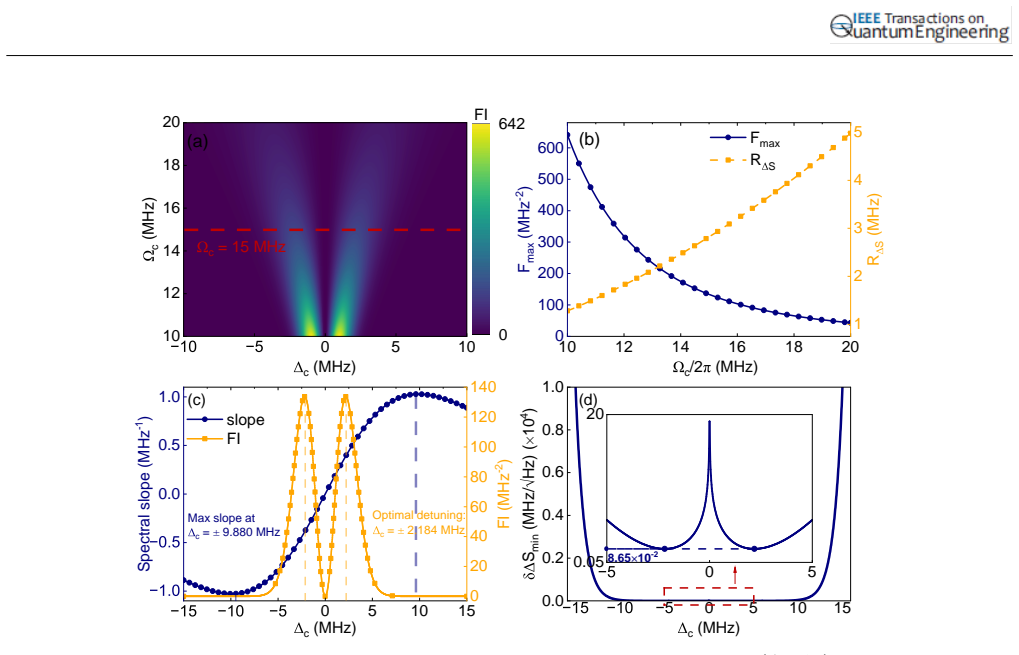
Within the Fisher-information and Cramér-Rao framework, a DC-biased two-point differential EIT readout removes the weak-field quadratic suppression for both DC and AC low-frequency fields, attaining a CRLB-limited sensitivity of approximately 1×10^{-4} V/m/√Hz; embedding the same atoms in a Fabry-Pérot cavity and applying intracavity phase modulation steepens the transmission slope and raises the Fisher information by more than two orders of magnitude over single-pass free-space operation.
What carries the argument
Fisher-information analysis of the EIT transmission spectrum under DC-biased differential readout and Fabry-Pérot intracavity phase modulation.
If this is right
- The DC-biased differential scheme converts the quadratic field response near zero into a linear slope usable for both static and oscillating low-frequency fields.
- Numerical results place the Cramér-Rao lower bound on sensitivity at approximately 1×10^{-4} V/m/√Hz.
- The Fabry-Pérot configuration with intracavity phase modulation increases Fisher information by more than two orders of magnitude compared with free-space EIT.
- The modeling framework supplies quantitative design guidance for quantum-based electromagnetic monitoring in smart-grid environments.
Where Pith is reading between the lines
- If the modeled sensitivity is realized experimentally, the technique could enable continuous, SI-traceable monitoring of power-line fields at distances where conventional sensors lose resolution.
- The same Fisher-information approach could be applied to other Rydberg transitions or to simultaneous electric and magnetic field sensing by adding a second probe laser.
- Practical limits will likely arise from atomic motion, laser phase noise, and cavity stability, none of which are quantified in the present calculations.
Load-bearing premise
The EIT readout model and linearized DC-biased differential measurement accurately represent the physical response of Rydberg atoms to low-frequency fields without unaccounted decoherence, nonlinearities, or other effects that would invalidate the Fisher information calculations.
What would settle it
An experiment that measures the actual electric-field sensitivity of a Rydberg EIT probe, with and without the DC bias and cavity, and checks whether the observed noise-equivalent field reaches or exceeds the predicted 1×10^{-4} V/m/√Hz bound.
Figures





read the original abstract
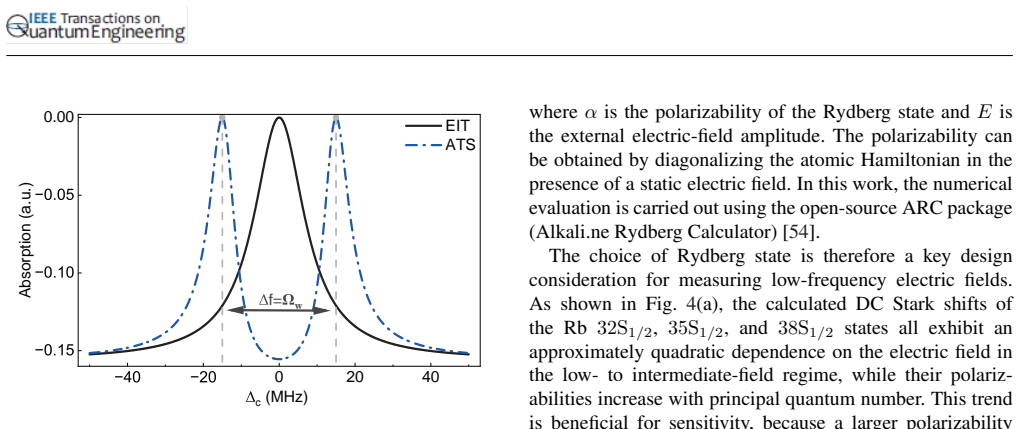
Rydberg atoms, which possess exceptionally large electric dipole moments, offer a promising route for electric field sensing as well as metrology traceable to the International System of Units (SI); however, current research predominantly focuses on the microwave (MW) regime, leaving the quasi-direct current (quasi-DC) and low-frequency bands, ubiquitous in power systems, largely unexplored. In this paper, we present a theoretical investigation into low-frequency electric field detection. To this end, we establish a comprehensive modeling framework incorporating Fisher information (FI) and the Cram\'{e}r-Rao lower bound (CRLB) to quantify the fundamental precision limits of electromagnetically induced transparency (EIT) readouts. Building upon this framework, we propose a linearized sensing strategy utilizing a DC-biased two-point differential measurement. Numerical validations demonstrate that this approach effectively mitigates the weak-field insensitivity for both DC and AC fields, achieving a CRLB-limited sensitivity bound of approximately $1\times 10^{-4}$ V/m/$\sqrt{\text{Hz}}$. Furthermore, to surpass the single-pass sensitivity limit, we introduce a Fabry-P\'{e}rot (FP) cavity-enhanced configuration. This architecture leverages intracavity phase modulation to significantly steepen the transmission slope, boosting the FI by over two orders of magnitude compared to standard free-space configurations. This work provides a rigorous theoretical basis and design guidance for the high-precision quantum monitoring of electromagnetic environments in smart grids.
Editorial analysis
A structured set of objections, weighed in public.
Referee Report
Summary. The manuscript develops a Fisher information (FI) and Cramér-Rao lower bound (CRLB) framework to quantify the fundamental precision limits of Rydberg EIT readouts for low-frequency (quasi-DC and low-frequency AC) electric field sensing. It proposes a linearized DC-biased two-point differential measurement to mitigate weak-field insensitivity and presents numerical validations claiming a CRLB-limited sensitivity of approximately 1×10^{-4} V/m/√Hz. A Fabry-Pérot cavity-enhanced configuration is introduced that uses intracavity phase modulation to boost the FI by over two orders of magnitude relative to free-space setups, providing theoretical guidance for high-precision monitoring in applications such as smart grids.
Significance. If the EIT transmission model and linearized differential scheme accurately capture the atom-field response, this work supplies a rigorous theoretical basis for extending Rydberg-based electric field metrology into the low-frequency regime. The application of standard FI/CRLB tools to this underexplored band, together with the explicit numerical validations of the differential strategy and the cavity-induced FI enhancement, constitutes a clear strength that can guide future experiments. The claimed sensitivity bound and two-order FI improvement would be impactful for SI-traceable sensing if the modeling assumptions are robust.
major comments (1)
- [Numerical validations] The numerical validations demonstrating mitigation of weak-field insensitivity and the CRLB-limited sensitivity bound of 1×10^{-4} V/m/√Hz rest on the EIT readout model combined with the linearized DC-biased differential measurement. Potential low-frequency decoherence channels (e.g., velocity-changing collisions or laser-frequency noise coupling) are not analyzed; if they contribute additional variance or distort the transmission slope, the computed FI and CRLB cease to be tight physical limits and the central sensitivity claims require revision.
minor comments (1)
- [Abstract] The abstract states that the FP cavity boosts the FI by 'over two orders of magnitude'; a specific numerical factor or reference to the relevant figure/table in the main text would improve clarity.
Simulated Author's Rebuttal
We thank the referee for the constructive feedback and positive evaluation of our Fisher information framework for Rydberg EIT-based low-frequency electric field sensing. We address the major comment point by point below.
read point-by-point responses
-
Referee: The numerical validations demonstrating mitigation of weak-field insensitivity and the CRLB-limited sensitivity bound of 1×10^{-4} V/m/√Hz rest on the EIT readout model combined with the linearized DC-biased differential measurement. Potential low-frequency decoherence channels (e.g., velocity-changing collisions or laser-frequency noise coupling) are not analyzed; if they contribute additional variance or distort the transmission slope, the computed FI and CRLB cease to be tight physical limits and the central sensitivity claims require revision.
Authors: We thank the referee for identifying this limitation. Our numerical validations rely on the standard EIT transmission model under idealized conditions and do not incorporate additional low-frequency decoherence mechanisms such as velocity-changing collisions or laser-frequency noise. These effects would indeed introduce extra variance and potentially modify the transmission slope, meaning the reported FI and CRLB represent theoretical bounds within the model assumptions rather than tight experimental limits. We agree that the manuscript should explicitly address this. In the revised version, we will add a dedicated discussion subsection on these potential decoherence channels, their possible impact on the computed quantities, and a clear statement that the CRLB sensitivity of ~1×10^{-4} V/m/√Hz is the fundamental limit under the idealized EIT model. This revision will appropriately scope the claims without altering the core results or framework. revision: yes
Circularity Check
No significant circularity; derivation applies standard FI/CRLB to EIT model
full rationale
The paper constructs an EIT transmission model for Rydberg atoms under low-frequency fields, then applies the externally established Fisher information and Cramér-Rao lower bound formalism to derive sensitivity limits for a DC-biased differential readout and an FP cavity enhancement. Numerical validations compute FI values and the resulting CRLB directly from this model for varying field amplitudes, showing mitigation of weak-field insensitivity and a two-order FI boost from intracavity modulation. No load-bearing step reduces to self-definition, fitted parameters renamed as predictions, or self-citation chains; the CRLB bound is the intended mathematical consequence of the FI calculation rather than an independent claim smuggled in by construction. The framework remains self-contained against standard statistical tools and the stated physical model.
Axiom & Free-Parameter Ledger
Reference graph
Works this paper leans on
-
[1]
The path of the smart grid,
H. Farhangi, “The path of the smart grid,” IEEE Power and Energy Magazine, vol. 8, no. 1, pp. 18–28, 2010
2010
-
[2]
Toward a smart grid: power delivery for the 21st century,
S. Massoud Amin and B. Wollenberg, “Toward a smart grid: power delivery for the 21st century,” IEEE Power and Energy Magazine, vol. 3, no. 5, pp. 34–41, 2005
2005
-
[3]
Liu, Ultra-high voltage AC/DC grids
Z. Liu, Ultra-high voltage AC/DC grids. Academic Press, 2014
2014
-
[4]
Kuffel and P
J. Kuffel and P. Kuffel, High voltage engineering fundamentals. Elsevier, 2000
2000
-
[5]
Sensors for electromagnetic pulse measurements both inside and away from nuclear source regions,
C. Baum, E. Breen, J. Giles, J. O’Neill, and G. Sower, “Sensors for electromagnetic pulse measurements both inside and away from nuclear source regions,” IEEE Transactions on Antennas and Propagation, vol. 26, no. 1, pp. 22–35, 1978
1978
-
[6]
Electrostatic charge and field sensors based on micromechanical resonators,
P. Riehl, K. Scott, R. Muller, R. Howe, and J. Yasaitis, “Electrostatic charge and field sensors based on micromechanical resonators,” Journal of Microelectromechanical Systems, vol. 12, no. 5, pp. 577–589, 2003
2003
-
[7]
Simultaneous measurement of two orthogonal components of electric field using a pockels device,
K. Hidaka, T. Kouno, and I. Hayashi, “Simultaneous measurement of two orthogonal components of electric field using a pockels device,” Review of Scientific Instruments, vol. 60, no. 7, pp. 1252–1257, 07 1989. [Online]. Available: https://doi.org/10.1063/1.1140299
-
[8]
Pockels effect based fully integrated, strained silicon electro-optic modulator,
B. Chmielak, M. Waldow, C. Matheisen, C. Ripperda, J. Bolten, T. Wahlbrink, M. Nagel, F. Merget, and H. Kurz, “Pockels effect based fully integrated, strained silicon electro-optic modulator,” Opt. Express, vol. 19, no. 18, pp. 17 212–17 219, Aug 2011. [Online]. Available: https://opg.optica.org/oe/abstract.cfm?URI=oe-19-18-17212
2011
-
[9]
Development of kerr electro-optic 3-d electric field measur- ing technique and its experimental verification,
R. Shimizu, M. Matsuoka, K. Kato, N. Hayakawa, M. Hikita, and H. Okubo, “Development of kerr electro-optic 3-d electric field measur- ing technique and its experimental verification,” IEEE Transactions on Dielectrics and Electrical Insulation, vol. 3, no. 2, pp. 191–196, 1996
1996
-
[10]
Review of Scientific Instruments , author=
Z. Q. Qiu and S. D. Bader, “Surface magneto-optic kerr effect,” Review of Scientific Instruments, vol. 71, no. 3, pp. 1243–1255, 03 2000. [Online]. Available: https://doi.org/10.1063/1.1150496
-
[11]
A review of three-dimensional electric field sensors,
X. Li, Y . Gu, Z. Li, Z. He, P. Yang, and C. Peng, “A review of three-dimensional electric field sensors,” Micromachines, vol. 16, no. 7,
-
[12]
Available: https://www.mdpi.com/2072-666X/16/7/737
[Online]. Available: https://www.mdpi.com/2072-666X/16/7/737
2072
-
[13]
Development and application of integrated optical sensors for intense e-field measurement,
R. Zeng, B. Wang, B. Niu, and Z. Yu, “Development and application of integrated optical sensors for intense e-field measurement,” Sensors, vol. 12, no. 8, pp. 11 406–11 434, 2012. [Online]. Available: https: //www.mdpi.com/1424-8220/12/8/11406
2012
-
[14]
An overview of optical voltage sensor based on pockels effect,
L. J. Li, W. H. Zhang, H. Li, and R. Pan, “An overview of optical voltage sensor based on pockels effect,” Advanced Materials Research, vol. 694, pp. 987–991, 2013
2013
-
[15]
Tzelepis, V
D. Tzelepis, V . Psaras, E. Tsotsopoulou, S. Mirsaeidi, A. Dy´sko, Q. Hong, X. Dong, S. M. Blair, V . C. Nikolaidis, V . Papaspiliotopoulos, G. Fusiek, G. M. Burt, P. Niewczas, and C. D. Booth, “V oltage and current measuring technologies for high voltage direct current supergrids: A technology review identifying the options for protection, fault location...
2020
-
[16]
C. L. Degen, F. Reinhard, and P. Cappellaro, “Quantum sensing,” Rev. Mod. Phys., vol. 89, p. 035002, Jul 2017. [Online]. Available: https://link.aps.org/doi/10.1103/RevModPhys.89.035002
-
[17]
Advances in photonic quantum sensing,
S. Pirandola, B. R. Bardhan, T. Gehring, C. Weedbrook, and S. Lloyd, “Advances in photonic quantum sensing,” Nature Photonics, vol. 12, no. 12, p. 724–733, Nov. 2018. [Online]. Available: http://dx.doi.org/10. 1038/s41566-018-0301-6
2018
-
[18]
V . Giovannetti, S. Lloyd, and L. Maccone, “Advances in quantum metrology,” Nature Photonics, vol. 5, no. 4, p. 222–229, Mar. 2011. [Online]. Available: http://dx.doi.org/10.1038/nphoton.2011.35
-
[19]
Optics and interferometry with atoms and molecules,
A. D. Cronin, J. Schmiedmayer, and D. E. Pritchard, “Optics and interferometry with atoms and molecules,” Rev. Mod. Phys., vol. 81, pp. 1051–1129, Jul 2009. [Online]. Available: https://link.aps.org/doi/10. 1103/RevModPhys.81.1051
2009
-
[20]
D. Budker and M. Romalis, “Optical magnetometry,” Nature Physics, vol. 3, no. 4, p. 227–234, Apr. 2007. [Online]. Available: http: //dx.doi.org/10.1038/nphys566
-
[21]
High- sensitivity diamond magnetometer with nanoscale resolution,
J. M. Taylor, P. Cappellaro, L. Childress, L. Jiang, D. Budker, P. R. Hemmer, A. Yacoby, R. Walsworth, and M. D. Lukin, “High- sensitivity diamond magnetometer with nanoscale resolution,” Nature Physics, vol. 4, no. 10, p. 810–816, Sep. 2008. [Online]. Available: http://dx.doi.org/10.1038/nphys1075
-
[22]
Kitching, Applied Physics Reviews5, 10.1063/1.5026238 (2018)
J. Kitching, “Chip-scale atomic devices,” Applied Physics Reviews, vol. 5, no. 3, p. 031302, 08 2018. [Online]. Available: https: //doi.org/10.1063/1.5026238 14 VOLUME 4, 2016
-
[23]
A giant electro-optic effect using polarizable dark states,
A. K. Mohapatra, M. G. Bason, B. Butscher, K. J. Weatherill, and C. S. Adams, “A giant electro-optic effect using polarizable dark states,” Nature Physics, vol. 4, no. 11, p. 890–894, Sep. 2008. [Online]. Available: http://dx.doi.org/10.1038/nphys1091
-
[24]
Microwave electrometry with rydberg atoms in a vapour cell using bright atomic resonances,
J. A. Sedlacek, A. Schwettmann, H. Kübler, R. Löw, T. Pfau, and J. P. Shaffer, “Microwave electrometry with rydberg atoms in a vapour cell using bright atomic resonances,” Nature Physics, vol. 8, no. 11, p. 819– 824, Sep. 2012. [Online]. Available: http://dx.doi.org/10.1038/nphys2423
-
[25]
S. Kumar, H. Fan, H. Kübler, A. J. Jahangiri, and J. P. Shaffer, “Rydberg-atom based radio-frequency electrometry using frequency modulation spectroscopy in room temperature vapor cells,” Optics Express, vol. 25, no. 8, p. 8625, Apr. 2017. [Online]. Available: http://dx.doi.org/10.1364/OE.25.008625
-
[26]
Atomic superheterodyne receiver based on microwave-dressed rydberg spectroscopy,
M. Jing, Y . Hu, J. Ma, H. Zhang, L. Zhang, L. Xiao, and S. Jia, “Atomic superheterodyne receiver based on microwave-dressed rydberg spectroscopy,” Nature Physics, vol. 16, no. 9, p. 911–915, Jun. 2020. [Online]. Available: http://dx.doi.org/10.1038/s41567-020-0918-5
-
[27]
Quantum scaling atomic superheterodyne receiver,
P. Zhang, M. Jing, Z. Wang, Y . Peng, S. Yuan, H. Zhang, L. Xiao, S. Jia, and L. Zhang, “Quantum scaling atomic superheterodyne receiver,” EPJ Quantum Technology, vol. 10, no. 1, Oct. 2023. [Online]. Available: http://dx.doi.org/10.1140/epjqt/s40507-023-00198-7
-
[28]
Linear dynamic range of a rydberg-atom microwave superheterodyne receiver,
F. Wu, Q. An, Z. Sun, and Y . Fu, “Linear dynamic range of a rydberg-atom microwave superheterodyne receiver,” Phys. Rev. A, vol. 107, p. 043108, Apr 2023. [Online]. Available: https: //link.aps.org/doi/10.1103/PhysRevA.107.043108
-
[29]
Enhanced metrology at the critical point of a many-body rydberg atomic system,
D.-S. Ding, Z.-K. Liu, B.-S. Shi, G.-C. Guo, K. Mølmer, and C. S. Adams, “Enhanced metrology at the critical point of a many-body rydberg atomic system,” Nature Physics, vol. 18, no. 12, p. 1447–1452, Oct. 2022. [Online]. Available: http://dx.doi.org/10.1038/s41567-022-01777-8
-
[30]
Deep learning enhanced rydberg multifrequency microwave recognition,
Z.-K. Liu, L.-H. Zhang, B. Liu, Z.-Y . Zhang, G.-C. Guo, D.-S. Ding, and B.-S. Shi, “Deep learning enhanced rydberg multifrequency microwave recognition,” Nature Communications, vol. 13, no. 1, Apr. 2022. [Online]. Available: http://dx.doi.org/10.1038/s41467-022-29686-7
-
[31]
Cavity-linewidth narrowing by means of electromagnetically induced transparency,
H. Wang, D. J. Goorskey, W. H. Burkett, and M. Xiao, “Cavity-linewidth narrowing by means of electromagnetically induced transparency,” Optics Letters, vol. 25, no. 23, p. 1732, Dec. 2000. [Online]. Available: http://dx.doi.org/10.1364/OL.25.001732
-
[32]
Cavity-enhanced rydberg atomic superheterodyne receiver,
Y . Liang, Q. Wang, Z. Wang, S. Guan, P. Yang, Y . Zhang, J. He, P. Zhang, G. Li, and T. Zhang, “Cavity-enhanced rydberg atomic superheterodyne receiver,” Optics Express, vol. 33, no. 6, p. 13034, Mar. 2025. [Online]. Available: http://dx.doi.org/10.1364/OE.552016
-
[33]
Cavity-enhanced microwave electric field measurement using rydberg atoms,
Y . Peng, J. Wang, A. Yang, Z. Jia, D. Li, and B. Chen, “Cavity-enhanced microwave electric field measurement using rydberg atoms,” Journal of the Optical Society of America B, vol. 35, no. 9, p. 2272, Aug. 2018. [Online]. Available: http://dx.doi.org/10.1364/JOSAB.35.002272
-
[34]
Cavity-enhanced rydberg atom microwave receiver,
B. Liu, L.-H. Zhang, Q.-F. Wang, Y . Ma, T.-Y . Han, Z.-K. Liu, Z.-Y . Zhang, S.-Y . Shao, J. Zhang, Q. Li, H.-C. Chen, Y .-L. Han, D.-S. Ding, and B.-S. Shi, “Cavity-enhanced rydberg atom microwave receiver,” Chinese Physics Letters, vol. 42, no. 5, p. 053201, May 2025. [Online]. Available: http://dx.doi.org/10.1088/0256-307X/42/5/053201
-
[35]
Observation of electromagnetically induced transparency,
K.-J. Boller, A. Imamo ˘glu, and S. E. Harris, “Observation of electromagnetically induced transparency,” Phys. Rev. Lett., vol. 66, pp. 2593–2596, May 1991. [Online]. Available: https://link.aps.org/doi/10. 1103/PhysRevLett.66.2593
1991
-
[36]
Electromagnetically induced transparency,
J. P. Marangos, “Electromagnetically induced transparency,” Journal of modern optics, vol. 45, no. 3, pp. 471–503, 1998
1998
-
[37]
Electromagnetically induced transparency: Optics in coherent media,
M. Fleischhauer, A. Imamoglu, and J. P. Marangos, “Electromagnetically induced transparency: Optics in coherent media,” Rev. Mod. Phys., vol. 77, pp. 633–673, Jul 2005. [Online]. Available: https://link.aps.org/ doi/10.1103/RevModPhys.77.633
-
[38]
Enhancing sensitivity of an atomic microwave receiver via a fabry-perot cavity,
B. Wu, D. Liao, D. Sang, Y . Liu, and Y . Fu, “Enhancing sensitivity of an atomic microwave receiver via a fabry-perot cavity,” IEEE Transactions on Antennas and Propagation, vol. 73, no. 2, pp. 863–872, 2025
2025
-
[39]
Shortwave ultrahigh- sensitivity rydberg atomic electric field sensing based on a subminiature resonator,
R. Mao, Y . Lin, A. Zhou, K. Yang, and Y . Fu, “Shortwave ultrahigh- sensitivity rydberg atomic electric field sensing based on a subminiature resonator,” IEEE Transactions on Antennas and Propagation, vol. 72, no. 11, pp. 8165–8172, 2024
2024
-
[40]
Dc and power- frequency electric field measurement with rydberg-atom interferometry,
Y . Han, C. He, Z. Weng, P. Xu, Y . Zhao, and T. Wang, “Dc and power- frequency electric field measurement with rydberg-atom interferometry,” Applied Physics Letters, vol. 127, no. 2, p. 024002, 07 2025. [Online]. Available: https://doi.org/10.1063/5.0272159
-
[41]
Theoretical study on stark effect of rydberg atom in super low frequency electric field measurement,
H. Song, Y . Xiao, S. Hu, D. Xiao, B. Wang, Z. Shi, and H. Zhang, “Theoretical study on stark effect of rydberg atom in super low frequency electric field measurement,” IET Energy Systems Integration, vol. 6, no. 2, p. 174–181, Apr. 2024. [Online]. Available: http: //dx.doi.org/10.1049/esi2.12149
-
[42]
D. Arumugam, “Stark modulated rydberg dissipative time crystals at room temperature applied to sub-khz electric field sensing,” Scientific Reports, vol. 15, no. 1, Oct. 2025. [Online]. Available: http://dx.doi.org/10.1038/s41598-025-19859-x
-
[43]
Dc electric fields in electrode-free glass vapor cell by photoillumination,
L. Ma, E. Paradis, and G. Raithel, “Dc electric fields in electrode-free glass vapor cell by photoillumination,” Optics Express, vol. 28, no. 3, p. 3676, Jan. 2020. [Online]. Available: http://dx.doi.org/10.1364/OE.380748
-
[44]
High sensitivity measurement of ulf, vlf, and lf fields with a rydberg-atom sensor,
M. Lei and M. Shi, “High sensitivity measurement of ulf, vlf, and lf fields with a rydberg-atom sensor,” Opt. Lett., vol. 49, no. 19, pp. 5547–5550, Oct 2024. [Online]. Available: https://opg.optica.org/ol/ abstract.cfm?URI=ol-49-19-5547
2024
-
[45]
Research of 110 kv high-voltage measurement method based on rydberg atoms,
Y . Diao, Z. Qu, N. Qu, J. Cao, X. Li, X. Xu, and S. You, “Research of 110 kv high-voltage measurement method based on rydberg atoms,” Electronics, vol. 14, no. 15, 2025. [Online]. Available: https://www.mdpi.com/2079-9292/14/15/2932
2025
-
[46]
Super low-frequency electric field measurement based on rydberg atoms,
L. Li, Y . Jiao, J. Hu, H. Li, M. Shi, J. Zhao, and S. Jia, “Super low-frequency electric field measurement based on rydberg atoms,” Opt. Express, vol. 31, no. 18, pp. 29 228–29 234, Aug 2023. [Online]. Available: https://opg.optica.org/oe/abstract.cfm?URI=oe-31-18-29228
2023
-
[47]
Vapor-cell-based atomic electrometry for detection frequencies below 1 khz,
Y .-Y . Jau and T. Carter, “Vapor-cell-based atomic electrometry for detection frequencies below 1 khz,” Phys. Rev. Appl., vol. 13, p. 054034, May 2020. [Online]. Available: https://link.aps.org/doi/10.1103/ PhysRevApplied.13.054034
2020
-
[48]
A. Duspayev, R. Cardman, D. A. Anderson, and G. Raithel, “High- angular-momentum rydberg states in a room-temperature vapor cell for dc electric-field sensing,” Phys. Rev. Res., vol. 6, p. 023138, May 2024. [Online]. Available: https://link.aps.org/doi/10.1103/PhysRevResearch.6. 023138
-
[49]
S. Yan, D. Xiao, H. Zhang, H. Wang, and F. Pan, “Dynamic response characteristics of rydberg atoms under the action of electric fields ranging from dc to 50 khz and electric field measurement method,” Journal of Physics D: Applied Physics, vol. 58, no. 38, p. 385104, Sep. 2025. [Online]. Available: http://dx.doi.org/10.1088/1361-6463/ae04f4
-
[50]
Electric field measurement using a three-photon double-dark-state model in rydberg atoms,
D. Xiao, X. Wei, S. Yan, and H. Zhang, “Electric field measurement using a three-photon double-dark-state model in rydberg atoms,” AIP Advances, vol. 15, no. 7, p. 075108, 07 2025. [Online]. Available: https://doi.org/10.1063/5.0265975
-
[51]
D. Xiao, Z. Shi, L. Chen, S. Yan, L. Xu, and H. Zhang, “Low-frequency weak electric field measurement based on rydberg atoms using cavity- enhanced three photon system,” Frontiers in Physics, vol. 12, Jun. 2024. [Online]. Available: http://dx.doi.org/10.3389/fphy.2024.1405149
-
[52]
Stark effect in rapidly varying fields,
S. H. Autler and C. H. Townes, “Stark effect in rapidly varying fields,” Phys. Rev., vol. 100, pp. 703–722, Oct 1955. [Online]. Available: https://link.aps.org/doi/10.1103/PhysRev.100.703
-
[53]
Electromagnetically induced transparency and autler- townes splitting: Two similar but distinct phenomena in two categories of three-level atomic systems,
T. Y . Abi-Salloum, “Electromagnetically induced transparency and autler- townes splitting: Two similar but distinct phenomena in two categories of three-level atomic systems,” Phys. Rev. A, vol. 81, p. 053836, May
-
[54]
Available: https://link.aps.org/doi/10.1103/PhysRevA.81
[Online]. Available: https://link.aps.org/doi/10.1103/PhysRevA.81. 053836
-
[55]
Observation of the separation of spectral lines by an electric field,
J. STARK, “Observation of the separation of spectral lines by an electric field,” Nature, vol. 92, no. 2301, p. 401–401, Dec. 1913. [Online]. Available: http://dx.doi.org/10.1038/092401b0
-
[56]
Arc: An open-source library for calculating properties of alkali rydberg atoms,
N. Šibali ´c, J. Pritchard, C. Adams, and K. Weatherill, “Arc: An open-source library for calculating properties of alkali rydberg atoms,” Computer Physics Communications, vol. 220, pp. 319–331,
-
[57]
Available: https://www.sciencedirect.com/science/article/ pii/S0010465517301972
[Online]. Available: https://www.sciencedirect.com/science/article/ pii/S0010465517301972
-
[58]
A tutorial on fisher information,
A. Ly, M. Marsman, J. Verhagen, R. P. Grasman, and E.-J. Wagenmakers, “A tutorial on fisher information,” Journal of Mathematical Psychology, vol. 80, pp. 40–55, 2017. [Online]. Available: https://www.sciencedirect. com/science/article/pii/S0022249617301396
2017
-
[59]
Fisher- based sensitivity framework for rydberg-atom microwave electrometry,
C.-R. Liu, R. Tao, X. Lv, Y . Dong, C. Li, B. Wei, and M. Zhou, “Fisher- based sensitivity framework for rydberg-atom microwave electrometry,” Phys. Rev. Appl., vol. 25, p. 034052, Mar 2026. [Online]. Available: https://link.aps.org/doi/10.1103/qsmd-yh44
-
[60]
Fisher information analysis for quantum-enhanced parameter estimation in an electromagnetically- induced-transparency spectrum with single photons,
P.-J. Tsai, L.-P. Yuan, and Y .-C. Chen, “Fisher information analysis for quantum-enhanced parameter estimation in an electromagnetically- induced-transparency spectrum with single photons,” Phys. Rev. A, vol. 108, p. 033711, Sep 2023. [Online]. Available: https://link.aps.org/doi/10. 1103/PhysRevA.108.033711 VOLUME 4, 2016 15 16 VOLUME 4, 2016
2023
discussion (0)
Sign in with ORCID, Apple, or X to comment. Anyone can read and Pith papers without signing in.