Recognition: unknown
Isospin-symmetry violation -- kaons and beyond (ISO-BREAK 25: summary and outlook)
Pith reviewed 2026-05-10 07:22 UTC · model grok-4.3
The pith
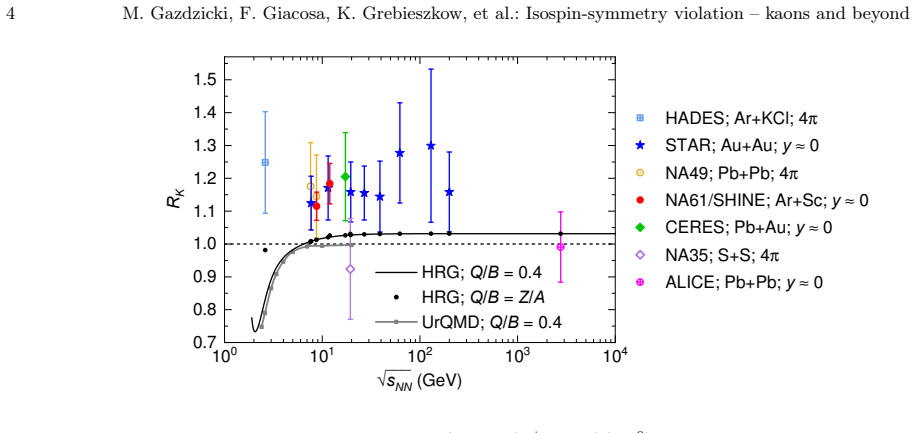
The isospin symmetry violation in particle ratios observed by NA61/SHINE at the CERN SPS remains unexplained.
A machine-rendered reading of the paper's core claim, the machinery that carries it, and where it could break.
Core claim
The isospin-symmetry breaking discovered by NA61/SHINE in heavy-ion collisions at the CERN SPS, visible as unexpected deviations in particle production ratios, has not been explained by existing theory, and the workshop outlines paths for confirmation and theoretical progress.
What carries the argument
Isospin-symmetry violation manifested in deviations of particle production ratios, especially involving kaons, in nucleus-nucleus collisions.
If this is right
- Dedicated measurements in additional collision systems and at different energies are required to confirm or refute the effect.
- Theoretical models of strong interactions must incorporate mechanisms that allow isospin symmetry to be broken in this way.
- Data from electron-positron annihilation and deep inelastic scattering can provide independent tests of whether the violation is specific to nuclear matter.
- Clear experimental and theoretical priorities are needed to guide the next steps toward understanding the origin of the breaking.
Where Pith is reading between the lines
- Confirmation would suggest that standard models of QCD in dense environments miss a symmetry-breaking channel.
- The effect, if real, might be tied to specific conditions in heavy-ion collisions rather than appearing universally.
- Resolving the question could influence how isospin is treated in predictions of particle yields across different collision types.
Load-bearing premise
The deviation in particle production ratios reported by NA61/SHINE is a genuine isospin symmetry violation rather than an experimental artifact or unaccounted systematic effect.
What would settle it
An independent high-precision experiment measuring the same particle production ratios at comparable energies and showing no deviation would falsify the existence of the reported isospin symmetry violation.
Figures


read the original abstract
This report summarizes the presentations and discussions during the ISO-BREAK 25 Workshop ``Isospin symmetry violation: kaons and beyond'', which was held at Jan Kochanowski University in Kielce on October 23-25, 2025. We address the current status of the isospin-symmetry breaking discovered by NA61/SHINE in nucleus-nucleus collisions at the CERN SPS, its confirmation by other experiments and studies in \ee and deep inelastic scattering. In addition, we discuss the theoretical status as well as we outline experimental and theoretical priorities towards understanding this currently unexplained phenomenon.
Editorial analysis
A structured set of objections, weighed in public.
Referee Report
Summary. This manuscript summarizes the presentations and discussions from the ISO-BREAK 25 workshop on isospin symmetry violation held at Jan Kochanowski University in Kielce on October 23-25, 2025. It reports the current status of the isospin-symmetry breaking discovered by NA61/SHINE in nucleus-nucleus collisions at the CERN SPS, efforts toward confirmation by other experiments and in e+e- and deep inelastic scattering, the theoretical status, and experimental and theoretical priorities for resolving this unexplained phenomenon.
Significance. As a workshop summary, the report documents an open experimental puzzle in nuclear physics whose resolution could affect understanding of isospin symmetry in QCD and hadronic interactions. It is useful for recording community consensus on the NA61/SHINE observation and for outlining next steps, though it introduces no new data, derivations, or machine-checked results itself.
Simulated Author's Rebuttal
We thank the referee for the careful review of our workshop summary and for the positive recommendation to accept the manuscript.
Circularity Check
No significant circularity in workshop summary report
full rationale
This document is a workshop summary report that compiles presentations, discussions, and priorities regarding an open experimental puzzle (isospin-symmetry breaking reported by NA61/SHINE). It contains no original derivations, equations, fitted parameters, or theoretical constructions that could reduce to self-referential inputs by construction. All references to data, confirmations, or theoretical status point to external experiments and prior literature without any internal prediction or uniqueness claim that depends on the paper's own content. The central claim is simply that the phenomenon remains unexplained, which is a factual status update rather than a derived result.
Axiom & Free-Parameter Ledger
axioms (2)
- standard math Isospin symmetry is an approximate symmetry of the strong interaction that can be violated in certain environments
- domain assumption The NA61/SHINE observation constitutes a genuine isospin symmetry violation
Forward citations
Cited by 1 Pith paper
-
Overview of results from NA61/SHINE
NA61/SHINE reports a subjective summary of particle production and related measurements in the intermediate-energy regime bridging LHC and FAIR heavy-ion experiments.
Reference graph
Works this paper leans on
-
[1]
Evidence of isospin-symmetry violation in high-energy collisions of atomic nuclei
H. Adhikary et al. “Evidence of isospin-symmetry violation in high-energy collisions of atomic nuclei”.Nature Commun.16.1 (2025), 2849.doi:10.1038/s41467-025-57234-6. arXiv:2312.06572 [nucl-ex]
-
[2]
W. Brylinski et al. “Evidence of isospin-symmetry violation in high-energy collisions of atomic nuclei: Theoret- ical and phenomenological considerations” (2023). arXiv:2312.07176 [nucl-th]
-
[3]
M. Ablikim et al. “Single Inclusiveπ± andK ± Production ine +e− Annihilation at Center-of-Mass Energies from 2.000 to 3.671 GeV”.Phys. Rev. Lett.135 (2025), 151901.doi:10.1103/5kxw-3mbw. arXiv:2502.16084 [hep-ex]
-
[4]
Flavor dependence of charged pion fragmentation functions
H. Bhatt et al. “Flavor dependence of charged pion fragmentation functions”.Phys. Lett. B865 (2025), 139485. doi:10.1016/j.physletb.2025.139485. arXiv:2408.16640 [nucl-ex]
-
[5]
News on strangeness production from the NA61/SHINE experiment
Y. Balkova and T. Šuša. “News on strangeness production from the NA61/SHINE experiment” (2025). arXiv: 2508.14998 [nucl-ex]
-
[6]
Centrality Dependence of Neutral Pion Production in 158AGeV 208Pb + 208Pb Collisions
M. M. Aggarwal et al. “Centrality Dependence of Neutral Pion Production in 158AGeV 208Pb + 208Pb Collisions”.Phys. Rev. Lett.81 (1998). [Erratum: Phys.Rev.Lett. 84, 578–579 (2000)], 4087–4091.doi:10 . 1103/PhysRevLett.81.4087. arXiv:nucl-ex/9806004
-
[7]
A. Adare et al. “Neutral pion production with respect to centrality and reaction plane in Au+Au collisions at √sN N=200 GeV”.Phys. Rev. C87.3 (2013), 034911.doi:10.1103/PhysRevC.87.034911. arXiv:1208.2254 [nucl-ex]
-
[8]
Neutral pion andηmeson production in proton–proton collisions at √s= 0.9TeV and √s= 7TeV
B. Abelev et al. “Neutral pion andηmeson production in proton–proton collisions at √s= 0.9TeV and √s= 7TeV”.Phys. Lett. B717 (2012), 162–172.doi:10.1016/j.physletb.2012.09.015. arXiv:1205.5724 [hep-ex]. M. Gazdzicki, F. Giacosa, K. Grebieszkow, et al.: Isospin-symmetry violation – kaons and beyond 25
-
[9]
Neutral pion andηmeson production at midrapidity in Pb-Pb collisions at√sN N = 2.76 TeV
S. Acharya et al. “Neutral pion andηmeson production at midrapidity in Pb-Pb collisions at√sN N = 2.76 TeV”.Phys. Rev. C98.4 (2018), 044901.doi:10.1103/PhysRevC.98.044901. arXiv:1803.05490 [nucl-ex]
-
[11]
C. Alt et al. “Pion and kaon production in central Pb+Pb collisions at 20Aand 30AGeV: Evidence for the onset of deconfinement”.Phys. Rev. C77 (2008), 024903.doi:10.1103/PhysRevC.77.024903. arXiv:0710.0118 [nucl-ex]
-
[12]
Energy dependence of pion and kaon production in central Pb+Pb collisions
S. V. Afanasiev et al. “Energy dependence of pion and kaon production in central Pb+Pb collisions”.Phys. Rev. C66 (2002), 054902.doi:10.1103/PhysRevC.66.054902. arXiv:nucl-ex/0205002
-
[13]
Strangeness measurements in NA49 experiment with Pb projectiles
S. Margetis et al. “Strangeness measurements in NA49 experiment with Pb projectiles”.J. Phys. G25 (1999), 189–197.doi:10.1088/0954-3899/25/2/006
-
[14]
Measurements ofΛ,ΛandK 0 S from Pb-Pb Collisions at 158 GeV per nucleon in a Large Ac- ceptance Experiment
L. S. Barnby. “Measurements ofΛ,ΛandK 0 S from Pb-Pb Collisions at 158 GeV per nucleon in a Large Ac- ceptance Experiment”. PhD thesis, University of Birmingham. 1999.url:https://edms.cern.ch/document/ 816018/1
1999
-
[15]
ΛundΛProduktion in zentralen Blei-Blei-Kollisionen bei 40, 80 und 158 GeV pro Nukleon
A. Mischke. “ΛundΛProduktion in zentralen Blei-Blei-Kollisionen bei 40, 80 und 158 GeV pro Nukleon”. PhD thesis, Johann Wolfgang Goethe-Universität. 2002.url:https://edms.cern.ch/document/3409580/1
-
[16]
Energieabhängigkeit der K0 S-Produktion in zentralen Pb+Pb Reaktionen
C. Strabel. “Energieabhängigkeit der K0 S-Produktion in zentralen Pb+Pb Reaktionen”. Diploma thesis, Johann Wolfgang Goethe-Universität. 2006.url:https://edms.cern.ch/document/2958534/1
-
[17]
Zentralitätsabhängigkeit derK0 S-Produktion in relativistischen Schwerionenkollisionen
J. Book. “Zentralitätsabhängigkeit derK0 S-Produktion in relativistischen Schwerionenkollisionen”. Diploma the- sis, Johann Wolfgang Goethe-Universität. 2009.url:https://edms.cern.ch/document/3409578/1
-
[20]
Measurements ofπ±,K ±,pand¯pspectra in 40Ar+45Sc collisions at 13Ato 150AGeV/c
H. Adhikary et al. “Measurements ofπ±,K ±,pand¯pspectra in 40Ar+45Sc collisions at 13Ato 150AGeV/c”. Eur. Phys. J. C84.4 (2024), 416.doi:10.1140/epjc/s10052-024-12602-2. arXiv:2308.16683 [nucl-ex]. 26 M. Gazdzicki, F. Giacosa, K. Grebieszkow, et al.: Isospin-symmetry violation – kaons and beyond
-
[21]
A. Aduszkiewicz et al. “Measurements ofπ± , K±, p and¯p spectra in proton-proton interactions at 20, 31, 40, 80 and 158 GeV/cwith the NA61/SHINE spectrometer at the CERN SPS”.Eur. Phys. J. C77.10 (2017), 671. doi:10.1140/epjc/s10052-017-5260-4. arXiv:1705.02467 [nucl-ex]
-
[22]
R. Kutsche. “Untersuchungen der In-Medium-Eigenschaften vonK0 S-Mesonen undΛ-Hyperonen an der Pro- duktionsschwelle”. PhD thesis, Technische Universität Darmstadt. 1999.url:https://tuprints.ulb.tu- darmstadt.de/entities/publication/1785882c-7b10-419f-8cc0-861d14893396
-
[23]
Production ofK+ and ofK − mesons in heavy-ion collisions from 0.6Ato 2.0AGeV incident energy
A. Förster et al. “Production ofK+ and ofK − mesons in heavy-ion collisions from 0.6Ato 2.0AGeV incident energy”.Phys. Rev. C75 (2007), 024906.doi:10.1103/PhysRevC.75.024906. arXiv:nucl-ex/0701014
-
[26]
B. Abelev et al. “Centrality dependence ofπ,K, andpproduction in Pb-Pb collisions at√sN N = 2.76 TeV”. Phys. Rev. C88 (2013), 044910.doi:10.1103/PhysRevC.88.044910. arXiv:1303.0737 [hep-ex]
-
[27]
K0 S andΛProduction in Pb-Pb Collisions at√sN N = 2.76 TeV
B. Abelev et al. “K0 S andΛProduction in Pb-Pb Collisions at√sN N = 2.76 TeV”.Phys. Rev. Lett.111 (2013), 222301.doi:10.1103/PhysRevLett.111.222301. arXiv:1307.5530 [nucl-ex]
-
[29]
On consistency of the interacting (anti)holomorphic higher-spin sector
K. Aamodt et al. “Strange particle production in proton–proton collisions at√s= 0.9 TeV with ALICE at the LHC”.Eur. Phys. J. C71 (2011), 1594.doi:10.1140/epjc/s10052- 011- 1594- 5. arXiv:1012.3257 [hep-ex]
-
[30]
Global analysis of fragmentation functions to charged hadrons with high-precision data from the LHC
J. Gao et al. “Global analysis of fragmentation functions to charged hadrons with high-precision data from the LHC”.Phys. Rev. D110.11 (2024), 114019.doi:10.1103/PhysRevD.110.114019. arXiv:2407.04422 [hep-ph]
-
[31]
Simultaneous Determination of Fragmentation Functions and Test on Momentum Sum Rule
J. Gao et al. “Simultaneous Determination of Fragmentation Functions and Test on Momentum Sum Rule”. Phys. Rev. Lett.132.26(2024),261903.doi:10.1103/PhysRevLett.132.261903.arXiv:2401.02781 [hep-ph]
work page doi:10.1103/physrevlett.132.261903.arxiv:2401.02781 2024
-
[33]
Flavor Dependence of Charged Pion Fragmentation Functions
D. Dutta. “Flavor Dependence of Charged Pion Fragmentation Functions”.Workshop on isospin symmetry violation: kaons and beyond – ISO-BREAK 25. 2025.url:https : / / indico . cern . ch / event / 1557894 / contributions/6698146
-
[37]
Modelling relativistic heavy-ion collisions with dynamical transport ap- proaches
M. Bleicher and E. Bratkovskaya. “Modelling relativistic heavy-ion collisions with dynamical transport ap- proaches”.Prog. Part. Nucl. Phys.122 (2022), 103920.doi:10.1016/j.ppnp.2021.103920
-
[38]
M. Bleicher et al. “Relativistic hadron-hadron collisions in the ultrarelativistic quantum molecular dynamics model”.J. Phys. G25 (1999), 1859–1896.doi:10.1088/0954-3899/25/9/308. arXiv:hep-ph/9909407
-
[39]
Parton–Hadron-String Dynamics at relativistic collider energies
E. L. Bratkovskaya et al. “Parton–Hadron-String Dynamics at relativistic collider energies”.Nucl. Phys. A856 (2011), 162–182.doi:10.1016/j.nuclphysa.2011.03.003. arXiv:1101.5793 [nucl-th]
-
[40]
Value ofRK in PHSD
V. Ozvenchuk. “Value ofRK in PHSD”.Private Communication. 2025
2025
-
[41]
J. Weil et al. “Particle production and equilibrium properties within a new hadron transport approach for heavy- ion collisions”.Phys. Rev. C94.5 (2016), 054905.doi:10.1103/PhysRevC.94.054905. arXiv:1606.06642 [nucl-th]
-
[43]
EPOS LHC: Test of collective hadronization with data measured at the CERN Large Hadron Collider
T. Pierog et al. “EPOS LHC: Test of collective hadronization with data measured at the CERN Large Hadron Collider”.Phys. Rev. C92.3 (2015), 034906.doi:10.1103/PhysRevC.92.034906. arXiv:1306.0121 [hep-ph]
-
[45]
On particle production for high energy neutrino beams
M. Bonesini et al. “On particle production for high energy neutrino beams”.Eur. Phys. J. C20 (2001), 13–27. doi:10.1007/s100520100656. arXiv:hep-ph/0101163. 28 M. Gazdzicki, F. Giacosa, K. Grebieszkow, et al.: Isospin-symmetry violation – kaons and beyond
-
[46]
On the relation betweenK0 s and charged kaon yields in proton–proton collisions
J. Stepaniak and D. Pszczel. “On the relation betweenK0 s and charged kaon yields in proton–proton collisions”. Eur. Phys. J. C83.10 (2023), 928.doi:10.1140/epjc/s10052-023-12108-3. arXiv:2305.03872 [hep-ph]
-
[47]
Value ofRK in QC approach without isospin breaking
M. Rohrmoser. “Value ofRK in QC approach without isospin breaking”.Private Communication. 2026
2026
-
[48]
Isospin kaon anomaly and its consequences
F. Giacosa and M. Rohrmoser. “Isospin kaon anomaly and its consequences”.Eur. Phys. J. C85.9 (2025), 1058. doi:10.1140/epjc/s10052-025-14798-3. arXiv:2504.02113 [nucl-th]
-
[50]
Computational Strategies in Lattice QCD
M. Lüscher. “Computational Strategies in Lattice QCD”.Les Houches Summer School: Session 93: Modern perspectives in lattice QCD: Quantum field theory and high performance computing. Feb. 2010, 331–399. arXiv: 1002.4232 [hep-lat]
-
[51]
The QCD equation of state from the lattice
O. Philipsen. “The QCD equation of state from the lattice”.Prog. Part. Nucl. Phys.70 (2013), 55–107.doi: 10.1016/j.ppnp.2012.09.003. arXiv:1207.5999 [hep-lat]
-
[52]
Lattice calculation of the pion mass differenceMπ+ −M π0 at orderO(α em)
R. Frezzotti et al. “Lattice calculation of the pion mass differenceMπ+ −M π0 at orderO(α em)”.Phys. Rev. D 106.1 (2022), 014502.doi:10.1103/PhysRevD.106.014502. arXiv:2202.11970 [hep-lat]
-
[53]
Isospin breaking effects due to the up-down mass difference in lattice QCD
G. M. de Divitiis et al. “Isospin breaking effects due to the up-down mass difference in lattice QCD”.JHEP04 (2012), 124.doi:10.1007/JHEP04(2012)124. arXiv:1110.6294 [hep-lat]
-
[54]
Ab initio calculation of the neutron-proton mass difference
S. Borsanyi et al. “Ab initio calculation of the neutron-proton mass difference”.Science347 (2015), 1452–1455. doi:10.1126/science.1257050. arXiv:1406.4088 [hep-lat]
-
[55]
D. Giusti et al. “Leading isospin-breaking corrections to pion, kaon, and charmed-meson masses with twisted- mass fermions”.Phys. Rev. D95.11 (2017), 114504.doi:10.1103/PhysRevD.95.114504. arXiv:1704.06561 [hep-lat]
-
[56]
Aoki et al., FLAG review 2024, Phys
Y. Aoki et al. “FLAG review 2024”.Phys. Rev. D113.1 (2026), 014508.doi:10.1103 /nfzp- p5dn. arXiv: 2411.04268 [hep-lat]
-
[57]
Phase transition in QCD with brokenSU(2)flavor symmetry
R. V. Gavai and S. Gupta. “Phase transition in QCD with brokenSU(2)flavor symmetry”.Phys. Rev. D66 (2002), 094510.doi:10.1103/PhysRevD.66.094510. arXiv:hep-lat/0208019
-
[59]
Explanation of the observed violation of isospin symmetry in relativistic nucleus-nucleus reactions
T. Reichert, J. Steinheimer, and M. Bleicher. “Explanation of the observed violation of isospin symmetry in relativistic nucleus-nucleus reactions”.Phys. Lett. B873 (2026), 140170.doi:10.1016/j.physletb.2026. 140170. arXiv:2503.10493 [nucl-th]. M. Gazdzicki, F. Giacosa, K. Grebieszkow, et al.: Isospin-symmetry violation – kaons and beyond 29
-
[60]
Bierlich, et al., SciPost Phys
C. Bierlich et al. “A comprehensive guide to the physics and usage of PYTHIA 8.3”.SciPost Phys. Codeb.2022 (2022), 8.doi:10.21468/SciPostPhysCodeb.8. arXiv:2203.11601 [hep-ph]
-
[61]
Hadron production and quark-gluon plasma hadronization in Pb-Pb collisions at√sN N = 2.76 TeV
M. Petráň et al. “Hadron production and quark-gluon plasma hadronization in Pb-Pb collisions at√sN N = 2.76 TeV”.Phys. Rev. C88.3 (2013), 034907.doi:10.1103/PhysRevC.88.034907. arXiv:1303.2098 [hep-ph]
-
[62]
Universal QGP Hadronization Conditions at RHIC and LHC
J. Rafelski and M. Petráň. “Universal QGP Hadronization Conditions at RHIC and LHC”.EPJ Web Conf. 78 (2014). Ed. by S. Varró and P. Ádám, 06004.doi:10 . 1051 / epjconf / 20147806004. arXiv:1406 . 1871 [nucl-th]
2014
-
[63]
QCD Phase Transition Studied by Means of Hadron Production
J. Rafelski and M. Petran. “QCD Phase Transition Studied by Means of Hadron Production”.Phys. Part. Nucl. 46.5 (2015), 748–755.doi:10.1134/S1063779615050238. arXiv:2212.13302 [hep-ph]
-
[64]
SHARE: Statistical hadronization with resonances
G. Torrieri et al. “SHARE: Statistical hadronization with resonances”.Comput. Phys. Commun.167 (2005), 229–251.doi:10.1016/j.cpc.2005.01.004. arXiv:nucl-th/0404083
-
[65]
SHAREv2: Fluctuations and a comprehensive treatment of decay feed-down
G. Torrieri et al. “SHAREv2: Fluctuations and a comprehensive treatment of decay feed-down”.Comput. Phys. Commun.175 (2006), 635–649.doi:10.1016/j.cpc.2006.07.010. arXiv:nucl-th/0603026
-
[66]
M. Petran et al. “SHARE with CHARM”.Comput. Phys. Commun.185 (2014), 2056–2079.doi:10.1016/j. cpc.2014.02.026. arXiv:1310.5108 [hep-ph]
work page doi:10.1016/j 2014
-
[67]
Implementing isospin breaking within THERMINATOR
R. Ryblewski. “Implementing isospin breaking within THERMINATOR”.Workshop on isospin symmetry vi- olation: kaons and beyond – ISO-BREAK 25. 2025.url:https : / / indico . cern . ch / event / 1557894 / contributions/6698189
-
[68]
S. Navas et al. “Review of Particle Physics”.Phys. Rev. D110.3 (2024), 030001.doi:10.1103/PhysRevD.110. 030001
-
[69]
Nonlinear selection rules due to isospin symmetry
L. Turko. “Nonlinear selection rules due to isospin symmetry”.Workshop on isospin symmetry violation: kaons and beyond – ISO-BREAK 25. 2025.url:https : / / indico . cern . ch / event / 1557894 / contributions / 6754662
2025
-
[70]
Thoughts on isospin
L. Tinti. “Thoughts on isospin”.Workshop on isospin symmetry violation: kaons and beyond – ISO-BREAK
-
[72]
Trends of Neutron Skins and Radii of Mirror Nuclei from First Principles
S. J. Novario et al. “Trends of Neutron Skins and Radii of Mirror Nuclei from First Principles”.Phys. Rev. Lett. 130.3 (2023), 032501.doi:10.1103/PhysRevLett.130.032501. arXiv:2111.12775 [nucl-th]
-
[73]
More on equations of motion for interacting massless fields of all spins in (3+1)-dimensions
D. Kharzeev. “Can gluons trace baryon number?”Phys. Lett. B378 (1996), 238–246.doi:10.1016/0370- 2693(96)00435-2. arXiv:nucl-th/9602027. 30 M. Gazdzicki, F. Giacosa, K. Grebieszkow, et al.: Isospin-symmetry violation – kaons and beyond
-
[74]
Unveiling Baryon Charge Carriers through Charge Stopping in Isobar Collisions
G. Pihan et al. “Unveiling Baryon Charge Carriers through Charge Stopping in Isobar Collisions”.Phys. Rev. Lett.133.18 (2024), 182301.doi:10.1103/PhysRevLett.133.182301. arXiv:2405.19439 [nucl-th]
-
[75]
The asymmetry of antimatter in the proton
J. Dove et al. “The asymmetry of antimatter in the proton”.Nature590.7847 (2021). [Erratum: Nature 604, E26 (2022)], 561–565.doi:10.1038/s41586-022-04707-z. arXiv:2103.04024 [hep-ph]
-
[76]
The sea of quarks and antiquarks in the nucleon
D. F. Geesaman and P. E. Reimer. “The sea of quarks and antiquarks in the nucleon”.Rept. Prog. Phys.82.4 (2019), 046301.doi:10.1088/1361-6633/ab05a7. arXiv:1812.10372 [nucl-ex]
-
[77]
Effects of Pauli blocking on pion production in central collisions of neutron-rich nuclei
N. Ikeno et al. “Effects of Pauli blocking on pion production in central collisions of neutron-rich nuclei”.Phys. Rev. C101.3 (2020), 034607.doi:10.1103/PhysRevC.101.034607. arXiv:1910.09173 [nucl-th]
-
[78]
R. L. Jaffe. “Exotica”.Phys. Rept.409 (2005), 1–45.doi:10.1016/j.physrep.2004.11.005. arXiv:hep- ph/0409065
-
[79]
Diquark induced short-range nucleon-nucleon correlations & the EMC effect
J. R. West. “Diquark induced short-range nucleon-nucleon correlations & the EMC effect”.Nucl. Phys. A1029 (2023), 122563.doi:10.1016/j.nuclphysa.2022.122563. arXiv:2009.06968 [hep-ph]
-
[81]
Born-Infeld Nonlinear Electromagnetism in Relativistic Heavy Ion Collisions
W. Price, M. Formanek, and J. Rafelski. “Born-Infeld Nonlinear Electromagnetism in Relativistic Heavy Ion Collisions”.Acta Phys. Polon. A143 (2023), S87.doi:10.12693/APhysPolA.143.S87. arXiv:2306.07704 [nucl-th]
-
[84]
Chiral symmetry restoration and dileptons in relativistic heavy-ion collisions
R. Rapp and J. Wambach. “Chiral symmetry restoration and dileptons in relativistic heavy-ion collisions”.Adv. Nucl. Phys.25 (2000), 1.doi:10.1007/0-306-47101-9_1. arXiv:hep-ph/9909229
-
[85]
Properties of hadrons in the nuclear medium
C. M. Ko, V. Koch, and G.-Q. Li. “Properties of hadrons in the nuclear medium”.Ann. Rev. Nucl. Part. Sci. 47 (1997), 505–539.doi:10.1146/annurev.nucl.47.1.505. arXiv:nucl-th/9702016
-
[86]
Kaon production in heavy ion reactions at intermediate energies
C. Fuchs. “Kaon production in heavy ion reactions at intermediate energies”.Prog. Part. Nucl. Phys.56 (2006), 1–103.doi:10.1016/j.ppnp.2005.07.004. arXiv:nucl-th/0507017
-
[88]
Quarkyonic picture of isospin QCD
O. Ivanytskyi. “Quarkyonic picture of isospin QCD”.Phys. Rev. D112.3 (2025), 034001.doi:10.1103/831v- 8mp4. arXiv:2505.07076 [nucl-th]
-
[90]
Light-quark masses and isospin violation
D. J. Gross, S. B. Treiman, and F. Wilczek. “Light-quark masses and isospin violation”.Phys. Rev. D19 (1979), 2188.doi:10.1103/PhysRevD.19.2188
-
[91]
Remarks on the chiral phase transition in chromodynamics
R. D. Pisarski and F. Wilczek. “Remarks on the chiral phase transition in chromodynamics”.Phys. Rev. D29 (1984), 338–341.doi:10.1103/PhysRevD.29.338
-
[92]
Anomalous interactions between mesons with nonzero spin and glueballs
F. Giacosa, S. Jafarzade, and R. D. Pisarski. “Anomalous interactions between mesons with nonzero spin and glueballs”.Phys. Rev. D109.7 (2024), L071502.doi:10.1103/PhysRevD.109.L071502. arXiv:2309.00086 [hep-ph]
-
[94]
Production of classical pion field in heavy ion high energy collisions
A. A. Anselm and M. G. Ryskin. “Production of classical pion field in heavy ion high energy collisions”.Phys. Lett. B266 (1991), 482–484.doi:10.1016/0370-2693(91)91073-5
-
[95]
Soft-pion emission in high-energy heavy-ion collisions
J.-P. Blaizot and A. Krzywicki. “Soft-pion emission in high-energy heavy-ion collisions”.Phys. Rev. D46 (1992), 246–251.doi:10.1103/PhysRevD.46.246
-
[96]
Emergence of coherent long wavelength oscillations after a quench: application to QCD
K. Rajagopal and F. Wilczek. “Emergence of coherent long wavelength oscillations after a quench: application to QCD”.Nucl. Phys. B404 (1993), 577–589.doi:10.1016/0550-3213(93)90591-C. arXiv:hep-ph/9303281
-
[97]
Observing disoriented chiral condensates
J. D. Bjorken, K. L. Kowalski, and C. C. Taylor. “Observing disoriented chiral condensates” (1993). arXiv: hep-ph/9309235
-
[98]
Disoriented chiral condensate dynamics with the SU(3) linear sigma model
J. Schaffner-Bielich and J. Randrup. “Disoriented chiral condensate dynamics with the SU(3) linear sigma model”.Phys. Rev. C59 (1999), 3329–3342.doi:10.1103/PhysRevC.59.3329. arXiv:nucl-th/9812032
-
[99]
Kaon and pion fluctuations from small disoriented chiral condensates
S. Gavin and J. I. Kapusta. “Kaon and pion fluctuations from small disoriented chiral condensates”.Phys. Rev. C65 (2002), 054910.doi:10.1103/PhysRevC.65.054910. arXiv:nucl-th/0112083
-
[100]
Neutral to charged kaon yield fluctuations in Pb – Pb collisions at√sNN =2.76 TeV
S. Acharya et al. “Neutral to charged kaon yield fluctuations in Pb – Pb collisions at√sNN =2.76 TeV”.Phys. Lett. B832 (2022), 137242.doi:10.1016/j.physletb.2022.137242. arXiv:2112.09482 [nucl-ex]. 32 M. Gazdzicki, F. Giacosa, K. Grebieszkow, et al.: Isospin-symmetry violation – kaons and beyond
-
[101]
Confronting anomalous kaon correlations measured in Pb-Pb collisions at √sN N = 2.76TeV
J. I. Kapusta, S. Pratt, and M. Singh. “Confronting anomalous kaon correlations measured in Pb-Pb collisions at √sN N = 2.76TeV”.Phys. Rev. C107.1 (2023), 014913.doi:10 . 1103 / PhysRevC . 107 . 014913. arXiv: 2210.03257 [hep-ph]
discussion (0)
Sign in with ORCID, Apple, or X to comment. Anyone can read and Pith papers without signing in.