Recognition: unknown
Scalar and Tensor Form Factors for Λ rightarrow pell bar{ν}_ell from Lattice QCD
Pith reviewed 2026-05-10 07:13 UTC · model grok-4.3
The pith
Lattice QCD determines the scalar and tensor form factors for the Lambda to proton transition.
A machine-rendered reading of the paper's core claim, the machinery that carries it, and where it could break.
Core claim
We present a determination of the scalar and tensor Λ→p transition form factors using lattice QCD on a twisted mass ensemble at the physical pion mass. Employing a model-independent parametrization, we obtain the form factors over the full range of q². Insertion of these form factors into the expression for the decay-rate ratio R^{μe} yields a prediction that can be compared with recent measurements to improve constraints on non-standard charged-current interactions.
What carries the argument
The twisted-mass lattice QCD ensemble at the physical pion mass together with the model-independent parametrization of the form factors.
If this is right
- Scalar and tensor contributions enter the ratio R^{μe} linearly and receive helicity enhancement in the muon channel.
- The lattice results allow direct use in BSM searches without additional large systematic corrections.
- Comparison with experiment provides improved bounds on the Wilson coefficients of scalar and tensor operators.
- The calculation follows the same strategy as the prior vector and axial form factor study for consistency.
Where Pith is reading between the lines
- The same computational framework could be extended to other baryon transitions to test consistency of BSM constraints across different processes.
- Refinements with additional ensembles would quantify the remaining finite-volume and discretization effects more precisely.
- These form factors might inform analyses of related processes such as neutrino scattering or beta decays involving hyperons.
Load-bearing premise
The single physical-pion-mass gauge ensemble and model-independent parametrization are sufficient to control all systematic uncertainties so that the extracted form factors can be used directly for constraining non-standard interactions.
What would settle it
An experimental value for the ratio R^{μe} that significantly disagrees with the lattice prediction within the combined uncertainties would indicate that the form factors or the control of lattice artifacts need revision.
Figures

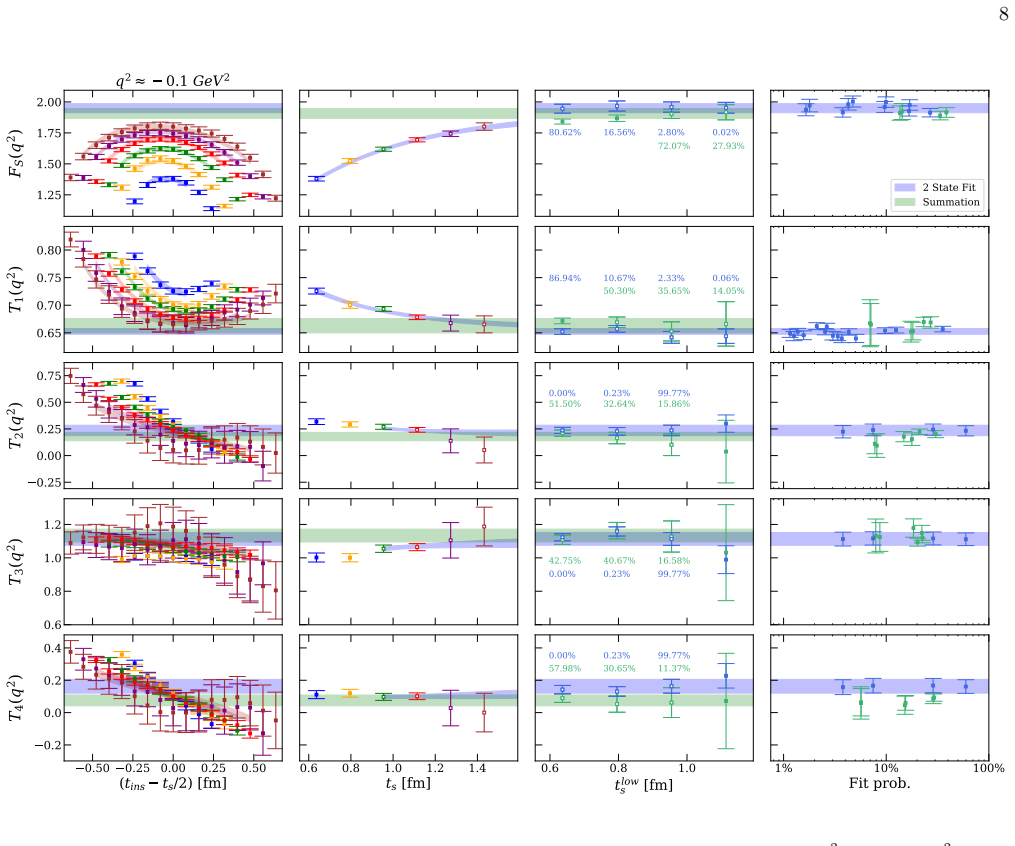
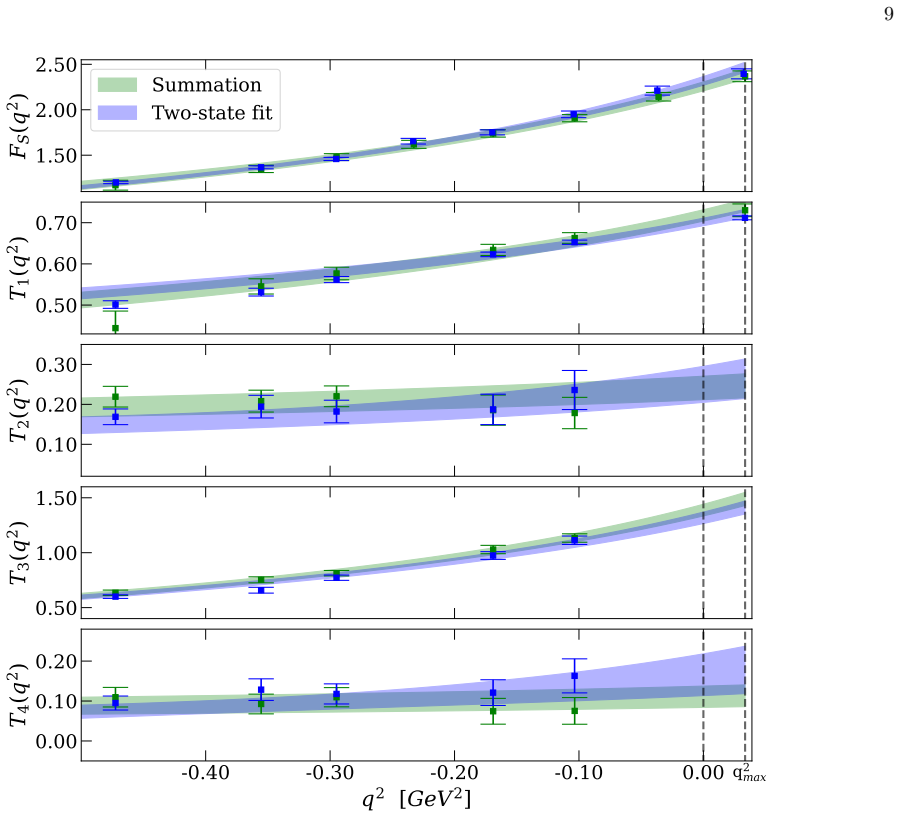


read the original abstract
We present a determination of the scalar and tensor $\Lambda\to p$ transition form factors using lattice QCD. These form factors are relevant for semileptonic hyperon decays in the presence of extensions of the Standard Model that include scalar and tensor interactions. The calculation is carried out using a gauge ensemble of twisted mass fermions at the physical pion mass, following the same strategy as our recent study on vector and axial form factors for the same transition. We provide the complete set of form factors as functions of $q^2$ employing a model-independent parametrization. We examine their impact on searches for non-standard charged-current interactions via the muon-to-electron decay-rate ratio $R^{\mu e}=\Gamma(\Lambda\to p\mu\bar\nu_\mu)/\Gamma(\Lambda\to pe\bar\nu_e)$, where scalar and tensor contributions enter linearly and are helicity-enhanced relative to the electron channel. We compare this first-principles prediction for the decay-rate ratio with recent experimental measurements, thereby enabling improved constraints on non-standard charged-current interactions.
Editorial analysis
A structured set of objections, weighed in public.
Referee Report
Summary. The manuscript reports a lattice QCD determination of the scalar and tensor form factors for the Λ→p transition on a single twisted-mass ensemble at the physical pion mass. The form factors are parametrized via the model-independent z-expansion over the small kinematic range of the decay. These are then used to compute the ratio R^{μe} = Γ(Λ→pμν̄μ)/Γ(Λ→peν̄e), where scalar and tensor contributions enter linearly and are helicity-enhanced, and the result is compared to experimental data to constrain non-standard charged-current interactions.
Significance. If the systematics are shown to be under control, this provides the first lattice-QCD input for these form factors and a first-principles prediction of R^{μe} that can tighten BSM bounds. The use of a model-independent parametrization and the direct comparison to independent experimental measurements are strengths that would make the result useful for the community.
major comments (1)
- [Lattice setup and results sections] Lattice setup and simulation parameters: the calculation uses only a single gauge ensemble at the physical pion mass. No additional ensembles at different lattice spacings or volumes are employed to quantify discretization effects, finite-volume corrections, or residual excited-state contamination in the scalar and tensor matrix elements. Because the central claim is that the extracted form factors (and the derived R^{μe}) can be inserted directly into BSM analyses without large additional shifts, the absence of explicit bounds on these O(a²) and O(e^{-m_π L}) contributions is load-bearing and must be addressed, either by multi-ensemble analysis or by rigorous justification that the effects are negligible at the quoted precision.
minor comments (1)
- [Abstract] The abstract and introduction would benefit from a concise statement of the quantitative error budget (statistical plus systematic) assigned to the form factors and to R^{μe}.
Simulated Author's Rebuttal
We thank the referee for their thorough review and positive assessment of the significance of our work. We address the major comment regarding the lattice setup below.
read point-by-point responses
-
Referee: Lattice setup and simulation parameters: the calculation uses only a single gauge ensemble at the physical pion mass. No additional ensembles at different lattice spacings or volumes are employed to quantify discretization effects, finite-volume corrections, or residual excited-state contamination in the scalar and tensor matrix elements. Because the central claim is that the extracted form factors (and the derived R^{μe}) can be inserted directly into BSM analyses without large additional shifts, the absence of explicit bounds on these O(a²) and O(e^{-m_π L}) contributions is load-bearing and must be addressed, either by multi-ensemble analysis or by rigorous justification that the effects are negligible at the quoted precision.
Authors: We agree that a multi-ensemble study would provide the most robust control over systematic uncertainties. However, this calculation is performed on a single physical-pion-mass ensemble using the same methodology as our prior work on the vector and axial form factors for the Λ→p transition, where discretization and finite-volume effects were estimated to be subdominant to the statistical uncertainties. For the scalar and tensor matrix elements, we employ the same three-point function analysis with sufficient source-sink separations to suppress excited-state contributions, as validated in the vector/axial study. In the revised manuscript, we will add an explicit discussion in the results section providing power-counting estimates for the expected size of O(a²) discretization effects and finite-volume corrections, showing that they are expected to be smaller than the current statistical precision of the form factors. We will also include a brief justification for the control of residual excited-state effects. While we cannot perform additional simulations at this time, these estimates will allow the form factors to be used in BSM analyses with the quoted uncertainties. revision: partial
Circularity Check
No circularity: first-principles lattice computation with independent prediction
full rationale
The derivation computes scalar and tensor form factors directly from lattice QCD matrix elements on an external gauge ensemble at physical pion mass, using a model-independent z-expansion to parametrize q² dependence. The R^{μe} ratio is then obtained by inserting these form factors into the decay-rate formula and compared to separate experimental data, rather than fitted to it. References to prior work on vector/axial form factors describe methodological consistency but do not reduce the scalar/tensor results or the BSM constraint to self-definition, fitted inputs renamed as predictions, or a self-citation chain. The chain remains externally falsifiable against lattice benchmarks and experiment.
Axiom & Free-Parameter Ledger
free parameters (1)
- z-expansion or similar parametrization coefficients
axioms (1)
- domain assumption Twisted-mass fermion ensemble at physical pion mass reproduces continuum QCD for the relevant matrix elements
Reference graph
Works this paper leans on
-
[1]
+O δ2 i .(A1) For the scalar–vector interference contribution, we begin from the decay rate defined as integral of its differential 13 form in Eq. (14), ΓLS = Z q2 max m2 ℓ G2 F |Vus|2√s+s− 64π3m3 Λ 1− m2 ℓ q2 2 mℓ s+ FS(q2) " (mΛ −m p)F1(q2) + q2 mΛ F3(q2) # dq2,(A2) wheres ± = (mΛ ±m p)2 −q 2.F 3(q2) is a second-class form factor, i.e. it is suppressed ...
-
[2]
S. Bacchio and A. Konstantinou, Phys. Rev. Lett.135, 231901 (2025), arXiv:2507.09970 [hep-lat]
-
[3]
N. Cabibbo, E. C. Swallow, and R. Winston, Ann. Rev. Nucl. Part. Sci.53, 39 (2003), arXiv:hep-ph/0307298
-
[4]
Kobayashi and T
M. Kobayashi and T. Maskawa, Prog. Theor. Phys.49, 652 (1973)
1973
-
[5]
Ademollo and R
M. Ademollo and R. Gatto, Phys. Rev. Lett.13, 264 (1964)
1964
-
[6]
V. Cirigliano, S. Gardner, and B. Holstein, Prog. Part. Nucl. Phys.71, 93 (2013), arXiv:1303.6953 [hep-ph]
- [7]
-
[8]
Hadronic tau decays as New Physics probes in the LHC era
V. Cirigliano, A. Falkowski, M. Gonz´ alez-Alonso, and A. Rodr´ ıguez-S´ anchez, Phys. Rev. Lett.122, 221801 (2019), arXiv:1809.01161 [hep-ph]. 14
work page Pith review arXiv 2019
-
[9]
Semileptonic decays of light quarks beyond the Standard Model,
V. Cirigliano, J. Jenkins, and M. Gonzalez-Alonso, Nucl. Phys. B830, 95 (2010), arXiv:0908.1754 [hep-ph]
-
[10]
M. Gonz´ alez-Alonso and J. Martin Camalich, JHEP12, 052 (2016), arXiv:1605.07114 [hep-ph]
-
[11]
D. Beˇ cirevi´ c, M. Martines, S. Rosauro-Alcaraz, and O. Sumensari, (2026), arXiv:2603.25837 [hep-ph]
-
[12]
T. Bhattacharya, V. Cirigliano, S. D. Cohen, A. Fil- ipuzzi, M. Gonzalez-Alonso, M. L. Graesser, R. Gupta, and H.-W. Lin, Phys. Rev. D85, 054512 (2012), arXiv:1110.6448 [hep-ph]
-
[13]
M. Gonz´ alez-Alonso, O. Naviliat-Cuncic, and N. Sev- erijns, Prog. Part. Nucl. Phys.104, 165 (2019), arXiv:1803.08732 [hep-ph]
-
[14]
A. Walker-Loudet al., PoSCD2018, 020 (2020), arXiv:1912.08321 [hep-lat]
- [15]
-
[16]
D. Djukanovic, G. von Hippel, H. B. Meyer, K. Ot- tnad, and H. Wittig, Phys. Rev. D109, 074507 (2024), arXiv:2402.03024 [hep-lat]
-
[17]
C. Alexandrou, S. Bacchio, J. Finkenrath, C. Iona, G. Koutsou, Y. Li, and G. Spanoudes, Phys. Rev. D 111, 054505 (2025), arXiv:2412.01535 [hep-lat]
-
[18]
Aoki et al., FLAG review 2024, Phys
Y. Aokiet al.(Flavour Lattice Averaging Group (FLAG)), Phys. Rev. D113, 014508 (2026), arXiv:2411.04268 [hep-lat]
- [19]
-
[20]
D. Djukanovic, G. von Hippel, J. Koponen, H. B. Meyer, K. Ottnad, T. Schulz, and H. Wittig, Phys. Rev. D106, 074503 (2022), arXiv:2207.03440 [hep-lat]
-
[21]
C. Alexandrou, S. Bacchio, M. Constantinou, J. Finken- rath, R. Frezzotti, B. Kostrzewa, G. Koutsou, G. Spanoudes, and C. Urbach (Extended Twisted Mass), Phys. Rev. D109, 034503 (2024), arXiv:2309.05774 [hep- lat]
-
[22]
D. Djukanovic, G. von Hippel, H. B. Meyer, K. Ottnad, M. Salg, and H. Wittig, Phys. Rev. D109, 094510 (2024), arXiv:2309.06590 [hep-lat]
- [23]
-
[24]
C. Alexandrou, S. Bacchio, G. Koutsou, B. Prasad, and G. Spanoudes, (2025), arXiv:2507.20910 [hep-lat]
-
[25]
Λb→pℓ−¯νℓand Λb→Λcℓ−¯νℓform factors from lattice QCD with rela- tivistic heavy quarks,
W. Detmold, C. Lehner, and S. Meinel, Phys. Rev. D 92, 034503 (2015), arXiv:1503.01421 [hep-lat]
-
[26]
Λc →Λℓ+νℓform factors and decay rates from lattice QCD with physical quark masses,
S. Meinel, Phys. Rev. Lett.118, 082001 (2017), arXiv:1611.09696 [hep-lat]
-
[27]
S. Meinel, Phys. Rev. D97, 034511 (2018), arXiv:1712.05783 [hep-lat]
-
[28]
S. Meinel and G. Rendon, Phys. Rev. D105, 054511 (2022), arXiv:2107.13140 [hep-lat]
-
[29]
S. Meinel and G. Rendon, Phys. Rev. D103, 094516 (2021), arXiv:2103.08775 [hep-lat]
-
[30]
C. Farrell and S. Meinel, Phys. Rev. D111, 114521 (2025), arXiv:2504.07302 [hep-lat]
- [31]
-
[32]
S. Sasaki, Phys. Rev. D96, 074509 (2017), arXiv:1708.04008 [hep-lat]
-
[33]
S. Sasaki and T. Yamazaki, Phys. Rev. D79, 074508 (2009), arXiv:0811.1406 [hep-ph]
- [34]
-
[35]
R. Frezzotti, P. A. Grassi, S. Sint, and P. Weisz (Alpha), JHEP08, 058 (2001), arXiv:hep-lat/0101001
-
[36]
R. Frezzotti and G. C. Rossi, JHEP08, 007 (2004), arXiv:hep-lat/0306014
-
[37]
Sheikholeslami and R
B. Sheikholeslami and R. Wohlert, Nucl. Phys. B259, 572 (1985)
1985
-
[38]
C. Alexandrouet al., Phys. Rev. D98, 054518 (2018), arXiv:1807.00495 [hep-lat]
-
[39]
Finkenrathet al., PoSLATTICE2021, 284 (2022), arXiv:2201.02551 [hep-lat]
J. Finkenrathet al., PoSLATTICE2021, 284 (2022), arXiv:2201.02551 [hep-lat]
-
[40]
Alexandrouet al.(Extended Twisted Mass), Phys
C. Alexandrouet al.(Extended Twisted Mass), Phys. Rev. D107, 074506 (2023), arXiv:2206.15084 [hep-lat]
-
[41]
Alexandrouet al.(Extended Twisted Mass), Phys
C. Alexandrouet al.(Extended Twisted Mass), Phys. Rev. D111, 054502 (2025), arXiv:2411.08852 [hep-lat]
-
[42]
Alexandrouet al.(Extended Twisted Mass), Phys
C. Alexandrouet al.(Extended Twisted Mass), Phys. Rev. D104, 074515 (2021), arXiv:2104.13408 [hep-lat]
-
[43]
C. Alexandrou, S. Bacchio, G. Christou, and J. Finken- rath, Phys. Rev. D108, 094510 (2023), arXiv:2309.04401 [hep-lat]
-
[44]
G. Martinelli, C. Pittori, C. T. Sachrajda, M. Testa, and A. Vladikas, Nucl. Phys. B445, 81 (1995), arXiv:hep- lat/9411010
-
[45]
Gusken, U
S. Gusken, U. Low, K. H. Mutter, R. Sommer, A. Patel, and K. Schilling, Phys. Lett. B227, 266 (1989)
1989
-
[46]
C. Alexandrou, S. Gusken, F. Jegerlehner, K. Schilling, and R. Sommer, Nucl. Phys. B414, 815 (1994), arXiv:hep-lat/9211042
-
[47]
Albaneseet al.(APE), Phys
M. Albaneseet al.(APE), Phys. Lett. B192, 163 (1987)
1987
-
[48]
C. Alexandrou, M. Constantinou, S. Dinter, V. Drach, K. Jansen, C. Kallidonis, and G. Koutsou, Phys. Rev. D88, 014509 (2013), arXiv:1303.5979 [hep-lat]
-
[49]
C. Alexandrou, M. Brinet, J. Carbonell, M. Constanti- nou, P. A. Harraud, P. Guichon, K. Jansen, T. Ko- rzec, and M. Papinutto, Phys. Rev. D83, 094502 (2011), arXiv:1102.2208 [hep-lat]
-
[50]
C. Alexandrou, G. Koutsou, J. W. Negele, and A. Tsapalis, Phys. Rev. D74, 034508 (2006), arXiv:hep- lat/0605017
-
[51]
Maiani, G
L. Maiani, G. Martinelli, M. L. Paciello, and B. Taglienti, Nucl. Phys. B293, 420 (1987)
1987
-
[52]
S. Capitani, M. Della Morte, G. von Hippel, B. Jager, A. Juttner, B. Knippschild, H. B. Meyer, and H. Wittig, Phys. Rev. D86, 074502 (2012), arXiv:1205.0180 [hep- lat]
- [53]
- [54]
- [55]
-
[56]
M. Gonz´ alez-Alonso and J. Martin Camalich, Phys. Rev. Lett.112, 042501 (2014), arXiv:1309.4434 [hep-ph]
- [57]
-
[58]
S.-Q. Zhang, X.-H. Zhang, and C.-F. Qiao, JHEP06, 122 (2024), arXiv:2402.15088 [hep-ph]
-
[59]
Navaset al.(Particle Data Group), Phys
S. Navaset al.(Particle Data Group), Phys. Rev. D110, 030001 (2024). 15
2024
-
[60]
Garcia and P
A. Garcia and P. Kielanowski,THE BETA DECAY OF HYPERONS, edited by A. Bohm, Vol. 222 (1985)
1985
-
[61]
Ablikimet al.(BESIII), (2025), arXiv:2509.09266 [hep-ex]
M. Ablikimet al.(BESIII), (2025), arXiv:2509.09266 [hep-ex]
-
[62]
Branching fraction measurement of the $\mathit{\Lambda} \to p \mu^- \overline{\nu}_{\mu}$ decay
R. Aaijet al.(LHCb), (2025), arXiv:2511.15681 [hep-ex]
work page internal anchor Pith review Pith/arXiv arXiv 2025
- [63]
-
[64]
V. Cirigliano, M. Gonzalez-Alonso, and M. L. Graesser, JHEP02, 046 (2013), arXiv:1210.4553 [hep-ph]
-
[65]
K. Jansen and C. Urbach, Comput. Phys. Commun.180, 2717 (2009), arXiv:0905.3331 [hep-lat]
-
[66]
A. Abdel-Rehim, F. Burger, A. Deuzeman, K. Jansen, B. Kostrzewa, L. Scorzato, and C. Urbach, PoSLAT- TICE2013, 414 (2014), arXiv:1311.5495 [hep-lat]
-
[67]
A. Deuzeman, K. Jansen, B. Kostrzewa, and C. Urbach, PoSLATTICE2013, 416 (2014), arXiv:1311.4521 [hep- lat]
-
[68]
B. Kostrzewa, S. Bacchio, J. Finkenrath, M. Garofalo, F. Pittler, S. Romiti, and C. Urbach (ETM), PoSLAT- TICE2022, 340 (2023), arXiv:2212.06635 [hep-lat]
-
[69]
A. Frommer, K. Kahl, S. Krieg, B. Leder, and M. Rottmann, SIAM J. Sci. Comput.36, A1581 (2014), arXiv:1303.1377 [hep-lat]
-
[70]
C. Alexandrou, S. Bacchio, J. Finkenrath, A. Frommer, K. Kahl, and M. Rottmann, Phys. Rev. D94, 114509 (2016), arXiv:1610.02370 [hep-lat]
-
[71]
S. Bacchio, C. Alexandrou, and J. Finkerath, EPJ Web Conf.175, 02002 (2018), arXiv:1710.06198 [hep-lat]
-
[72]
C. Alexandrou, S. Bacchio, and J. Finkenrath, Comput. Phys. Commun.236, 51 (2019), arXiv:1805.09584 [hep- lat]
- [73]
-
[74]
Scaling lattice QCD beyond 100 GPUs,
R. Babich, M. A. Clark, B. Joo, G. Shi, R. C. Brower, and S. Gottlieb (QUDA), inInternational Conference for High Performance Computing, Networking, Storage and Analysis(2011) arXiv:1109.2935 [hep-lat]
- [75]
discussion (0)
Sign in with ORCID, Apple, or X to comment. Anyone can read and Pith papers without signing in.