Mircomechanical insights into unconstrained grain boundary sliding
Pith reviewed 2026-05-10 08:36 UTC · model grok-4.3
The pith
High strain-rate sensitivity of grain boundary sliding in polycrystals arises from accommodation processes, not the sliding mechanism itself.
A machine-rendered reading of the paper's core claim, the machinery that carries it, and where it could break.
Core claim
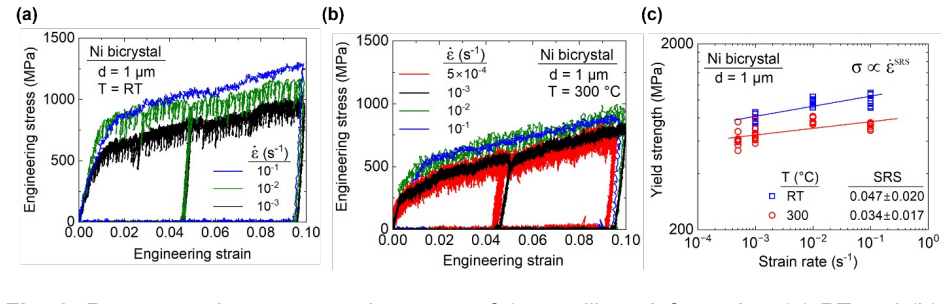
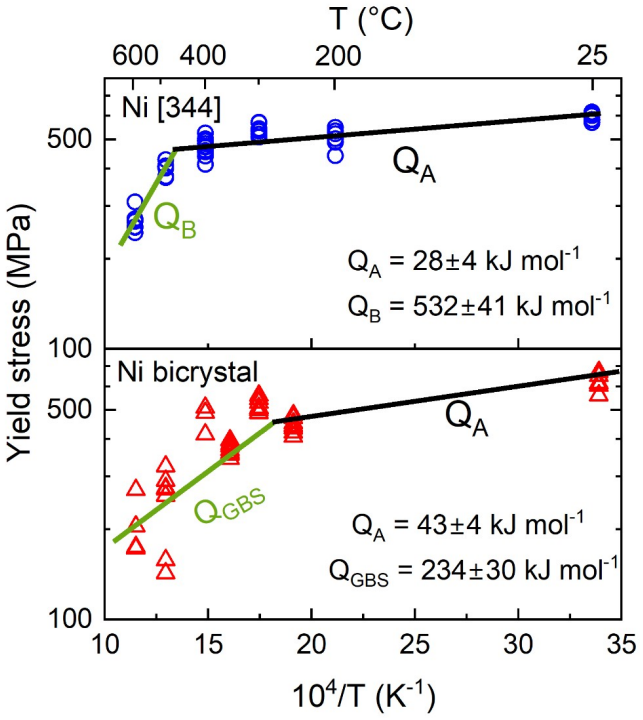
Dislocation-mediated unconstrained grain boundary sliding isolated by bicrystal-minus-single-crystal subtraction exhibits a strain-rate sensitivity of 0.034 ± 0.017 across the tested temperature and rate range, together with an activation energy of 234 kJ mol^{-1} that corresponds to grain-boundary diffusion-assisted glide of grain-boundary dislocations. The low sensitivity demonstrates that the high strain-rate sensitivity conventionally linked to grain boundary sliding in polycrystals is supplied by accommodation processes rather than by the sliding mechanism.
What carries the argument
Bicrystal micropillar minus single-crystal micropillar subtraction that isolates the intrinsic grain-boundary sliding contribution from total pillar strain.
Load-bearing premise
Subtracting the single-crystal micropillar response from the bicrystal response cleanly isolates the intrinsic grain-boundary sliding contribution without residual effects from pillar geometry, surface constraints, or other deformation modes.
What would settle it
An independent measurement of sliding displacement rate in the same bicrystals that yields strain-rate sensitivity above 0.1 at 600 °C would falsify the claim that intrinsic sliding is rate-insensitive.
Figures



read the original abstract
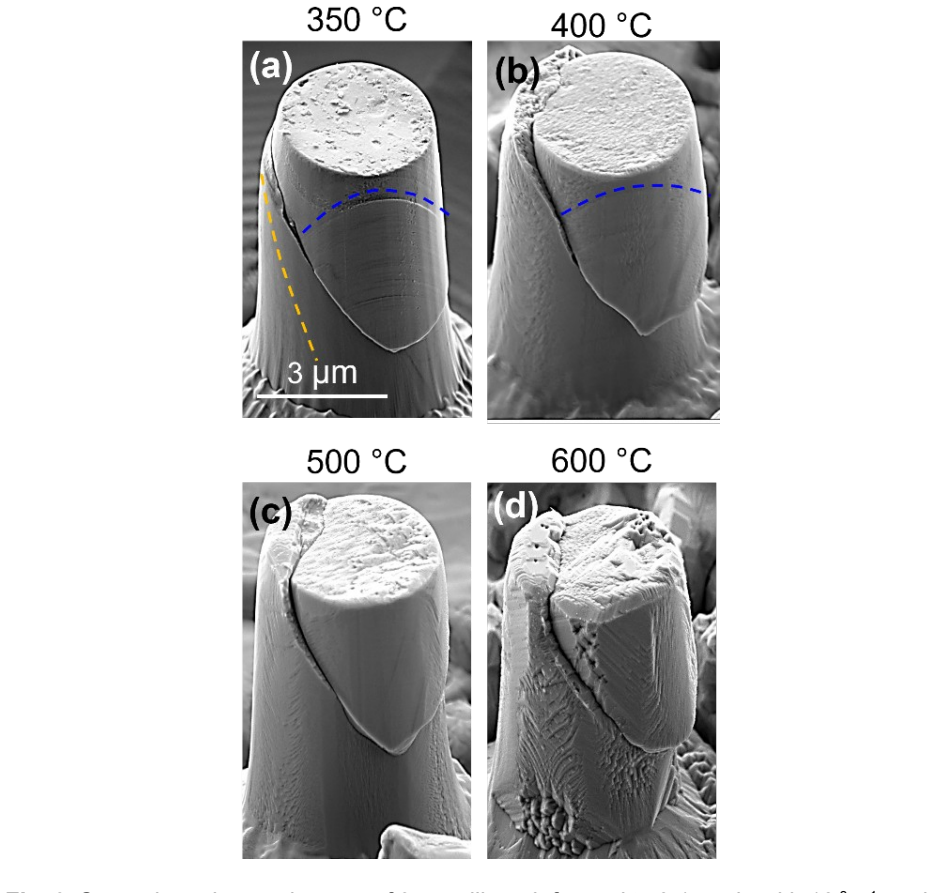
Grain boundary sliding (GBS) is a key deformation mechanism at high homologous temperatures in polycrystalline materials, however, its intrinsic behavior is often obscured by additional strain accommodation processes. In this study, dislocation-mediated unconstrained GBS was investigated using Ni bicrystal micropillars containing a single high-angle grain boundary. Micropillar compression tests were conducted over a temperature range from room temperature to $600\,^{\circ}\mathrm{C}$ and strain rates between $5\times10^{-4}$ and $10^{-1}\,\mathrm{s}^{-1}$. By comparing bicrystal and single-crystal responses, the intrinsic contribution of GBS was isolated. The strain-rate sensitivity remained low (SRS $\approx 0.034 \pm 0.017$), comparable to room temperature values, indicating the absence of diffusion-controlled accommodation mechanisms. The activation energy for GBS was determined to be $234\,\mathrm{kJ\,mol^{-1}}$, consistent with grain boundary diffusion-assisted glide of grain boundary dislocations. These results demonstrate that the high strain-rate sensitivity commonly associated with GBS in polycrystals originates primarily from accommodation processes rather than the intrinsic sliding mechanism.
Editorial analysis
A structured set of objections, weighed in public.
Referee Report
Summary. The paper investigates intrinsic grain boundary sliding (GBS) in Ni bicrystal micropillars with a single high-angle grain boundary by performing compression tests from room temperature to 600°C at strain rates 5×10^{-4} to 10^{-1} s^{-1}. Subtracting the single-crystal micropillar response from the bicrystal response is used to isolate the GBS contribution, yielding a low strain-rate sensitivity (SRS ≈ 0.034 ± 0.017) comparable to room-temperature values and an activation energy of 234 kJ mol^{-1} consistent with grain-boundary diffusion-assisted glide of GB dislocations. The authors conclude that the high SRS typically seen for GBS in polycrystals arises from accommodation processes rather than the intrinsic sliding mechanism.
Significance. If the subtraction cleanly isolates unconstrained GBS, the result would be significant for high-temperature deformation modeling by showing that intrinsic GBS has low rate sensitivity independent of diffusion-controlled accommodation. The micropillar geometry enables direct comparison at small scales over a useful temperature-rate window, and the reported activation energy aligns with expected GB diffusion values. The work is purely experimental with no ad-hoc parameters or circular derivations, which strengthens its potential impact once methodological details are supplied.
major comments (2)
- [Abstract] Abstract and implied Methods: The central claim that 'by comparing bicrystal and single-crystal responses, the intrinsic contribution of GBS was isolated' is load-bearing for the reported SRS and activation energy. However, the grain boundary can alter dislocation nucleation, transmission, or pile-up in the adjacent grains relative to an isolated single-crystal pillar, so the subtracted difference may retain accommodation or geometry-dependent terms rather than representing pure sliding. Post-deformation EBSD or TEM analysis of dislocation structures near the boundary, or finite-element validation of pillar geometry effects, is required to support the isolation.
- [Abstract] Abstract/Results: No information is given on data reduction, error propagation, number of replicates, curve alignment for subtraction, or how elastic versus plastic contributions were handled before extracting SRS ≈ 0.034 ± 0.017 and the activation energy. These details are essential because the low SRS value and the conclusion about accommodation processes depend directly on the reliability of the difference curves.
minor comments (3)
- [Title] Title: 'Mircomechanical' is a typographical error and should read 'Micromechanical'.
- [Abstract] Abstract: The strain-rate range is stated as 'between 5×10^{-4} and 10^{-1} s^{-1}' without specifying the exact discrete rates tested or whether logarithmic spacing was used; this affects reproducibility of the SRS calculation.
- [Results] General: Inclusion of representative raw stress-strain curves (bicrystal, single-crystal, and subtracted) as a main figure or supplementary material would greatly improve transparency of the subtraction procedure.
Circularity Check
No circularity: purely experimental isolation of GBS contribution
full rationale
The manuscript reports micropillar compression experiments on Ni bicrystals and single crystals across temperature and strain-rate ranges. The intrinsic GBS response is obtained by direct subtraction of the single-crystal stress-strain curve from the bicrystal curve; the resulting strain-rate sensitivity (≈0.034) and activation energy (234 kJ mol⁻¹) are then read off from the experimental difference data via standard Arrhenius plotting. No equations, models, or fitted parameters are introduced that would make any reported quantity equivalent to its own inputs by construction. No self-citations, uniqueness theorems, or ansatzes appear as load-bearing steps in the derivation chain. The work therefore remains self-contained against external benchmarks and receives the default non-circularity score.
Axiom & Free-Parameter Ledger
Reference graph
Works this paper leans on
-
[1]
Langdon, Grain boundary sliding revisited: Developments in sliding over four decades, J
T.G. Langdon, Grain boundary sliding revisited: Developments in sliding over four decades, J. Mater. Sci. 41 (2006) 597–609. https://doi.org/10.1007/s10853-006-6476-0
-
[2]
J.-J. He, R. Sandström, S.-R. Lü, P. Korzhavyi, J. Zhang, H.-Y. Qin, J.-B. Liu, Predicting grain boundary sliding in metallic materials, Acta Mater. 286 (2025) 120718. https://doi.org/10.1016/j.actamat.2025.120718
-
[3]
M.J.N.V. Prasad, A.H. Chokshi, Superplasticity in electrodeposited nanocrystalline nickel, Acta Mater. 58 (2010) 5724–5736. https://doi.org/10.1016/j.actamat.2010.06.047
-
[4]
P.S. Roodposhti, A. Sarkar, K.L. Murty, H. Brody, R. Scattergood, Grain boundary sliding mechanism during high temperature deformation of AZ31 Magnesium alloy, Mater. Sci. Eng. A 669 (2016) 171–177. https://doi.org/10.1016/j.msea.2016.05.076
-
[5]
T.G. Langdon, A unified approach to grain boundary sliding in creep and superplasticity, Acta Metall. Mater. 42 (1994) 2437–2443. https://doi.org/10.1016/0956- 7151(94)90322-0
-
[6]
J. Gong, A.J. Wilkinson, Sample size effects on grain boundary sliding, Scr. Mater. 114 (2016) 17–20. https://doi.org/10.1016/j.scriptamat.2015.11.029
- [7]
-
[8]
https://doi.org/10.1002/smll.201301060
-
[9]
D.S. Bandla, S. Lee, C. Kirchlechner, On the critical temperature required for grain boundary sliding in Nickel bicrystal: A micromechanical approach, Mater. Sci. Eng. A (2026) 150130. https://doi.org/10.1016/j.msea.2026.150130
-
[10]
Q. Wei, S. Cheng, K.T. Ramesh, E. Ma, Effect of nanocrystalline and ultrafine grain sizes on the strain rate sensitivity and activation volume: fcc versus bcc metals, Mater. Sci. Eng. A 381 (2004) 71–79. https://doi.org/10.1016/j.msea.2004.03.064
-
[11]
Q. Wei, Strain rate effects in the ultrafine grain and nanocrystalline regimes— influence on some constitutive responses, J. Mater. Sci. 42 (2007) 1709–1727. https://doi.org/10.1007/s10853-006-0700-9
-
[12]
J.Y. Zhang, G. Liu, J. Sun, Strain rate effects on the mechanical response in multi- and single-crystalline Cu micropillars: Grain boundary effects, Int. J. Plast. 50 (2013) 1–17. https://doi.org/10.1016/j.ijplas.2013.03.009. 13
-
[13]
N.V. Malyar, G. Dehm, C. Kirchlechner, Strain rate dependence of the slip transfer through a penetrable high angle grain boundary in copper, Scr. Mater. 138 (2017) 88–91. https://doi.org/10.1016/j.scriptamat.2017.05.042
-
[14]
C. Peng, Y. Zhong, Y. Lu, S. Narayanan, T. Zhu, J. Lou, Strain rate dependent mechanical properties in single crystal nickel nanowires, Appl. Phys. Lett. 102 (2013) 083102. https://doi.org/10.1063/1.4793481
-
[15]
Y. Xiao, B. Gan, A.S. Sologubenko, R. Spolenak, J.M. Wheeler, Size- and strain rate-dependence of nickel and Ni–Co micropillars with varying stacking fault energy, Mater. Sci. Eng. A 800 (2021) 140266. https://doi.org/10.1016/j.msea.2020.140266
-
[16]
P. Feldner, B. Merle, M. Göken, Breakdown of the superplastic deformation behavior of heterogeneous nanomaterials at small length scales, Mater. Res. Lett. 9 (2021) 41–49. https://doi.org/10.1080/21663831.2020.1818323
-
[17]
C. Zener, J.H. Hollomon, Effect of Strain Rate Upon Plastic Flow of Steel, J. Appl. Phys. 15 (1944) 22–32. https://doi.org/10.1063/1.1707363
- [18]
-
[19]
S.V. Divinski, G. Reglitz, G. Wilde, Grain boundary self-diffusion in polycrystalline nickel of different purity levels, Acta Mater. 58 (2010) 386–395. https://doi.org/10.1016/j.actamat.2009.09.015
-
[20]
K. Maier, H. Mehrer, E. Lessmann, W. Schüle, Self‐diffusion in nickel at low temperatures, Phys. Status Solidi B 78 (1976) 689–698. https://doi.org/10.1002/pssb.2220780230. 1 Mircomechanical insights into unconstrained grain boundary sliding Divya Sri Bandla1, Subin Lee1,*, Christoph Kirchlechner1 1 Institute for Applied Materials, Karlsruhe Institute of ...
discussion (0)
Sign in with ORCID, Apple, or X to comment. Anyone can read and Pith papers without signing in.