Recognition: unknown
Unraveling the Hyperon Puzzle in Neutron Stars via Novel, High-Precision Hyperon Factories
Pith reviewed 2026-05-10 07:05 UTC · model grok-4.3
The pith
Hyperons produced in proton-proton collisions can be precisely tagged to create high-statistics sources for studying their interactions with nucleons.
A machine-rendered reading of the paper's core claim, the machinery that carries it, and where it could break.
Core claim
Hyperons such as the Lambda produced in pp collisions at a fixed target can be tagged by detecting the accompanying proton and K+, fixing their kinematics precisely; an additional surrounding target then allows high-statistics measurements of Lambda-nucleon and Lambda-nucleus interactions. The same principle extends to other hyperons, supplying the missing data needed to address the hyperon puzzle in neutron stars.
What carries the argument
Tagging the proton and K+ in pp to p K+ hyperon reactions to determine the hyperon's momentum and flux, combined with a nested secondary target for interaction measurements.
If this is right
- Provides the first high-statistics data sets on Lambda-nucleon scattering and hyperon production in nuclei.
- Supplies constraints on the hyperon-nucleon potentials that enter neutron-star equation-of-state calculations.
- Extends naturally to Sigma, Xi, and Omega hyperons, broadening the range of strange-matter interactions that can be measured.
- Can be implemented by adding a second target to existing detectors such as HADES or CBM without major redesign.
Where Pith is reading between the lines
- Refined hyperon-nucleon data would narrow the range of allowed neutron-star mass-radius curves that include strangeness.
- The same tagging technique might be adapted to study hyperon-hyperon interactions if a suitable secondary hyperon target is used.
- Successful implementation would test whether current theoretical models of dense matter correctly predict the onset density of hyperons.
Load-bearing premise
Tagging the proton and K+ in pp collisions determines the hyperon flux and momentum with enough precision that backgrounds and efficiencies permit high-statistics interaction studies on a second target.
What would settle it
An experiment that measures the actual momentum resolution or interaction yield of the tagged hyperons and finds them substantially worse than the expected values due to tagging inefficiencies or backgrounds would show the method does not deliver the claimed precision.
Figures

read the original abstract
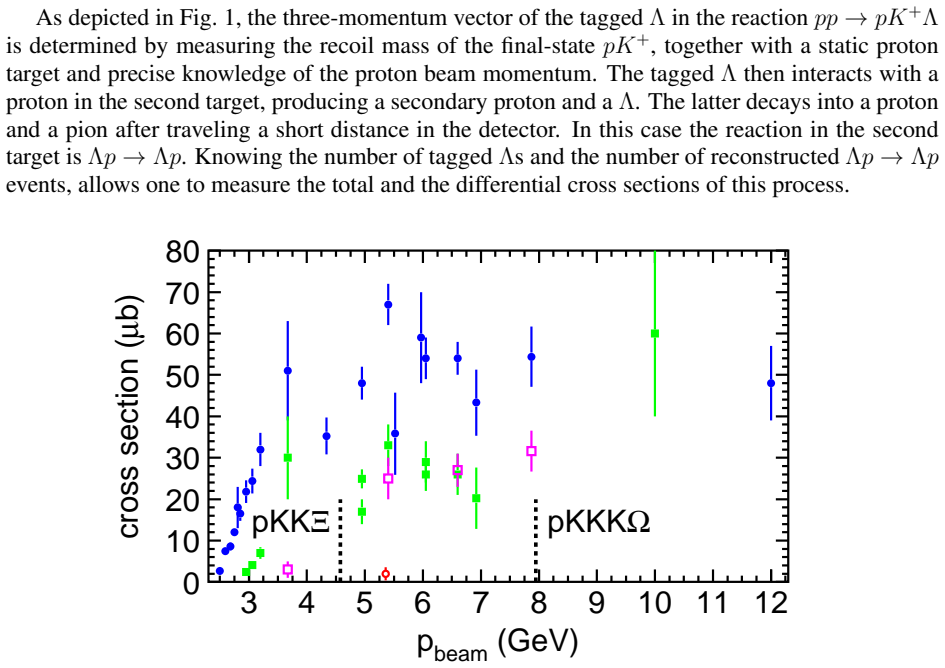
The strong forces between nucleons ($N$=$p$, $n$) are fundamental to the visible universe. The interactions between hyperons (baryons with strange quarks) and nucleons are essential for the intrinsic properties of neutron stars. Whereas the interactions between nucleons ($pp$, $pn$, $nn$) have been extensively studied, the interactions between nucleons and hyperons ($N\Lambda$, $N\Sigma$, $N\Xi$, $N\Omega$, ...) are not well understood, due to the small amount of relevant data, limited by the scarcity of suitable hyperon sources. Here we point out and investigate a new high-quality source: hyperons produced in $pp$ collisions, such as $pp\to pK^+\Lambda$, $pK\Sigma$, $pK\pi\Sigma$, $pKK\Xi$, $pKKK\Omega$. At a fixed target experiment using proton beam with known momentum and liquid hydrogen target, $pp\to pK^+\Lambda$ can be produced copiously. By tagging $p$ and $K^+$, the flux and momentum of the $\Lambda$ can be determined precisely. By placing an additional target around the primary one, these $\Lambda$-s serve as an ideal source, enabling an unprecedentedly precise study of $\Lambda$ interactions with a wide range of targets. Similar methods can be used to obtain high-quality sources of other hyperons, such as $\Sigma$, $\Xi$ and $\Omega$. These novel, high-statistics sources of hyperons with precisely known kinematics present new opportunities for applications in particle and nuclear physics, particularly in understanding the hyperon puzzle of neutron stars. We propose a new high-luminosity experiment with two nested concentric targets, optimized for such measurements. This concept can also be incorporated into existing experiments, such as HADES and CBM at FAIR, as well as proposed experiments, such as H-NS and HHaS at HIAF, by adding a second target without significant modification of the current detectors.
Editorial analysis
A structured set of objections, weighed in public.
Referee Report
Summary. The manuscript proposes a new experimental concept for producing high-quality hyperon beams using fixed-target pp collisions (e.g., pp → pK⁺Λ and analogous channels for Σ, Ξ, Ω). By tagging the outgoing proton and K⁺ (or equivalent particles), the hyperon four-momentum is reconstructed via missing-mass techniques and four-momentum conservation. A secondary concentric target is then used to enable high-statistics studies of hyperon-nucleon interactions. The authors argue this setup, implementable at facilities such as FAIR (HADES, CBM) or HIAF, can provide the precision and luminosity needed to address the hyperon puzzle in neutron-star equations of state.
Significance. If the tagging method delivers the claimed kinematic precision and background rejection at high rates, the approach could supply a new, accessible source of hyperons with well-determined momenta, enabling improved measurements of N-hyperon scattering and potentials that are currently limited by low statistics. This would directly impact neutron-star modeling by constraining the softening of the equation of state due to hyperon degrees of freedom. The proposal leverages established production kinematics but requires quantitative validation to realize its potential.
major comments (3)
- [Abstract and experimental concept] The central claim that tagging p and K⁺ determines the Λ flux and momentum 'precisely' (Abstract and proposal description) rests on missing-mass reconstruction but supplies no Monte-Carlo estimates of finite detector resolution, multiple scattering, acceptance losses, or background contamination from channels such as pp → pK⁺Σ⁰(→Λγ), pp → pK⁺π⁺π⁻, or higher-multiplicity strangeness production. These numbers are load-bearing for the assertion of 'unprecedentedly high statistics' on the secondary target.
- [Proposal for two nested concentric targets] No yield calculations, luminosity estimates, target-thickness optimizations, or interaction-rate projections are provided for the nested-target configuration (proposal section). Without these, it is impossible to evaluate whether the setup can actually deliver the high-statistics data required to impact the hyperon puzzle.
- [Introduction and conclusions] The manuscript asserts that the new sources 'present new opportunities ... particularly in understanding the hyperon puzzle of neutron stars' but contains no concrete examples of how the anticipated data would resolve specific ambiguities in existing hyperon-nucleon potentials or neutron-star mass-radius constraints.
minor comments (2)
- [Introduction] The notation for hyperon-nucleon channels (NΛ, NΣ, ...) is introduced without a short reminder of the current experimental status of these cross sections.
- [References] A few additional references to existing hyperon-production data at COSY, HADES, or J-PARC would help place the proposed luminosity gains in context.
Simulated Author's Rebuttal
We thank the referee for the constructive and detailed comments on our manuscript. We address each major comment point by point below, providing clarifications based on the conceptual nature of the proposal while committing to revisions that strengthen the presentation without misrepresenting the work.
read point-by-point responses
-
Referee: [Abstract and experimental concept] The central claim that tagging p and K⁺ determines the Λ flux and momentum 'precisely' (Abstract and proposal description) rests on missing-mass reconstruction but supplies no Monte-Carlo estimates of finite detector resolution, multiple scattering, acceptance losses, or background contamination from channels such as pp → pK⁺Σ⁰(→Λγ), pp → pK⁺π⁺π⁻, or higher-multiplicity strangeness production. These numbers are load-bearing for the assertion of 'unprecedentedly high statistics' on the secondary target.
Authors: We agree that quantitative estimates of detector effects are important for fully substantiating the claims of precision and high statistics. The manuscript is a conceptual proposal that relies on the exact kinematics of fixed-target pp collisions with a known beam momentum, where missing-mass reconstruction determines the hyperon four-momentum via four-momentum conservation in the absence of resolution smearing. We acknowledge that the current text does not include Monte Carlo studies of resolution, multiple scattering, acceptance, or specific backgrounds. In the revised manuscript we will add a paragraph discussing typical momentum and angular resolutions achievable with existing or planned detectors at FAIR (e.g., HADES/CBM) and HIAF, along with qualitative arguments for background suppression via particle identification and vertex constraints. Full quantitative simulations remain outside the scope of this conceptual paper but will be pursued in follow-up work. revision: yes
-
Referee: [Proposal for two nested concentric targets] No yield calculations, luminosity estimates, target-thickness optimizations, or interaction-rate projections are provided for the nested-target configuration (proposal section). Without these, it is impossible to evaluate whether the setup can actually deliver the high-statistics data required to impact the hyperon puzzle.
Authors: We recognize that the lack of explicit numerical projections limits the ability to assess feasibility quantitatively. The proposal builds on established hyperon production cross sections in pp collisions and the high luminosities available in fixed-target mode at the cited facilities. In the revised manuscript we will include order-of-magnitude yield estimates using published cross sections for channels such as pp → pK⁺Λ, combined with representative beam intensities and luminosities at FAIR and HIAF. We will also discuss target-thickness considerations that balance secondary interaction probability against multiple scattering and rate limitations, thereby providing the projections needed to evaluate the potential for high-statistics hyperon-nucleon data. revision: yes
-
Referee: [Introduction and conclusions] The manuscript asserts that the new sources 'present new opportunities ... particularly in understanding the hyperon puzzle of neutron stars' but contains no concrete examples of how the anticipated data would resolve specific ambiguities in existing hyperon-nucleon potentials or neutron-star mass-radius constraints.
Authors: The manuscript centers on the experimental concept and its enabling role for hyperon-nucleon studies, citing the hyperon puzzle as the primary physics motivation. We agree that more explicit connections to open questions would improve the motivation section. In the revised introduction and conclusions we will add brief, referenced examples: for instance, how improved precision on the ΛN interaction parameters can help discriminate between models that predict different degrees of EoS softening, thereby affecting predicted neutron-star maximum masses and radii. These additions will draw on existing literature on the hyperon puzzle without claiming that the new data alone will resolve all ambiguities. revision: yes
Circularity Check
No circularity: pure experimental concept proposal with no derivations or fits
full rationale
The manuscript is a forward-looking experimental proposal for a nested-target setup to produce tagged hyperons from pp collisions. It invokes standard four-momentum conservation (p_Λ = p_beam − p_p − p_K) but performs no fits, no parameter tuning, no predictions that reduce to prior data, and no self-citation chains that justify the core claim. The hyperon-puzzle motivation is stated as an application area, not derived from the proposal itself. Absence of any load-bearing mathematical steps or self-referential definitions yields zero circularity.
Axiom & Free-Parameter Ledger
axioms (2)
- domain assumption Hyperons are produced copiously in pp collisions at accessible beam momenta with known cross sections
- domain assumption Tagging the outgoing proton and K+ determines the hyperon four-momentum with high precision
Reference graph
Works this paper leans on
-
[1]
This energy will be sufficient to produce all kinds of hyperons with open strangeness,|S|= 1,2,3
It will have proton beam momentum spanning a broad range–from 5 to 30 GeV–and a major increase in intensity of up to2.5×10 13 protons/cycle. This energy will be sufficient to produce all kinds of hyperons with open strangeness,|S|= 1,2,3. The HIAF in China [38] started operation at the end of 2025. It is designed to produce ion beams ranging from protons ...
2025
-
[2]
Haidenbauer, S
J. Haidenbauer, S. Petschauer, N. Kaiser, U. G. Meissner, A. Nogga and W. Weise, Nucl. Phys. A915, 24-58 (2013)
2013
-
[3]
Vida ˜na, Proc
I. Vida ˜na, Proc. Roy. Soc. Lond. A474, 0145 (2018)
2018
-
[4]
Tolos and L
L. Tolos and L. Fabbietti, Prog. Part. Nucl. Phys.112, 103770 (2020)
2020
-
[5]
Chatziioannou, H
K. Chatziioannou, H. T. Cromartie, S. Gandolfi, I. Tews, D. Radice, A. W. Steiner and A. L. Watts, Rev. Mod. Phys.97, no.4, 045007 (2025)
2025
-
[6]
G. F. Burgio, H. J. Schulze, I. Vidana and J. B. Wei, Prog. Part. Nucl. Phys.120, 103879 (2021)
2021
-
[7]
Antoniadis, P
J. Antoniadis, P. C. C. Freire, N. Wex, T. M. Tauris, R. S. Lynch, M. H. van Kerkwijk, M. Kramer, C. Bassa, V . S. Dhillon and T. Driebe,et al.Science340, 6131 (2013). 7
2013
-
[8]
H. T. Cromartieet al.[NANOGrav], Nature Astron.4, no.1, 72-76 (2019)
2019
-
[9]
Rutherford, Phil
E. Rutherford, Phil. Mag. Ser. 621, 669-688 (1911)
1911
-
[10]
Engelmann, H
R. Engelmann, H. Filthuth, V . Hepp, E. Kluge, Phys. Lett.21, 587-589 (1966)
1966
-
[11]
Sechi-Zorn, B
B. Sechi-Zorn, B. Kehoe, J. Twitty and R. A. Burnstein, Phys. Rev.175, 1735-1740 (1968)
1968
-
[12]
Alexander, U
G. Alexander, U. Karshon, A. Shapira, G. Yekutieli, R. Engelmann, H. Filthuth and W. Lughofer, Phys. Rev.173, 1452-1460 (1968)
1968
-
[13]
Eisele, H
F. Eisele, H. Filthuth, W. Foehlisch, V . Hepp and G. Zech, Phys. Lett. B37, 204-206 (1971)
1971
-
[14]
J. A. Kadyk, G. Alexander, J. H. Chan, P. Gaposchkin and G. H. Trilling, Nucl. Phys. B27, 13-22 (1971)
1971
-
[15]
J. M. Hauptman, J. A. Kadyk and G. H. Trilling, Nucl. Phys. B125, 29-51 (1977)
1977
-
[16]
J. K. Ahnet al.[KEK-PS E-251], Nucl. Phys. A648, 263-279 (1999)
1999
-
[17]
S. Aoki, S. Asai, S. Y . Bahk, S. H. Chung, H. Funahashi, C. H. Hahn, M. Hanabata, T. Hara, K. Hoshino and M. Ieiri,et al.Nucl. Phys. A644, 365-385 (1998)
1998
-
[18]
Kondoet al.[KEK-PS-E289], Nucl
Y . Kondoet al.[KEK-PS-E289], Nucl. Phys. A676, 371-387 (2000)
2000
-
[19]
J. K. Ahn, S. Aoki, K. S. Chung, M. S. Chung, H. En’yo, T. Fukuda, H. Funahashi, Y . Goto, A. Higashi and M. Ieiri,et al.Phys. Lett. B633, 214-218 (2006)
2006
-
[20]
Miwaet al.[J-PARC E40], Phys
K. Miwaet al.[J-PARC E40], Phys. Rev. Lett.128, no.7, 072501 (2022)
2022
-
[21]
C. Z. Yuan and M. Karliner, Phys. Rev. Lett.127, 012003 (2021)
2021
-
[22]
Achasov, X
M. Achasov, X. C. Ai, R. Aliberti, L. P. An, Q. An, X. Z. Bai, Y . Bai, O. Bakina, A. Barnyakov and V . Blinov,et al.Front. Phys. (Beijing)19, no.1, 14701 (2024)
2024
-
[23]
D. A. Epifanov [SCTF], Phys. Atom. Nucl.83, no.6, 944-948 (2020)
2020
-
[24]
Z. L. Zhang, X. Gao, W. M. Song and C. Z. Yuan, [arXiv:2603.16075 [hep-ex]]
work page internal anchor Pith review Pith/arXiv arXiv
-
[25]
Zhang, PoSCD2024, 059 (2026)
J. Zhang, PoSCD2024, 059 (2026)
2026
-
[26]
A. Gal, E. V . Hungerford and D. J. Millener, Rev. Mod. Phys.88, no.3, 035004 (2016)
2016
-
[27]
Botta, T
E. Botta, T. Bressani and G. Garbarino, Eur. Phys. J. A48, 41 (2012)
2012
-
[28]
Pochodzallaet al.[ PANDA Collaboration], JPS Conf
J. Pochodzallaet al.[ PANDA Collaboration], JPS Conf. Proc.17, 091002 (2017) [arXiv:1609.01916 [nucl-ex]]
-
[29]
Schopper, J
H. Schopper, J. Bystricky, P. Carlson, C. Lechanoine, F. Lehar, F. Monnig and K. R. Schubert, Landolt- Boernstein - Group I Elementary Particles, Nuclei and Atoms, 9a, Springer, 1980,
1980
-
[30]
Hofmannet al.[Bonn-Hamburg-Munich], Nucl
J. Hofmannet al.[Bonn-Hamburg-Munich], Nucl. Phys. B125, 404-422 (1977)
1977
-
[31]
Abdel-Baryet al.[COSY-TOF], Eur
M. Abdel-Baryet al.[COSY-TOF], Eur. Phys. J. A46, 27-44 (2010) [erratum: Eur. Phys. J. A46, 435-436 (2010)]
2010
-
[32]
Abdel-Samadet al.[COSY-TOF], Phys
S. Abdel-Samadet al.[COSY-TOF], Phys. Lett. B632, 27-34 (2006)
2006
-
[33]
Bilger, A
R. Bilger, A. B ¨ohm, H. Brand, S. Brand, K. T. Brinkmann, H. Clement, M. Dellert, H. Dennert, W. Eyrich and D. Filges,et al.Phys. Lett. B420, 217-224 (1998)
1998
-
[34]
Agakishievet al.[HADES], Phys
G. Agakishievet al.[HADES], Phys. Lett. B742, 242-248 (2015)
2015
-
[35]
Abdel-Baryet al.[TOF], Eur
M. Abdel-Baryet al.[TOF], Eur. Phys. J. A48, 23 (2012)
2012
-
[36]
Agakishiev, O
G. Agakishiev, O. Arnold, A. Balanda, D. Belver, A. V . Belyaev, J. C. Berger-Chen, A. Blanco, M. B¨ohmer, J. L. Boyard and P. Cabanelas,et al.Phys. Rev. Lett.114, 212301 (2015)
2015
-
[37]
Adamczewski-Muschet al.[HADES and PANDA], Eur
J. Adamczewski-Muschet al.[HADES and PANDA], Eur. Phys. J. A57, no.4, 138 (2021)
2021
- [38]
-
[39]
Zhouet al.[HIAF project Team], AAPPS Bull.32, no.1, 35 (2022)
X. Zhouet al.[HIAF project Team], AAPPS Bull.32, no.1, 35 (2022)
2022
- [40]
- [41]
discussion (0)
Sign in with ORCID, Apple, or X to comment. Anyone can read and Pith papers without signing in.