Recognition: unknown
Lepton masses and mixing in non-holomorphic modular A₄ with universal couplings
Pith reviewed 2026-05-10 08:35 UTC · model grok-4.3
The pith
A modular A4 flavor model with universal couplings reproduces charged lepton masses via the modulus tau and predicts correlated neutrino observables for normal mass ordering and right-handed weight k_N = -1.
A machine-rendered reading of the paper's core claim, the machinery that carries it, and where it could break.
Core claim
The experimental charged lepton masses are reproduced with high precision for values of tau located near modular fixed points. Viable solutions arise only for normal neutrino mass ordering and a unique right handed neutrino modular weight, k_N=-1. The model yields strong correlations among mixing angles, the effective neutrinoless double beta decay parameter m_ee, and the total neutrino mass sum m_i.
Load-bearing premise
The assumption of universal couplings (equal magnitudes, different phases only) together with the specific modular weight assignments for right-handed charged leptons and neutrinos that are chosen to make the tau-driven hierarchy and the neutrino scan work.
Figures



read the original abstract
We propose a non-holomorphic modular $A_4$ model under the assumption of universal couplings. In this framework, a charged lepton mass hierarchy is not created through parameter fine tuning or hierarchical Yukawa couplings, but instead is determined by the modulus $\tau$, with certain modular weight assignments of right handed charged leptons. The experimental charged lepton masses are reproduced with high precision for values of $\tau$ located near modular fixed points. In neutrino sector the couplings are imposed to be equal in magnitude with different relative phases. By fixing the modulus $\tau$ from charged lepton sector, we perform a comprehensive scan over the phase parameters and modular weight assignments of the right handed neutrinos. We find that viable solutions arise only for normal neutrino mass ordering and a unique right handed neutrino modular weight, $k_N=-1$. The model yields strong correlations among mixing angles, the effective neutrinoless double beta decay parameter $m_{ee}$, and the total neutrino mass $\sum m_i$. These results underscore the predictive quality of non-holomorphic modular symmetry with minimal parameter inputs and offer implications for neutrino experiments and cosmological observations that can be tested.
Editorial analysis
A structured set of objections, weighed in public.
Referee Report
Summary. The paper proposes a non-holomorphic modular A4 model with universal couplings (equal magnitudes, phases only) for lepton Yukawa interactions. Charged-lepton masses are generated hierarchically via the modulus τ near fixed points with chosen modular weights for the right-handed fields, reproducing experimental values to high precision. Fixing τ from this sector, a scan over relative phases and right-handed neutrino modular weights yields viable neutrino solutions exclusively for normal ordering and k_N = -1, producing correlations among the PMNS angles, m_ee, and Σm_i.
Significance. If the numerical scan results hold, the construction demonstrates that non-holomorphic modular symmetry plus a single universal-coupling assumption can yield a predictive lepton flavor model with very few free parameters. The reported correlations would constitute falsifiable predictions for oscillation experiments, 0νββ searches, and cosmological neutrino-mass bounds, strengthening the case for modular symmetry approaches in flavor model building.
major comments (3)
- [§3] §3 (charged-lepton sector): the assertion of 'high-precision' reproduction of the three charged-lepton masses for τ near fixed points is not accompanied by explicit numerical values of τ, the resulting mass eigenvalues, or the fractional deviations from experiment; without these, the precision claim cannot be verified.
- [§4] §4 (neutrino scan): the statement that viable solutions exist 'only' for normal ordering and k_N = -1 requires the scan range, number of sampled points, and precise viability criteria (e.g., 3σ intervals on Δm²_{21}, Δm²_{31}, and mixing angles) to be reported; absent this information the exclusivity of the reported solutions cannot be assessed.
- [§5] §5 (correlations): the reported correlations among mixing angles, m_ee, and Σm_i are derived from the same numerical scan that selects viable points after fixing τ from the charged-lepton fit; the paper should clarify whether these correlations survive when the neutrino data are varied within their experimental uncertainties or whether they are artifacts of the fitting procedure.
minor comments (2)
- [Abstract] The abstract and introduction should explicitly list the modular weights assigned to the right-handed charged leptons, as these are central to the τ-driven hierarchy.
- [§2] Notation for the universal coupling magnitude and the relative phases should be defined once in a dedicated subsection rather than introduced piecemeal.
Simulated Author's Rebuttal
We thank the referee for the careful reading and constructive comments, which help improve the clarity and verifiability of our results. We address each major comment point by point below and will revise the manuscript to incorporate additional details where appropriate.
read point-by-point responses
-
Referee: [§3] §3 (charged-lepton sector): the assertion of 'high-precision' reproduction of the three charged-lepton masses for τ near fixed points is not accompanied by explicit numerical values of τ, the resulting mass eigenvalues, or the fractional deviations from experiment; without these, the precision claim cannot be verified.
Authors: We agree that explicit numerical values are necessary to substantiate the high-precision claim. In the revised manuscript, we will add a table in Section 3 listing the specific τ values near the fixed points used, the resulting charged-lepton mass eigenvalues, and the fractional deviations from experimental values. This addition will allow direct verification without changing the underlying model or results. revision: yes
-
Referee: [§4] §4 (neutrino scan): the statement that viable solutions exist 'only' for normal ordering and k_N = -1 requires the scan range, number of sampled points, and precise viability criteria (e.g., 3σ intervals on Δm²_{21}, Δm²_{31}, and mixing angles) to be reported; absent this information the exclusivity of the reported solutions cannot be assessed.
Authors: We concur that reporting the scan details is essential for assessing the robustness and exclusivity of the solutions. In the revised Section 4, we will specify the scanned ranges for the relative phases and right-handed neutrino modular weights, the total number of sampled points, and the precise viability criteria based on the 3σ experimental intervals for the neutrino oscillation parameters. This will clarify the basis for finding viable solutions exclusively in normal ordering with k_N = -1. revision: yes
-
Referee: [§5] §5 (correlations): the reported correlations among mixing angles, m_ee, and Σm_i are derived from the same numerical scan that selects viable points after fixing τ from the charged-lepton fit; the paper should clarify whether these correlations survive when the neutrino data are varied within their experimental uncertainties or whether they are artifacts of the fitting procedure.
Authors: The correlations arise from the model's structure with universal couplings and τ fixed by the charged-lepton sector; they are exhibited by points that satisfy the neutrino data within the current 3σ uncertainties and are not fitting artifacts. In the revised Section 5, we will add explicit clarification that the scan selects points consistent with experimental ranges and that the correlations are robust within those bounds, while noting that future shifts in data uncertainties could affect the viable region but preserve the model's predictive correlations for testing. revision: yes
Axiom & Free-Parameter Ledger
free parameters (2)
- modulus tau
- relative phases of universal couplings
axioms (2)
- domain assumption Non-holomorphic modular A4 symmetry governs the lepton superpotential
- ad hoc to paper All couplings have equal magnitude (universal couplings)
Reference graph
Works this paper leans on
-
[1]
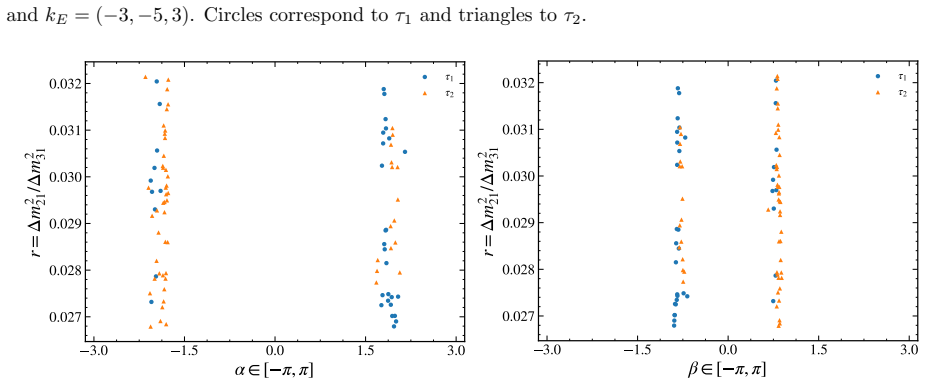
In this case, the number of the independent phases reduced to three, i.e.M ν =M ν(τ, α, β, ϕ, kN)
Fork N =−1,1, the modular weights in Majorana sector,k 4,5 ̸= 4, so the modular formY 4,5 1′ vanishes, and the corresponding terms in the Lagrangian are absent. In this case, the number of the independent phases reduced to three, i.e.M ν =M ν(τ, α, β, ϕ, kN)
-
[2]
Consequently, the phaseγ R is not physical in this setup
In the right handed neutrino sector, the contribution fromY k5 1′ is always absent, since the condition k5 = 2k N together with the allowed odd values ofk N does not permitk 5 = 4. Consequently, the phaseγ R is not physical in this setup
-
[3]
In this case, an additional phaseγ D becomes relevant, and the total number of independent phases increases to four
Fork N = 3, the Dirac sector allowsk 4 =k N +k L = 4, so that the modular formY (4) 1′ contributes. In this case, an additional phaseγ D becomes relevant, and the total number of independent phases increases to four. For each value ofτin Eq. (39), we perform a scan over the full range of phases, the allowed values ofk N, and all possible charged lepton pe...
-
[4]
Thus, future measurements of the cosmic 23 microwave background and the large scale structure will serve as a powerful and complementary probe of this model
combined with large scale structure observations. Thus, future measurements of the cosmic 23 microwave background and the large scale structure will serve as a powerful and complementary probe of this model. •These results show that the non-holomorphic modularA 4 framework with universal couplings is highly predictive. The model selects a specific modular...
2025
-
[5]
R. de Adelhart Toorop, F. Feruglio and C. Hagedorn, Nucl. Phys. B858, 437 (2012) doi:10.1016/j.nuclphysb.2012.01.017 [arXiv:1112.1340 [hep-ph]]
-
[6]
The strong coupling: a theoretical perspective,
F. Feruglio, doi:10.1142/9789813238053 0012 arXiv:1706.08749 [hep-ph]
-
[7]
B. Y. Qu and G. J. Ding, JHEP08, 136 (2024) doi:10.1007/JHEP08(2024)136 [arXiv:2406.02527 [hep-ph]]
- [8]
-
[9]
M. A. Loualidi, M. Miskaoui and S. Nasri, Phys. Rev. D112, no.1, 1 (2025) doi:10.1103/1py2-cmfx [arXiv:2503.12594 [hep-ph]]
-
[10]
Abbas, PHEP2025, 7 (2025) doi:10.31526/PHEP.2025.07
M. Abbas, PHEP2025, 7 (2025) doi:10.31526/PHEP.2025.07
-
[11]
T. Nomura and H. Okada, Chin. Phys.50, no.2, 023108 (2026) doi:10.1088/1674-1137/ae15ee [arXiv:2506.02639 [hep-ph]]
-
[12]
X. Zhang and Y. Reyimuaji, Phys. Rev. D112, no.7, 075050 (2025) doi:10.1103/17p3-bw5r [arXiv:2507.06945 [hep-ph]]
-
[13]
Priya, L. Singh, B. C. Chauhan and S. Verma, JHEP01, 036 (2026) doi:10.1007/JHEP01(2026)036 [arXiv:2508.05047 [hep-ph]]
-
[14]
B. Kumar and M. K. Das, Phys. Lett. B872, 140064 (2026) doi:10.1016/j.physletb.2025.140064 [arXiv:2509.01205 [hep-ph]]
- [15]
-
[16]
S. Jangid and H. Okada, [arXiv:2510.17292 [hep-ph]]
- [17]
-
[18]
Verma, [arXiv:2602.17243 [hep-ph]]
Tapender and S. Verma, [arXiv:2602.17243 [hep-ph]]
- [19]
-
[20]
Type-II seesaw of a non-holomorphic modular A4 symmetry,
T. Nomura and H. Okada, [arXiv:2408.01143 [hep-ph]]
-
[21]
T. Nomura, H. Okada and O. Popov, Phys. Lett. B860, 139171 (2025) doi:10.1016/j.physletb.2024.139171 [arXiv:2409.12547 [hep-ph]]
- [22]
-
[23]
C. C. Li, J. N. Lu and G. J. Ding, JHEP12, 189 (2024) doi:10.1007/JHEP12(2024)189 [arXiv:2410.24103 [hep-ph]]
- [24]
-
[25]
C. C. Li and G. J. Ding, JHEP01, 032 (2026) doi:10.1007/JHEP01(2026)032 [arXiv:2509.15183 [hep- ph]]
-
[26]
Navaset al.(Particle Data Group), Phys
S. Navaset al.(Particle Data Group), Phys. Rev. D110, 030001 (2024) and 2025 update 25
2024
-
[27]
I. Esteban, M. C. Gonzalez-Garcia, A. Hernandez-Cabezudo, M. Maltoni and T. Schwetz, JHEP1901, 106 (2019) doi:10.1007/JHEP01(2019)106 [arXiv:1811.05487 [hep-ph]]
-
[28]
S. T. Goswami and S. Roy, Nucl. Phys. B1022, 117275 (2026) doi:10.1016/j.nuclphysb.2025.117275 [arXiv:2501.18181 [hep-ph]]
- [29]
-
[30]
G. Altarelli and F. Feruglio, “Discrete Flavor Symmetries and Models of Neutrino Mixing,” Rev. Mod. Phys.82, 2701 (2010), arXiv:1002.0211 [hep-ph]
-
[31]
Neutrino Mass and Mixing with Discrete Symmetry,
S. F. King and C. Luhn, “Neutrino Mass and Mixing with Discrete Symmetry,” Rept. Prog. Phys.76, 056201 (2013), arXiv:1301.1340 [hep-ph]
-
[32]
Lepton Mixing Parameters from Discrete and CP Symme- tries,
F. Feruglio, C. Hagedorn, and R. Ziegler, “Lepton Mixing Parameters from Discrete and CP Symme- tries,” JHEP07, 027 (2013), arXiv:1211.5560 [hep-ph]
-
[33]
M. Holthausen, M. Lindner, and M. A. Schmidt, “CP and Discrete Flavour Symmetries,” JHEP04, 122 (2013), arXiv:1211.6953 [hep-ph]
-
[34]
T. Kobayashiet al., “ModularA 4 invariance and neutrino mixing,” JHEP11, 196 (2018), arXiv:1808.03012 [hep-ph]
-
[35]
Modular invariance faces precision neutrino data,
J. C. Criado and F. Feruglio, “Modular invariance faces precision neutrino data,” SciPost Phys.5, 042 (2018), arXiv:1807.01125 [hep-ph]
-
[36]
Modular symmetry and predictions for lepton mixing,
S. F. King and Y. L. Zhou, “Modular symmetry and predictions for lepton mixing,” JHEP04, 2021, arXiv:2005.06897 [hep-ph]
-
[37]
J. B. Albertet al.[nEXO Collaboration], doi:10.1103/PhysRevC.97.065503, arXiv:1710.05075 [nucl-ex]
-
[38]
Abgrallet al.[LEGEND Collaboration], doi:10.1063/1.5007652, arXiv:1709.01980 [physics.ins-det]
N. Abgrallet al.[LEGEND Collaboration], doi:10.1063/1.5007652, arXiv:1709.01980 [physics.ins-det]
-
[39]
A. Gandoet al.[KamLAND-Zen Collaboration], doi:10.1103/PhysRevLett.117.082503, arXiv:1605.02889 [hep-ex]
-
[40]
Wanget al.[CUPID Interest Group], arXiv:1907.09376 [physics.ins-det]
G. Wanget al.[CUPID Interest Group], arXiv:1907.09376 [physics.ins-det]
-
[41]
Andringaet al.[SNO+ Collaboration], doi:10.1155/2016/6194250, arXiv:1508.05759 [physics.ins- det]
S. Andringaet al.[SNO+ Collaboration], doi:10.1155/2016/6194250, arXiv:1508.05759 [physics.ins- det]
-
[42]
Planck 2018 results. VI. Cosmological parameters
N. Aghanimet al.[Planck Collaboration], “Planck 2018 results. VI. Cosmological parameters,” Astron. Astrophys.641, A6 (2020), arXiv:1807.06209 [astro-ph.CO]
work page Pith review arXiv 2018
discussion (0)
Sign in with ORCID, Apple, or X to comment. Anyone can read and Pith papers without signing in.