Recognition: unknown
Probing Primordial Black Holes with upcoming Radio Telescopes: a case study for LOFAR2.0, FAST Core Array and BINGO
Pith reviewed 2026-05-10 07:31 UTC · model grok-4.3
The pith
Upcoming radio telescopes can bound the fraction of dark matter in primordial black holes using lensed fast radio bursts.
A machine-rendered reading of the paper's core claim, the machinery that carries it, and where it could break.
Core claim
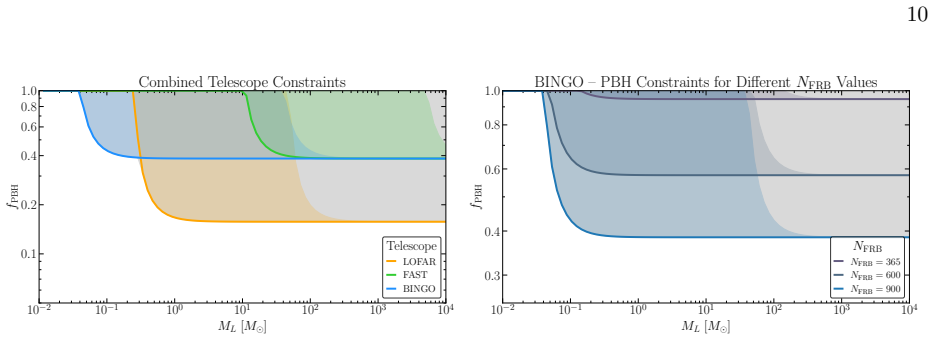
The central claim is that the absence of observed lensed FRB events in surveys by LOFAR2.0, FAST Core Array, and BINGO will translate into upper limits on the PBH dark matter fraction f_PBH of 0.16 for M_PBH > 1 M_sun with LOFAR2.0, and 0.39 for M_PBH > 10 M_sun with FAST and M_PBH > 10^{-2} M_sun with BINGO, based on calculated lensing probabilities and expected event rates.
What carries the argument
The lensing optical depth for FRBs due to PBHs, which determines the probability of detecting multiply-imaged bursts and depends on the PBH mass and their fraction of dark matter.
If this is right
- Non-observation of lensed FRBs with LOFAR2.0 implies f_PBH < 0.16 for masses above 1 solar mass.
- FAST Core Array can restrict f_PBH < 0.39 for PBHs heavier than 10 solar masses.
- BINGO provides a bound f_PBH < 0.39 for PBHs above 0.01 solar masses.
- FRB lensing acts as an independent and complementary test of the PBH scenario.
- Larger future catalogs of FRBs will strengthen these constraints over time.
Where Pith is reading between the lines
- Higher than assumed FRB rates would allow even tighter bounds on PBH abundance from the same telescopes.
- This radio lensing approach could be extended to other upcoming surveys to cover more PBH mass ranges.
- If PBHs are ruled out in these windows, attention may shift to other dark matter candidates like axions or WIMPs.
Load-bearing premise
The calculations depend on particular assumptions about the overall rate and redshift distribution of FRBs as well as the precise lensing optical depth.
What would settle it
Finding a number of lensed FRB events much larger than the background expectation in the LOFAR2.0 survey would indicate either a higher PBH fraction or that the FRB assumptions need revision.
Figures



read the original abstract
Fast Radio Bursts (FRBs) are among the most intriguing phenomena observed in radio astronomy. So far, about 130 FRB signals have been confirmed and characterized by different surveys, and the CHIME telescope has recently reported a new catalog of 4539 bursts. Therefore, these numbers are expected to increase in the coming years. The detection, or lack thereof, of lensed FRB events can be used to probe Primordial Black Holes (PBHs) as a fraction of dark matter. We investigate the potential of three upcoming radio telescopes, LOFAR2.0, FAST Core Array, and BINGO, to test the PBH scenario. We forecast that LOFAR2.0 will constrain $f_{\mathrm{PBH}} < 0.16$ for PBH masses $M_{\rm PBH}>1\,{M_{\odot}}$, while FAST Core Array and BINGO will restrict $f_{\mathrm{PBH}} < 0.39$ for $M_{\rm PBH}>10\,{M_{\odot}}$ and $M_{\rm PBH}>10^{-2}\,{M_{\odot}}$, respectively. Despite the existence of stricter constraints, FRB lensing offers an independent and complementary probe of PBHs in the Universe, which will improve in the future.
Editorial analysis
A structured set of objections, weighed in public.
Referee Report
Summary. The manuscript forecasts upper limits on the primordial black hole dark matter fraction f_PBH using the non-detection of gravitationally lensed fast radio bursts (FRBs) observable by three upcoming radio telescopes. It claims LOFAR2.0 can reach f_PBH < 0.16 for M_PBH > 1 M_⊙, while FAST Core Array and BINGO reach f_PBH < 0.39 for M_PBH > 10 M_⊙ and M_PBH > 10^{-2} M_⊙ respectively. The forecasts combine assumed FRB detection rates and redshift distributions with standard PBH point-mass lensing optical depths and telescope-specific detection efficiencies.
Significance. If the underlying FRB population models and lensing calculations hold, the work supplies an independent radio-based probe of PBHs in the stellar-mass range that is complementary to existing microlensing and gravitational-wave bounds. The paper correctly notes that stricter limits already exist but emphasizes the method's future improvement with larger FRB samples. The significance is reduced by the absence of robustness tests against plausible variations in the input FRB models.
major comments (1)
- [Abstract and §3] Abstract and forecasting methodology: the headline limits are obtained by setting the expected number of detectable lensed FRBs equal to a small threshold (~1-3 events). This expectation is proportional to the integral over dN_FRB/dz × τ_lens(f_PBH, M_PBH, z) × f_det(z). No alternative FRB redshift distributions, luminosity functions, or evolution scenarios are explored; a factor-of-two shift in the high-z tail directly rescales the quoted f_PBH bounds by the same factor, making the numerical claims load-bearing on untested model choices.
minor comments (2)
- [Abstract] The abstract states that 'about 130 FRB signals have been confirmed' while citing the CHIME catalog of 4539 bursts; a brief clarification of the distinction between confirmed and total detected events would improve clarity.
- No table or figure shows the sensitivity curves or the explicit dependence of the expected event rate on telescope parameters; adding one would make the forecasts more transparent.
Simulated Author's Rebuttal
We thank the referee for the careful reading and constructive feedback. We address the single major comment below and will incorporate revisions to strengthen the presentation of our forecasting methodology.
read point-by-point responses
-
Referee: [Abstract and §3] Abstract and forecasting methodology: the headline limits are obtained by setting the expected number of detectable lensed FRBs equal to a small threshold (~1-3 events). This expectation is proportional to the integral over dN_FRB/dz × τ_lens(f_PBH, M_PBH, z) × f_det(z). No alternative FRB redshift distributions, luminosity functions, or evolution scenarios are explored; a factor-of-two shift in the high-z tail directly rescales the quoted f_PBH bounds by the same factor, making the numerical claims load-bearing on untested model choices.
Authors: We agree that the quoted limits depend on the adopted FRB population model. In §3 we use a fiducial redshift distribution and detection-rate normalization drawn from the CHIME catalog and other current surveys, which is the standard approach for such forecasts. We did not perform a full parameter scan over alternative luminosity functions or evolution scenarios. In the revised manuscript we will add a short subsection (or paragraph in §3) that explicitly states the linear scaling of the expected lensed-event rate with the high-z tail and illustrates how a factor-of-two change in that tail would rescale the f_PBH bounds. This addition will make the model dependence transparent without altering the headline numbers derived from the fiducial model. revision: partial
Circularity Check
No circularity in the forecast derivation for PBH constraints
full rationale
The paper computes expected numbers of lensed FRBs for LOFAR2.0, FAST Core Array and BINGO by integrating an external FRB redshift distribution (extrapolated from CHIME) times the standard PBH point-mass lensing optical depth (linear in f_PBH) times a detection efficiency factor. Upper limits on f_PBH are obtained by requiring this expectation to fall below a small integer threshold. This is a forward calculation from stated model inputs and telescope parameters; no equation, fit, or self-citation reduces the quoted bounds (f_PBH < 0.16 etc.) back to the inputs by construction. The derivation contains no self-definitional steps, fitted-input predictions, load-bearing self-citations, or imported uniqueness theorems.
Axiom & Free-Parameter Ledger
Forward citations
Cited by 1 Pith paper
-
Constraints on the baryon density from fast radio bursts using a non-parametric reconstruction of the Hubble parameter
FRB dispersion measures combined with non-parametric H(z) reconstruction yield Ω_b h² = 0.02236 ± 0.00090, agreeing with BBN and Planck CMB to within 0.05%.
Reference graph
Works this paper leans on
-
[1]
We find that a fit toN(z) in the histogram of Fig
to constrain Hubble and cosmographic parameters. We find that a fit toN(z) in the histogram of Fig. 2 is given by a Gamma distribution, whose explicit form is N(z) =N 0 za1 e−a2 z ;N 0 = 208.7210 ;a 1 = 0.2465 ;a 2 = 4.6269.(2.16) To reach this fit, we tested three different distributions: the Lognormal, Gamma, and Weibull. The tests consisted of computin...
2012
-
[2]
4, we present the exclusion regions forf PBH max for each radio telescope
In the shaded regions of Fig. 4, we present the exclusion regions forf PBH max for each radio telescope. The shaded colored regions unveil the lowest best interval of time resolution of LOFAR (orange), FAST (green), and BINGO (blue), to computef PBH. The shaded gray regions mark the constraints use the highest best interval of time resolution of Tab. I, a...
2021
- [3]
-
[4]
Generalized Distributions of Host Dispersion Measures in the Fast Radio Burst Cosmology
J.-Y. Jia, D.-C. Qiang, L.-Y. Li, and H. Wei, Generalized distributions of host dispersion measures in the fast radio burst cosmology (2025), arXiv:2510.09463 [astro-ph.CO]
work page internal anchor Pith review Pith/arXiv arXiv 2025
-
[5]
Abbottet al.(The CHIME/FRB), Astrophys
T. Abbott et al. (The CHIME/FRB), Astrophys. J. Suppl.283, 34 (2026), arXiv:2601.09399 [astro- ph.HE]
- [6]
- [7]
- [8]
- [9]
- [10]
- [11]
- [12]
-
[13]
K. Kainulainen, S. Nurmi, E. D. Schiappacasse, and T. T. Yanagida, Phys. Rev. D104, 123033 (2021), arXiv:2108.08717 [astro-ph.HE]
- [14]
- [15]
- [16]
-
[17]
Meng, Q.-J
M. Meng, Q.-J. Huang, and C.-M. Deng, Res. Astron. Astrophys.24, 095006 (2024)
2024
- [18]
- [19]
-
[20]
A. Walters, Y.-Z. Ma, J. Sievers, and A. Weltman, Phys. Rev. D100, 103519 (2019), arXiv:1909.02821 [astro-ph.CO]
-
[21]
D.-C. Qiang and H. Wei, JCAP04, 023, arXiv:2002.10189 [astro-ph.CO]
-
[22]
J. B. Mu˜ noz, E. D. Kovetz, L. Dai, and M. Kamionkowski, Physical Review Letters117, 10.1103/phys- revlett.117.091301 (2016)
-
[23]
T. D. Brandt, Astrophys. J. Lett.824, L31 (2016), arXiv:1605.03665 [astro-ph.GA]
work page Pith review arXiv 2016
- [24]
- [25]
-
[26]
C. Leung et al., Phys. Rev. D106, 043017 (2022), arXiv:2204.06001 [astro-ph.HE]
- [27]
-
[28]
Profumo, JCAP10, 075, arXiv:2508.06688 [astro-ph.HE]
S. Profumo, JCAP10, 075, arXiv:2508.06688 [astro-ph.HE]
-
[29]
Li, S.-J
J.-H. Li, S.-J. Wang, X.-Y. Zhao, and N. Li, Universe11, 311 (2025)
2025
-
[30]
Y. B. Zel’dovich and I. D. Novikov, Sov. Astron.10, 602 (1967)
1967
-
[31]
Hawking, Mon
S. Hawking, Mon. Not. Roy. Astron. Soc.152, 75 (1971)
1971
-
[32]
B. J. Carr and S. W. Hawking, Mon. Not. Roy. Astron. Soc.168, 399 (1974)
1974
-
[33]
B. Carr and F. Kuhnel, Ann. Rev. Nucl. Part. Sci.70, 355 (2020), arXiv:2006.02838 [astro-ph.CO]
- [34]
- [35]
-
[36]
Mroz et al., Nature548, 183 (2017), arXiv:1707.07634 [astro-ph.EP]
P. Mroz et al., Nature548, 183 (2017), arXiv:1707.07634 [astro-ph.EP]
-
[37]
H. Niikura, M. Takada, S. Yokoyama, T. Sumi, and S. Masaki, Phys. Rev. D99, 083503 (2019), arXiv:1901.07120 [astro-ph.CO]
-
[38]
S. Sugiyama, M. Takada, N. Yasuda, and N. Tominaga, (2026), arXiv:2602.05840 [astro-ph.CO]
-
[39]
G. H¨ utsi, M. Raidal, V. Vaskonen, and H. Veerm¨ ae, JCAP03, 068, arXiv:2012.02786 [astro-ph.CO]
-
[40]
E. Berti, F. Crescimbeni, G. Franciolini, S. Mastrogiovanni, P. Pani, and G. Pierra, Phys. Rev. D113, 043048 (2026), arXiv:2512.03152 [gr-qc]
- [41]
-
[42]
M. Kawasaki, A. Kusenko, and T. T. Yanagida, Phys. Lett. B711, 1 (2012), arXiv:1202.3848 [astro- ph.CO]. 15
- [43]
- [44]
-
[45]
Primordial Black Holes - Perspectives in Gravitational Wave Astronomy -
M. Sasaki, T. Suyama, T. Tanaka, and S. Yokoyama, Class. Quant. Grav.35, 063001 (2018), arXiv:1801.05235 [astro-ph.CO]
work page Pith review arXiv 2018
- [46]
-
[47]
C. Casanueva-Villarreal, N. Padilla, P. B. Tissera, B. Liu, and V. Bromm, Astron. Astrophys.699, A49 (2025), arXiv:2505.10706 [astro-ph.CO]
-
[48]
Byrnes, G
C. Byrnes, G. Franciolini, T. Harada, P. Pani, and M. Sasaki, eds., Primordial Black Holes, Springer Series in Astrophysics and Cosmology (Springer, 2025)
2025
-
[49]
M. Zumalacarregui and U. Seljak, Phys. Rev. Lett.121, 141101 (2018), arXiv:1712.02240 [astro- ph.CO]
-
[50]
Mr´ oz et al.,No massive black holes in the Milky Way halo,Nature632(2024) 749 [2403.02386]
P. Mr´ ozet al., Nature632, 749 (2024), arXiv:2403.02386 [astro-ph.GA]
-
[51]
P. Mr´ ozet al., Astrophys. J. Suppl.280, 49 (2025), arXiv:2507.13794 [astro-ph.GA]
- [52]
- [53]
-
[54]
M. Andr´ es-Carcasona, A. J. Iovino, V. Vaskonen, H. Veerm¨ ae, M. Mart´ ınez, O. Pujol` as, and L. M. Mir, Phys. Rev. D110, 023040 (2024), arXiv:2405.05732 [astro-ph.CO]
- [55]
- [56]
- [57]
-
[58]
B. Carr, A. J. Iovino, G. Perna, V. Vaskonen, and H. Veerm¨ ae 10.1007/s40766-026-00080-z (2026), arXiv:2601.06024 [astro-ph.CO]
-
[59]
LOFAR, LOFAR2.0 White paper,https://www.lofar.eu/lofar2-0-documentation/(2023), [On- line; accessed 17-April-2026]
2023
- [60]
- [61]
- [62]
-
[63]
The BINGO Project I: Baryon Acoustic Oscillations from Integrated Neutral Gas Observations,
E. Abdalla et al., Astron. Astrophys.664, A14 (2022), arXiv:2107.01633 [astro-ph.CO]
- [64]
- [65]
-
[66]
Planck 2018 results. VI. Cosmological parameters
N. Aghanim et al. (Planck), Astron. Astrophys.641, A6 (2020), [Erratum: Astron.Astrophys. 652, C4 (2021)], arXiv:1807.06209 [astro-ph.CO]
work page Pith review arXiv 2020
-
[67]
E. Petroff et al., Mon. Not. Roy. Astron. Soc.447, 246 (2015), arXiv:1412.0342 [astro-ph.HE]
-
[68]
C. W. James, J. X. Prochaska, J.-P. Macquart, F. O. North-Hickey, K. W. Bannister, and A. Dunning, Monthly Notices of the Royal Astronomical Society509, 4775–4802 (2021)
2021
- [69]
-
[70]
J. M. Shull, B. D. Smith, and C. W. Danforth, The Astrophysical Journal759, 23 (2012)
2012
- [71]
- [72]
-
[73]
M. Bartelmann, Class. Quant. Grav.27, 233001 (2010), arXiv:1010.3829 [astro-ph.CO]
- [74]
- [75]
- [76]
- [77]
-
[78]
X. X. Zhang, R. Duan, V. Gajjar, H. Y. Zhang, P. Wang, C. H. Niu, D. Werthimer, J. Cobb, S. Y. Li, X. Pei, Y. Zhu, and D. Li, Research in Astronomy and Astrophysics23, 095023 (2023)
2023
- [79]
-
[80]
S. Sanidas et al., Astron. Astrophys.626, A104 (2019), arXiv:1905.04977 [astro-ph.HE]
discussion (0)
Sign in with ORCID, Apple, or X to comment. Anyone can read and Pith papers without signing in.