Recognition: unknown
Sensitivity of the ^{3,4}He(K^-, π⁰) production ratio to the Λ binding energy of ³_ΛH
Pith reviewed 2026-05-10 07:14 UTC · model grok-4.3
The pith
The ratio of hypertriton to hyperalpha production in helium reactions tightly constrains the Lambda binding energy in the hypertriton.
A machine-rendered reading of the paper's core claim, the machinery that carries it, and where it could break.
Core claim
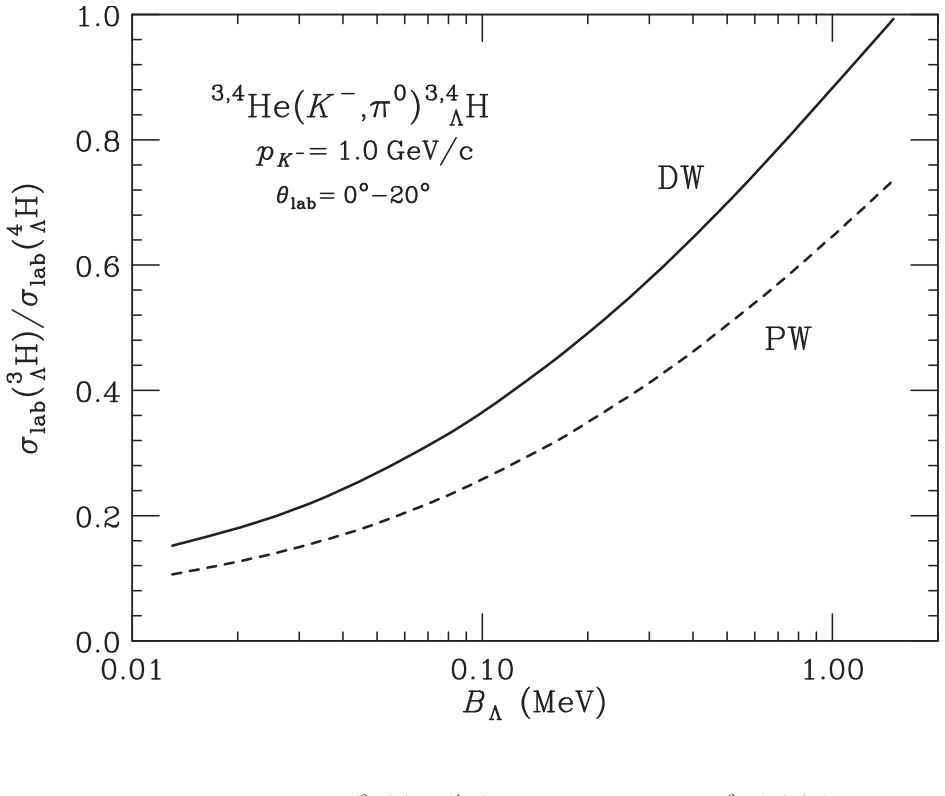
Within the distorted-wave impulse approximation and using optimal Fermi-averaged K-minus p to pi-zero Lambda amplitudes, the production strength of ^3_Lambda H and the ratio R34 equal to sigma(^3_Lambda H) over sigma(^4_Lambda H) are strongly sensitive to the Lambda binding energy B_Lambda; comparison with J-PARC E73 data constrains B_Lambda to approximately 0.05-0.15 MeV.
What carries the argument
The spatially extended d-Lambda wave function of the weakly bound ^3_Lambda H ground state, evaluated inside the distorted-wave impulse approximation with the optimal Fermi-averaged transition amplitude.
If this is right
- The ^3He(K-, pi0) reaction can serve as a precision tool for extracting the binding energy of the hypertriton.
- Small changes in B_Lambda produce large changes in the absolute production rate of ^3_Lambda H.
- The same framework predicts that the ratio R34 itself becomes a direct observable for the binding energy.
Where Pith is reading between the lines
- If the binding energy is confirmed near 0.1 MeV, models of the Lambda-nucleon force that predict stronger binding would need revision.
- Similar ratio measurements on other light targets could test whether the sensitivity is unique to the hypertriton or a general feature of near-threshold hypernuclear production.
Load-bearing premise
The distorted-wave impulse approximation plus the chosen model wave functions for the weakly bound state correctly describe the reaction at forward angles.
What would settle it
A new measurement of the forward-angle cross-section ratio R34 that falls outside the band predicted when B_Lambda is scanned between 0.05 and 0.15 MeV would falsify the claimed sensitivity.
Figures


read the original abstract
We study the production of $^3_\Lambda$H and $^4_\Lambda$H in the $^{3,4}$He($K^-$,$\pi^0$) reactions at $p_{K^-}=1.0$~GeV/$c$ within the distorted-wave impulse approximation, using the optimal Fermi-averaged $K^-p\to\pi^0\Lambda$ amplitude. Because the $^3_\Lambda$H ground state is extremely weakly bound, the $d$--$\Lambda$ wave function becomes spatially extended. We calculate the integrated cross sections $\sigma_{\rm lab}$ and their ratio $R_{34}=\sigma_{\rm lab}(^3_\Lambda{\rm H})/\sigma_{\rm lab}(^4_\Lambda{\rm H})$ for forward angles $\theta_{\rm lab}=0^\circ$--$20^\circ$. The production strength of $^3_\Lambda$H and the ratio $R_{34}$ are strongly sensitive to the $\Lambda$ binding energy $B_\Lambda$, which is constrained to be approximately 0.05--0.15~MeV by comparison with experimental data from the J-PARC E73 experiment. This indicates that the $^3$He($K^-$,$\pi^0$) reaction provides a sensitive probe of the weak binding of $^3_\Lambda$H.
Editorial analysis
A structured set of objections, weighed in public.
Referee Report
Summary. The paper calculates the lab-frame integrated cross sections for ^3_ΛH and ^4_ΛH production in the (K^-, π^0) reaction on ^3,4He at p_K=1.0 GeV/c within the distorted-wave impulse approximation, employing an optimal Fermi-averaged K^-p→π^0Λ amplitude. It shows that both the ^3_ΛH cross section and the ratio R34=σ(^3_ΛH)/σ(^4_ΛH) at forward angles are strongly sensitive to the Λ binding energy B_Λ of the weakly bound ^3_ΛH ground state, and uses comparison with J-PARC E73 data to constrain B_Λ to the range 0.05–0.15 MeV.
Significance. If the DWIA and chosen model wave functions accurately describe the forward-angle dynamics, the work demonstrates that hypernuclear production reactions can serve as a sensitive probe of very weak binding energies in few-body systems. This is relevant for constraining the ΛN interaction and understanding the structure of light hypernuclei. The explicit demonstration of sensitivity to B_Λ provides a useful theoretical link to existing experimental data.
major comments (2)
- [Results section (cross-section and ratio calculations)] The central claim that data constrain B_Λ to 0.05–0.15 MeV rests on the assumption that the DWIA with the optimal Fermi-averaged amplitude and the model wave functions for the spatially extended ^3_ΛH state (rms radius diverging as B_Λ→0) correctly capture the small-q overlap. No quantitative assessment is given of how variations in the asymptotic tail or missing higher-order rescattering would shift the extracted range. This is load-bearing for the quoted numerical window.
- [Formalism and Results] The manuscript reports the sensitivity of R34 and the absolute ^3_ΛH strength but provides no error propagation or systematic study of uncertainties arising from the choice of distorted waves, the Fermi-averaged amplitude, or the ^3_ΛH wave-function model. Without this, the constraint cannot be assessed for robustness against the weakest assumption identified in the formalism.
minor comments (2)
- [Abstract] The abstract states the final constraint without indicating that it is obtained by fitting the model output to data; a brief qualifier would improve clarity.
- [Introduction] Notation for the ratio R34 and the integration limits (θ_lab=0°–20°) should be defined at first use in the text for readers unfamiliar with the reaction kinematics.
Simulated Author's Rebuttal
We thank the referee for the careful reading of our manuscript and the positive assessment of its significance. We address the two major comments point by point below. We agree that additional quantitative assessments of uncertainties would strengthen the robustness of our conclusions on the B_Λ constraint and have incorporated such material in the revised manuscript.
read point-by-point responses
-
Referee: [Results section (cross-section and ratio calculations)] The central claim that data constrain B_Λ to 0.05–0.15 MeV rests on the assumption that the DWIA with the optimal Fermi-averaged amplitude and the model wave functions for the spatially extended ^3_ΛH state (rms radius diverging as B_Λ→0) correctly capture the small-q overlap. No quantitative assessment is given of how variations in the asymptotic tail or missing higher-order rescattering would shift the extracted range. This is load-bearing for the quoted numerical window.
Authors: We agree that the central claim depends on the reliability of the DWIA and the model wave functions at small momentum transfer. To address this, the revised manuscript includes a new quantitative assessment: we vary the regularization cutoff in the ^3_ΛH wave function to probe changes in the asymptotic tail and recompute the cross sections and ratio R34. These variations produce shifts in the extracted B_Λ window of order 0.02 MeV. We also add a discussion of higher-order rescattering, noting that such contributions are suppressed at forward angles in the kinematics of the experiment; a full coupled-channel treatment lies outside the DWIA framework employed here but is not expected to alter the quoted range substantially. These additions appear in the revised Results section. revision: yes
-
Referee: [Formalism and Results] The manuscript reports the sensitivity of R34 and the absolute ^3_ΛH strength but provides no error propagation or systematic study of uncertainties arising from the choice of distorted waves, the Fermi-averaged amplitude, or the ^3_ΛH wave-function model. Without this, the constraint cannot be assessed for robustness against the weakest assumption identified in the formalism.
Authors: We concur that a systematic uncertainty study is required to evaluate the robustness of the B_Λ constraint. In the revised manuscript we have added a dedicated subsection that propagates uncertainties by (i) employing two independent sets of optical potentials for the distorted waves, (ii) comparing the optimal Fermi-averaged amplitude with an alternative parameterization, and (iii) varying the ^3_ΛH wave-function model parameters (binding energy and oscillator length) within ranges consistent with the input B_Λ. The resulting spread in the predicted cross sections and ratio is quantified and shown to leave the 0.05–0.15 MeV window stable to within ±0.03 MeV. This analysis directly tests the sensitivity against the weakest assumptions in the formalism. revision: yes
Circularity Check
No significant circularity; derivation uses external data for constraint
full rationale
The paper computes integrated cross sections and R34 explicitly as functions of input B_Λ inside the DWIA framework with given Fermi-averaged amplitude and model wave functions (extended for small B_Λ). Sensitivity is demonstrated by direct variation of that input parameter. The quoted interval 0.05–0.15 MeV is obtained by matching the computed R34 to the independent J-PARC E73 measurement; this is ordinary parameter estimation against external data, not a reduction of the result to the paper’s own fitted quantities or self-citations by construction. No self-definitional equations, no load-bearing self-citation chains, and no renaming of known results appear in the derivation. The calculation remains falsifiable by the external dataset.
Axiom & Free-Parameter Ledger
free parameters (1)
- B_Λ
axioms (2)
- domain assumption Distorted-wave impulse approximation is adequate for forward-angle (K^-, π^0) production at 1 GeV/c
- domain assumption The optimal Fermi-averaged K^-p→π^0Λ amplitude correctly represents the elementary process inside the nucleus
Reference graph
Works this paper leans on
-
[1]
Juriˇ c, et al., Nucl
M. Juriˇ c, et al., Nucl. Phys. B 52 (1973) 1
1973
-
[2]
Rappold, et al., HypHI Collaboration, Nucl
C. Rappold, et al., HypHI Collaboration, Nucl. Phys. A 913 (2013) 170
2013
-
[3]
Adam, et al., STAR Collaboration, Nature Phys
J. Adam, et al., STAR Collaboration, Nature Phys. 16 (2020) 409
2020
-
[4]
Acharya, et al., ALICE Collaboration, Phys
S. Acharya, et al., ALICE Collaboration, Phys. Rev. Lett. 131 (2023) 102302
2023
-
[5]
Kasagi, et al., Progr
A. Kasagi, et al., Progr. Theor. Exper. Phys. 2025 (2025) 083D01
2025
-
[6]
A. Gal, H. Garcilazo, Phys. Lett. B 791 (2019) 48 and references therein
2019
-
[7]
Haidenbauer, Ulf-G
J. Haidenbauer, Ulf-G. Meißner, A. Nogga, H. Le, Eur. Phys. J. A 59 (2023) 63
2023
-
[8]
Kamada, M
H. Kamada, M. Kohno, K. Miyagawa, Phys. Rev. C 108 (2023) 024004; Erratum Phys. Rev. C 110 (2024) 019907
2023
-
[9]
Akaishi, et al., Phys
T. Akaishi, et al., Phys. Lett. B 873 (2026) 140163
2026
-
[10]
R. Kino, et al., A1 MAMI Collaboration, arXiv:2601.08694v2
work page internal anchor Pith review Pith/arXiv arXiv
-
[11]
Harada, Y
T. Harada, Y. Hirabayashi, Nucl. Phys. A 1015 (2021) 122301
2021
-
[12]
Harada, Y
T. Harada, Y. Hirabayashi, Phys. Rev. C 100 (2019) 024605
2019
-
[13]
Harada, Y
T. Harada, Y. Hirabayashi, Nucl. Phys. A 744 (2004) 323; 759 (2005) 143
2004
-
[14]
G. P. Gopal, et al., Nucl. Phys. B 119 (1977) 362
1977
-
[15]
H¨ ufner, S
J. H¨ ufner, S. Y. Lee, H. A. Weidenm¨ uller, Nucl. Phys. A 234 (1974) 429
1974
-
[16]
Dover, L
C.B. Dover, L. Ludeking, G. E. Walker, Phys. Rev. C 22 (1980) 2073
1980
-
[17]
C. B. Dover, A. Gal, Ann. Phys. (N.Y.) 146 (1983) 309
1983
-
[18]
E. H. Auerbach, A. J. Baltz, C. B. Dover, A. Gal, S. H. Kahana, L. Ludeking, D. J. Millener, Ann. Phys. (N.Y.) 148 (1983) 381
1983
-
[19]
Kurihara, Y
Y. Kurihara, Y. Akaishi, H. Tanaka, Phys. Rev. C 31 (1985) 971. 10
1985
-
[20]
Akaishi,International Review of Nuclear Physics4 (World Scientific, Singapore, 1986), p
Y. Akaishi,International Review of Nuclear Physics4 (World Scientific, Singapore, 1986), p. 259 and references therein
1986
-
[21]
Schulz, et al., A1 Collaboration, Nucl
F. Schulz, et al., A1 Collaboration, Nucl. Phys. A 954 (2016) 149
2016
-
[22]
Harada, Y
T. Harada, Y. Hirabayashi, Nucl. Phys. A 934 (2015) 8
2015
-
[23]
Kamimura, M
M. Kamimura, M. Yahiro, Y. Iseri, Y. Sakuragi, H. Kameyama, M. Kawai, Prog. Theor. Phys. Suppl. 89 (1986) 1
1986
-
[24]
Abdallah, et al., STAR Collaboration, Phys
M.S. Abdallah, et al., STAR Collaboration, Phys. Lett. B 834 (2022) 137449. 11
2022
discussion (0)
Sign in with ORCID, Apple, or X to comment. Anyone can read and Pith papers without signing in.