Recognition: unknown
Preparation and detection of quasiparticles for quantum simulations of scattering
Pith reviewed 2026-05-10 08:34 UTC · model grok-4.3
The pith
Dressed creation operators built from intermediate Wannier functions enable selective quasiparticle wave-packet preparation and detection in lattice models.
A machine-rendered reading of the paper's core claim, the machinery that carries it, and where it could break.
Core claim
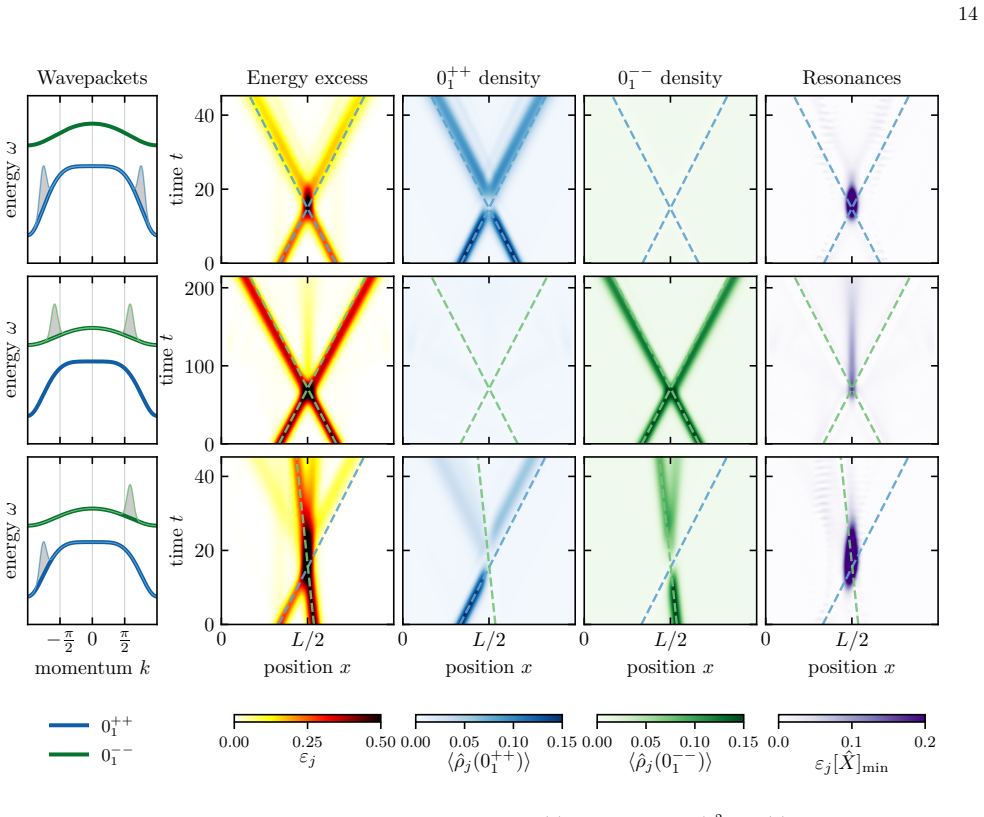
Maximally localized Wannier functions constructed from quasiparticle bands at intermediate system sizes yield unitary local dressed creation operators that generate localized excitations on interacting vacua; these operators support species-resolved wave-packet preparation and detection, enabling the isolation of known quasiparticle signals from unknown resonances in scattering processes, as demonstrated via matrix product state simulations of pure hardcore Hamiltonian QCD on a ladder lattice.
What carries the argument
Maximally localized Wannier functions (MLWFs) from quasiparticle bands at intermediate sizes, used to build unitary local dressed creation operators for selective wave-packet operations.
If this is right
- Species-resolved preparation and detection of quasiparticle wave packets becomes possible on interacting vacua.
- Known quasiparticle contributions can be separated from unknown resonances in scattering outputs.
- Scattering processes and mass resonances can be detected in models such as hardcore Hamiltonian QCD on ladder lattices using matrix product states.
- The method applies to selective excitation in (quasi-)one-dimensional quantum lattice theories for simulation purposes.
Where Pith is reading between the lines
- The same intermediate-size Wannier construction might reduce computational cost when extending the approach to larger or higher-dimensional lattices.
- If the operators remain local, they could be combined with other tensor-network or quantum-circuit methods to simulate more complex scattering channels.
- Detection of resonances could help identify new quasiparticle species in models where analytic band structures are unavailable.
- The technique may generalize to other strongly interacting lattice systems beyond the hardcore QCD test case.
Load-bearing premise
Maximally localized Wannier functions from quasiparticle bands at intermediate system sizes produce unitary local dressed creation operators that remain accurate and local when applied to the full interacting system and larger lattices.
What would settle it
The prepared wave packets lose localization or unitarity when the operators are applied to larger lattices or the complete interacting Hamiltonian, or the scattering outputs fail to separate known quasiparticle contributions from detected mass resonances in the tested ladder model.
Figures





read the original abstract
We introduce a method for the selective preparation and detection of quasiparticle wave packets, based on creation operators that generate dressed, localized excitations on top of interacting vacua of (quasi-)one-dimensional quantum lattice theories. This method exploits maximally localized Wannier functions (MLWFs) constructed from quasiparticle bands at intermediate system sizes, enabling the construction of unitary local dressed creation operators. The algorithm allows for species-resolved wave-packet preparation and detection, enabling the separation of known quasiparticle contributions from unknown resonances. We test this approach with matrix product states (MPS) on pure hardcore Hamiltonian QCD on a ladder lattice, detecting scattering outputs and mass resonances.
Editorial analysis
A structured set of objections, weighed in public.
Referee Report
Summary. The paper introduces a method for selective preparation and detection of quasiparticle wave packets in (quasi-)one-dimensional quantum lattice theories. It constructs unitary local dressed creation operators from maximally localized Wannier functions (MLWFs) of quasiparticle bands computed at intermediate system sizes, then applies them to interacting vacua. This enables species-resolved operations that separate known quasiparticle contributions from unknown resonances. The approach is tested numerically with matrix product states (MPS) on a pure hardcore Hamiltonian QCD model on a ladder lattice, showing detection of scattering outputs and mass resonances.
Significance. If the central construction holds, the method would provide a practical, species-resolved tool for analyzing scattering in lattice gauge theories and other strongly interacting 1D systems simulated on quantum hardware or classical tensor networks. The explicit MPS demonstration on the hardcore QCD ladder is a concrete strength, as it applies the operators to a non-trivial interacting model and reports observable outputs. However, the overall significance remains provisional without quantitative validation of operator robustness under extrapolation.
major comments (2)
- [Method section (construction of dressed operators)] The construction of dressed creation operators from MLWFs at intermediate system sizes (described in the method section) assumes these operators remain unitary, local, and accurate when applied to the full interacting vacuum and larger lattices, but no explicit bounds, scaling analysis, or fidelity metrics versus system size or interaction strength are provided to support this extrapolation.
- [Numerical tests section] In the numerical tests with MPS on the hardcore ladder QCD model, the results demonstrate detection of scattering outputs and resonances, yet the section reports no quantitative error analysis, overlap fidelities, operator-norm deviations, or localization-length scaling with lattice size, leaving the key claim of reliable species separation unverified beyond the specific tested parameters.
minor comments (2)
- [Abstract] The abstract refers to 'pure hardcore Hamiltonian QCD on a ladder lattice' without a brief reference or citation to the specific model Hamiltonian, which would aid readers from outside lattice gauge theory.
- [Introduction/Method] Notation for the dressed operators and MLWFs could be introduced with a short table or explicit definition early in the text to improve readability for the general quantum simulation audience.
Simulated Author's Rebuttal
We thank the referee for the careful reading of the manuscript and for highlighting both the potential significance of the dressed-operator approach and the concrete value of the MPS demonstration on the hardcore QCD ladder. We address each major comment below.
read point-by-point responses
-
Referee: [Method section (construction of dressed operators)] The construction of dressed creation operators from MLWFs at intermediate system sizes (described in the method section) assumes these operators remain unitary, local, and accurate when applied to the full interacting vacuum and larger lattices, but no explicit bounds, scaling analysis, or fidelity metrics versus system size or interaction strength are provided to support this extrapolation.
Authors: We agree that explicit quantitative support for the extrapolation would strengthen the presentation. In the revised manuscript we will add a dedicated subsection that reports fidelity metrics, deviations from unitarity, and localization-length scaling of the dressed operators versus system size and interaction strength, computed from the existing MPS data on the ladder model. These results will provide concrete bounds for the regimes tested and thereby support the applicability of the construction beyond the intermediate sizes used to build the MLWFs. revision: yes
-
Referee: [Numerical tests section] In the numerical tests with MPS on the hardcore ladder QCD model, the results demonstrate detection of scattering outputs and resonances, yet the section reports no quantitative error analysis, overlap fidelities, operator-norm deviations, or localization-length scaling with lattice size, leaving the key claim of reliable species separation unverified beyond the specific tested parameters.
Authors: We acknowledge that the current numerical section would benefit from additional quantitative metrics. We will revise the section to include overlap fidelities between the states prepared by the dressed operators and the target quasiparticle eigenstates, operator-norm deviations from the ideal creation operators, and explicit localization-length scaling with lattice size. These additions will directly verify the reliability of species separation for the parameters already simulated and will quantify the robustness of the method within the tested regime. revision: yes
Circularity Check
No significant circularity; construction is self-contained
full rationale
The paper presents a method for quasiparticle wave-packet preparation using MLWFs from intermediate-size bands to build dressed creation operators, then applies them in MPS simulations on a specific hardcore ladder model. This follows standard Wannier and tensor-network techniques without any step that reduces the central claim to a fitted parameter renamed as prediction, a self-definitional loop, or a load-bearing self-citation whose content is unverified. The numerical test supplies independent evidence for the tested regime rather than defining the operators by construction. No ansatz is smuggled via citation, and no uniqueness theorem is invoked to force the choice. The derivation chain remains externally grounded in established MLWF and MPS methods.
Axiom & Free-Parameter Ledger
axioms (2)
- domain assumption Quasiparticle bands exist and can be computed at intermediate system sizes in the models considered.
- domain assumption Matrix product states can accurately represent the relevant states and dynamics in the ladder QCD model.
invented entities (1)
-
Dressed creation operators from MLWFs
no independent evidence
Reference graph
Works this paper leans on
-
[1]
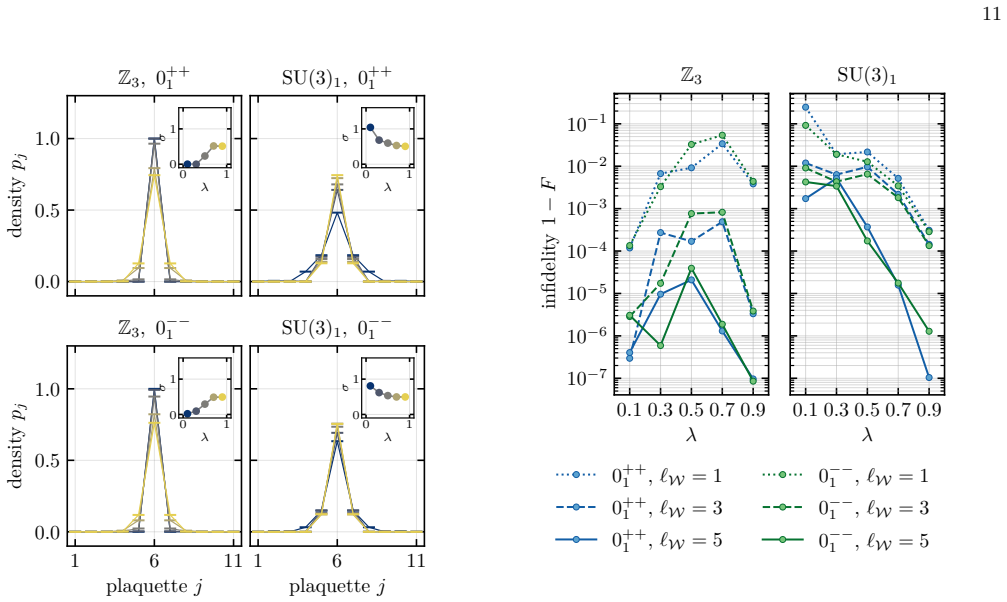
Variational problem for the creation operator Given the vacuum state|Ω⟩and a MLWF state|ϕj⟩ centered at sitej, we want to find an operatorˆϕ† j such that ˆϕ† j|Ω⟩≃|ϕj⟩with maximum fidelity. This operator must be (a) localized in the Wannier supportW of length ℓW (this assumption enables the construction of wave- packets) and (b) unitary, so that it preser...
-
[2]
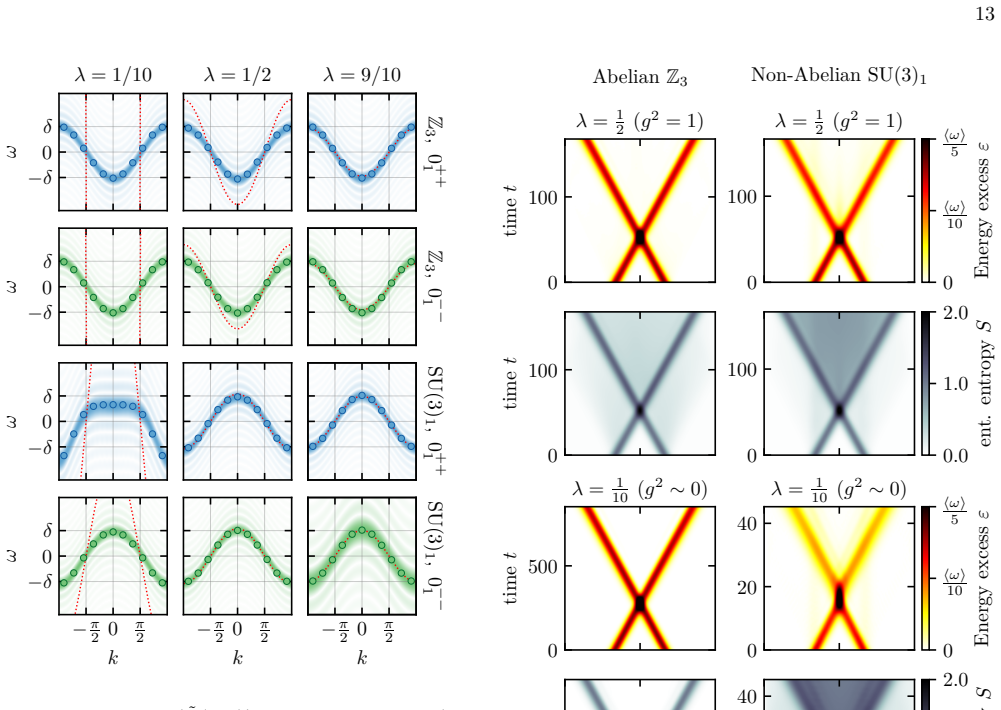
Wave packets from the creation operator Once the dressed creation operator ˆϕ† j is obtained, a generic single-quasiparticle wave packet can be con- structed as ˆΨ†= 1 N L∑ j=1 cj ˆϕ† j,(B9) where cj are generic complex coefficients and N =√∑ j|cj|2 is the normalization factor. The wave-packet state is then obtained by applying this operator to the vacuum...
-
[3]
Detection of resonances In this section, we describe the procedure to detect the presence of resonances and unknown quasiparticles in scattering simulations with a TN approach. To this aim, we introduce a nonlinear functional, designed to suppress contributions associated with known quasiparticles while isolating the residual contribution due to uncharact...
-
[4]
For numerical simulations with continuous gauge groups, the infinite-dimensional link Hilbert space associated with the gauge fields must be truncated
Dressed site formalism In LGTs, by convention, matter DoFs are located on lattice sites, while gauge DoFs reside on the links. For numerical simulations with continuous gauge groups, the infinite-dimensional link Hilbert space associated with the gauge fields must be truncated. To implement the truncation of gauge DoFs, we work in the irrep basis, where t...
-
[5]
(43) with Eq
Electric term operator mapping Starting from the expression for the electric energy ˆHE = ∑ j ˆE↑2 j + ∑ j ˆE↓2 j + ∑ j ˆEr2 j ,(E2) we represent the local link DoFs by ˆσℓ≡eiˆnℓφ= 1 ei2π/3 ei4π/3 .(E3) By combining Eq. (43) with Eq. (E3), one finds ˆE2 ℓ C2 = 0 1 1 ℓ = 2−ˆσℓ−ˆσ† ℓ 3 ,(E4) which gives the expression for the electric field ...
-
[6]
The⊤-junction basis, shown in Fig
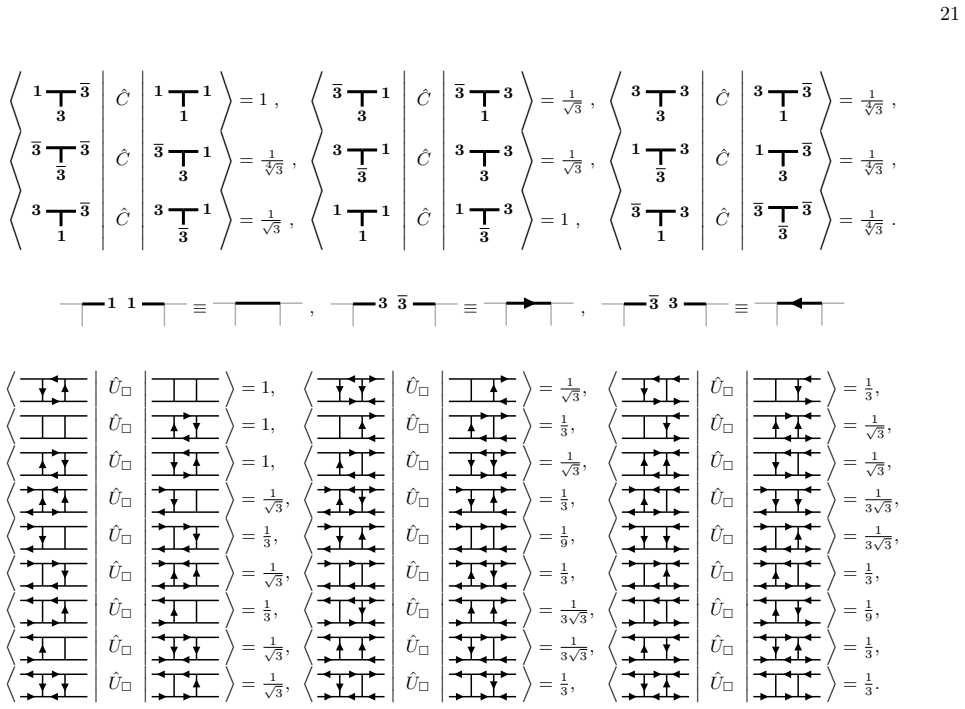
Plaquette operator matrix elements In this subsection, we outline the computation of matrix elementsoftheparalleltransporterinthe ⊤-junctionbasis. The⊤-junction basis, shown in Fig. 12, comprises all singlet states localized on a lattice site with three adjacent links and therefore satisfies Gauss’s law. These states include all possible assignments of ir...
-
[7]
G. S. Bali, QCD forces and heavy quark bound states, Physics Reports343, 1 (2001)
2001
-
[8]
Greensite,An Introduction to the Confinement Prob- lem, Vol
J. Greensite,An Introduction to the Confinement Prob- lem, Vol. 821 (Springer, 2011)
2011
-
[9]
Metz and A
A. Metz and A. Vossen, Parton fragmentation functions, Progress in Particle and Nuclear Physics91, 136 (2016)
2016
-
[10]
Albino, Hadronization of partons, Reviews of Modern Physics82, 2489 (2010)
S. Albino, Hadronization of partons, Reviews of Modern Physics82, 2489 (2010)
2010
-
[11]
Berges, K
J. Berges, K. Boguslavski, S. Schlichting, and R. Venu- gopalan, Turbulent thermalization process in heavy-ion collisions at ultrarelativistic energies, Physical Review D89, 074011 (2014)
2014
-
[12]
M. C. Bañuls, R. Blatt, J. Catani, A. Celi, J. I. Cirac, M. Dalmonte, L. Fallani, K. Jansen, M. Lewenstein, S. Montangero, C. A. Muschik, B. Reznik, E. Rico, L. Tagliacozzo, K. Van Acoleyen, F. Verstraete, U.-J. Wiese, M. Wingate, J. Zakrzewski, and P. Zoller, Simu- lating Lattice Gauge Theories within Quantum Technolo- gies, The European Physical Journal...
2020
-
[13]
Busza, K
W. Busza, K. Rajagopal, and W. Van Der Schee, Heavy ion collisions: The big picture and the big questions, Annual Review of Nuclear and Particle Science68, 339 21 ⟨ 1 3 3 ⏐⏐⏐⏐⏐ ˆC ⏐⏐⏐⏐⏐ 1 1 1 ⟩ = 1, ⟨ 3 3 1 ⏐⏐⏐⏐⏐ ˆC ⏐⏐⏐⏐⏐ 3 1 3 ⟩ = 1√ 3 , ⟨ 3 3 3 ⏐⏐⏐⏐⏐ ˆC ⏐⏐⏐⏐⏐ 3 1 3 ⟩ = 1 4√ 3 , ⟨ 3 3 3 ⏐⏐⏐⏐⏐ ˆC ⏐⏐⏐⏐⏐ 3 3 1 ⟩ = 1 4√ 3 , ⟨ 3 3 1 ⏐⏐⏐⏐⏐ ˆC ⏐⏐⏐⏐⏐ 3 3 3 ⟩ = 1...
2018
-
[14]
Gelis, E
F. Gelis, E. Iancu, J. Jalilian-Marian, and R. Venu- gopalan, The color glass condensate, Annual Review of Nuclear and Particle Science60, 463 (2010)
2010
-
[15]
K. G. Wilson, Confinement of Quarks, Physical Review D10, 2445 (1974)
1974
-
[16]
H. J. Rothe,Lattice Gauge Theories: An Introduction (Fourth Edition)(World Scientific Publishing Company, 2012)
2012
-
[17]
Creutz, Monte Carlo Study of Quantized SU(2) Gauge Theory, Physical Review D21, 2308 (1980)
M. Creutz, Monte Carlo Study of Quantized SU(2) Gauge Theory, Physical Review D21, 2308 (1980)
1980
-
[18]
Creutz, L
M. Creutz, L. Jacobs, and C. Rebbi, Monte Carlo Com- putations in Lattice Gauge Theories, Physics Reports 95, 201 (1983)
1983
-
[19]
Metropolis, A
N. Metropolis, A. W. Rosenbluth, M. N. Rosenbluth, A. H. Teller, and E. Teller, Equation of state calculations by fast computing machines, The journal of chemical physics21, 1087 (1953)
1953
-
[20]
E. Y. Loh, J. E. Gubernatis, R. T. Scalettar, S. R. White, D. J. Scalapino, and R. L. Sugar, Sign Problem in the Numerical Simulation of Many-Electron Systems, Physical Review B41, 9301 (1990)
1990
-
[21]
Troyer and U.-J
M. Troyer and U.-J. Wiese, Computational Complexity and Fundamental Limitations to Fermionic Quantum Monte Carlo Simulations, Physical Review Letters94, 170201 (2005)
2005
-
[22]
Barbour, N.-E
I. Barbour, N.-E. Behilil, E. Dagotto, F. Karsch, A. Moreo, M. Stone, and HW. Wyld, Problems with fi- nite density simulations of lattice QCD, Nuclear Physics B275, 296 (1986)
1986
-
[23]
L. V. Keldysh, Diagram technique for nonequilibrium processes, inSelected Papers of Leonid V Keldysh(World Scientific, 2024) pp. 47–55
2024
-
[24]
Polkovnikov, K
A. Polkovnikov, K. Sengupta, A. Silva, and M. Vengalat- tore, Colloquium: Nonequilibrium dynamics of closed interactingquantumsystems,ReviewsofModernPhysics 83, 863 (2011)
2011
-
[25]
Fannes, B
M. Fannes, B. Nachtergaele, and R. F. Werner, Finitely correlated states on quantum spin chains, Communica- tions in Mathematical Physics144, 443 (1992)
1992
-
[26]
Östlund and S
S. Östlund and S. Rommer, Thermodynamic limit of density matrix renormalization, Physical Review Letters 75, 3537 (1995)
1995
-
[27]
S. R. White, Density Matrix Formulation for Quantum Renormalization Groups, Physical Review Letters69, 2863 (1992)
1992
-
[28]
S. Abel, M. Spannowsky, and S. Williams, Real-Time Scattering Processes with Continuous-Variable Quantum Computers, Physical Review A112, 012614 (2025)
2025
-
[29]
Schollwöck, The density-matrix renormalization group, Rev
U. Schollwöck, The density-matrix renormalization group, Rev. Mod. Phys.77, 259 (2005)
2005
-
[30]
Haegeman, J
J. Haegeman, J. I. Cirac, T. J. Osborne, I. Pižorn, H. Ver- 22 schelde, and F. Verstraete, Time-dependent variational principle for quantum lattices, Physical Review Letters 107, 070601 (2011)
2011
-
[31]
Haegeman, B
J. Haegeman, B. Pirvu, D. J. Weir, J. I. Cirac, T. J. Osborne, H. Verschelde, and F. Verstraete, Variational matrix product ansatz for dispersion relations, Physical Review B85, 100408 (2012)
2012
-
[32]
R. P. Feynman, Simulating physics with computers, in Feynman and Computation(cRc Press, 2018) pp. 133– 153
2018
-
[33]
Lloyd, Universal quantum simulators, Science273, 1073 (1996)
S. Lloyd, Universal quantum simulators, Science273, 1073 (1996)
1996
-
[34]
C. W. Bauer, Z. Davoudi, N. Klco, and M. J. Sav- age, Quantum Simulation of Fundamental Particles and Forces, Nature Reviews Physics5, 420 (2023)
2023
-
[35]
Kogut and L
J. Kogut and L. Susskind, Hamiltonian Formulation of Wilson’s Lattice Gauge Theories, Physical Review D11, 395 (1975)
1975
-
[36]
J. B. Kogut, An Introduction to Lattice Gauge Theory and Spin Systems, Reviews of Modern Physics51, 659 (1979)
1979
-
[37]
Chandrasekharan and U
S. Chandrasekharan and U. J. Wiese, Quantum Link Models: A Discrete Approach to Gauge Theories, Nu- clear Physics B492, 455 (1997)
1997
-
[38]
Zohar and M
E. Zohar and M. Burrello, Formulation of Lattice Gauge Theories for Quantum Simulations, Physical Review D 91, 054506 (2015)
2015
-
[39]
Buyens, S
B. Buyens, S. Montangero, J. Haegeman, F. Verstraete, and K. Van Acoleyen, Finite-Representation Approxima- tion of Lattice Gauge Theories at the Continuum Limit with Tensor Networks, Physical Review D95, 094509 (2017)
2017
-
[40]
Bañuls, K
M. Bañuls, K. Cichy, J. Cirac, and K. Jansen, The Mass Spectrum of the Schwinger Model with Matrix Product States, Journal of High Energy Physics2013, 158 (2013)
2013
-
[41]
Buyens, J
B. Buyens, J. Haegeman, K. Van Acoleyen, H. Ver- schelde, and F. Verstraete, Matrix Product States for Gauge Field Theories, Physical Review Letters113, 091601 (2014)
2014
-
[42]
M. C. Bañuls, K. Cichy, K. Jansen, and H. Saito, Chiral condensate in the Schwinger model with matrix product operators, Physical Review D93, 094512 (2016)
2016
-
[43]
Felser, P
T. Felser, P. Silvi, M. Collura, and S. Montangero, Two- Dimensional Quantum-Link Lattice Quantum Electrody- namics at Finite Density, Physical Review X10, 041040 (2020)
2020
-
[44]
Magnifico, T
G. Magnifico, T. Felser, P. Silvi, and S. Montangero, Lattice quantum electrodynamics in (3+1)-dimensions at finite density with tensor networks, Nature Commu- nications12, 3600 (2021)
2021
-
[45]
Cataldi, G
G. Cataldi, G. Magnifico, P. Silvi, and S. Montangero, Simulating(2+1)DSU(2) yang-mills lattice gauge theory at finite density with tensor networks, Phys. Rev. Res. 6, 033057 (2024)
2024
-
[46]
M. Rigobello, G. Magnifico, P. Silvi, and S. Montangero, Hadrons in (1+1)D hamiltonian hardcore lattice QCD (2023), arXiv:2308.04488
-
[47]
Eisert, M
J. Eisert, M. Cramer, and M. B. Plenio, Colloquium: Area Laws for the Entanglement Entropy, Reviews of Modern Physics82, 277 (2010)
2010
-
[48]
Vidal, Efficient Simulation of One-Dimensional Quan- tum Many-Body Systems, Physical Review Letters93, 040502 (2004)
G. Vidal, Efficient Simulation of One-Dimensional Quan- tum Many-Body Systems, Physical Review Letters93, 040502 (2004)
2004
-
[49]
Rigobello, S
M. Rigobello, S. Notarnicola, G. Magnifico, and S. Mon- tangero, Entanglement Generation in (1+1)D QED Scat- tering Processes, Physical Review D104, 114501 (2021)
2021
-
[50]
Belyansky, S
R. Belyansky, S. Whitsitt, N. Mueller, A. Fahimniya, E. R. Bennewitz, Z. Davoudi, and A. V. Gorshkov, High- Energy Collision of Quarks and Mesons in the Schwinger Model: From Tensor Networks to Circuit QED, Physical Review Letters132, 091903 (2024)
2024
-
[51]
Byrnes and Y
T. Byrnes and Y. Yamamoto, Simulating Lattice Gauge Theories on a Quantum Computer, Physical Review A 73, 022328 (2006)
2006
-
[52]
Zohar, J
E. Zohar, J. I. Cirac, and B. Reznik, Quantum simu- lations of gauge theories with ultracold atoms: Local gauge invariance from angular momentum conservation, Physical Review A88, 023617 (2013)
2013
- [53]
-
[54]
M. V. Damme, L. Vanderstraeten, J. D. Nardis, J. Haege- man, and F. Verstraete, Real-time scattering of inter- acting quasiparticles in quantum spin chains, Physical Review Research3, 013078 (2021)
2021
-
[55]
Milsted, J
A. Milsted, J. Liu, J. Preskill, and G. Vidal, Collisions of False-Vacuum Bubble Walls in a Quantum Spin Chain, PRX Quantum3, 020316 (2022)
2022
-
[56]
R. G. Jha, A. Milsted, D. Neuenfeld, J. Preskill, and P. Vieira, Real-Time Scattering in Ising Field Theory using Matrix Product States, Physical Review Research 7, 023266 (2025)
2025
-
[57]
S. R. White, Site basis excitation ansatz for matrix product states (2026), arXiv:2509.06241 [cond-mat.str- el]
work page internal anchor Pith review Pith/arXiv arXiv 2026
-
[58]
Pichler, M
T. Pichler, M. Dalmonte, E. Rico, P. Zoller, and S. Mon- tangero, Real-Time Dynamics in U(1) Lattice Gauge Theories with Tensor Networks, Physical Review X6, 011023 (2016)
2016
-
[59]
F. M. Surace and A. Lerose, Scattering of mesons in quantum simulators, New Journal of Physics23, 062001 (2021)
2021
-
[60]
Davoudi, C.-C
Z. Davoudi, C.-C. Hsieh, and S. V. Kadam, Scattering wave packets of hadrons in gauge theories: Preparation on a quantum computer, Quantum8, 1520 (2024)
2024
-
[61]
Papaefstathiou, J
I. Papaefstathiou, J. Knolle, and M. C. Bañuls, Real- time scattering in the lattice Schwinger model, Physical Review D111, 014504 (2025)
2025
-
[62]
Z. Davoudi, C.-C. Hsieh, and S. V. Kadam, Quantum computation of hadron scattering in a lattice gauge theory (2025), arXiv:2505.20408
-
[63]
J. Barata and E. Rico, Real-Time Simulation of Jet Energy Loss and Entropy Production in High-Energy Scattering with Matter (2025), arXiv:2502.17558
-
[64]
Calliari, M
G. Calliari, M. D. Liberto, H. Pichler, and T. V. Zache, Quantum simulating continuum field theories with large- spin lattice models, PRX Quantum6, 030304 (2025)
2025
-
[65]
G.-X. Su, J. J. Osborne, and J. C. Halimeh, Cold-Atom Particle Collider, PRX Quantum5, 040310 (2024)
2024
- [66]
-
[67]
J. Schuhmacher, G.-X. Su, J. J. Osborne, A. Gandon, J. C. Halimeh, and I. Tavernelli, Observation of hadron scattering in a lattice gauge theory on a quantum com- puter (2025), arXiv:2505.20387
-
[68]
Y. Chai, A. Crippa, K. Jansen, S. Kühn, V. R. Pascuzzi, 23 F. Tacchino, and I. Tavernelli, Fermionic wave packet scattering: A quantum computing approach, Quantum 9, 1638 (2025)
2025
- [69]
-
[70]
J. Ingoldby, M. Spannowsky, T. Sypchenko, S. Williams, and M. Wingate, Real-time scattering on quan- tum computers via hamiltonian truncation (2025), arXiv:2505.03878
-
[71]
L. Pavešić, M. D. Liberto, and S. Montangero, Scattering and induced false vacuum decay in the two-dimensional quantum ising model (2026), arXiv:2509.02702
- [72]
-
[73]
Hadronic scattering in (1+1)D SU(2) lattice gauge theory from tensor networks
J. Barata, J. Hormaza, Z.-B. Kang, and W. Qian, Hadronic scattering in (1+1)D SU(2) lattice gauge the- ory from tensor networks (2025), arXiv:2511.00154
work page internal anchor Pith review arXiv 2025
-
[74]
Turco, G
M. Turco, G. m. c. Quinta, J. a. Seixas, and Y. Omar, Quantum simulation of bound state scattering, PRX Quantum5, 020311 (2024)
2024
-
[75]
Turco, G
M. Turco, G. m. c. Quinta, J. a. Seixas, and Y. Omar, Creation of wave packets for quantum chromodynam- ics on quantum computers, Phys. Rev. D112, 034506 (2025)
2025
-
[76]
G. H. Wannier, The Structure of Electronic Excitation Levels in Insulating Crystals, Physical Review52, 191 (1937)
1937
-
[77]
Kohn, Analytic Properties of Bloch Waves and Wan- nier Functions, Physical Review115, 809 (1959)
W. Kohn, Analytic Properties of Bloch Waves and Wan- nier Functions, Physical Review115, 809 (1959)
1959
-
[78]
Marzari and D
N. Marzari and D. Vanderbilt, Maximally localized gen- eralized Wannier functions for composite energy bands, Physical Review B56, 12847 (1997)
1997
-
[79]
Marzari, A
N. Marzari, A. A. Mostofi, J. R. Yates, I. Souza, and D. Vanderbilt, Maximally localized Wannier functions: Theory and applications, Reviews of Modern Physics84, 1419 (2012)
2012
-
[80]
Silvi, F
P. Silvi, F. Tschirsich, M. Gerster, J. Jünemann, D. Jaschke, M. Rizzi, and S. Montangero, The Tensor Networks Anthology: Simulation Techniques for Many- Body Quantum Lattice Systems, SciPost Physics Lecture Notes , 008 (2019)
2019
discussion (0)
Sign in with ORCID, Apple, or X to comment. Anyone can read and Pith papers without signing in.