Recognition: 2 theorem links
· Lean TheoremFunctional Similarity Metric for Neural Networks: Overcoming Parametric Ambiguity via Activation Region Analysis
Pith reviewed 2026-05-13 17:44 UTC · model grok-4.3
The pith
Neural networks can be compared by the topology of their activation regions rather than their raw weights, removing permutation and scaling ambiguities.
A machine-rendered reading of the paper's core claim, the machinery that carries it, and where it could break.
Core claim
The central claim is that discrete binary signatures of neuron activation regions, obtained after L2-normalization to eliminate scaling, combined with MinHash approximation of the Jaccard index and Hungarian assignment for neuron matching, yield a functional similarity metric that is invariant under neuron permutation and positive diagonal scaling and remains stable under small weight perturbations.
What carries the argument
Binary functional signature of activation regions: the pattern of which neurons fire for each input in a finite sample, used as a discrete topological descriptor of each neuron’s role.
If this is right
- Neuron matching becomes stable across independently trained models, allowing reliable identification of corresponding units for merging.
- Pruning decisions can be guided by functional redundancy rather than weight magnitude, reducing the risk of removing critical neurons.
- Transfer learning can align layers by functional role instead of index, improving initialization quality.
- Model merging can proceed without post-merge fine-tuning to correct for flickering neurons.
Where Pith is reading between the lines
- The same activation-region signatures could track how a network’s functional decomposition evolves during training.
- If extended to other piecewise-linear activations, the metric might serve as a general tool for comparing networks across different activation families.
- The approach suggests a route to canonical forms for entire networks that could be used to detect functional equivalence classes in large model zoos.
Load-bearing premise
Binary activation patterns over a chosen finite data sample are sufficient to distinguish functionally distinct neurons without introducing new ambiguities from sampling or discretization.
What would settle it
Two networks that realize identical input-output functions yet produce substantially different binary activation signatures on the same data sample would show the metric fails to capture functional equivalence.
Figures

read the original abstract
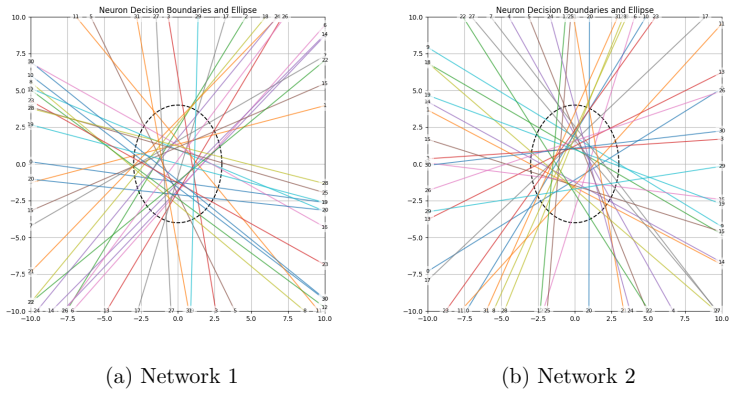
As modern deep learning architectures grow in complexity, representational ambiguity emerges as a critical barrier to their interpretability and reliable merging. For ReLU networks, identical functional mappings can be achieved through entirely different weight configurations due to algebraic symmetries: neuron permutation and positive diagonal scaling. Consequently, traditional parameter-based comparison methods exhibit extreme instability to slight weight perturbations during training. This paper proposes a mathematically grounded approach to constructing a stable canonical representation of neural networks and a robust functional similarity metric. We shift focus from comparing raw weights to analyzing the topology of neuron activation regions. The algorithm first eliminates scaling ambiguity via L2-normalization of weight vectors with subsequent layer compensation. Next, discrete approximations of activation regions are generated as binary functional signatures evaluated over a data sample. To overcome the computational bottleneck of comparing large binary vectors, we adapt Locality-Sensitive Hashing, specifically MinHash, providing a fast and statistically precise approximation of the Jaccard index. The final cross-network neuron matching is formulated as a linear sum assignment problem solved via the Hungarian algorithm. We demonstrate theoretically and experimentally that our metric mitigates the neuron "flickering" effect and exhibits exceptional robustness to minor weight perturbations. This framework provides a solid foundation for model merging, transfer learning, objective assessment during pruning, and Explainable AI paradigms.
Editorial analysis
A structured set of objections, weighed in public.
Referee Report
Summary. The paper proposes a functional similarity metric for ReLU networks to resolve parametric ambiguities (neuron permutation and positive scaling) that cause instability in weight-based comparisons. The approach first applies L2-normalization to weight vectors with layer compensation, then constructs discrete binary signatures of activation regions by evaluating ReLU patterns on a finite data sample, approximates Jaccard similarity via MinHash, and solves neuron matching as a linear assignment problem using the Hungarian algorithm. The central claim is that this yields a stable metric that mitigates neuron flickering and exhibits strong robustness to minor weight perturbations, supported by theoretical arguments and experiments, with applications to model merging, pruning, and XAI.
Significance. If the robustness claims hold under the stated construction, the metric would provide a useful tool for functional comparison of networks that is less sensitive to training-induced parameter variations than direct weight matching, potentially aiding reliable model merging and interpretability studies. The shift to activation-region topology is a coherent direction, though its practical value depends on whether finite-sample signatures reliably capture the relevant functional distinctions.
major comments (2)
- [§3] §3 (Activation region analysis and binary signatures): The theoretical claim that the metric mitigates flickering and is robust to perturbations rests on the unstated assumption that a finite data sample produces binary signatures that recover the full topological partition of activation regions. Because ReLU regions are unbounded polyhedral cones whose boundaries are hyperplanes, a finite sample can miss entire cones or boundaries in high-dimensional space, allowing functionally inequivalent networks to receive identical signatures. This assumption is load-bearing for the central robustness result and requires either sample-size bounds or explicit error analysis.
- [Abstract and §4] Abstract and §4 (theoretical demonstration): The abstract states that theoretical and experimental support is provided for robustness, yet no derivation details, error bounds on the MinHash approximation, or analysis of how sample size and data distribution affect the Jaccard estimate or final similarity score are supplied. Without these, it is not possible to verify that the metric remains parameter-free or that the reported stability is not an artifact of the chosen sampling procedure.
minor comments (1)
- [§2] Notation for the normalized weight vectors and the subsequent layer compensation step could be clarified with an explicit equation showing how scaling factors are propagated across layers.
Simulated Author's Rebuttal
We thank the referee for the insightful and constructive comments. We provide point-by-point responses to the major comments below, indicating where revisions will be made to address the concerns.
read point-by-point responses
-
Referee: [§3] §3 (Activation region analysis and binary signatures): The theoretical claim that the metric mitigates flickering and is robust to perturbations rests on the unstated assumption that a finite data sample produces binary signatures that recover the full topological partition of activation regions. Because ReLU regions are unbounded polyhedral cones whose boundaries are hyperplanes, a finite sample can miss entire cones or boundaries in high-dimensional space, allowing functionally inequivalent networks to receive identical signatures. This assumption is load-bearing for the central robustness result and requires either sample-size bounds or explicit error analysis.
Authors: We acknowledge the validity of this concern. The use of a finite data sample for constructing binary signatures is indeed an approximation that may not capture all unbounded activation regions in high dimensions. Our robustness claims are based on the observation that for small weight perturbations, the sampled signatures remain consistent in practice, as demonstrated in our experiments. To strengthen the theoretical foundation, we will revise the manuscript to include a discussion of the sampling limitations, potential error sources, and practical guidelines for choosing sample sizes relative to the input dimensionality. We will also reference results on the number of linear regions in ReLU networks to provide probabilistic guarantees where possible. This constitutes a partial revision as deriving tight, general sample-size bounds may require substantial additional analysis. revision: partial
-
Referee: [Abstract and §4] Abstract and §4 (theoretical demonstration): The abstract states that theoretical and experimental support is provided for robustness, yet no derivation details, error bounds on the MinHash approximation, or analysis of how sample size and data distribution affect the Jaccard estimate or final similarity score are supplied. Without these, it is not possible to verify that the metric remains parameter-free or that the reported stability is not an artifact of the chosen sampling procedure.
Authors: We agree that additional details would enhance the clarity and verifiability of our theoretical claims. The MinHash approximation for Jaccard similarity has standard error bounds from the literature, which we will now explicitly derive and include in the revised §4. Furthermore, we will add an analysis of the impact of sample size on the Jaccard estimate, including convergence rates and sensitivity to the data distribution. Regarding parameter-freeness, the core metric computation does not require tuning beyond the choice of sample, which we will clarify. These additions will be incorporated in the revised manuscript. revision: yes
Circularity Check
No significant circularity in the metric derivation
full rationale
The paper constructs its functional similarity metric through a sequence of independent algorithmic steps: L2-normalization of weight vectors to eliminate scaling ambiguity, generation of discrete binary signatures from ReLU activation patterns evaluated on a data sample, MinHash approximation of Jaccard similarity, and Hungarian algorithm for neuron matching. These operations are defined directly from the network weights and input data without reducing any output quantity to a fitted parameter or self-referential definition. No self-citations are invoked as load-bearing premises for uniqueness or ansatz choices, and the theoretical demonstration of robustness is presented as following from the construction rather than presupposing the target result. The derivation chain remains self-contained against external benchmarks.
Axiom & Free-Parameter Ledger
axioms (1)
- domain assumption Activation regions of ReLU networks determine functional equivalence up to permutation and positive scaling symmetries
Lean theorems connected to this paper
-
IndisputableMonolith/Cost/FunctionalEquation.leanwashburn_uniqueness_aczel unclear?
unclearRelation between the paper passage and the cited Recognition theorem.
We shift focus from comparing raw weights to analyzing the topology of neuron activation regions... discrete approximations... binary functional signatures... Jaccard index... MinHash... Hungarian algorithm.
-
IndisputableMonolith/Foundation/AbsoluteFloorClosure.leanabsolute_floor_iff_bare_distinguishability unclear?
unclearRelation between the paper passage and the cited Recognition theorem.
L2 normalization of weight vectors with subsequent layer compensation... positive diagonal scaling group (D) and neuron permutation group (P)
What do these tags mean?
- matches
- The paper's claim is directly supported by a theorem in the formal canon.
- supports
- The theorem supports part of the paper's argument, but the paper may add assumptions or extra steps.
- extends
- The paper goes beyond the formal theorem; the theorem is a base layer rather than the whole result.
- uses
- The paper appears to rely on the theorem as machinery.
- contradicts
- The paper's claim conflicts with a theorem or certificate in the canon.
- unclear
- Pith found a possible connection, but the passage is too broad, indirect, or ambiguous to say the theorem truly supports the claim.
Reference graph
Works this paper leans on
-
[1]
K., Hayase, J., and Srinivasa, S
Samuel K. Ainsworth, Jonathan Hayase, and Siddhartha S. Srinivasa. Git re-basin: Merging models modulo permutation symmetries. arXiv preprint arXiv:2209.04836, Sep 2022. Version 6, last revised 1 Mar 2023
-
[2]
Igor A. Antonov and Viktor M. Saleev. An economic method of comput- ing lpτ -sequences. USSR Computational Mathematics and Mathematical Physics, 19(1):252–256, 1979
work page 1979
-
[3]
Mathe- matical Programming Models for Exact and Interpretable Formulation of Neural Networks
Masoud Ataei, Edrin Hasaj, Jacob Gipp, and Sepideh Forouzi. Mathe- matical Programming Models for Exact and Interpretable Formulation of Neural Networks. arXiv preprint arXiv:2504.14356 , Apr 2025
-
[4]
Anselm Blumer, Andrzej Ehrenfeucht, David Haussler, and Manfred K. Warmuth. Learnability and the vapnik-chervonenkis dimension. Journal of the ACM , 36(4):929–965, 1989
work page 1989
-
[5]
Andrei Z. Broder. On the resemblance and containment of documents. In Proceedings. Compression and Complexity of SEQUENCES 1997 (Cat. No.97TB100171), pages 21–29. IEEE, 1997
work page 1997
-
[6]
LSH-preserving functions and their applications
Flavio Chierichetti and Ravi Kumar. LSH-preserving functions and their applications. Journal of the ACM , 62(5):33:1–33:28, 2015. Tight char- acterization of LSH-preserving transformations
work page 2015
-
[7]
Luc Devroye, László Györfi, and Gábor Lugosi. A Probabilistic Theory of Pattern Recognition , volume 31 of Stochastic Modelling and Applied Probability. Springer, New York, 1996
work page 1996
- [8]
-
[9]
Chapter 6: Deep Feedforward Networks. 88
-
[10]
Delving deep into rectifiers: Surpassing human-level performance on imagenet classi- fication
Kaiming He, Xiangyu Zhang, Shaoqing Ren, and Jian Sun. Delving deep into rectifiers: Surpassing human-level performance on imagenet classi- fication. IEEE International Conference on Computer Vision (ICCV) , pages 1026–1034, 2015
work page 2015
-
[11]
Approximate nearest neighbors: To- wards removing the curse of dimensionality
Piotr Indyk and Rajeev Motwani. Approximate nearest neighbors: To- wards removing the curse of dimensionality. In Proceedings of the Thir- tieth Annual ACM Symposium on Theory of Computing (STOC) , pages 604–613. ACM, 1998
work page 1998
-
[12]
Cs231n: Convolutional neural networks for visual recognition, 2015
Andrej Karpathy. Cs231n: Convolutional neural networks for visual recognition, 2015. Stanford University Course Notes
work page 2015
-
[13]
Michael J. Kearns and Umesh V. Vazirani. An Introduction to Compu- tational Learning Theory . MIT Press, Cambridge, MA, 1994
work page 1994
-
[14]
Jure Leskovec, Anand Rajaraman, and Jeffrey David Ullman. Mining of Massive Datasets . Cambridge University Press, 2nd edition, 2014. Chapter 3 covers Locality-Sensitive Hashing
work page 2014
-
[15]
Yixuan Li, Jason Yosinski, Jeff Clune, Hod Lipson, and John E. Hopcroft. Convergent learning: Do different neural networks learn the same representations? In Proceedings of the 4th International Confer- ence on Learning Representations (ICLR) , 2016. Published as a confer- ence paper at ICLR 2016
work page 2016
-
[16]
Normalization and effective learning rates in reinforcement learning
Clare Lyle, Zeyu Zheng, Khimya Khetarpal, James Martens, Hado van Hasselt, Razvan Pascanu, and Will Dabney. Normalization and effective learning rates in reinforcement learning. arXiv preprint arXiv:2407.01800, Jul 2024
- [17]
-
[18]
Michael D. McKay, Richard J. Beckman, and William J. Conover. A comparison of three methods for selecting values of input variables in the analysis of output from a computer code. Technometrics, 21(2):239–245, 1979
work page 1979
-
[19]
Understanding the role of training regimes in contin- ual learning
Seyed Iman Mirzadeh, Mehrdad Farajtabar, Razvan Pascanu, and Has- san Ghasemzadeh. Understanding the role of training regimes in contin- ual learning. arXiv preprint arXiv:2006.06958 , Jun 2020. 89
-
[20]
Founda- tions of Machine Learning
Mehryar Mohri, Afshin Rostamizadeh, and Ameet Talwalkar. Founda- tions of Machine Learning . Adaptive Computation and Machine Learn- ing. MIT Press, Cambridge, MA, 2nd edition, 2018
work page 2018
-
[21]
Meth- ods for interpreting and understanding deep neural networks
Grégoire Montavon, Wojciech Samek, and Klaus-Robert Müller. Meth- ods for interpreting and understanding deep neural networks. In Digital Signal Processing, volume 73, pages 1–15, 2017
work page 2017
-
[22]
Vinod Nair and Geoffrey E. Hinton. Rectified Linear Units Improve Restricted Boltzmann Machines . 2010
work page 2010
-
[23]
Low-discrepancy and low-dispersion sequences
Harald Niederreiter. Low-discrepancy and low-dispersion sequences. Journal of Number Theory , 30(1):51–70, 1988
work page 1988
-
[24]
Art B. Owen. Quasi-monte carlo sampling. SIGGRAPH Course Notes ,
-
[25]
Monte Carlo and Quasi-Monte Carlo Methods in Scientific Com- puting
-
[26]
ReLU Neural Networks with Linear Layers are Biased Towards Single- and Multi- Index Models
Suzanna Parkinson, Greg Ongie, and Rebecca Willett. ReLU Neural Networks with Linear Layers are Biased Towards Single- and Multi- Index Models. arXiv preprint arXiv:2305.15598 , May 2023. Last revised 17 Mar 2025
-
[27]
Davide Sartor, Alberto Sinigaglia, and Gian Antonio Susto. Advancing constrained monotonic neural networks: Achieving universal approxi- mation beyond bounded activations. arXiv preprint arXiv:2505.02537 , May 2025. Last revised 6 May 2025
-
[28]
Neural predictors for detecting and removing re- dundant information
Jürgen Schmidhuber. Neural predictors for detecting and removing re- dundant information. pages 1–18, 2000
work page 2000
-
[29]
Scaling up exact neural network compression by ReLU stability
Thiago Serra, Abhinav Kumar, Xin Yu, and Srikumar Ramalingam. Scaling up exact neural network compression by ReLU stability. In M. Ranzato, A. Beygelzimer, Y. Dauphin, P.S. Liang, and J. Wortman Vaughan, editors, Advances in Neural Information Processing Systems 34 (NeurIPS 2021) , pages 26097–26109, 2021
work page 2021
-
[30]
Understanding Machine Learning: From Theory to Algorithms
Shai Shalev-Shwartz and Shai Ben-David. Understanding Machine Learning: From Theory to Algorithms . Cambridge University Press, 2014
work page 2014
-
[31]
Open Problems in Mechanistic Interpretability
Lee Sharkey, Bilal Chughtai, Joshua Batson, Jack Lindsey, Jeff Wu, Lucius Bushnaq, Nicholas Goldowsky-Dill, Stefan Heimersheim, Ale- jandro Ortega, Joseph Bloom, Stella Biderman, Adria Garriga-Alonso, 90 Arthur Conmy, Neel Nanda, Jessica Rumbelow, Martin Wattenberg, Nandi Schoots, Joseph Miller, Eric J. Michaud, Stephen Casper, Max Tegmark, William Saunde...
work page internal anchor Pith review arXiv 2025
-
[32]
Ilya M. Sobol’ . On the distribution of points in a cube and the approx- imate evaluation of integrals. USSR Computational Mathematics and Mathematical Physics , 7(4):86–112, 1967
work page 1967
-
[33]
Eduardo D. Sontag. Vc dimension of neural networks. In Christopher M. Bishop, editor, Neural Networks and Machine Learning , pages 69–95. Springer, Berlin, 1998
work page 1998
-
[34]
Joseph Tatro, Pin-Yu Chen, Payel Das, Igor Melnyk, Prasanna Sat- tigeri, and Rongjie Lai
N. Joseph Tatro, Pin-Yu Chen, Payel Das, Igor Melnyk, Prasanna Sat- tigeri, and Rongjie Lai. Optimizing mode connectivity via neuron align- ment. In H. Larochelle, M. Ranzato, R. Hadsell, M.F. Balcan, and H. Lin, editors, Advances in Neural Information Processing Systems 33 (NeurIPS 2020) , 2020. arXiv:2009.02439 [cs.LG]
-
[35]
Viet-Hoang Tran, Thieu N. Vo, Tho H. Tran, An T. Nguyen, and Tan M. Nguyen. Monomial matrix group equivariant neural functional networks. In Advances in Neural Information Processing Systems 37 (NeurIPS 2024), Sep 2024. Published at NeurIPS 2024. arXiv version 3, last revised 13 Mar 2025
work page 2024
-
[36]
V. N. Vapnik and A. Ya. Chervonenkis. On the uniform convergence of relative frequencies of events to their probabilities. Theory of Proba- bility and Its Applications , 16(2):264–280, 1971. English translation by B. Seckler of the Russian paper published in Dokl. Akad. Nauk SSSR 181(4):781-783, 1968
work page 1971
-
[37]
Vladimir N. Vapnik. Statistical Learning Theory . Wiley-Interscience, New York, 1998
work page 1998
-
[38]
Empirical evalua- tion of rectified activations in convolutional network
Bing Xu, Naiyan Wang, Tianqi Chen, and Mu Li. Empirical evalua- tion of rectified activations in convolutional network. arXiv preprint arXiv:1505.00853, 2015
-
[39]
Efficient Neural Network Robustness Certification with General Activation Functions
Huan Zhang, Tsui-Wei Weng, Pin-Yu Chen, Cho-Jui Hsieh, and Luca Daniel. Efficient neural network robustness certification with general 91 activation functions. In S. Bengio, H. Wallach, H. Larochelle, K. Grau- man, N. Cesa-Bianchi, and R. Garnett, editors, Advances in Neural In- formation Processing Systems 31 (NIPS 2018) , 2018. arXiv:1811.00866 [cs.LG]. 92
work page Pith review arXiv 2018
discussion (0)
Sign in with ORCID, Apple, or X to comment. Anyone can read and Pith papers without signing in.