Recognition: no theorem link
Signature of Unconventional Superconductivity in the High Temperature Normal State Resistivity
Pith reviewed 2026-05-10 18:52 UTC · model grok-4.3
The pith
Machine learning finds that resistivity data from 150-300 K predicts superconductivity in iron-based materials.
A machine-rendered reading of the paper's core claim, the machinery that carries it, and where it could break.
Core claim
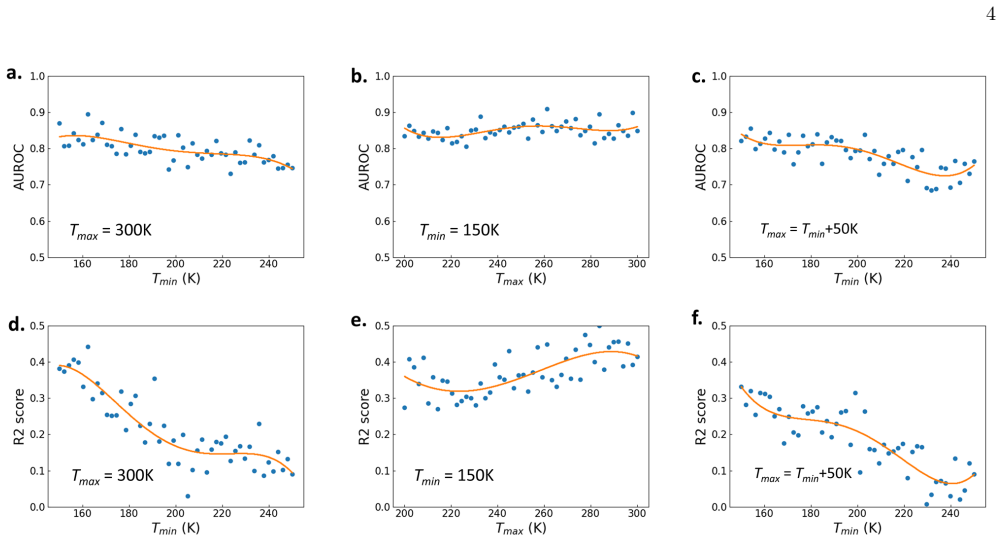
Using machine learning on normal-state resistivity data, we demonstrate a strong correlation between normal-state resistivity and superconductivity in Fe-based superconductors. Remarkably, the predictive information resides in the wide window of 150-300 K, far above Tc of this family. We further show that the signatures of superconductivity are distributed across multiple scattering channels, which requires further theoretical investigation.
What carries the argument
Machine learning model that extracts predictive features from temperature-dependent resistivity curves specifically in the 150-300 K interval to forecast superconducting behavior.
If this is right
- The pairing mechanism in these unconventional superconductors imprints detectable signatures on resistivity at temperatures several times higher than Tc.
- Multiple distinct scattering channels in the normal state each carry information relevant to superconductivity rather than a single dominant process.
- Theoretical models of the pairing mechanism must incorporate or explain the observed high-temperature transport properties in addition to low-temperature behavior.
- Resistivity measurements in the 150-300 K range could serve as a practical screening tool for identifying new candidate superconductors without requiring millikelvin temperatures.
Where Pith is reading between the lines
- The same machine-learning approach might reveal analogous high-temperature resistivity signatures in other families of unconventional superconductors such as cuprates or heavy-fermion compounds.
- If the extracted features can be mapped to specific microscopic quantities like scattering rates or susceptibilities, they could constrain or guide the development of microscopic theories.
- Controlled experiments that vary doping, pressure, or disorder while tracking both the resistivity window and Tc could test whether the correlation strength scales with the superconducting dome.
Load-bearing premise
The machine learning correlations reflect genuine physical links to the superconducting mechanism rather than statistical artifacts or overfitting within the available collection of Fe-based samples.
What would settle it
Train the model on one subset of Fe-based resistivity curves and test its predictions on an independent set of previously unexamined Fe-based compounds by measuring their actual superconducting transition temperatures.
Figures


read the original abstract
Unconventional superconductivity remains one of the central unsolved problems in quantum materials, and revealing its connection to the normal state is widely believed to be key to uncovering the pairing mechanism. Previous efforts have largely focused on the temperature range immediately above the superconducting transition, where specific scattering channels-such as strange-metal transport-have been identified as sharing a possible microscopic origin with superconductivity. Here, using machine learning, we demonstrate a strong correlation between normal-state resistivity and superconductivity in Fe-based superconductors. Remarkably, the predictive information reside in a wide window of 150-300 K, far above $T_c$ of this family. We further show that the signatures of superconductivity are distributed across multiple scattering channels, which requires further theoretical investigation.
Editorial analysis
A structured set of objections, weighed in public.
Referee Report
Summary. The paper claims that machine learning applied to normal-state resistivity curves of Fe-based superconductors reveals a strong correlation with superconductivity, with the key predictive information residing in the 150-300 K temperature window far above Tc; it further asserts that this signature is distributed across multiple scattering channels.
Significance. If the ML correlation proves robust, the result would suggest that high-temperature normal-state transport encodes information about the pairing mechanism in iron-based superconductors, potentially broadening the search for microscopic links beyond the immediate vicinity of Tc and motivating new theoretical work on multi-channel scattering.
major comments (3)
- [Abstract] Abstract: the assertion of a 'strong correlation' is presented without any quantitative performance metrics (e.g., R², classification accuracy, or cross-validated error), dataset cardinality, or compound list, making it impossible to judge whether the result exceeds what would be expected from a small, chemically related sample set.
- [Methods] Methods (or equivalent section describing the ML pipeline): no information is supplied on model architecture, training/validation splits, cross-validation strategy, regularization, or ablation tests that would rule out overfitting to shared non-universal traits such as doping ranges or measurement protocols common to the Fe-based family.
- [Results] Results section on temperature-window analysis: the claim that predictive power is localized to 150-300 K requires explicit comparison (e.g., feature-importance or window-ablation curves) against other temperature intervals; without this, the specificity of the window remains untested.
minor comments (2)
- [Abstract] Abstract: grammatical error ('the predictive information reside' should read 'resides').
- The phrase 'multiple scattering channels' is used without defining how these channels were extracted or distinguished from the resistivity data.
Simulated Author's Rebuttal
We thank the referee for the constructive feedback, which highlights important aspects for improving the clarity and rigor of our work. We will revise the manuscript to incorporate quantitative metrics, expanded methodological details, and additional analyses supporting the temperature-window claims. Our responses to each major comment are provided below.
read point-by-point responses
-
Referee: [Abstract] Abstract: the assertion of a 'strong correlation' is presented without any quantitative performance metrics (e.g., R², classification accuracy, or cross-validated error), dataset cardinality, or compound list, making it impossible to judge whether the result exceeds what would be expected from a small, chemically related sample set.
Authors: We agree that the abstract would benefit from explicit quantitative details to allow proper evaluation of the correlation strength. In the revised manuscript, we will add performance metrics including cross-validated classification accuracy and error rates, the total number of resistivity curves in the dataset, and a summary of the compounds included. These additions will clarify that the reported correlation is evaluated against appropriate baselines and is not limited to a trivially small or homogeneous set. revision: yes
-
Referee: [Methods] Methods (or equivalent section describing the ML pipeline): no information is supplied on model architecture, training/validation splits, cross-validation strategy, regularization, or ablation tests that would rule out overfitting to shared non-universal traits such as doping ranges or measurement protocols common to the Fe-based family.
Authors: We acknowledge the need for a transparent description of the machine-learning pipeline to address potential concerns about overfitting. The revised Methods section will specify the model architecture, the procedure for training/validation splits, the cross-validation strategy employed, regularization methods used, and results from ablation tests that explicitly check robustness against family-specific features such as common doping ranges or experimental protocols. revision: yes
-
Referee: [Results] Results section on temperature-window analysis: the claim that predictive power is localized to 150-300 K requires explicit comparison (e.g., feature-importance or window-ablation curves) against other temperature intervals; without this, the specificity of the window remains untested.
Authors: We will strengthen the temperature-window analysis by including feature-importance rankings across the full temperature range and ablation experiments that retrain the model on alternative windows (e.g., below 150 K or above 300 K). These additions will provide direct quantitative evidence that the 150-300 K interval carries the dominant predictive signal relative to other intervals, thereby confirming the specificity of the reported finding. revision: yes
Circularity Check
No circularity: empirical ML correlation on resistivity data
full rationale
The paper presents a machine-learning analysis that identifies correlations between normal-state resistivity (150-300 K window) and superconductivity across Fe-based compounds. This is framed as an empirical finding rather than a mathematical derivation. No load-bearing step reduces by construction to fitted inputs, self-definition, or a self-citation chain; the result is a statistical correlation extracted from data, with no equations or uniqueness theorems invoked that loop back to the inputs. The approach is self-contained against external benchmarks as a data-driven observation.
Axiom & Free-Parameter Ledger
Reference graph
Works this paper leans on
-
[1]
Keimer, S
B. Keimer, S. A. Kivelson, M. R. Norman, S. Uchida, and J. Zaanen. From quantum matter to high-temperature superconductivity in copper oxides.Nature, 518:179–186, 2015
2015
-
[2]
Silva, S
E. Silva, S. Sarti, R. Fastampa, and M. Giura. Ex- cess conductivity of overdoped Bi 2Sr2CaCu2O8+x crys- tals well abovet c.Physical Review B, 64:144508, 2001
2001
-
[3]
Grbi´ c, Miroslav Poˇ zek, Guichuan Yu, Takao Sasagawa, Martin Greven, and Neven Bariˇ si´ c
Damjan Pelc, Marija Vuckovic, Mihael S. Grbi´ c, Miroslav Poˇ zek, Guichuan Yu, Takao Sasagawa, Martin Greven, and Neven Bariˇ si´ c. Emergence of superconductivity in the cuprates via a universal percolation process.Nature Communications, 9, 2018
2018
-
[4]
Percolative nature of the direct-current para- conductivity in cuprate superconductors.npj Quantum Materials, 3, 2018
Petar Popˇ cevi´ c, Damjan Pelc, Yang Tang, Kristi- jan Velebit, Zachary Anderson, Vikram Nagarajan, Guichuan Yu, Miroslav Poˇ zek, Neven Bariˇ si´ c, and Mar- tin Greven. Percolative nature of the direct-current para- conductivity in cuprate superconductors.npj Quantum Materials, 3, 2018
2018
-
[5]
Yu, D.-D
G. Yu, D.-D. Xia, D. Pelc, R.-H. He, N.-H. Kaneko, T. Sasagawa, Y. Li, X. Zhao, N. Bariˇ si´ c, and et al. Universal precursor of superconductivity in the cuprates. Physical Review B, 99:214502, 2019
2019
-
[6]
Scaling of the strange-metal scattering in unconventional superconductors.Nature, 602:431–436, 2022
Jie Yuan, Qihong Chen, Kun Jiang, Zhongpei Feng, Ze- feng Lin, Heshan Yu, Ge He, Jinsong Zhang, Xingyu Jiang, Xu Zhang, Yujun Shi, Yanmin Zhang, Mingyang Qin, Zhi Gang Cheng, Nobumichi Tamura, Yi-feng Yang, Tao Xiang, Jiangping Hu, Ichiro Takeuchi, Kui Jin, and Zhongxian Zhao. Scaling of the strange-metal scattering in unconventional superconductors.Natur...
2022
-
[7]
Greene, Pampa R
Richard L. Greene, Pampa R. Mandal, Nicholas R. Poni- atowski, and Tarapada Sarkar. The strange metal state of the electron-doped cuprates.Annual Review of Con- densed Matter Physics, 11:213–229, 2020
2020
-
[8]
Chandra M. Varma. Colloquium: Linear in temperature resistivity and associated mysteries including high tem- perature superconductivity.Reviews of Modern Physics, 92:031001, 2020
2020
-
[9]
Interplay between superconductivity and the strange-metal state in fese.Nature Physics, 19:365–371, 2023
Xingyu Jiang, Mingyang Qin, Xinjin Wei, Li Xu, Jiezun Ke, Haipeng Zhu, Ruozhou Zhang, Zhanyi Zhao, Qimei Liang, Zhongxu Wei, Zefeng Lin, Zhongpei Feng, Fu- cong Chen, Peiyu Xiong, Jie Yuan, Beiyi Zhu, Yangmu Li, Chuangying Xi, Zhaosheng Wang, Ming Yang, Jun- feng Wang, Tao Xiang, Jiangping Hu, Kun Jiang, and Zhongxian Zhao. Interplay between superconducti...
2023
-
[10]
Bulk superconductivity up to 96 K in pressurized nickelate single crystals
Feiyu Li, Zhenfang Xing, Di Peng, Jie Dou, Ning Guo, 6 Liang Ma, Yulin Zhang, Jun Luo, Jie Yang, Jian Zhang, et al. Ambient pressure growth of bilayer nickelate sin- gle crystals with superconductivity over 90 k under high pressure.arXiv preprint arXiv:2501.14584, 2025
work page internal anchor Pith review Pith/arXiv arXiv 2025
-
[11]
N Ni, M. E. Tillman, J.-Q. Yan, A. Kracher, S. T. Han- nahs, S. L. Bud’ko, and P. C. Canfield. Effects of co substitution on thermodynamic and transport properties and anisotropic hc2 in ba(fe 1−xcox)2as2 single crystals. Physical Review B, 78:214515, 2008
2008
-
[12]
A Thaler, H Hodovanets, M. S. Torikachvili, S Ran, A Kracher, W Straszheim, J. Q. Yan, E Mun, and P. C. Canfield. Physical and magnetic properties of ba(fe1−xmnx)2as2 single crystals.Physical Review B, 84:144528, 2011
2011
-
[13]
N Ni, A Thaler, J. Q. Yan, A Kracher, E Colombier, S. L. Bud’ko, P. C. Canfield, and S. T. Hannahs. Tempera- ture versus doping phase diagrams for ba(fe 1−xtmx)2as2 (tm=ni, cu, cu/co) single crystals.Physical Review B, 82:024519, 2010
2010
-
[14]
N Ni, A Thaler, A Kracher, J. Q. Yan, S. L. Bud’ko, and P. C. Canfield. Phase diagrams of ba(fe1−xmx)2as2 single crystals (m=rh, pd).Physical Review B, 80:024511, 2009
2009
-
[15]
A Thaler, N Ni, A Kracher, J. Q. Yan, S. L. Bud’ko, and P. C. Canfield. Physical and magnetic properties of ba(fe 1−xrux)2as2 single crystals.Physical Review B, 82:014534, 2010
2010
-
[16]
Evolution from non-fermi- to fermi-liquid transport via isovalent doping in bafe2(as1−xpx)2 superconductors.Physical Review B, 81:184519, 2010
S Kasahara, T Shibauchi, K Hashimoto, K Ikada, S Tone- gawa, R Okazaki, H Shishido, H Ikeda, H Takeya, K Hi- rata, T Terashima, and Y Matsuda. Evolution from non-fermi- to fermi-liquid transport via isovalent doping in bafe2(as1−xpx)2 superconductors.Physical Review B, 81:184519, 2010
2010
-
[17]
H Luo, Z Wang, H Yang, P Cheng, X Zhu, and H.- H. Wen. Growth and characterization of a 1−xkxfe2as2 (a=ba, sr) single crystals with x=0–0.4.Superconductor Science and Technology, 21:125014, 2008
2008
-
[18]
M. S. Torikachvili, S. L. Bud’ko, N Ni, and P. C. Canfield. Effect of pressure on the structural phase transition and superconductivity in (ba1−xkx)fe2as2 (x=0 and 0.45) and srfe2as2 single crystals.Physical Review B, 78:104527, 2008
2008
-
[19]
Control of structural transition in fese1−xtex thin films by changing substrate materials.Scientific Reports, 7:46653, 2017
Yoshinori Imai, Yuichi Sawada, Fuyuki Nabeshima, Daisuke Asami, Masataka Kawai, and Atsutaka Maeda. Control of structural transition in fese1−xtex thin films by changing substrate materials.Scientific Reports, 7:46653, 2017
2017
-
[20]
Su- perconductivity in pressurized trilayer la 4ni3o10−δ single crystals.Nature, 631:531–536, 2024
Yinghao Zhu, Di Peng, Enkang Zhang, Bingying Pan, Xu Chen, Lixing Chen, Huifen Ren, Feiyang Liu, Yiqing Hao, Nana Li, Fujun Lan, Jiyuan Han, Junjie Wang, Donghan Jia, Hongliang Wo, Yiqing Gu, Yimeng Gu, Li Ji, Wenbin Wang, Huiyang Gou, Yao Shen, Tianping Ying, Xiaolong Chen, Wenge Yang, Huibo Cao, Changlin Zheng, Qiaoshi Zeng, Jian-gang Guo, and Jun Zhao....
2024
-
[21]
Saha, Tyler Drye, and Johnpierre Paglione
Kevin Kirshenbaum, Shanta R. Saha, Tyler Drye, and Johnpierre Paglione. Superconductivity and magnetism in platinum-substituted srfe2as2 single crystals.Physical Review B, 82(14):144518, 2010
2010
-
[22]
S. Ran, S. L. Bud’ko, W. E. Straszheim, J. Soh, M. G. Kim, A. Kreyssig, A. I. Goldman, and P. C. Canfield. Control of magnetic, nonmagnetic, and superconducting states in annealed ca(fe 1−xcox)2as2.Physical Review B, 85:224528, 2012
2012
-
[23]
S. Ran, S. L. Bud’ko, W. E. Straszheim, and P. C. Can- field. Combined effects of transition metal (ni and rh) substitution and annealing/quenching on the physical properties of CaFe 2As2.Physical Review B, 90:054501, 2014
2014
-
[24]
M. Xu, J. Schmidt, M. A. Tanatar, R. Prozorov, S. L. Bud’ko, and P. C. Canfield. Superconductivity and magnetic and transport properties of single-crystalline cak(fe1−xcrx)4as4.Physical Review B, 107:134511, 2023
2023
-
[25]
Review of single crystal synthesis of 11 iron-based super- conductors.Materials, 16(14):4895, 2023
Qiang Hou, Longfei Sun, Yue Sun, and Zhixiang Shi. Review of single crystal synthesis of 11 iron-based super- conductors.Materials, 16(14):4895, 2023
2023
-
[26]
S. K. Kim, M. S. Torikachvili, E. Colombier, A. Thaler, S. L. Bud’ko, and P. C. Canfield. Combined effects of pressure and ru substitution on bafe2as2.Physical Review B, 84:134525, 2011
2011
-
[27]
S. K. Kim, E. Colombier, N. Ni, S. L. Bud’ko, and P. C. Canfield. Evolution of the electronic transport properties of v 6o11 and v 7o13 under pressure.Physical Review B, 87:115140, 2013
2013
-
[28]
S. K. Kim, M. S. Torikachvili, S. L. Bud’ko, and P. C. Canfield. Search for pressure-induced quantum criticality in ybfe2zn20.Physical Review B, 88:045116, 2013
2013
-
[29]
Influence of interstitial fe to the phase diagram of fe 1+yte1−xsex single crystals.Scientific Re- ports, 6:32290, 2016
Yue Sun, Tatsuhiro Yamada, Sunseng Pyon, and Tsuyoshi Tamegai. Influence of interstitial fe to the phase diagram of fe 1+yte1−xsex single crystals.Scientific Re- ports, 6:32290, 2016
2016
-
[30]
Comprehensive phase diagram of two- dimensional space charge doped bi2sr2cacu2o8+x.Nature Communications, 8(1):2060, 2017
Edoardo Sterpetti, Johan Biscaras, Andreas Erb, and Abhay Shukla. Comprehensive phase diagram of two- dimensional space charge doped bi2sr2cacu2o8+x.Nature Communications, 8(1):2060, 2017
2060
-
[31]
Cava, and Liling Sun
Shu Cai, Jinyu Zhao, Ni Ni, Jing Guo, Run Yang, Pengyu Wang, Jinyu Han, Sijin Long, Yazhou Zhou, Qi Wu, Xi- anggang Qiu, Tao Xiang, Robert J. Cava, and Liling Sun. The breakdown of both strange metal and superconduct- ing states at a pressure-induced quantum critical point in iron-pnictide superconductors.Nature Communications, 14(1), May 2023
2023
-
[32]
R. E. A. Goodall and Alpha A. Lee. Predicting super- conductor critical temperatures with machine learning. npj Computational Materials, 6:18, 2020
2020
-
[33]
C. Oses, E. Gossett, and et al. Data-mining approaches for superconductivity.Journal of Chemical Physics, 150(4):041101, 2018
2018
-
[34]
Zhang and et al
H. Zhang and et al. Machine learning study of supercon- ductivity.npj Computational Materials, 5:25, 2019
2019
-
[35]
Wang and et al
W. Wang and et al. Supervised learning approaches to predicting superconductivity.Computational Materials Science, 153:241–248, 2018
2018
-
[36]
Jiang and et al
W. Jiang and et al. Neural-network approaches to super- conductivity prediction.Journal of Physical Chemistry, 125(15):7860–7868, 2021
2021
-
[37]
Zhang and et al
P. Zhang and et al. Machine learning prediction of su- perconducting critical temperatures from chemical com- position.npj Computational Materials, 4:25, 2018
2018
-
[38]
Chen and et al
W. Chen and et al. Machine learning prediction of new superconductors.npj Computational Materials, 7:52, 2021
2021
-
[39]
Sanfilippo and et al
P. Sanfilippo and et al. Machine-learning-assisted dis- covery of superconductors.npj Computational Materials, 8:15, 2022
2022
-
[40]
Sanna and et al
A. Sanna and et al. Machine learning prediction of hydride superconductivity.Physical Review B, 102(5):054507, 2020. 7
2020
-
[41]
M. J. Hutcheon, A. M. Shipley, and R. J. Needs. Predic- tions of novel superconducting hydrides using machine learning and structure searching.Physical Review B, 101(14):144506, 2020
2020
-
[42]
Zhang and et al
Y. Zhang and et al. Unsupervised learning in supercon- ductivity.Journal of Chemical Physics, 152(5):054101, 2020
2020
-
[43]
Zhang and et al
Z. Zhang and et al. Prediction of superconducting ma- terials using machine learning.Computational Materials Science, 193:110360, 2021
2021
-
[44]
Structure-driven prediction of magnetic order in uranium compounds.Physical Review Materials, 8(11):114405, 2024
Christopher Broyles, William Charles, and Sheng Ran. Structure-driven prediction of magnetic order in uranium compounds.Physical Review Materials, 8(11):114405, 2024
2024
discussion (0)
Sign in with ORCID, Apple, or X to comment. Anyone can read and Pith papers without signing in.