Recognition: unknown
Modelling Gas-Phase Reaction Kinetics with Guided Particle Diffusion Sampling
Pith reviewed 2026-05-10 17:27 UTC · model grok-4.3
The pith
Guided diffusion sampling reconstructs full space-time trajectories for gas-phase reaction kinetics and generalizes to unseen parameters.
A machine-rendered reading of the paper's core claim, the machinery that carries it, and where it could break.
Core claim
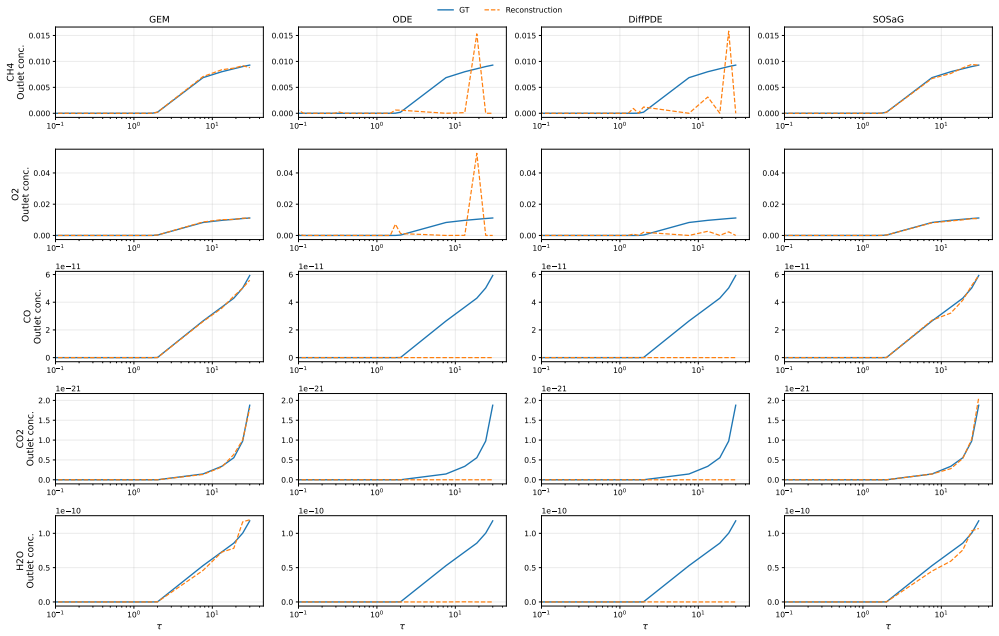
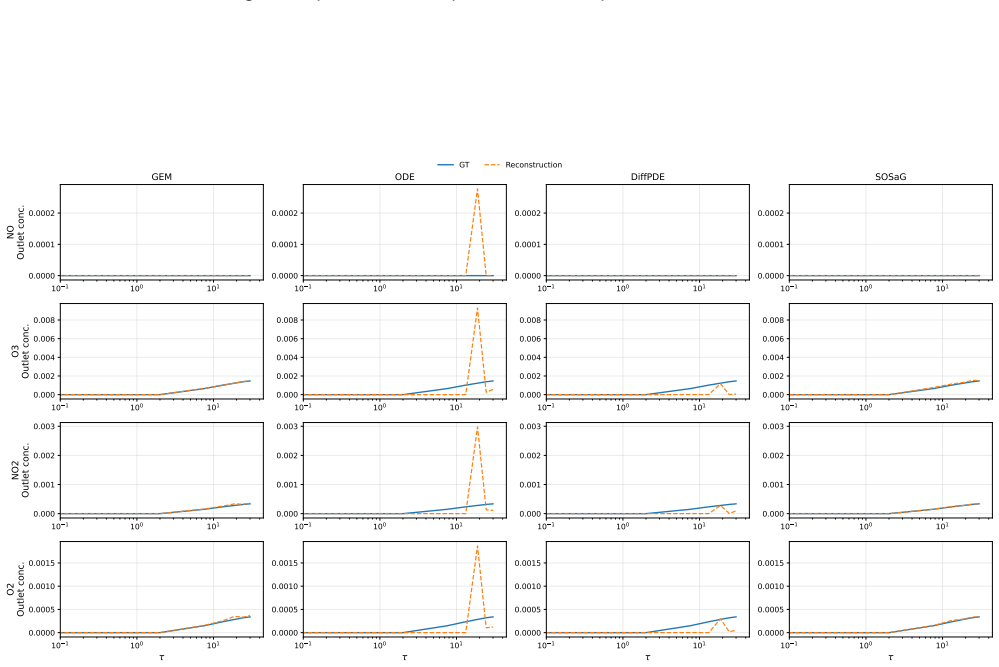
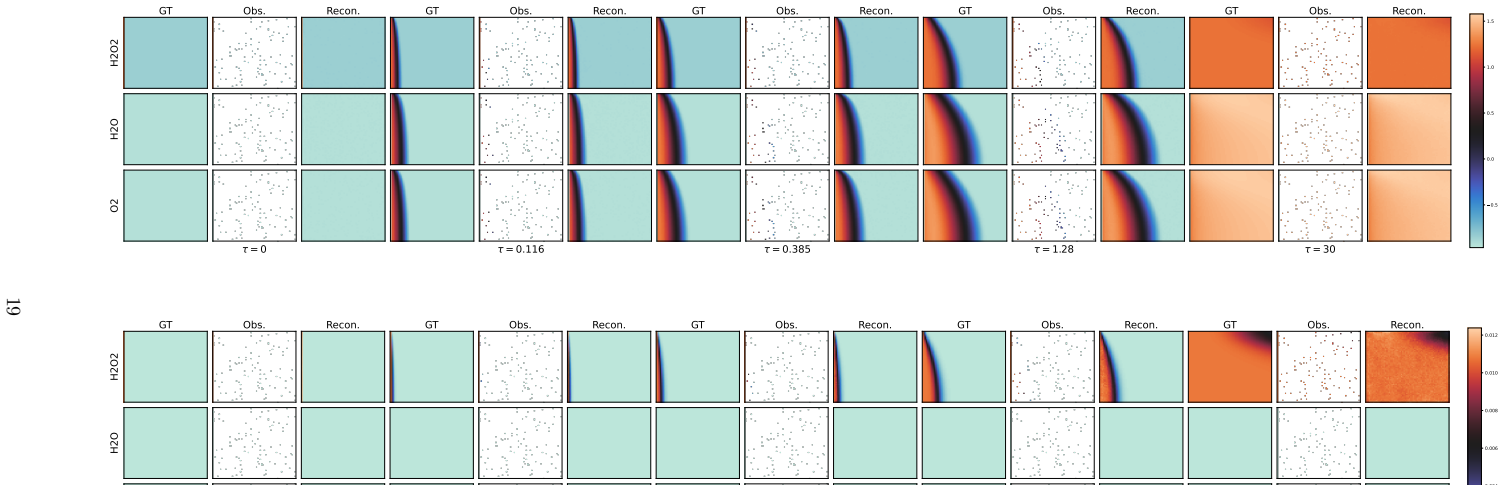
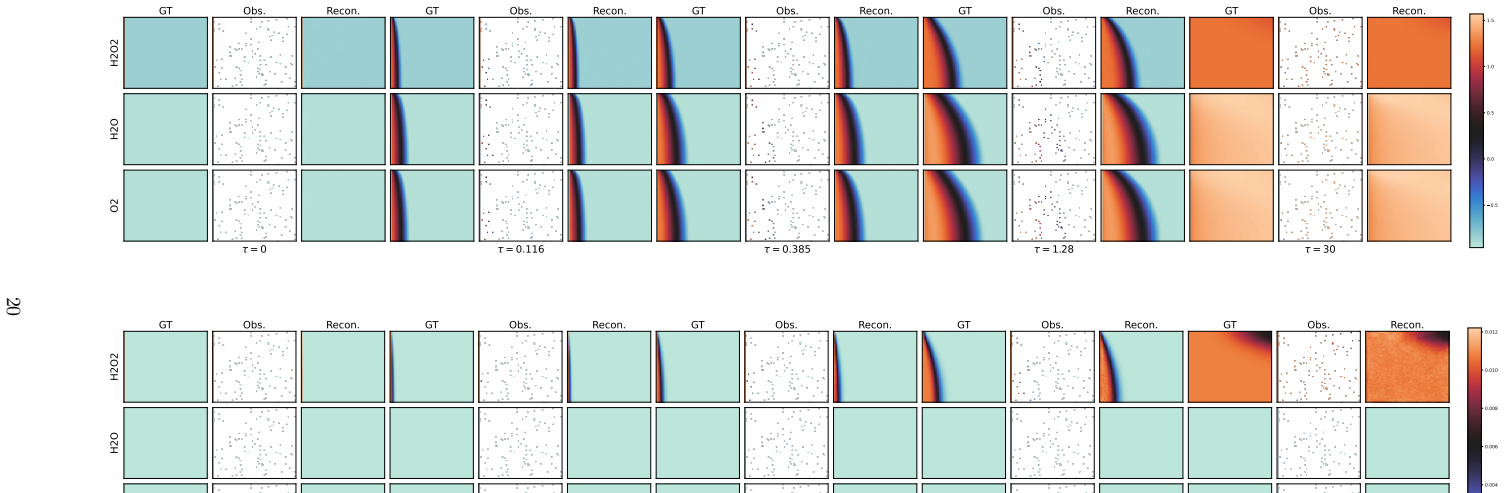
Guided sampling with diffusion priors trained on generic PDEs can be steered by the ARD equation and sparse observations to recover full spatiotemporal trajectories of gas-phase reaction systems; these trajectories remain consistent with the governing physics and retain accuracy when reaction parameters move outside the training distribution.
What carries the argument
Guided particle diffusion sampling, which uses a pretrained diffusion model as a prior and conditions the generative process on both observed data points and the residual of the advection-reaction-diffusion equation to enforce physical consistency across the entire trajectory.
If this is right
- Full spatiotemporal trajectories can be recovered instead of single isolated states.
- The reconstructions remain accurate when reaction parameters take values never seen during training.
- The approach becomes suitable for settings that resemble actual laboratory experiments with sparse measurements.
- The same sampling procedure can be used to model other time-dependent advection-reaction-diffusion systems once the priors are fixed.
Where Pith is reading between the lines
- The ability to generalize across parameters suggests the method could be used to infer unknown rate constants from partial experimental records.
- If the diffusion prior can be updated with a modest amount of new data, the framework might serve as a lightweight surrogate for expensive kinetic simulations in industrial process design.
- Similar guided sampling could be tested on related systems such as combustion fronts or biological reaction waves where advection, diffusion, and nonlinear reactions interact.
Load-bearing premise
Diffusion priors learned on standard PDE benchmark problems transfer directly to the nonlinear dynamics and parameter sensitivities of gas-phase reaction kinetics without retraining or loss of temporal coherence.
What would settle it
If the sampled trajectories violate the ARD equation residuals or become temporally inconsistent when the method is run on laboratory data from a gas-phase reaction experiment whose rate constants lie outside the training range, the central claim would be falsified.
Figures





read the original abstract
Physics-guided sampling with diffusion priors has recently shown strong performance in solving complex systems of partial differential equations (PDEs) from sparse observations. However, these methods are typically evaluated on benchmark problems that do not fully demonstrate their ability to generate temporally consistent solutions of time-dependent PDEs, often focusing instead on reconstructing a single snapshot. In this work, we apply these methods to gas-phase reaction kinetics problems governed by the advection-reaction-diffusion (ARD) equation, providing a setting that more closely reflects realistic laboratory experiments. We demonstrate that guided sampling can be used to reconstruct full spatiotemporal trajectories, rather than isolated states. Furthermore, we show that these methods generalise to previously unseen parameter regimes, highlighting their potential for real-world applications.
Editorial analysis
A structured set of objections, weighed in public.
Referee Report
Summary. The manuscript applies guided sampling with diffusion priors (trained on generic PDE benchmarks) to gas-phase reaction kinetics governed by the advection-reaction-diffusion (ARD) equation. It claims that this enables reconstruction of full spatiotemporal trajectories from sparse observations (rather than isolated states) and that the approach generalizes to previously unseen parameter regimes, with potential for real-world laboratory applications.
Significance. If the central claims of temporally consistent trajectory reconstruction and parameter generalization are substantiated with quantitative evidence, the work would offer a useful extension of score-based generative models to stiff, nonlinear reaction systems relevant to combustion and atmospheric chemistry. The emphasis on full-trajectory consistency rather than snapshot reconstruction addresses a noted limitation of prior PDE applications.
major comments (3)
- [Abstract] Abstract: the claim of strong performance and generalization to unseen parameter regimes is asserted without any quantitative results, error metrics (e.g., trajectory RMSE, integrated reaction-rate error), baseline comparisons, or validation details, so the data cannot be checked against the stated claims.
- [Results] Results (generalization experiments): no ablation isolates the effect of parameter shift on trajectory consistency (e.g., mass-conservation violation or reaction-rate error over time) when the diffusion prior was trained only on generic PDE benchmarks; without this, apparent generalization could be an artifact of test cases remaining close to the training distribution rather than true extrapolation.
- [Methods] Methods: the score-based guidance mechanism is not shown to have any explicit pathway for adjusting the underlying nonlinear reaction terms or rate constants when parameters lie outside the training distribution; the manuscript therefore provides no mechanism that would guarantee the claimed generalization without domain-specific retraining.
minor comments (2)
- Clarify whether the diffusion prior is used off-the-shelf or fine-tuned on ARD data; the abstract refers to 'generic PDE benchmarks' while the title emphasizes 'Gas-Phase Reaction Kinetics'.
- [Abstract] The abstract states that prior methods 'often focus on reconstructing a single snapshot'; provide a brief citation or reference to the specific works being contrasted.
Simulated Author's Rebuttal
We thank the referee for their constructive and detailed feedback on our manuscript. We have revised the paper to incorporate quantitative metrics in the abstract, add an ablation study on parameter generalization, and clarify the role of the physics-based guidance in enabling extrapolation. Our point-by-point responses follow.
read point-by-point responses
-
Referee: [Abstract] Abstract: the claim of strong performance and generalization to unseen parameter regimes is asserted without any quantitative results, error metrics (e.g., trajectory RMSE, integrated reaction-rate error), baseline comparisons, or validation details, so the data cannot be checked against the stated claims.
Authors: We agree that the abstract would be strengthened by including key quantitative results. In the revised version we have added specific metrics (trajectory RMSE, integrated reaction-rate error) and a brief reference to baseline comparisons, drawn directly from the experiments reported in the Results section. revision: yes
-
Referee: [Results] Results (generalization experiments): no ablation isolates the effect of parameter shift on trajectory consistency (e.g., mass-conservation violation or reaction-rate error over time) when the diffusion prior was trained only on generic PDE benchmarks; without this, apparent generalization could be an artifact of test cases remaining close to the training distribution rather than true extrapolation.
Authors: We accept that an explicit ablation isolating parameter shift would improve clarity. Although our test parameters already lie outside the ranges used for the generic PDE benchmark training, we have added a new ablation in the revised Results section that reports mass-conservation violation and reaction-rate error for both in-distribution and shifted-parameter cases, confirming that guidance maintains trajectory consistency under extrapolation. revision: yes
-
Referee: [Methods] Methods: the score-based guidance mechanism is not shown to have any explicit pathway for adjusting the underlying nonlinear reaction terms or rate constants when parameters lie outside the training distribution; the manuscript therefore provides no mechanism that would guarantee the claimed generalization without domain-specific retraining.
Authors: The guidance term is constructed directly from the ARD equation and therefore receives the specific nonlinear reaction terms and rate constants as inputs. When parameters change, only the guidance function is updated with the new constants; the pre-trained diffusion prior remains fixed. We have revised the Methods section to state this mechanism explicitly, including the relevant equation that shows how rate constants enter the guidance score. revision: yes
Circularity Check
No significant circularity; empirical generalization claims are not reduced to self-defined inputs.
full rationale
The manuscript applies existing guided diffusion sampling techniques to the ARD equation for gas-phase kinetics and reports empirical results on full trajectory reconstruction and generalization to unseen parameter regimes. No equations, parameter-fitting procedures, or self-citation chains are shown that would make the reported predictions equivalent to the training data or model inputs by construction. The claims rest on demonstrated performance rather than tautological redefinitions or fitted quantities renamed as predictions.
Axiom & Free-Parameter Ledger
Reference graph
Works this paper leans on
-
[1]
Elsevier, 1974. K.-Y. Lam and Y. Lou.Introduction to Reaction- Diffusion Equations: Theory and Applications to Spatial Ecology and Evolutionary Biology. Springer Nature, 01 2022. ISBN 978-3-031-20421-0. doi: 10.1007/978-3-031-20422-7. R. J. LeVeque.Finite Difference Methods for Ordinary and Partial Differential Equations: Steady-State and Time-Dependent P...
-
[2]
doi: https://doi.org/10.1016/j.envsoft.2007. 05.009. URL https://www.sciencedirect.com/ science/article/pii/S136481520700093X. J. Sohl-Dickstein, E. Weiss, N. Maheswaranathan, and S. Ganguli. Deep Unsupervised Learning Using Nonequilibrium Thermodynamics. InInternational Conference on Machine Learning, pages 2256–2265. PMLR, 2015. Y. Song, J. Sohl-Dickste...
discussion (0)
Sign in with ORCID, Apple, or X to comment. Anyone can read and Pith papers without signing in.