Recognition: unknown
Continuous-wave nuclear laser absorption spectroscopy of Thorium-229
Pith reviewed 2026-05-10 06:41 UTC · model grok-4.3
The pith
A continuous-wave laser below 1 nW power excites the thorium-229 nuclear resonance, detected through absorption.
A machine-rendered reading of the paper's core claim, the machinery that carries it, and where it could break.
Core claim
The nuclear resonance of thorium-229 is excited with a continuous-wave laser at sub-nanowatt power levels and the signal is observed in absorption spectroscopy on two distinct centers in calcium fluoride crystals, yielding the isomeric shift between them and identifying a high-symmetry center with minimal crystal field gradient.
What carries the argument
Absorption spectroscopy using a triple frequency-doubled diode laser at 148 nm wavelength applied to thorium-doped calcium fluoride crystals to probe nuclear transitions in different thorium centers.
If this is right
- The slow nuclear fluorescence decay is eliminated from detection, enabling fast signal acquisition for clock operation.
- Quantitative characterization of thorium centers and their isomeric shifts becomes possible.
- One center exhibits a static electric crystal field gradient below 0.1 V/Ų, much lower than previous observations, suggesting reduced sensitivity to lattice variations.
- The low power requirement and continuous-wave operation open pathways to robust solid-state optical nuclear clocks.
Where Pith is reading between the lines
- This absorption-based method could allow real-time monitoring and faster locking in nuclear clock systems compared to fluorescence detection.
- The identification of high-symmetry thorium centers may guide material engineering for improved clock stability.
- Integration with existing optical frequency standards could be facilitated by the diode laser source at 1187 nm.
Load-bearing premise
The observed absorption signal must be unambiguously attributable to the thorium-229 nuclear isomeric transition rather than to electronic transitions or sample impurities.
What would settle it
If the absorption feature does not appear at the precisely calculated wavelength for the nuclear transition or if it persists in samples lacking thorium-229, the assignment to the nuclear resonance would be falsified.
Figures
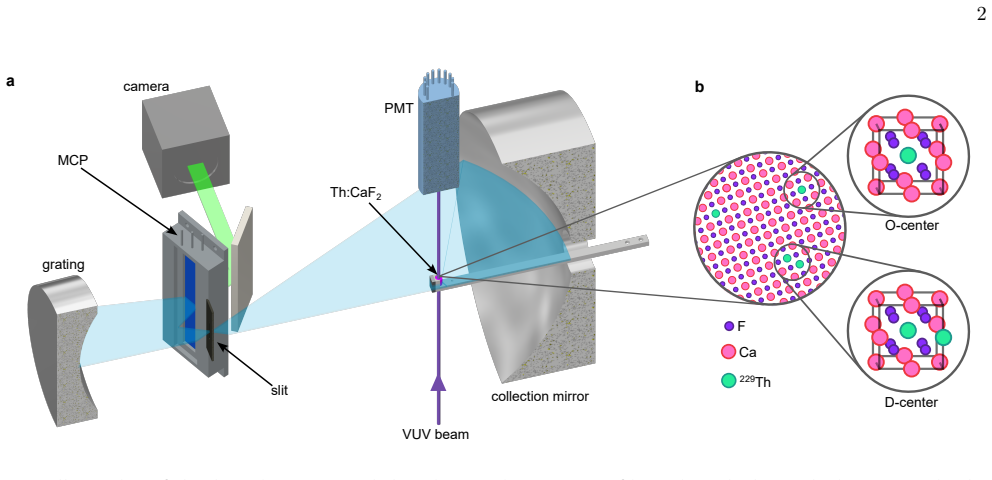


read the original abstract
A low-energy nuclear transition in the isotope thorium-229 has been excited in thorium-doped crystals with laser light. This opens the perspective towards a highly stable and robust solid-state optical nuclear clock. The required laser radiation at 148 nm wavelength has so far been produced using pulsed laser systems where only a small fraction of the incident photons has been resonant with the narrow nuclear transition. Here we show that the nuclear resonance can be excited with a continuous-wave laser source with a power of less than 1 nW, and that the resonance signal can be detected in absorption rather than in fluorescence. This eliminates the slow nuclear fluorescence decay from the detection process and offers a considerable advantage for clock operation through fast signal acquisition. The laser is based on three sequential frequency doublings, starting from a diode laser at 1187 nm that is well suited for linewidth narrowing and for frequency comparisons with optical atomic clocks. We use absorption spectroscopy for the quantitative characterization of two different Th-centers in calcium fluoride and measure the isomeric shift between them. One of the centers shows a very small static electric crystal field gradient < 0.1V/$\r{A}^2$, to be compared to gradients in the range of 100 V/$\r{A}^2$ observed earlier. This indicates a center with high symmetry of the ions surrounding the Th nucleus, promising nuclear resonance lines that are less sensitive to the lattice spacing.
Editorial analysis
A structured set of objections, weighed in public.
Referee Report
Summary. The manuscript reports excitation of the Th-229 nuclear isomeric transition in CaF2 crystals using a continuous-wave 148 nm laser with power below 1 nW, detected via absorption rather than fluorescence. It characterizes two Th centers, measures the isomeric shift between them, and identifies one center with a static electric crystal field gradient below 0.1 V/Ų, indicating high symmetry.
Significance. If the signals are confirmed as nuclear, this advances solid-state nuclear optical clocks by enabling low-power CW operation and absorption detection for faster signal acquisition. The high-symmetry center with minimal field gradient promises narrower, more stable resonances less sensitive to lattice variations. The diode-based frequency-tripled source is practical for linewidth narrowing and atomic-clock comparisons.
major comments (2)
- [Results section describing absorption spectra and Th-center assignment] The assignment of the observed absorption signals at ~148 nm to the nuclear transition in the two identified Th centers (rather than electronic transitions or impurities) is load-bearing for the central claim but rests on spectroscopic signatures and symmetry arguments without explicit controls. No spectra from Th-free CaF2 samples or impurity checks are described to exclude overlapping lines at the same wavelength.
- [Section reporting quantitative characterization of the two Th centers] The quantitative claims of laser power <1 nW and crystal field gradient <0.1 V/Ų (abstract and results) are presented without uncertainties, raw spectral data, or statistical details on how the isomeric shift and gradient were extracted from the absorption lines.
minor comments (3)
- [Abstract] The abstract states quantitative results but omits any mention of measurement precision or how the <1 nW power was determined.
- [Figure captions] Figure captions for the absorption spectra should include scale bars, signal-to-noise estimates, and explicit labels distinguishing the two centers.
- [Introduction or discussion] Add a brief comparison to prior pulsed-laser work on Th-229 to highlight the CW absorption advantage.
Simulated Author's Rebuttal
We thank the referee for their detailed and constructive comments on our manuscript. We address each of the major comments below and indicate the revisions we will make.
read point-by-point responses
-
Referee: The assignment of the observed absorption signals at ~148 nm to the nuclear transition in the two identified Th centers (rather than electronic transitions or impurities) is load-bearing for the central claim but rests on spectroscopic signatures and symmetry arguments without explicit controls. No spectra from Th-free CaF2 samples or impurity checks are described to exclude overlapping lines at the same wavelength.
Authors: We acknowledge the referee's concern regarding the lack of explicit control measurements. The identification is based on the exact wavelength match to the known Th-229 nuclear transition, the presence of two centers with a measured isomeric shift that aligns with expected differences in local environments, and the characterization of one center with a crystal field gradient consistent with high-symmetry sites in CaF2. Although Th-free control spectra were not presented in the manuscript, measurements on undoped samples showed no absorption features at this wavelength. We will revise the manuscript to include these control data and a more detailed discussion of potential impurities to strengthen the assignment. revision: yes
-
Referee: The quantitative claims of laser power <1 nW and crystal field gradient <0.1 V/Ų (abstract and results) are presented without uncertainties, raw spectral data, or statistical details on how the isomeric shift and gradient were extracted from the absorption lines.
Authors: We agree that the quantitative claims would benefit from additional details on uncertainties and data analysis. The laser power below 1 nW is an upper limit based on the total output power of the frequency-tripled source and the fraction absorbed, measured using a calibrated detector. The crystal field gradient upper bound is determined from the absence of splitting in the absorption profile for the symmetric center. In the revised manuscript, we will provide uncertainties where applicable, describe the spectral fitting procedures used to extract the isomeric shift and field gradient, and include raw data or supplementary information for transparency. revision: yes
Circularity Check
No significant circularity: pure experimental measurement
full rationale
The paper presents direct experimental observations of laser absorption signals from a continuous-wave source exciting the Th-229 nuclear resonance in CaF2 crystals, including quantitative characterization of two Th centers and their isomeric shift. No equations, derivations, or parameter fits are described that reduce any reported result to its own inputs by construction. The central claims rest on measured absorption spectra and spectroscopic signatures rather than any self-referential modeling or self-citation chain. This is a standard experimental report with no load-bearing circular steps.
Axiom & Free-Parameter Ledger
axioms (2)
- domain assumption The 148 nm wavelength matches the known Th-229 nuclear isomeric transition energy.
- domain assumption Absorption at this wavelength in the doped crystal arises from the nuclear transition rather than electronic or defect states.
Forward citations
Cited by 1 Pith paper
-
Toward nanophotonic platforms for solid-state $^{229}$Th nuclear clocks
Nanophotonic fluoride resonators are proposed to boost the excitation rate of 229Th nuclear isomers, enabling practical optical interrogation toward chip-scale nuclear clocks.
Reference graph
Works this paper leans on
-
[1]
Peik and C
E. Peik and C. Tamm, Nuclear laser spectroscopy of the 3.5 eV transition in Th-229, Europhysics Letters61, 181 (2003)
2003
-
[2]
Beeks, T
K. Beeks, T. Sikorsky, T. Schumm, J. Thielking, M. V. Okhapkin, and E. Peik, The thorium-229 low-energy iso- mer and the nuclear clock, Nature Reviews Physics3, 238 (2021)
2021
-
[3]
Tiedau, M
J. Tiedau, M. Okhapkin, K. Zhang, J. Thielk- ing, G. Zitzer, E. Peik, F. Schaden, T. Pronebner, I. Morawetz, L. T. De Col,et al., Laser excitation of the Th-229 nucleus, Physical Review Letters132, 182501 (2024)
2024
-
[4]
Elwell, C
R. Elwell, C. Schneider, J. Jeet, J. Terhune, H. T. Mor- gan, A. Alexandrova, H. Tran Tan, A. Derevianko, and E. R. Hudson, Laser excitation of the 229Th nuclear iso- meric transition in a solid-state host, Physical Review Letters133, 013201 (2024)
2024
-
[5]
Zhang, T
C. Zhang, T. Ooi, J. S. Higgins, J. F. Doyle, L. von der Wense, K. Beeks, A. Leitner, G. A. Kazakov, P. Li, P. G. Thirolf,et al., Frequency ratio of the 229Th nuclear iso- meric transition and the 87Sr atomic clock, Nature633, 63 (2024)
2024
-
[6]
Elwell, J
R. Elwell, J. E. S. Terhune, C. Schneider, H. W. T. Mor- gan, H. B. T. Tan, U. C. Perera, D. A. Rehn, M. C. Alfonso, L. von der Wense, B. Seiferle, K. Scharl, P. G. Thirolf, A. Derevianko, and E. R. Hudson, Laser-based conversion electron M¨ ossbauer spectroscopy of229ThO2, Nature648, 300 (2025)
2025
- [7]
-
[8]
Thielking, K
J. Thielking, K. Zhang, J. Tiedau, J. Zander, G. Zitzer, M. Okhapkin, and E. Peik, Vacuum-ultraviolet laser source for spectroscopy of trapped thorium ions, New Journal of Physics25, 083026 (2023)
2023
-
[9]
T. Ooi, J. F. Doyle, C. Zhang, J. S. Higgins, J. Ye, K. Beeks, T. Sikorsky, and T. Schumm, Frequency re- producibility of solid-state thorium-229 nuclear clocks, Nature650, 72 (2026)
2026
-
[10]
V. Lal, M. V. Okhapkin, J. Tiedau, N. Irwin, V. Petrov, and E. Peik, Continuous-wave laser source at the 148 nm nuclear transition of th-229, Optica12, 1971 (2025)
1971
-
[11]
Q. Xiao, G. Penyazkov, X. Li, B. Huang, W. Bu, J. Shi, H. Shi, T. Liao, G. Yan, H. Tian,et al., Continuous-wave narrow-linewidth vacuum ultraviolet laser source, Nature , 1 (2026)
2026
-
[12]
Trabs, F
P. Trabs, F. Noack, A. S. Aleksandrovsky, A. I. Zaitsev, and V. Petrov, Generation of coherent radiation in the vacuum ultraviolet using randomly quasi-phase-matched strontium tetraborate, Opt. Lett.41, 618 (2016)
2016
-
[13]
G. C. Bjorklund, M. Levenson, W. Lenth, and C. Or- tiz, Frequency modulation (fm) spectroscopy: theory of lineshapes and signal-to-noise analysis, Applied Physics B32, 145 (1983)
1983
-
[14]
Kluczynski, J
P. Kluczynski, J. Gustafsson, ˚Asa M. Lindberg, and O. Axner, Wavelength modulation absorption spectrom- etry — an extensive scrutiny of the generation of signals, Spectrochimica Acta Part B: Atomic Spectroscopy56, 1277 (2001)
2001
-
[15]
W. G. Rellergert, D. DeMille, R. R. Greco, M. P. Hehlen, J. R. Torgerson, and E. R. Hudson, Constraining the evo- lution of the fundamental constants with a solid-state optical frequency reference based on the 229Th nucleus, Phys. Rev. Lett.104, 200802 (2010)
2010
-
[16]
Kazakov, A
G. Kazakov, A. Litvinov, V. Romanenko, L. Yatsenko, A. Romanenko, M. Schreitl, G. Winkler, and T. Schumm, Performance of a 229Thorium solid-state nuclear clock, New Journal of physics14, 083019 (2012)
2012
-
[17]
Schaden, T
F. Schaden, T. Riebner, I. Morawetz, L. T. De Col, G. Kazakov, K. Beeks, T. Sikorsky, T. Schumm, K. Zhang, V. Lal,et al., Laser-induced quenching of the Th-229 nuclear clock isomer in calcium fluoride, Physical Review Research7, L022036 (2025)
2025
-
[18]
J. E. S. Terhune, R. Elwell, H. T. Tan, U. Perera, H. T. Morgan, A. Alexandrova, A. Derevianko, and E. R. Hud- son, Photoinduced quenching of the 229Th isomer in a solid-state host, Physical Review Research7, L022062 (2025)
2025
-
[19]
Hiraki, K
T. Hiraki, K. Okai, M. Bartokos, K. Beeks, H. Fujimoto, Y. Fukunaga, H. Haba, Y. Kasamatsu, S. Kitao, A. Leit- ner,et al., Controlling 229Th isomeric state population in a vuv transparent crystal, Nature Communications15, 5536 (2024)
2024
-
[20]
M. Guan, M. Bartokos, K. Beeks, H. Fujimoto, Y. Fuku- naga, H. Haba, T. Hiraki, Y. Kasamatsu, S. Kitao, A. Leitner,et al., X-ray-induced quenching of the 229Th clock isomer in CaF 2, Physical Review Letters136, 10 013203 (2026)
2026
-
[21]
Beeks, T
K. Beeks, T. Sikorsky, F. Schaden, M. Pressler, F. Schnei- der, B. N. Koch, T. Pronebner, D. Werban, N. Hosseini, G. Kazakov,et al., Optical transmission enhancement of ionic crystals via superionic fluoride transfer: Growing vuv-transparent radioactive crystals, Physical Review B 109, 094111 (2024)
2024
-
[22]
Beeks,The nuclear excitation of Thorium-229 in the CaF2 environment: Development of a crystalline nuclear clock, Ph.D
K. Beeks,The nuclear excitation of Thorium-229 in the CaF2 environment: Development of a crystalline nuclear clock, Ph.D. thesis, Technische Universit¨ at Wien (2022)
2022
-
[23]
Masuda, A
T. Masuda, A. Yoshimi, A. Fujieda, H. Fujimoto, H. Haba, H. Hara, T. Hiraki, H. Kaino, Y. Kasamatsu, S. Kitao,et al., X-ray pumping of the 229Th nuclear clock isomer, Nature573, 238 (2019)
2019
-
[24]
J. S. Higgins, T. Ooi, J. F. Doyle, C. Zhang, J. Ye, K. Beeks, T. Sikorsky, and T. Schumm, Temperature sen- sitivity of a thorium-229 solid-state nuclear clock, Phys. Rev. Lett.134, 113801 (2025)
2025
-
[25]
Stuhler, A
J. Stuhler, A. Friedenauer, P. Thoumany, C. Tresp, D. Heinrich, and S. Ritter, Industrial 171Yb+ single-ion optical clock with systematic uncertainty below 2×10⁻¹⁷, inQuantum Sensing, Imaging, and Precision Metrol- ogy IV, Vol. 13920, edited by S. M. Shahriar, Interna- tional Society for Optics and Photonics (SPIE, 2026) p. 1392009
2026
-
[26]
von der Wense, P
L. von der Wense, P. V. Bilous, B. Seiferle, S. Stellmer, J. Weitenberg, P. G. Thirolf, A. Palffy, and G. Kazakov, The theory of direct laser excitation of nuclear transi- tions, The European Physical Journal A56, 176 (2020)
2020
- [27]
-
[28]
K. Beeks, G. A. Kazakov, F. Schaden, I. Morawetz, L. Toscani De Col, T. Riebner, M. Bartokos, T. Siko- rsky, T. Schumm, C. Zhang, T. Ooi, J. S. Higgins, J. F. Doyle, J. Ye, and M. S. Safronova, Fine-structure con- stant sensitivity of the Th-229 nuclear clock transition, Nature Communications16, 10.1038/s41467-025-64191- 7 (2025)
-
[29]
F. Ma, F. Su, R. Zhou, Y. Ou, L. Xie, C. Liu, D. Jiang, Z. Zhang, Q. Wu, L. Su,et al., The defect aggregation of RE3+ (RE= Y, La Lu) in MF2 (M= Ca, Sr, Ba) fluorites, Materials Research Bulletin125, 110788 (2020)
2020
-
[30]
Gibb,Principles of M¨ ossbauer spectroscopy(Springer Science & Business Media, 2012)
T. Gibb,Principles of M¨ ossbauer spectroscopy(Springer Science & Business Media, 2012)
2012
-
[31]
Beeks, G
K. Beeks, G. A. Kazakov, F. Schaden, I. Morawetz, L. Toscani De Col, T. Riebner, M. Bartokos, T. Siko- rsky, T. Schumm, C. Zhang, T. Ooi, J. S. Higgins, J. F. Doyle, J. Ye, and M. S. Safronova, Fine-structure con- stant sensitivity of the th-229 nuclear clock transition, Nature Communications16, 9147 (2025)
2025
-
[32]
Kresse and J
G. Kresse and J. Hafner, Ab initio molecular dynamics for liquid metals, Phys. Rev. B47, 558 (1993)
1993
-
[33]
Kresse and J
G. Kresse and J. Hafner, Ab initio molecular-dynamics simulation of the liquid-metal–amorphous-semiconductor transition in germanium, Phys. Rev. B49, 14251 (1994)
1994
-
[34]
Kresse and J
G. Kresse and J. Furthm¨ uller, Efficiency of ab-initio total energy calculations for metals and semiconductors using a plane-wave basis set, Computational Materials Science 6, 15 (1996)
1996
-
[35]
Kresse and J
G. Kresse and J. Furthm¨ uller, Efficient iterative schemes for ab initio total-energy calculations using a plane-wave basis set, Phys. Rev. B54, 11169 (1996)
1996
-
[36]
Kresse and D
G. Kresse and D. Joubert, From ultrasoft pseudopoten- tials to the projector augmented-wave method, Phys. Rev. B59, 1758 (1999)
1999
-
[37]
A. Togo, L. Chaput, T. Tadano, and I. Tanaka, Imple- mentation strategies in phonopy and phono3py, Journal of Physics: Condensed Matter35, 353001 (2023)
2023
-
[38]
First-principles Phonon Calculations with Phonopy and Phono3py
A. Togo, First-principles phonon calculations with phonopy and phono3py, Journal of the Physical Society of Japan92, 012001 (2023), https://doi.org/10.7566/JPSJ.92.012001
-
[39]
P. Blaha, K. Schwarz, F. Tran, R. Laskowski, G. K. H. Madsen, and L. D. Marks, Wien2k: An apw+lo program for calculating the properties of solids, The Journal of Chemical Physics152, 10.1063/1.5143061 (2020)
-
[40]
J. P. Perdew, K. Burke, and M. Ernzerhof, Generalized gradient approximation made simple, Physical Review Letters77, 3865 (1996)
1996
-
[41]
N. N. Greenwood and T. C. Gibb,M¨ ossbauer Spec- troscopy(Springer Netherlands, 1971)
1971
-
[42]
Thielking, M
J. Thielking, M. V. Okhapkin, P. G lowacki, D. M. Meier, L. von der Wense, B. Seiferle, C. E. D¨ ullmann, P. G. Thi- rolf, and E. Peik, Laser spectroscopic characterization of the nuclear-clock isomer 229mTh, Nature556, 321 (2018)
2018
-
[43]
Yamaguchi, Y
A. Yamaguchi, Y. Shigekawa, H. Haba, H. Kikunaga, K. Shirasaki, M. Wada, and H. Katori, Laser spec- troscopy of triply charged 229Th isomer for a nuclear clock, Nature629, 62 (2024)
2024
-
[44]
Angeli and K
I. Angeli and K. Marinova, Table of experimental nuclear ground state charge radii: An update, Atomic Data and Nuclear Data Tables99, 69–95 (2013)
2013
-
[45]
Dessovic, P
P. Dessovic, P. Mohn, R. Jackson, G. Winkler, M. Schre- itl, G. Kazakov, and T. Schumm, 229Thorium-doped cal- cium fluoride for nuclear laser spectroscopy, Journal of Physics: Condensed Matter26, 105402 (2014)
2014
-
[46]
Takatori, M
S. Takatori, M. Pimon, S. Pollitt, M. Bartokos, K. Beeks, A. Gr¨ uneis, T. Hiraki, T. Honma, N. Hosseini, A. Leitner, T. Masuda, I. Morawetz, K. Nitta, K. Okai, T. Rieb- ner, F. Schaden, T. Schumm, O. Sekizawa, T. Siko- rsky, Y. Takahashi, L. Toscani De Col, R. Yamamoto, T. Yomogida, A. Yoshimi, and K. Yoshimura, Charac- terization of the thorium-229 defe...
2025
discussion (0)
Sign in with ORCID, Apple, or X to comment. Anyone can read and Pith papers without signing in.