Recognition: unknown
Enabling Lie-Algebraic Classical Simulation beyond Free Fermions
Pith reviewed 2026-05-10 07:56 UTC · model grok-4.3
The pith
Symmetry-adapted bases enable polynomial-cost Lie-algebraic simulation beyond free fermions.
A machine-rendered reading of the paper's core claim, the machinery that carries it, and where it could break.
Core claim
We identify additional non-trivial families of polynomial-dimensional dynamical Lie algebras and introduce symmetry-adapted basis representations that make the adjoint space mapping tractable. In particular, we develop an explicit Pauli orbit basis for permutation-equivariant dynamics, supporting cubic-dimensional algebras despite exponential Pauli support, and a subspace-adapted (modified) generalized Gell-Mann basis for bounded Hamming-weight (U(1)-equivariant) dynamics, yielding polynomial costs on fixed excitation sectors. Together with streamlined routines for free-fermionic Pauli algebras and translation-invariant variants thereof, these constructions significantly broaden the scope of
What carries the argument
Pauli orbit basis for permutation-equivariant dynamics and subspace-adapted modified generalized Gell-Mann basis for U(1)-equivariant dynamics, each keeping the adjoint representation polynomially sized.
If this is right
- Classical simulation of permutation-symmetric circuits becomes feasible at polynomial cost.
- Fixed particle-number sectors in U(1)-conserving systems admit efficient adjoint-space evolution.
- Translation-invariant free-fermion circuits gain simplified simulation routines.
- A single Lie-algebraic framework now covers both free-fermion and selected non-free-fermion structured dynamics.
Where Pith is reading between the lines
- The same orbit-construction technique may apply to other discrete symmetries whose orbits remain polynomially enumerable.
- Fixed-excitation simulations could be combined with existing tensor-network methods for hybrid large-scale runs.
- Numerical evidence of favorable preprocessing scaling suggests immediate applicability to symmetry-constrained variational algorithms.
Load-bearing premise
The newly identified dynamical Lie algebras remain polynomially bounded in dimension and the symmetry-adapted bases render the adjoint-space mapping computationally tractable for the targeted circuit families.
What would settle it
An explicit family of permutation-equivariant or fixed-excitation circuits whose dynamical Lie algebra dimension grows exponentially with qubit number, or whose basis change matrices require superpolynomial preprocessing time.
Figures




read the original abstract
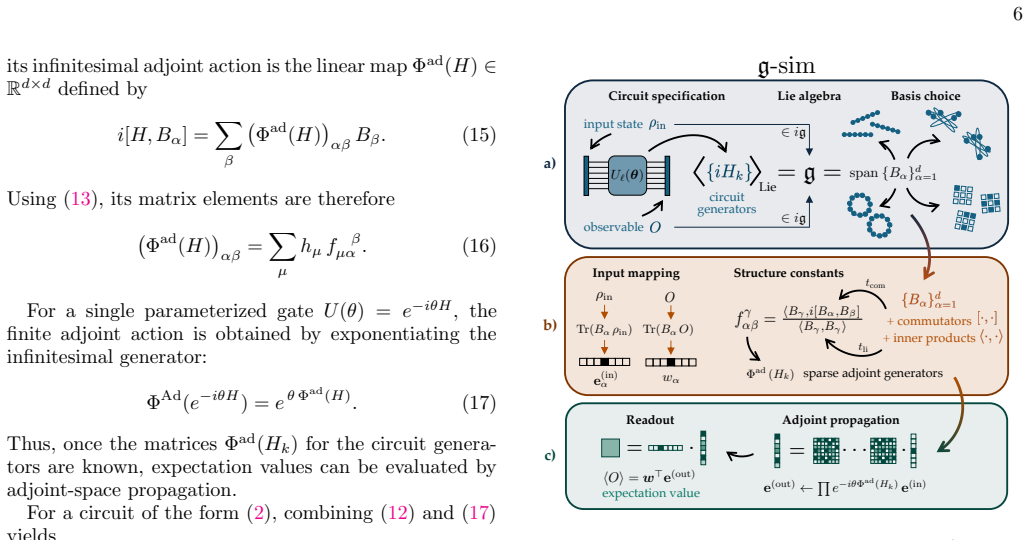
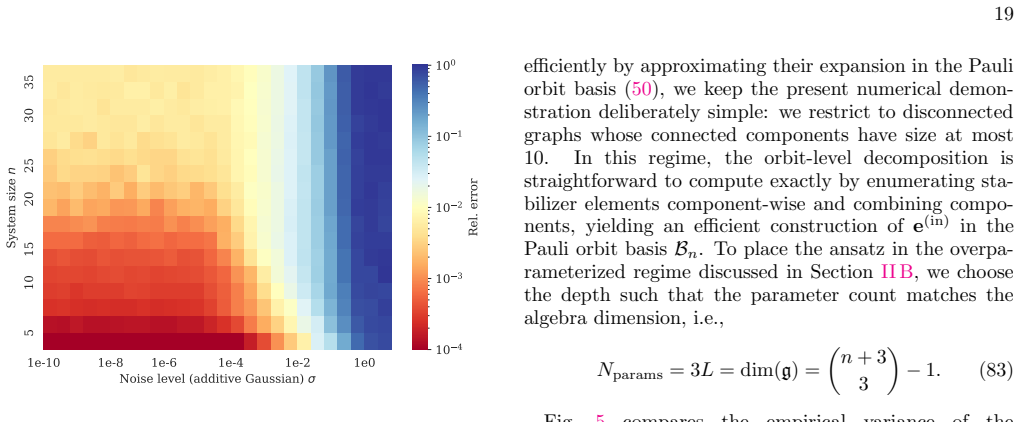
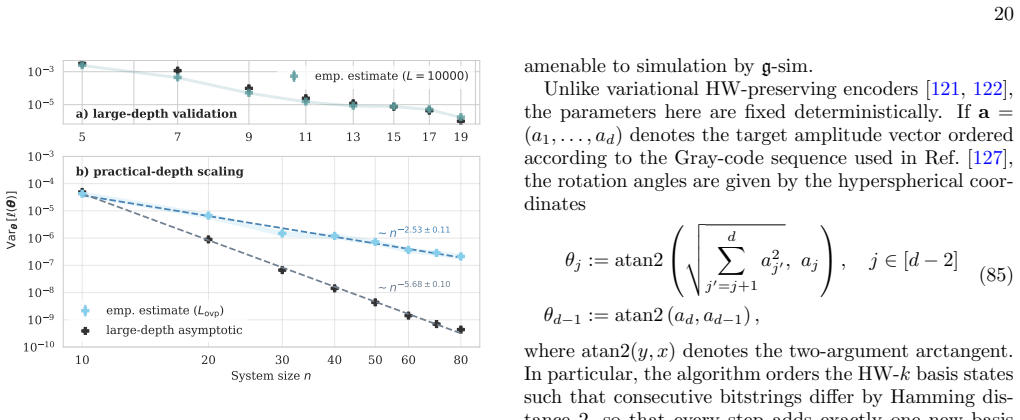
Efficient classical simulation has matured to a critical component of the quantum computing stack, driving hardware validation, algorithm design, and the study of structured quantum dynamics. Lie-algebraic simulation ($\mathfrak{g}$-sim) is a compelling approach: it replaces exponentially large Hilbert-space evolution by dynamics in a reduced adjoint space whose dimension is set by the dynamical Lie algebra (DLA) of the circuit, enabling efficient simulation whenever the DLA grows only polynomially with system size. In practice, however, existing applications of $\mathfrak{g}$-sim have been confined to free-fermionic (matchgate) regimes, and it has been unclear how to extend the paradigm to other structured circuits whose generators may have large Pauli expansions. Here we enable Lie-algebraic classical simulation beyond free fermions by identifying additional non-trivial families of polynomial-dimensional DLAs and introducing symmetry-adapted basis representations that make the adjoint space mapping tractable. In particular, we develop an explicit Pauli orbit basis for permutation-equivariant dynamics, supporting cubic-dimensional algebras despite exponential Pauli support, and a subspace-adapted (modified) generalized Gell-Mann basis for bounded Hamming-weight ($U(1)$-equivariant) dynamics, yielding polynomial costs on fixed excitation sectors. Together with streamlined routines for free-fermionic Pauli algebras and translation-invariant variants thereof, these constructions significantly broaden the practical scope of $\mathfrak{g}$-sim as a unifying simulation tool for structured quantum dynamics. Numerical benchmarks confirm favorable preprocessing scaling and validate large-scale proof-of-concept simulations.
Editorial analysis
A structured set of objections, weighed in public.
Referee Report
Summary. The paper claims to extend Lie-algebraic classical simulation (g-sim) beyond free-fermion (matchgate) regimes by identifying families of polynomial-dimensional dynamical Lie algebras (DLAs) for permutation-equivariant and U(1)-equivariant circuits. It introduces an explicit Pauli orbit basis that reduces permutation-equivariant DLAs to cubic dimension despite exponential Pauli support, and a subspace-adapted modified generalized Gell-Mann basis for fixed Hamming-weight sectors that yields polynomial-cost adjoint-space mappings. Streamlined free-fermion and translation-invariant routines are also provided, with numerical benchmarks confirming favorable preprocessing scaling and enabling large-scale simulations.
Significance. If the explicit constructions and polynomial bounds hold, the work meaningfully broadens g-sim from its current free-fermionic confinement to additional structured circuit families, offering a practical tool for classical simulation in quantum hardware validation and algorithm design. Credit is due for the concrete symmetry-adapted bases, the explicit orbit constructions, and the numerical validation of scaling; these directly address the exponential-support obstacle while preserving tractability.
major comments (2)
- [§3.2] §3.2, the Pauli orbit basis construction: the reduction to O(n^3) dimension is load-bearing for the central claim of polynomial DLAs; the orbit enumeration under the permutation group action must be shown to be exhaustive and free of hidden linear dependencies among the chosen representatives, otherwise the adjoint-space mapping cost could exceed the stated cubic bound.
- [§4.1] §4.1, the modified Gell-Mann basis for fixed-weight U(1) sectors: the polynomial cost on fixed excitation number k is central, yet the basis change must preserve the Lie bracket structure exactly; any truncation or approximation in the subspace projection would undermine the exactness of the g-sim evolution for the targeted circuits.
minor comments (2)
- [Numerical benchmarks] The numerical benchmarks section would benefit from explicit reporting of the largest system sizes simulated and the precise preprocessing times versus n, to allow direct comparison with existing free-fermion g-sim implementations.
- [Notation] Notation for the adjoint-space mapping (e.g., the precise definition of the structure constants in the chosen bases) is introduced without a dedicated table; a compact summary table would improve readability.
Simulated Author's Rebuttal
We thank the referee for their careful reading, positive assessment of the work, and recommendation for minor revision. We address each major comment below with clarifications and revisions to strengthen the manuscript.
read point-by-point responses
-
Referee: [§3.2] §3.2, the Pauli orbit basis construction: the reduction to O(n^3) dimension is load-bearing for the central claim of polynomial DLAs; the orbit enumeration under the permutation group action must be shown to be exhaustive and free of hidden linear dependencies among the chosen representatives, otherwise the adjoint-space mapping cost could exceed the stated cubic bound.
Authors: We thank the referee for emphasizing the importance of rigorously establishing the O(n^3) bound. The Pauli orbit basis is constructed by selecting one canonical representative per orbit under the S_n action on Pauli strings (e.g., via lexicographically minimal support ordering). Exhaustiveness follows because the orbits partition the full Pauli basis, and our enumeration systematically covers all possible weight classes and relative positions. Linear independence is guaranteed by the disjointness of orbits and the fact that distinct representatives have orthogonal supports under the Hilbert-Schmidt product. In the revised manuscript we have added Proposition 3.4, which explicitly counts the number of orbits for each Pauli weight (yielding at most O(n^3) total) and proves that the adjoint representation decomposes as a direct sum over these orbits with no cross terms or hidden dependencies. This confirms the cubic cost of the adjoint-space mapping. revision: yes
-
Referee: [§4.1] §4.1, the modified Gell-Mann basis for fixed-weight U(1) sectors: the polynomial cost on fixed excitation number k is central, yet the basis change must preserve the Lie bracket structure exactly; any truncation or approximation in the subspace projection would undermine the exactness of the g-sim evolution for the targeted circuits.
Authors: We agree that exact preservation of the Lie bracket is indispensable. The modified generalized Gell-Mann basis is obtained by restricting the standard su(2^n) generators to the fixed-weight-k subspace and orthonormalizing via Gram-Schmidt within that subspace. Because the target circuits are U(1)-equivariant, the fixed-excitation subspace is invariant under the adjoint action; consequently the Lie bracket of any two DLA elements remains inside the subspace. The basis change is therefore an isometry on an invariant subspace and preserves all structure constants exactly, with no truncation or approximation. The revised Section 4.1 now includes an explicit verification that [X_i, X_j] projected equals the projected bracket, together with a remark confirming invariance of the subspace under the circuit generators. revision: yes
Circularity Check
No significant circularity
full rationale
The paper's central contribution consists of explicit constructive definitions: an orbit basis for permutation-equivariant Pauli algebras (reducing dimension to cubic) and a subspace-adapted generalized Gell-Mann basis for fixed-weight U(1) sectors. These are obtained by direct application of group representation theory and symmetry constraints to the adjoint representation, without any parameter fitting, self-referential redefinition of the target quantity, or load-bearing reliance on prior self-citations. The free-fermion routines are presented as streamlined versions of known matchgate techniques, and numerical benchmarks serve as independent verification rather than as the source of the claimed polynomial scaling. The derivation chain therefore remains self-contained and externally falsifiable.
Axiom & Free-Parameter Ledger
axioms (1)
- domain assumption Dynamical Lie algebra dimension controls classical simulation cost
Reference graph
Works this paper leans on
-
[1]
Knill, D
E. Knill, D. Leibfried, R. Reichle, J. Britton, R. B. Blakestad, J. D. Jost, C. Langer, R. Ozeri, S. Sei- delin, and D. J. Wineland, Randomized benchmarking of quantum gates, Physical Review A—Atomic, Molec- ular, and Optical Physics77, 012307 (2008)
2008
-
[2]
Helsen, S
J. Helsen, S. Nezami, M. Reagor, and M. Walter, Match- gate benchmarking: Scalable benchmarking of a con- tinuous family of many-qubit gates, Quantum6, 657 (2022)
2022
-
[3]
Arute, K
F. Arute, K. Arya, R. Babbush, D. Bacon, J. C. Bardin, R. Barends, R. Biswas, S. Boixo, F. G. Bran- dao, D. A. Buell,et al., Quantum supremacy using a programmable superconducting processor, nature574, 505 (2019)
2019
-
[4]
Tang, A quantum-inspired classical algorithm for rec- ommendation systems, inProceedings of the 51st an- nual ACM SIGACT symposium on theory of computing (2019) pp
E. Tang, A quantum-inspired classical algorithm for rec- ommendation systems, inProceedings of the 51st an- nual ACM SIGACT symposium on theory of computing (2019) pp. 217–228
2019
-
[5]
A. Gily´ en, S. Lloyd, and E. Tang, Quantum- inspired low-rank stochastic regression with logarith- mic dependence on the dimension, arXiv preprint arXiv:1811.04909 (2018)
-
[6]
N.-H. Chia, H.-H. Lin, and C. Wang, Quantum-inspired sublinear classical algorithms for solving low-rank linear systems, arXiv preprint arXiv:1811.04852 (2018). 23
-
[7]
J. Chen, E. Stoudenmire, and S. R. White, Quantum fourier transform has small entanglement, PRX Quan- tum4, 040318 (2023)
2023
-
[9]
Larocca, P
M. Larocca, P. Czarnik, K. Sharma, G. Muraleedharan, P. J. Coles, and M. Cerezo, Diagnosing Barren Plateaus with Tools from Quantum Optimal Control, Quantum 6, 824 (2022)
2022
-
[10]
Larocca, N
M. Larocca, N. Ju, D. Garc´ ıa-Mart´ ın, P. J. Coles, and M. Cerezo, Theory of overparametrization in quantum neural networks, Nat Comput Sci3, 542 (2023)
2023
-
[11]
Larocca, S
M. Larocca, S. Thanasilp, S. Wang, K. Sharma, J. Bia- monte, P. J. Coles, L. Cincio, J. R. McClean, Z. Holmes, and M. Cerezo,A Review of Barren Plateaus in Varia- tional Quantum Computing, Tech. Rep. (arXiv, 2024)
2024
-
[12]
S. R. White, Density matrix formulation for quantum renormalization groups, Physical review letters69, 2863 (1992)
1992
-
[13]
Vidal, Efficient classical simulation of slightly entan- gled quantum computations, Physical review letters91, 147902 (2003)
G. Vidal, Efficient classical simulation of slightly entan- gled quantum computations, Physical review letters91, 147902 (2003)
2003
-
[14]
Schollw¨ ock, The density-matrix renormalization group, Reviews of modern physics77, 259 (2005)
U. Schollw¨ ock, The density-matrix renormalization group, Reviews of modern physics77, 259 (2005)
2005
-
[15]
Schollw¨ ock, The density-matrix renormalization group in the age of matrix product states, Annals of physics326, 96 (2011)
U. Schollw¨ ock, The density-matrix renormalization group in the age of matrix product states, Annals of physics326, 96 (2011)
2011
-
[16]
E. Lieb, T. Schultz, and D. Mattis, Two soluble models of an antiferromagnetic chain, Annals of Physics16, 407 (1961)
1961
-
[17]
R. J. Baxter, Exactly solved models in statistical me- chanics, inIntegrable systems in statistical mechanics (World Scientific, 1985) pp. 5–63
1985
-
[18]
I. D. Kivlichan, J. McClean, N. Wiebe, C. Gidney, A. Aspuru-Guzik, G. K.-L. Chan, and R. Babbush, Quantum simulation of electronic structure with lin- ear depth and connectivity, Physical review letters120, 110501 (2018)
2018
-
[19]
G. A. Quantum, Collaborators, F. Arute, K. Arya, R. Babbush, D. Bacon, J. C. Bardin, R. Barends, S. Boixo, M. Broughton, B. B. Buckley,et al., Hartree- fock on a superconducting qubit quantum computer, Science369, 1084 (2020)
2020
-
[20]
Fomichev, K
S. Fomichev, K. Hejazi, M. S. Zini, M. Kiser, J. Frax- anet, P. A. M. Casares, A. Delgado, J. Huh, A.-C. Voigt, J. E. Mueller,et al., Initial state preparation for quan- tum chemistry on quantum computers, PRX Quantum 5, 040339 (2024)
2024
-
[21]
Ran, Encoding of matrix product states into quan- tum circuits of one-and two-qubit gates, Physical Re- view A101, 032310 (2020)
S.-J. Ran, Encoding of matrix product states into quan- tum circuits of one-and two-qubit gates, Physical Re- view A101, 032310 (2020)
2020
-
[22]
Holmes and A
A. Holmes and A. Y. Matsuura, Efficient quantum cir- cuits for accurate state preparation of smooth, differen- tiable functions, in2020 IEEE international conference on quantum computing and engineering (QCE)(IEEE,
-
[23]
Gonzalez-Conde, T
J. Gonzalez-Conde, T. W. Watts, P. Rodriguez-Grasa, and M. Sanz, Efficient quantum amplitude encoding of polynomial functions, Quantum8, 1297 (2024)
2024
-
[24]
M. S. Rudolph, J. Chen, J. Miller, A. Acharya, and A. Perdomo-Ortiz, Decomposition of matrix product states into shallow quantum circuits, Quantum Science and Technology9, 015012 (2024)
2024
-
[25]
D. W. Berry, Y. Tong, T. Khattar, A. White, T. I. Kim, G. H. Low, S. Boixo, Z. Ding, L. Lin, S. Lee,et al., Rapid initial-state preparation for the quantum simula- tion of strongly correlated molecules, PRX Quantum6, 020327 (2025)
2025
-
[26]
W. J. Huggins, O. Leimkuhler, T. F. Stetina, and K. B. Whaley, Efficient state preparation for the quan- tum simulation of molecules in first quantization, PRX Quantum6, 020319 (2025)
2025
-
[27]
Sparse quantum state preparation with improved toffoli cost.arXiv preprint arXiv:2601.09388, 2026
F. Rupprecht and S. W¨ olk, Sparse quantum state preparation with improved toffoli cost, arXiv preprint arXiv:2601.09388 (2026)
-
[28]
Huang, R
H.-Y. Huang, R. Kueng, and J. Preskill, Predicting many properties of a quantum system from very few measurements, Nat. Phys.16, 1050 (2020)
2020
-
[29]
Elben, S
A. Elben, S. T. Flammia, H.-Y. Huang, R. Kueng, J. Preskill, B. Vermersch, and P. Zoller, The random- ized measurement toolbox, Nature Reviews Physics5, 9 (2023)
2023
-
[30]
A. Zhao, N. C. Rubin, and A. Miyake, Fermionic par- tial tomography via classical shadows, Physical Review Letters127, 110504 (2021)
2021
-
[31]
K. Wan, W. J. Huggins, J. Lee, and R. Babbush, Match- gate shadows for fermionic quantum simulation, Com- munications in Mathematical Physics404, 629 (2023)
2023
-
[32]
Yen and A
T.-C. Yen and A. F. Izmaylov, Cartan subalgebra ap- proach to efficient measurements of quantum observ- ables, PRX quantum2, 040320 (2021)
2021
-
[33]
Aaronson and D
S. Aaronson and D. Gottesman, Improved simulation of stabilizer circuits, Physical Review A—Atomic, Molec- ular, and Optical Physics70, 052328 (2004)
2004
-
[34]
Kissinger and J
A. Kissinger and J. Van De Wetering, Reducing the number of non-clifford gates in quantum circuits, Phys- ical Review A102, 022406 (2020)
2020
-
[35]
Gibbs and L
J. Gibbs and L. Cincio, Deep circuit compression for quantum dynamics via tensor networks, Quantum9, 1789 (2025)
2025
-
[36]
Strikis, D
A. Strikis, D. Qin, Y. Chen, S. C. Benjamin, and Y. Li, Learning-based quantum error mitigation, PRX Quan- tum2, 040330 (2021)
2021
-
[37]
Czarnik, A
P. Czarnik, A. Arrasmith, P. J. Coles, and L. Cincio, Er- ror mitigation with clifford quantum-circuit data, Quan- tum5, 592 (2021)
2021
- [38]
-
[39]
A. Montanaro and S. Stanisic, Error mitigation by training with fermionic linear optics, arXiv preprint arXiv:2102.02120 (2021)
-
[40]
Gottesman,Stabilizer codes and quantum error cor- rection(California Institute of Technology, 1997)
D. Gottesman,Stabilizer codes and quantum error cor- rection(California Institute of Technology, 1997)
1997
-
[41]
A. G. Fowler, M. Mariantoni, J. M. Martinis, and A. N. Cleland, Surface codes: Towards practical large-scale quantum computation, Physical Review A—Atomic, Molecular, and Optical Physics86, 032324 (2012)
2012
-
[42]
A. J. Ferris and D. Poulin, Tensor networks and quan- tum error correction, Physical Review Letters113, 030501 (2014)
2014
-
[43]
Farrelly, R
T. Farrelly, R. J. Harris, N. A. McMahon, and T. M. Stace, Tensor-network codes, Physical Review Letters 127, 040507 (2021). 24
2021
-
[44]
Gidney, Stim: a fast stabilizer circuit simulator, Quantum5, 497 (2021)
C. Gidney, Stim: a fast stabilizer circuit simulator, Quantum5, 497 (2021)
2021
-
[45]
L. G. Valiant, Quantum computers that can be simu- lated classically in polynomial time, inProceedings of the thirty-third annual ACM symposium on Theory of computing, STOC01 (ACM, 2001) p. 114–123
2001
-
[46]
Fermionic Linear Optics and Matchgates
E. Knill, Fermionic linear optics and matchgates (2001), arXiv:quant-ph/0108033 [quant-ph]
work page Pith review arXiv 2001
-
[47]
B. M. Terhal and D. P. DiVincenzo, Classical simula- tion of noninteracting-fermion quantum circuits, Physi- cal Review A65, 10.1103/physreva.65.032325 (2002)
-
[48]
Perez-Garcia, F
D. Perez-Garcia, F. Verstraete, M. Wolf, and J. Cirac, Matrix product state representations, Quantum Infor- mation and Computation7, 401 (2007)
2007
-
[49]
I. L. Markov and Y. Shi, Simulating quantum computa- tion by contracting tensor networks, SIAM Journal on Computing38, 963–981 (2008)
2008
-
[50]
Jerrum and A
M. Jerrum and A. Sinclair, Polynomial-time approxima- tion algorithms for the ising model, SIAM Journal on Computing22, 1087–1116 (1993)
1993
-
[51]
Bravyi, Monte carlo simulation of stoquastic hamilto- nians, Quantum Information and Computation15, 1122 (2015)
S. Bravyi, Monte carlo simulation of stoquastic hamilto- nians, Quantum Information and Computation15, 1122 (2015)
2015
-
[52]
S. D. Bartlett, B. C. Sanders, S. L. Braunstein, and K. Nemoto, Efficient classical simulation of continuous variable quantum information processes, Physical Re- view Letters88, 097904 (2002)
2002
-
[53]
Mari and J
A. Mari and J. Eisert, Positive wigner functions render classical simulation of quantum computation efficient, Physical review letters109, 230503 (2012)
2012
-
[54]
E. R. Anschuetz, A. Bauer, B. T. Kiani, and S. Lloyd, Efficient classical algorithms for simulating symmetric quantum systems, Quantum7, 1189 (2023)
2023
- [55]
-
[56]
Fontana, M
E. Fontana, M. S. Rudolph, R. Duncan, I. Rungger, and C. Cˆ ırstoiu, Classical simulations of noisy varia- tional quantum circuits, npj Quantum Information11, 84 (2025)
2025
-
[57]
A. C. Nakhl, B. Harper, M. West, N. Dowling, M. Se- vior, T. Quella, and M. Usman, Stabilizer tensor net- works with magic state injection, Physical Review Let- ters134, 190602 (2025)
2025
- [58]
-
[59]
R. Somma, H. Barnum, G. Ortiz, and E. Knill, Efficient Solvability of Hamiltonians and Limits on the Power of Some Quantum Computational Models, Phys. Rev. Lett.97, 10.1103/physrevlett.97.190501 (2006)
-
[60]
M. L. Goh, M. Larocca, L. Cincio, M. Cerezo, and F. Sauvage, Lie-algebraic classical simulations for quantum computing, Physical Review Research7, 10.1103/3y65-f5w6 (2025)
-
[61]
J. R. McClean, J. Romero, R. Babbush, and A. Aspuru- Guzik, The theory of variational hybrid quantum- classical algorithms, New J. Phys.18, 023023 (2016)
2016
-
[62]
Cerezo, A
M. Cerezo, A. Arrasmith, R. Babbush, S. C. Benjamin, S. Endo, K. Fujii, J. R. McClean, K. Mitarai, X. Yuan, L. Cincio, and P. J. Coles, Variational quantum algo- rithms, Nat Rev Phys3, 625 (2021)
2021
-
[63]
Kottmann, Tim Menke, Wai-Keong Mok, Sukin Sim, Leong-Chuan Kwek, and Al´ an Aspuru-Guzik
K. Bharti, A. Cervera-Lierta, T. H. Kyaw, T. Haug, S. Alperin-Lea, A. Anand, M. Degroote, H. Hei- monen, J. S. Kottmann, T. Menke, W.-K. Mok, S. Sim, L.-C. Kwek, and A. Aspuru-Guzik, Noisy intermediate-scale quantum algorithms, Rev. Mod. Phys.94, 10.1103/RevModPhys.94.015004 (2022)
-
[64]
Peruzzo, J
A. Peruzzo, J. McClean, P. Shadbolt, M.-H. Yung, X.-Q. Zhou, P. J. Love, A. Aspuru-Guzik, and J. L. O’Brien, A variational eigenvalue solver on a photonic quantum processor, Nat Commun5, 4213 (2014)
2014
-
[65]
Tilly, H
J. Tilly, H. Chen, S. Cao, D. Picozzi, K. Setia, Y. Li, E. Grant, L. Wossnig, I. Rungger, G. H. Booth, and J. Tennyson, The Variational Quantum Eigensolver: A review of methods and best practices, Physics Reports 986, 1 (2022)
2022
-
[66]
A Quantum Approximate Optimization Algorithm
E. Farhi, J. Goldstone, and S. Gutmann, A quan- tum approximate optimization algorithm (2014), arXiv:1411.4028 [quant-ph]
work page internal anchor Pith review Pith/arXiv arXiv 2014
-
[67]
Abbas, A
A. Abbas, A. Ambainis, B. Augustino, A. B¨ artschi, H. Buhrman, C. Coffrin, G. Cortiana, V. Dunjko, D. J. Egger, B. G. Elmegreen, N. Franco, F. Fratini, B. Fuller, J. Gacon, C. Gonciulea, S. Gribling, S. Gupta, S. Had- field, R. Heese, G. Kircher, T. Kleinert, T. Koch, G. Ko- rpas, S. Lenk, J. Marecek, V. Markov, G. Mazzola, S. Mensa, N. Mohseni, G. Nanni...
2024
-
[68]
Biamonte, P
J. Biamonte, P. Wittek, N. Pancotti, P. Rebentrost, N. Wiebe, and S. Lloyd, Quantum machine learning, Nature549, 195–202 (2017)
2017
-
[69]
Cerezo, G
M. Cerezo, G. Verdon, H.-Y. Huang, L. Cincio, and P. J. Coles, Challenges and opportunities in quantum machine learning, Nature Computational Science2, 567–576 (2022)
2022
-
[70]
J. R. McClean, S. Boixo, V. N. Smelyanskiy, R. Bab- bush, and H. Neven, Barren plateaus in quantum neu- ral network training landscapes, Nat Commun9, 4812 (2018)
2018
- [71]
-
[72]
E. R. Anschuetz and B. T. Kiani, Quantum variational algorithms are swamped with traps, Nat Commun13, 7760 (2022)
2022
-
[73]
D’Alessandro,Introduction to Quantum Control and Dynamics, 2nd ed
D. D’Alessandro,Introduction to Quantum Control and Dynamics, 2nd ed. (Chapman and Hall/CRC, Boca Ra- ton, 2021)
2021
-
[74]
Ragone, B
M. Ragone, B. N. Bakalov, F. Sauvage, A. F. Kemper, C. Ortiz Marrero, M. Larocca, and M. Cerezo, A Lie algebraic theory of barren plateaus for deep parameter- ized quantum circuits, Nat Commun15, 7172 (2024)
2024
-
[75]
Fontana, D
E. Fontana, D. Herman, S. Chakrabarti, N. Kumar, R. Yalovetzky, J. Heredge, S. H. Sureshbabu, and M. Pistoia, Characterizing barren plateaus in quantum ans¨ atze with the adjoint representation, Nat Commun 15, 7171 (2024)
2024
-
[76]
https://doi.org/10.1038/ s41467-025-63099-6 , https://doi.org/10.1038/s41467-025-63099-6
M. Cerezo, M. Larocca, D. Garc´ ıa-Mart´ ın, N. L. Diaz, P. Braccia, E. Fontana, M. S. Rudolph, P. Bermejo, A. Ijaz, S. Thanasilp, E. R. Anschuetz, and Z. Holmes, Does provable absence of barren plateaus imply classical simulability?, Nature Communications16, 25 10.1038/s41467-025-63099-6 (2025)
- [77]
-
[78]
J. Heredge, N. Kumar, D. Herman, S. Chakrabarti, R. Yalovetzky, S. H. Sureshbabu, C. Li, and M. Pis- toia, Characterizing privacy in quantum machine learn- ing, npj Quantum Information11, 10.1038/s41534-025- 01022-z (2025)
-
[79]
R. Bhowmick, H. Wadhwa, A. Singh, T. Sidana, Q. H. Tran, and K. K. Sabapathy, Enhancing vari- ational quantum algorithms by balancing training on classical and quantum hardware, arXiv preprint arXiv:2503.16361 (2025)
-
[80]
Lecamwasam, T
R. Lecamwasam, T. Iakovleva, and J. Twamley, Quan- tum metrology with linear Lie algebra parameteriza- tions, Phys. Rev. Research6, 043137 (2024)
2024
-
[81]
M. L. Goh,Protocols and applications for imperfect quantum devices, Ph.D. thesis, University of Oxford (2024)
2024
discussion (0)
Sign in with ORCID, Apple, or X to comment. Anyone can read and Pith papers without signing in.