Recognition: unknown
Dynamics of spinor Bose-Einstein condensates close to spin-spatial resonances
Pith reviewed 2026-05-10 06:32 UTC · model grok-4.3
The pith
Tuning the quadratic Zeeman shift excites resonant Bogoliubov modes in spinor BECs, requiring beyond-quadratic terms for long-time dynamics.
A machine-rendered reading of the paper's core claim, the machinery that carries it, and where it could break.
Core claim
By developing a coupled-channel framework that uses Bogoliubov modes of the spin-independent part of the Hamiltonian as basis functions, the dynamics near spin-spatial resonances can be described efficiently. Resonant excitations are found when tuning the quadratic Zeeman shift, falling into categories with and without particle-hole correlations, and beyond-quadratic-order terms prove crucial for long-time dynamics near these resonances.
What carries the argument
The coupled-channel framework employing Bogoliubov modes of the spin-independent Hamiltonian as basis functions for the full spinor dynamics.
Load-bearing premise
The large disparity between spin-dependent and spin-independent scattering lengths in typical spinor BECs makes the Bogoliubov modes of the spin-independent Hamiltonian a suitable and efficient basis for the coupled-channel treatment.
What would settle it
A direct comparison showing that the coupled-channel predictions deviate from full 1D Gross-Pitaevskii equation simulations at long times near resonance, or experimental data on spin dynamics that cannot be explained without the higher-order terms.
Figures





read the original abstract
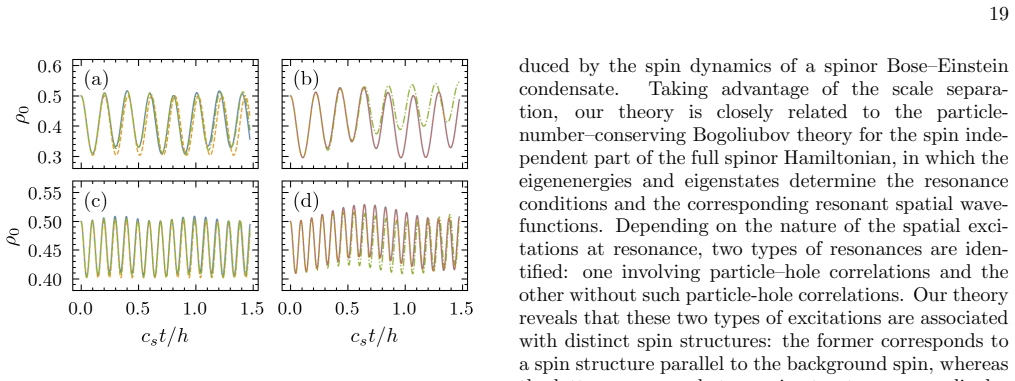
We develop a coupled-channel framework to describe the dynamics of spinor Bose-Einstein condensates (BECs), with particular emphasis on the behavior near resonances between spin dynamics and spatial excitations. Taking advantage of the disparity between the spin-dependent and spin-independent scattering lengths in typical spinor BECs, the Bogoliubov modes of the spin-independent part of the full system Hamiltonian provide an efficient set of basis functions for describing the system dynamics in a coupled-channel framework. For quadratic Zeeman shifts far from any resonance, the system can be described by a single spatial wavefunction during the spin dynamics, i.e., the so-called single-mode approximation holds. By tuning the quadratic Zeeman shift, we find resonant excitations of the Bogoliubov modes, which can be classified into two categories: those with particle-hole correlations and those without particle-hole correlations. We show that the beyond-quadratic-order terms that are neglected in standard Bogoliubov theories become increasingly important for capturing the long-time dynamics of the system near resonances. The coupled-channel framework is benchmarked against results from 1D Gross-Pitaevskii equation simulations. The framework developed in this work not only provides a numerically efficient tool for describing spinor BEC dynamics governed by different length scales, but also provides a clean physical interpretation of resonance phenomena in spinor BECs. Applications of this approach to other systems and extensions to the beyond-mean-field regime are also discussed.
Editorial analysis
A structured set of objections, weighed in public.
Referee Report
Summary. The manuscript develops a coupled-channel framework for the dynamics of spinor Bose-Einstein condensates near spin-spatial resonances. It exploits the disparity between spin-dependent and spin-independent scattering lengths to adopt the Bogoliubov modes of the spin-independent Hamiltonian as an efficient basis for a coupled-channel expansion. The work identifies resonant excitations of these modes (classified into those with and without particle-hole correlations) by tuning the quadratic Zeeman shift, demonstrates that beyond-quadratic-order terms become important for long-time dynamics near resonance, and benchmarks the framework against 1D Gross-Pitaevskii simulations. Applications to other systems and extensions beyond mean-field are discussed.
Significance. If the central claims hold, the framework supplies a numerically efficient tool for treating spinor BEC dynamics across disparate length scales together with a physically transparent classification of resonances. The explicit benchmarking against 1D GPE simulations is a constructive feature that supplies concrete validation data.
major comments (3)
- [Abstract and coupled-channel framework section] The central modeling assumption (stated in the abstract and developed in the coupled-channel construction) that the spin-independent Bogoliubov modes remain an efficient, essentially complete basis near resonance rests on the disparity |a_s - a_n| ≪ |a_n|. At resonance the quadratic Zeeman shift brings a spin mode into degeneracy with a spatial Bogoliubov mode; the effective coupling is then set by the matrix element of the spin-dependent interaction. No explicit estimate or numerical test of the size of this matrix element relative to the detuning or mode spacing is provided, leaving open whether the truncation remains controlled.
- [Benchmarking and long-time dynamics discussion] The claim that beyond-quadratic-order terms become increasingly important near resonance is asserted in the abstract and supported by the benchmarking discussion, yet the manuscript does not isolate the contribution of these terms (e.g., via a controlled comparison that retains versus drops them) in the resonant regime. Without such a decomposition it is difficult to quantify how much of the long-time discrepancy with standard Bogoliubov theory is truly due to higher-order terms versus basis incompleteness.
- [Resonance classification subsection] The classification of resonances into “particle-hole correlated” and “uncorrelated” categories is presented as a key result, but the manuscript does not supply an explicit diagnostic (e.g., a correlation function or overlap integral) that unambiguously assigns each resonance to one category. This diagnostic is needed to make the classification falsifiable and to confirm that the distinction survives the inclusion of higher-order terms.
minor comments (2)
- [Figures] Figure captions and axis labels should explicitly state the value of the quadratic Zeeman shift (in units of the relevant energy scale) for each resonant case shown.
- [Introduction and methods] The notation for the spin-dependent and spin-independent scattering lengths should be introduced once with a clear definition and used consistently thereafter.
Simulated Author's Rebuttal
We thank the referee for the careful reading of our manuscript and for the constructive comments, which have helped us identify areas where additional clarity and supporting analysis will strengthen the presentation. We address each major comment below and indicate the revisions we will make.
read point-by-point responses
-
Referee: [Abstract and coupled-channel framework section] The central modeling assumption (stated in the abstract and developed in the coupled-channel construction) that the spin-independent Bogoliubov modes remain an efficient, essentially complete basis near resonance rests on the disparity |a_s - a_n| ≪ |a_n|. At resonance the quadratic Zeeman shift brings a spin mode into degeneracy with a spatial Bogoliubov mode; the effective coupling is then set by the matrix element of the spin-dependent interaction. No explicit estimate or numerical test of the size of this matrix element relative to the detuning or mode spacing is provided, leaving open whether the truncation remains controlled.
Authors: We appreciate the referee's emphasis on rigorously justifying the basis truncation. The small ratio |a_s - a_n|/|a_n| directly suppresses the coupling matrix elements between spin and spatial modes. In the revised manuscript we will add an explicit perturbative estimate of these matrix elements (scaled by the spin-dependent interaction strength) relative to both the resonant detuning (which is tuned to zero) and the typical spacing of the Bogoliubov modes. This estimate demonstrates that the off-resonant couplings remain perturbative, thereby controlling the truncation even at resonance. revision: yes
-
Referee: [Benchmarking and long-time dynamics discussion] The claim that beyond-quadratic-order terms become increasingly important near resonance is asserted in the abstract and supported by the benchmarking discussion, yet the manuscript does not isolate the contribution of these terms (e.g., via a controlled comparison that retains versus drops them) in the resonant regime. Without such a decomposition it is difficult to quantify how much of the long-time discrepancy with standard Bogoliubov theory is truly due to higher-order terms versus basis incompleteness.
Authors: We agree that an explicit isolation strengthens the argument. In the revised version we will include a direct comparison, within the same coupled-channel basis, between (i) the dynamics obtained by retaining only quadratic terms and (ii) the full dynamics that includes the beyond-quadratic contributions. This decomposition will be shown specifically for the resonant cases, allowing a quantitative assessment of the higher-order terms' role in the long-time deviation from standard Bogoliubov theory. revision: yes
-
Referee: [Resonance classification subsection] The classification of resonances into “particle-hole correlated” and “uncorrelated” categories is presented as a key result, but the manuscript does not supply an explicit diagnostic (e.g., a correlation function or overlap integral) that unambiguously assigns each resonance to one category. This diagnostic is needed to make the classification falsifiable and to confirm that the distinction survives the inclusion of higher-order terms.
Authors: The classification follows directly from the structure of the underlying Bogoliubov modes (whether the mode functions exhibit particle-hole pairing). To make the assignment unambiguous we will introduce an explicit diagnostic based on the particle-hole correlation function evaluated on each resonant mode. We will also apply this diagnostic to the full (higher-order) dynamics obtained from the GPE benchmarks, thereby confirming that the distinction persists beyond the quadratic approximation. revision: yes
Circularity Check
Derivation chain is self-contained; no circular reductions identified
full rationale
The paper starts from the standard spinor BEC Hamiltonian, invokes the physical disparity |a_s - a_n| ≪ |a_n| to justify using spin-independent Bogoliubov modes as an efficient basis for the coupled-channel expansion, and then tunes the quadratic Zeeman shift to locate resonances by direct diagonalization or time evolution within that basis. The two-category classification of resonances (particle-hole correlated vs. uncorrelated) follows from the algebraic structure of the mode-coupling matrix elements. Long-time importance of beyond-quadratic terms is established by explicit comparison to independent 1D Gross-Pitaevskii simulations rather than by redefinition or self-fitting. No equation or claim reduces a derived quantity to a parameter fitted from the same resonance data, nor does any load-bearing step rest on a self-citation whose content is itself unverified within the present work. The derivation therefore remains independent of its target observables.
Axiom & Free-Parameter Ledger
axioms (2)
- domain assumption Bogoliubov modes of the spin-independent Hamiltonian form an efficient basis for the coupled-channel dynamics
- domain assumption Standard Bogoliubov theory applies away from resonance but requires higher-order corrections near resonance
Reference graph
Works this paper leans on
-
[1]
Kawaguchi and M
Y. Kawaguchi and M. Ueda, Spinor Bose–Einstein con- densates, Physics Reports520, 253 (2012)
2012
-
[2]
D. M. Stamper-Kurn and M. Ueda, Spinor Bose gases: Symmetries, magnetism, and quantum dynamics, Rev. Mod. Phys.85, 1191 (2013)
2013
-
[3]
S. Yi, O. E. M¨ ustecaplıo˘ glu, C. P. Sun, and L. You, Single-mode approximation in a spinor-1 atomic conden- sate, Phys. Rev. A66, 011601 (2002)
2002
-
[4]
Ho, Spinor Bose condensates in optical traps, Phys
T.-L. Ho, Spinor Bose condensates in optical traps, Phys. Rev. Lett.81, 742 (1998)
1998
-
[5]
C. V. Ciobanu, S.-K. Yip, and T.-L. Ho, Phase diagrams off= 2 spinor Bose-Einstein condensates, Phys. Rev. A 61, 033607 (2000)
2000
-
[6]
Zhang, D
W. Zhang, D. L. Zhou, M.-S. Chang, M. S. Chapman, and L. You, Coherent spin mixing dynamics in a spin-1 atomic condensate, Phys. Rev. A72, 013602 (2005)
2005
-
[7]
Gerbier, A
F. Gerbier, A. Widera, S. F¨ olling, O. Mandel, and I. Bloch, Resonant control of spin dynamics in ultracold quantum gases by microwave dressing, Phys. Rev. A73, 041602 (2006)
2006
-
[8]
L. Zhao, J. Jiang, T. Tang, M. Webb, and Y. Liu, Dy- namics in spinor condensates tuned by a microwave dress- ing field, Phys. Rev. A89, 023608 (2014)
2014
-
[9]
L. E. Sadler, J. M. Higbie, S. R. Leslie, M. Vengalattore, and D. M. Stamper-Kurn, Spontaneous symmetry break- ing in a quenched ferromagnetic spinor Bose–Einstein condensate, Nature443, 312 (2006)
2006
-
[10]
E. M. Bookjans, A. Vinit, and C. Raman, Quan- tum phase transition in an antiferromagnetic spinor Bose-Einstein condensate, Phys. Rev. Lett.107, 195306 (2011)
2011
-
[11]
Y. Liu, S. Jung, S. E. Maxwell, L. D. Turner, E. Tiesinga, and P. D. Lett, Quantum phase transitions and contin- uous observation of spinor dynamics in an antiferromag- netic condensate, Phys. Rev. Lett.102, 125301 (2009)
2009
-
[12]
Feldmann, C
P. Feldmann, C. Klempt, A. Smerzi, L. Santos, and M. Gessner, Interferometric order parameter for excited- state quantum phase transitions in Bose-Einstein con- densates, Phys. Rev. Lett.126, 230602 (2021)
2021
-
[13]
H.-X. Yang, T. Tian, Y.-B. Yang, L.-Y. Qiu, H.-Y. Liang, A.-J. Chu, C. B. Da˘ g, Y. Xu, Y. Liu, and L.-M. Duan, Observation of dynamical quantum phase transitions in a spinor condensate, Phys. Rev. A100, 013622 (2019)
2019
-
[14]
C. B. Da˘ g, S.-T. Wang, and L.-M. Duan, Classification of quench-dynamical behaviors in spinor condensates, Phys. Rev. A97, 023603 (2018)
2018
-
[15]
L. Zhou, J. Kong, Z. Lan, and W. Zhang, Dynamical quantum phase transitions in a spinor Bose-Einstein con- densate and criticality enhanced quantum sensing, Phys. Rev. Res.5, 013087 (2023)
2023
-
[16]
J. O. Austin-Harris, P. Sigdel, C. Binegar, S. E. Begg, T. Bilitewski, and Y. Liu, Observation of phase memory and dynamical phase transitions in spinor gases (2025), arXiv:2511.03720 [cond-mat.quant-gas]
work page internal anchor Pith review Pith/arXiv arXiv 2025
-
[17]
Tian, H.-X
T. Tian, H.-X. Yang, L.-Y. Qiu, H.-Y. Liang, Y.-B. Yang, Y. Xu, and L.-M. Duan, Observation of dynam- ical quantum phase transitions with correspondence in an excited state phase diagram, Phys. Rev. Lett.124, 043001 (2020)
2020
-
[18]
Q. Guan, D. Blume, and R. J. Lewis-Swan, Controlling the dynamical phase diagram of a spinor Bose-Einstein condensate using time-dependent potentials, Phys. Rev. A112, 023306 (2025)
2025
-
[19]
Evrard, A
B. Evrard, A. Qu, J. Dalibard, and F. Gerbier, Observa- tion of fragmentation of a spinor Bose-Einstein conden- sate, Science373, 1340 (2021)
2021
-
[20]
Luo, Y.-Q
X.-Y. Luo, Y.-Q. Zou, L.-N. Wu, Q. Liu, M.-F. Han, M. K. Tey, and L. You, Deterministic entanglement gen- eration from driving through quantum phase transitions, Science355, 620 (2017)
2017
-
[21]
T.-W. Mao, Q. Liu, X.-W. Li, J.-H. Cao, F. Chen, W.- X. Xu, M. K. Tey, Y.-X. Huang, and L. You, Quantum- enhanced sensing by echoing spin-nematic squeezing in atomic Bose–Einstein condensate, Nature Physics19, 1585 (2023)
2023
-
[22]
J. P. Wrubel, A. Schwettmann, D. P. Fahey, Z. Glassman, H. K. Pechkis, P. F. Griffin, R. Barnett, E. Tiesinga, and P. D. Lett, Spinor Bose-Einstein-condensate phase- sensitive amplifier for SU(1,1) interferometry, Phys. Rev. A98, 023620 (2018)
2018
-
[23]
Linnemann, H
D. Linnemann, H. Strobel, W. Muessel, J. Schulz, R. J. Lewis-Swan, K. V. Kheruntsyan, and M. K. Oberthaler, Quantum-enhanced sensing based on time reversal of nonlinear dynamics, Phys. Rev. Lett.117, 013001 (2016)
2016
-
[24]
L¨ ucke, M
B. L¨ ucke, M. Scherer, J. Kruse, L. Pezz´ e, F. Deuret- zbacher, P. Hyllus, O. Topic, J. Peise, W. Ertmer, J. Arlt, L. Santos, A. Smerzi, and C. Klempt, Twin matter waves for interferometry beyond the classical limit, Science334, 773 (2011)
2011
-
[25]
Gabbrielli, L
M. Gabbrielli, L. Pezz` e, and A. Smerzi, Spin-mixing in- terferometry with Bose-Einstein condensates, Phys. Rev. Lett.115, 163002 (2015)
2015
-
[26]
Z. N. Hardesty-Shaw, Q. Guan, J. O. Austin, D. Blume, R. J. Lewis-Swan, and Y. Liu, Quench-induced nonequi- librium dynamics of spinor gases in a moving lattice, Phys. Rev. A107, 053311 (2023)
2023
-
[27]
Z. N. Hardesty-Shaw, Q. Guan, J. O. Austin-Harris, D. Blume, R. J. Lewis-Swan, and Y. Liu, Nonlinear mul- tistate tunneling dynamics in a spinor Bose-Einstein con- densate, Phys. Rev. A108, 053307 (2023)
2023
-
[28]
J. O. Austin-Harris, Z. N. Hardesty-Shaw, Q. Guan, C. Binegar, D. Blume, R. J. Lewis-Swan, and Y. Liu, Engineering dynamical phase diagrams with driven lat- tices in spinor gases, Phys. Rev. A109, 043309 (2024)
2024
-
[29]
Stenger, S
J. Stenger, S. Inouye, D. M. Stamper-Kurn, H.-J. Mies- ner, A. P. Chikkatur, and W. Ketterle, Spin domains in ground-state Bose–Einstein condensates, Nature396, 345 (1998)
1998
-
[30]
Jim´ enez-Garc´ ıa, A
K. Jim´ enez-Garc´ ıa, A. Invernizzi, B. Evrard, C. Frapolli, J. Dalibard, and F. Gerbier, Spontaneous formation and relaxation of spin domains in antiferromagnetic spin-1 condensates, Nature Communications10, 1422 (2019). 22
2019
-
[31]
S. Tojo, Y. Taguchi, Y. Masuyama, T. Hayashi, H. Saito, and T. Hirano, Controlling phase separation of binary Bose-Einstein condensates via mixed-spin-channel Fesh- bach resonance, Phys. Rev. A82, 033609 (2010)
2010
-
[32]
Vinit, E
A. Vinit, E. M. Bookjans, C. A. R. S´ a de Melo, and C. Raman, Antiferromagnetic spatial ordering in a quenched one-dimensional spinor gas, Phys. Rev. Lett. 110, 165301 (2013)
2013
-
[33]
J. Kim, J. Jung, J. Lee, D. Hong, and Y. Shin, Chaos- assisted turbulence in spinor Bose-Einstein condensates, Phys. Rev. Res.6, L032030 (2024)
2024
- [34]
-
[35]
Scherer, B
M. Scherer, B. L¨ ucke, G. Gebreyesus, O. Topic, F. Deuretzbacher, W. Ertmer, L. Santos, J. J. Arlt, and C. Klempt, Spontaneous breaking of spatial and spin symmetry in spinor condensates, Phys. Rev. Lett.105, 135302 (2010)
2010
-
[36]
Scherer, B
M. Scherer, B. L¨ ucke, J. Peise, O. Topic, G. Gebreye- sus, F. Deuretzbacher, W. Ertmer, L. Santos, C. Klempt, and J. J. Arlt, Spontaneous symmetry breaking in spinor Bose-Einstein condensates, Phys. Rev. A88, 053624 (2013)
2013
-
[37]
Klempt, O
C. Klempt, O. Topic, G. Gebreyesus, M. Scherer, T. Hen- ninger, P. Hyllus, W. Ertmer, L. Santos, and J. J. Arlt, Parametric amplification of vacuum fluctuations in a spinor condensate, Phys. Rev. Lett.104, 195303 (2010)
2010
-
[38]
J. Jie, S. Zhong, Q. Zhang, I. Morgenstern, H. G. Ooi, Q. Guan, A. Bhagat, D. Nematollahi, A. Schwettmann, and D. Blume, Dynamical mean-field-driven spinor- condensate physics beyond the single-mode approxima- tion, Phys. Rev. A107, 053309 (2023)
2023
-
[39]
J. Jie, Q. Guan, S. Zhong, A. Schwettmann, and D. Blume, Mean-field spin-oscillation dynamics be- yond the single-mode approximation for a harmonically trapped spin-1 Bose-Einstein condensate, Phys. Rev. A 102, 023324 (2020)
2020
-
[40]
N. T. Phuc, Y. Kawaguchi, and M. Ueda, Beliaev theory of spinor Bose–Einstein condensates, Annals of Physics 328, 158 (2013)
2013
-
[41]
Castin and R
Y. Castin and R. Dum, Low-temperature Bose-Einstein condensates in time-dependent traps: Beyond theU(1) symmetry-breaking approach, Phys. Rev. A57, 3008 (1998)
1998
-
[42]
Ciliberto, R
G. Ciliberto, R. Balbinot, A. Fabbri, and N. Pavloff, Quantum backreaction in an analog black hole, Phys. Rev. A112, 063323 (2025)
2025
-
[43]
S.-S. Baak, C. C. H. Ribeiro, and U. R. Fischer, Number- conserving solution for dynamical quantum backreaction in a Bose-Einstein condensate, Phys. Rev. A106, 053319 (2022)
2022
-
[44]
Sch¨ utzhold, M
R. Sch¨ utzhold, M. Uhlmann, Y. Xu, and U. R. Fischer, Quantum backreaction in dilute Bose-Einstein conden- sates, Phys. Rev. D72, 105005 (2005)
2005
-
[45]
Lewenstein and L
M. Lewenstein and L. You, Quantum phase diffusion of a Bose-Einstein condensate, Phys. Rev. Lett.77, 3489 (1996)
1996
-
[46]
C. W. Gardiner, Particle-number-conserving Bogoliubov method which demonstrates the validity of the time- dependent Gross-Pitaevskii equation for a highly con- densed Bose gas, Phys. Rev. A56, 1414 (1997)
1997
-
[47]
Knoop, T
S. Knoop, T. Schuster, R. Scelle, A. Trautmann, J. App- meier, M. K. Oberthaler, E. Tiesinga, and E. Tiemann, Feshbach spectroscopy and analysis of the interaction po- tentials of ultracold sodium, Phys. Rev. A83, 042704 (2011)
2011
-
[48]
A. J. Leggett, Bose-Einstein condensation in the alkali gases: Some fundamental concepts, Rev. Mod. Phys.73, 307 (2001)
2001
-
[49]
Zaremba, T
E. Zaremba, T. Nikuni, and A. Griffin, Dynamics of trapped Bose gases at finite temperatures, Journal of Low Temperature Physics116, 277 (1999)
1999
-
[50]
M. A. Garcia-March, S. v. Frank, M. Bonneau, J. Schmiedmayer, M. Lewenstein, and L. F. Santos, Relaxation, chaos, and thermalization in a three-mode model of a Bose–Einstein condensate, New Journal of Physics20, 113039 (2018)
2018
-
[51]
Shchedrin, D
G. Shchedrin, D. Jaschke, and L. D. Carr, Absence of Landau damping in driven three-component Bose– Einstein condensate in optical lattices, Scientific Reports 8, 11523 (2018)
2018
-
[52]
I. M. Georgescu, S. Ashhab, and F. Nori, Quantum sim- ulation, Rev. Mod. Phys.86, 153 (2014)
2014
-
[53]
Altman, K
E. Altman, K. R. Brown, G. Carleo, L. D. Carr, E. Dem- ler, C. Chin, B. DeMarco, S. E. Economou, M. A. Eriks- son, K.-M. C. Fu, M. Greiner, K. R. Hazzard, R. G. Hulet, A. J. Koll´ ar, B. L. Lev, M. D. Lukin, R. Ma, X. Mi, S. Misra, C. Monroe, K. Murch, Z. Nazario, K.-K. Ni, A. C. Potter, P. Roushan, M. Saffman, M. Schleier- Smith, I. Siddiqi, R. Simmonds,...
2021
-
[54]
F. J. Harris, On the Use of Windows for Harmonic Anal- ysis with the Discrete Fourier Transform, IEEE Proceed- ings66, 51 (1978)
1978
discussion (0)
Sign in with ORCID, Apple, or X to comment. Anyone can read and Pith papers without signing in.