Recognition: unknown
Q-SINDy: Quantum-Kernel Sparse Identification of Nonlinear Dynamics with Provable Coefficient Debiasing
Pith reviewed 2026-05-10 07:38 UTC · model grok-4.3
The pith
Orthogonalizing quantum kernel features against polynomials removes exact cannibalization bias from Q-SINDy equation recovery.
A machine-rendered reading of the paper's core claim, the machinery that carries it, and where it could break.
Core claim
Quantum features in Q-SINDy induce coefficient cannibalization bias given exactly by Δξ_P = (P^T P)^{-1} P^T Q ξ̂_Q; orthogonalizing the quantum matrix Q against the polynomial matrix P at fit time eliminates the bias identically, restoring the polynomial coefficients that vanilla SINDy would have found.
What carries the argument
The orthogonalization step that projects quantum feature columns Q perpendicular to the polynomial basis P before the sparse regression, which nulls the derived cannibalization term.
If this is right
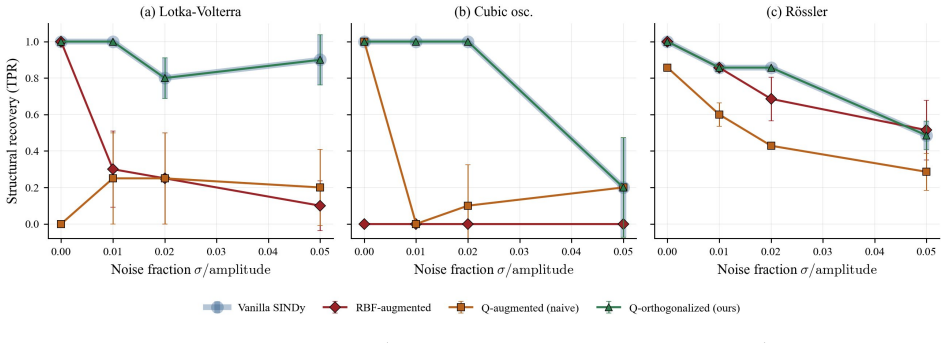
- Orthogonalized Q-SINDy recovers the same true-positive rates as vanilla SINDy across Duffing, Van der Pol, Lorenz, Lotka-Volterra, cubic oscillator and Rössler systems.
- Uncorrected quantum augmentation lowers true-positive recovery by as much as 100 percent on the same systems.
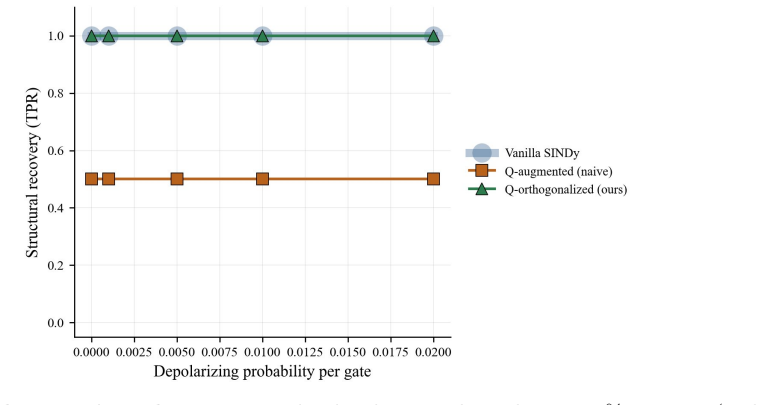
- The bias correction remains effective under depolarizing noise up to 2 percent per gate and applies unchanged to Burgers’ equation.
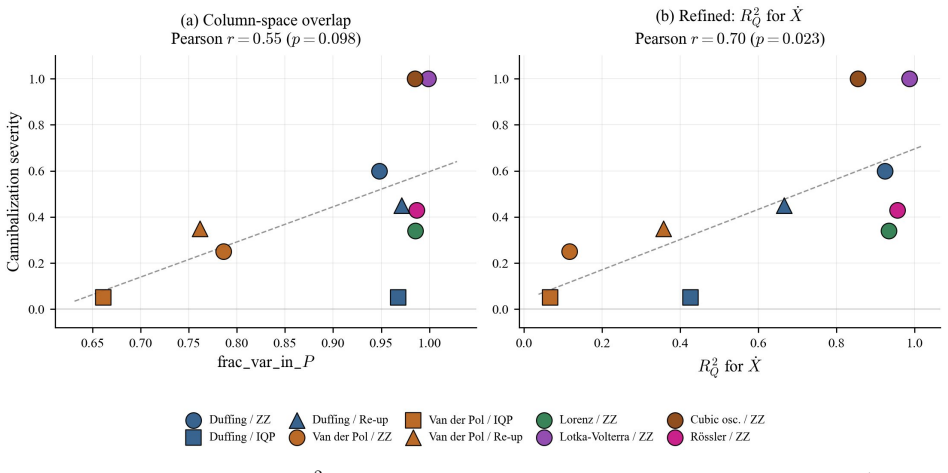
- An R^2_Q diagnostic computed on the derivative data correlates with cannibalization severity at Pearson r = 0.70.
Where Pith is reading between the lines
- The same orthogonalization step can be inserted into any kernel-augmented sparse regression to protect the original basis coefficients.
- The R^2_Q diagnostic offers a practical gatekeeper for deciding whether quantum features add value on a given dataset.
- Because the correction is linear-algebraic rather than hardware-specific, it remains available even if future quantum feature maps become more expressive.
Load-bearing premise
The polynomial basis is treated as the reference explanatory space whose coefficients must be recovered without distortion.
What would settle it
On any system whose true governing equation is known, run orthogonalized Q-SINDy and check whether the recovered polynomial coefficients differ from those of vanilla SINDy by more than 10^{-12}.
Figures



read the original abstract
Quantum feature maps offer expressive embeddings for classical learning tasks, and augmenting sparse identification of nonlinear dynamics (SINDy) with such features is a natural but unexplored direction. We introduce \textbf{Q-SINDy}, a quantum-kernel-augmented SINDy framework, and identify a specific failure mode that arises: \emph{coefficient cannibalization}, in which quantum features absorb coefficient mass that rightfully belongs to the polynomial basis, corrupting equation recovery. We derive the exact cannibalization-bias formula $\Delta\xi_P = (P^\top P)^{-1}P^\top Q\,\hat\xi_Q$ and prove that orthogonalizing quantum features against the polynomial column space at fit time eliminates this bias exactly. The claim is verified numerically to machine precision ($<10^{-12}$) on multiple systems. Empirically, across six canonical dynamical systems (Duffing, Van der Pol, Lorenz, Lotka-Volterra, cubic oscillator, R\"ossler) and three quantum feature map architectures (ZZ-angle encoding, IQP, data re-uploading), orthogonalized Q-SINDy consistently matches vanilla SINDy's structural recovery while uncorrected augmentation degrades true-positive rates by up to 100\%. A refined dynamics-aware diagnostic, $R^2_Q$ for $\dot X$, predicts cannibalization severity with statistical significance (Pearson $r=0.70$, $p=0.023$). An RBF classical-kernel control across 20 hyperparameter configurations fails more severely than any quantum variant, ruling out feature count as the cause. Orthogonalization remains robust under depolarizing hardware noise up to 2\% per gate, and the framework extends without modification to Burgers' equation.
Editorial analysis
A structured set of objections, weighed in public.
Referee Report
Summary. The manuscript introduces Q-SINDy, a quantum-kernel-augmented SINDy framework for nonlinear dynamics identification. It identifies the coefficient cannibalization failure mode in which quantum features absorb mass from the polynomial basis, derives the exact bias formula Δξ_P = (P^⊤ P)^{-1} P^⊤ Q ξ̂_Q, proves that orthogonalizing the quantum feature matrix Q against the polynomial column space P at fit time eliminates the bias exactly (by enforcing P^⊤ Q_perp = 0 and decoupling the normal equations), and verifies the elimination to machine precision (<10^{-12}) on multiple systems. Empirically, orthogonalized Q-SINDy matches vanilla SINDy structural recovery across six dynamical systems (Duffing, Van der Pol, Lorenz, Lotka-Volterra, cubic oscillator, Rössler) and three quantum maps (ZZ-angle encoding, IQP, data re-uploading), while uncorrected augmentation degrades true-positive rates by up to 100%; a dynamics-aware diagnostic R²_Q for Ẋ predicts cannibalization severity (Pearson r=0.70, p=0.023), an RBF classical-kernel control across 20 configurations fails more severely, and the method remains robust to depolarizing noise up to 2% per gate. The framework extends without modification to Burgers' equation.
Significance. If the central linear-algebra result holds, the work supplies a principled, exact debiasing technique that permits safe incorporation of expressive quantum features into sparse regression without corrupting the interpretable polynomial coefficients or the SINDy thresholding procedure. The derivation from standard least-squares identities, the explicit proof of bias elimination, and the machine-precision numerical verification (<10^{-12}) constitute clear strengths, as does the consistent empirical matching to the vanilla baseline and the control experiment that rules out feature-count explanations. The approach may generalize to other hybrid quantum-classical sparse identification tasks in physics and engineering.
minor comments (3)
- The bias formula in the abstract uses the notation Δξ_P = (P^⊤ P)^{-1}P^⊤ Q ξ̂_Q; ensure identical symbol definitions and hat notation appear in the main-text derivation (likely §3) to avoid reader confusion on first reading.
- The claim that orthogonality is preserved under SINDy’s sequential thresholded least-squares iterations is central to asserting identical recovery at every step; a one-sentence reference to the fact that column subsetting preserves the P^⊤ Q_perp = 0 property would improve clarity without lengthening the proof.
- The R²_Q diagnostic is reported with Pearson r=0.70 (p=0.023); state the number of independent configurations or systems over which the correlation was computed so that the statistical significance can be assessed directly.
Simulated Author's Rebuttal
We thank the referee for their positive and accurate summary of the manuscript, which correctly identifies the coefficient cannibalization issue, the exact bias formula, the orthogonalization proof, and the empirical results across the tested systems. We appreciate the recommendation to accept.
Circularity Check
No significant circularity detected
full rationale
The central derivation applies the normal equations of ordinary least squares to the joint feature matrix [P Q] to obtain the exact bias formula Δξ_P = (PᵀP)⁻¹PᵀQ ξ̂_Q; this is a direct algebraic identity independent of SINDy or quantum features. Orthogonalization of Q against the column space of P sets PᵀQ_perp = 0 by the definition of the orthogonal complement, decoupling the estimators with no additional assumptions. Numerical checks to machine precision (<10^{-12}) simply confirm the identity and are expected by construction. Performance comparisons across six dynamical systems, three quantum feature maps, an RBF control, and noise robustness constitute external empirical validation rather than self-referential evidence. No self-citations, ansatzes, or renamings load-bear the proof.
Axiom & Free-Parameter Ledger
axioms (1)
- standard math Standard properties of orthogonal projection in linear algebra (P^⊤Q = 0 after orthogonalization implies no bias transfer)
Reference graph
Works this paper leans on
-
[1]
Harnessing quantum algorithms in nuclear engineering
Samrendra Roy, Kazuma Kobayashi, Sajedul Talukder, and Syed Bahauddin Alam. Harnessing quantum algorithms in nuclear engineering. InNuclear Plant Instrumentation, Control & Human-Machine Interface Technology (NPIC & HMIT 2025). American Nuclear Society, 2025a. Vojtˇ ech Havl´ ıˇ cek, Antonio D. C´ orcoles, Kristan Temme, Aram W. Harrow, Abhinav Kandala, J...
2025
-
[2]
Sparse identification of quantum hamiltonian dynamics via quantum circuit learning.arXiv:2602.14556,
Yusei Tateyama and Yuzuru Kato. Sparse identification of quantum hamiltonian dynamics via quantum circuit learning.arXiv:2602.14556,
- [3]
-
[4]
Protocols for solving nonlinear ODEs without grid evalua- tion,
Annie E. Paine, Vincent E. Elfving, and Oleksandr Kyriienko. Physics-informed quantum machine learning: Solving nonlinear differential equations in latent spaces without costly grid evaluations.arXiv:2308.01827,
-
[5]
PennyLane: Automatic differentiation of hybrid quantum-classical computations
Ville Bergholm et al. PennyLane: Automatic differentiation of hybrid quantum-classical computations. arXiv:1811.04968,
work page internal anchor Pith review arXiv
-
[6]
Foundation models for dynamic nuclear systems: Energy-efficient surrogates via deep operator learning
Samrendra Roy, Kazuma Kobayashi, Souvik Chakraborty, Sajedul Talukder, and Syed Bahauddin Alam. Foundation models for dynamic nuclear systems: Energy-efficient surrogates via deep operator learning. Transactions of the American Nuclear Society, 133(1):158–161, 2025b. Kazuma Kobayashi, Farid Ahmed, Samrendra Roy, Mehedi H. Tusar, Sajedul Talukder, and Syed...
2025
-
[7]
System Equations IC Poly deg
13 A System specifications Table 2: Systems, parameters, and library configurations. System Equations IC Poly deg. STLSQ thresh. Duffing ˙x=y,˙y=−x−0.3x 3 −0.1y[1,0] 3 0.05 Van der Pol ˙x=y,˙y=µ(1−x 2)y−x, µ= 1 [2,0] 3 0.05 Lorenz [Lorenz, 1963] ˙x= 10(y−x),˙y=x(28−z)−y,˙z=xy− 8 3 z[1,1,1] 2 0.1 Lotka-Volterra ˙x= 2 3 x− 4 3 xy,˙y=xy−y[1,1] 2 0.05 Cubic o...
1963
discussion (0)
Sign in with ORCID, Apple, or X to comment. Anyone can read and Pith papers without signing in.