Recognition: unknown
Coarse-Grained Dynamics with Spatial Disorder and Non-Markovian Memory
Pith reviewed 2026-05-10 07:20 UTC · model grok-4.3
The pith
The spatial disorder-generalized Langevin equation separates fixed spatial variations from viscoelastic memory to extrapolate long-time anomalous diffusion from short trajectories in heterogeneous systems.
A machine-rendered reading of the paper's core claim, the machinery that carries it, and where it could break.
Core claim
The central claim is that standard generalized Langevin equations reach clear limits when spatial disorder is present, whereas the spatial disorder-generalized Langevin equation, constructed via variational Bayesian inference with a random field prior, disentangles static spatial disorder from non-Markovian friction and thereby accurately extrapolates long-time dynamics, captures the anomalous diffusion crossover, and recovers the ensemble statistical properties that are inherent to the disordered systems.
What carries the argument
The spatial disorder-generalized Langevin equation (SD-GLE), which employs a random field prior within variational Bayesian inference to represent position-dependent static disorder separately from the memory kernel that encodes viscoelastic friction.
If this is right
- Standard generalized Langevin equations fail to capture long-time dynamics once spatial disorder is present.
- SD-GLE extrapolates long-time trajectories and the anomalous diffusion crossover directly from short data segments.
- The fitted model recovers the correct ensemble statistical properties that arise from the disordered nature of the system.
- A data-driven coarse-grained description becomes feasible for heterogeneous systems without requiring a mean-field potential.
Where Pith is reading between the lines
- The same separation technique could be tested on experimental single-particle tracking data where the underlying disorder is independently measurable.
- If the random-field separation proves robust, many apparent memory effects observed in crowded media may turn out to be projections of static spatial heterogeneity rather than intrinsic time correlations.
- The approach suggests a route to parameter-free upscaling: once disorder and memory are isolated from short runs, the resulting SD-GLE could serve as a surrogate for much longer simulations in porous or biological environments.
Load-bearing premise
The assumption that variational Bayesian inference with a random field prior can separate unchanging spatial disorder from time-dependent friction forces without creating artificial behaviors or losing physical consistency.
What would settle it
Generate an independent set of long trajectories in a known disordered system, fit the SD-GLE parameters exclusively from short segments of those trajectories, then simulate forward with the fitted model and check whether the predicted mean-squared-displacement crossover time and long-time ensemble variance match the direct long trajectories.
Figures


read the original abstract
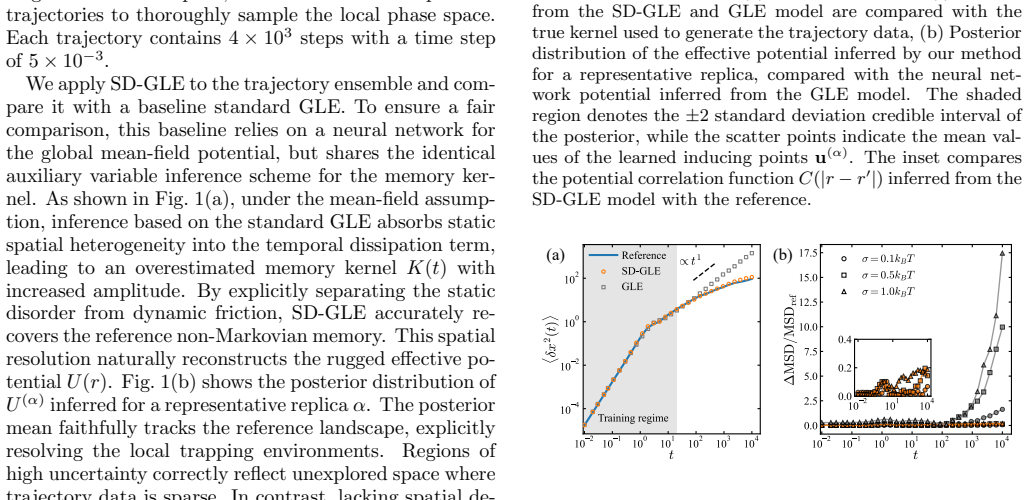
We introduce the spatial disorder-generalized Langevin equation (SD-GLE), a data-driven method for constructing coarse-grained (CG) dynamics in heterogeneous systems. Unlike conventional CG approaches that rely on a mean-field potential, SD-GLE utilizes a variational Bayesian framework with a random field prior to explicitly disentangle static spatial disorder from viscoelastic friction. Numerical results demonstrate the limits of standard GLEs, whereas SD-GLE accurately extrapolates long-time dynamics to capture the anomalous diffusion crossover from short trajectories and recover the ensemble statistical properties inherent to the disordered nature of these systems.
Editorial analysis
A structured set of objections, weighed in public.
Referee Report
Summary. The manuscript introduces the spatial disorder-generalized Langevin equation (SD-GLE) as a data-driven coarse-graining approach for heterogeneous systems exhibiting both spatial disorder and non-Markovian memory. It employs a variational Bayesian framework with a random field prior to explicitly separate static spatial disorder from viscoelastic friction, in contrast to mean-field CG methods. Numerical results are presented to argue that standard GLEs fail to capture long-time behavior, while SD-GLE extrapolates anomalous diffusion crossovers from short trajectories and recovers the underlying ensemble statistics of the disordered system.
Significance. If the separation of disorder and memory proves reliable, the method offers a useful advance for coarse-graining in soft-matter and biological systems where spatial heterogeneity drives anomalous transport. The explicit use of a random-field prior within variational inference provides a principled way to quantify uncertainty and could enable predictions from limited short-time data. The data-driven character with Bayesian treatment of disorder is a clear strength relative to purely phenomenological GLE extensions.
major comments (2)
- [Numerical Results] The central claim that SD-GLE 'accurately extrapolates long-time dynamics' and recovers ensemble statistics rests on the assumption that the variational posterior uniquely attributes fluctuations to either the random field or the memory kernel. No analysis of posterior identifiability or degeneracy (e.g., whether a slowly varying random field can trade off against a long-tailed memory kernel while fitting short trajectories) is provided; without ground-truth tests on synthetic data with known spatial statistics, the numerical demonstrations cannot rule out fitting artifacts.
- [Methods] The variational Bayesian procedure is load-bearing for the entire method, yet the manuscript does not supply the explicit form of the random-field prior, the parameterization of the disorder field, or the evidence lower bound used in inference. Without these, it is impossible to verify that the inferred disorder field reproduces the true spatial correlation function when ground-truth heterogeneity is available.
minor comments (3)
- [Abstract] The abstract asserts that 'numerical results demonstrate' the claimed accuracy but supplies no system details, trajectory lengths, error metrics, or comparison baselines; adding one quantitative sentence would strengthen the summary.
- [Figures] Figure captions and axis labels in the numerical section should explicitly state the short-trajectory length used for inference versus the extrapolation horizon, and whether error bars represent posterior uncertainty or ensemble variability.
- [Introduction] A brief comparison paragraph placing SD-GLE against existing Bayesian or random-field extensions of the GLE in the literature would clarify the incremental contribution.
Simulated Author's Rebuttal
We thank the referee for their constructive feedback and for recognizing the potential significance of the SD-GLE approach. We provide point-by-point responses to the major comments below and outline the revisions we will implement.
read point-by-point responses
-
Referee: [Numerical Results] The central claim that SD-GLE 'accurately extrapolates long-time dynamics' and recovers ensemble statistics rests on the assumption that the variational posterior uniquely attributes fluctuations to either the random field or the memory kernel. No analysis of posterior identifiability or degeneracy (e.g., whether a slowly varying random field can trade off against a long-tailed memory kernel while fitting short trajectories) is provided; without ground-truth tests on synthetic data with known spatial statistics, the numerical demonstrations cannot rule out fitting artifacts.
Authors: We appreciate the referee pointing out the need for explicit validation of identifiability. While our current numerical results use data from heterogeneous systems with known underlying disorder and memory properties to demonstrate extrapolation and recovery of ensemble statistics, we acknowledge that a dedicated identifiability study was not included. In the revised manuscript, we will add synthetic experiments specifically designed to test for degeneracy, such as comparing inference results when the random field correlation length is varied relative to the memory kernel timescale. This will include quantitative assessment of how well the inferred random field matches the true spatial statistics, thereby addressing concerns about fitting artifacts. revision: yes
-
Referee: [Methods] The variational Bayesian procedure is load-bearing for the entire method, yet the manuscript does not supply the explicit form of the random-field prior, the parameterization of the disorder field, or the evidence lower bound used in inference. Without these, it is impossible to verify that the inferred disorder field reproduces the true spatial correlation function when ground-truth heterogeneity is available.
Authors: We agree that the lack of these explicit details hinders full verification. The manuscript focuses on the conceptual framework and results, with some details in the supplementary information, but we will expand the main text or add a dedicated methods appendix in the revision. This will include the precise form of the random field prior (Gaussian random field with specified covariance function), the parameterization (e.g., via finite element or grid-based representation), and the derivation of the evidence lower bound (ELBO) used in the variational inference. With these additions, readers will be able to confirm the reproduction of spatial correlation functions on ground-truth data. revision: yes
Circularity Check
Long-time extrapolation presented as prediction but derived from short-trajectory variational fit
specific steps
-
fitted input called prediction
[Abstract]
"SD-GLE accurately extrapolates long-time dynamics to capture the anomalous diffusion crossover from short trajectories and recover the ensemble statistical properties inherent to the disordered nature of these systems."
The variational Bayesian framework with random field prior is used to fit parameters to short trajectories; the long-time crossover and ensemble statistics are then generated from those same fitted parameters, so the 'accurate extrapolation' is produced by the model fit rather than tested against independent long-time data.
full rationale
The abstract describes a data-driven variational Bayesian method that fits an SD-GLE (with random-field prior) to short trajectories and then claims accurate long-time extrapolation of anomalous diffusion. This is a standard use of a fitted model for prediction rather than a mathematical derivation that reduces to its inputs by construction. No equations, self-citations, uniqueness theorems, or ansatzes are quoted that would trigger self-definitional or load-bearing circularity. The separation of disorder from memory is presented as the method's contribution, with numerical results offered as validation; without explicit held-out long-time tests or identifiability proofs in the visible text, the extrapolation claim carries some risk of being reconstruction, but does not meet the strict criteria for high circularity. The paper appears self-contained as a modeling proposal.
Axiom & Free-Parameter Ledger
invented entities (1)
-
SD-GLE
no independent evidence
Reference graph
Works this paper leans on
-
[1]
I. M. Toli ´ c Nørrelykke, E.-L. Munteanu, G. Thon, L. Oddershede, and K. Berg-Sørensen, Phys. Rev. Lett. 93, 078102 (2004)
2004
-
[2]
H. D. Pinholt, S. S.-R. Bohr, J. F. Iversen, W. Boomsma, and N. S. Hatzakis, Proceedings of the National Academy of Sciences118, e2104624118 (2021)
2021
-
[3]
I. M. Sokolov, Soft Matter8, 9043 (2012)
2012
-
[4]
P. Ge, Z. Zhang, and H. Lei, Phys. Rev. Lett.133, 077301 (2024)
2024
-
[5]
B. Mei, G. S. Grest, S. Liu, T. C. O’Connor, and K. S. Schweizer, Proceedings of the National Academy of Sci- ences121, e2403964121 (2024)
2024
-
[6]
B. Wang, S. M. Kuo, S. C. Bae, and S. Granick, Nature materials11, 481 (2012)
2012
-
[7]
G. Jung, G. Biroli, and L. Berthier, Phys. Rev. Lett.130, 238202 (2023)
2023
-
[8]
Bapst, T
V. Bapst, T. Keck, A. Grabska-Barwi´ nska, C. Donner, E. D. Cubuk, S. S. Schoenholz, A. Obika, A. W. R. Nel- son, T. Back, D. Hassabis, and P. Kohli, Nature Physics 16, 448 (2020)
2020
-
[9]
A. V. Weigel, B. Simon, M. M. Tamkun, and D. Krapf, Proceedings of the National Academy of Sciences of the United States of America108, 6438 (2011)
2011
-
[10]
Meroz, I
Y. Meroz, I. M. Sokolov, and J. Klafter, Phys. Rev. E 81, 010101 (2010)
2010
-
[11]
Goychuk and V
I. Goychuk and V. O. Kharchenko, Phys. Rev. Lett.113, 100601 (2014)
2014
-
[12]
Metzler, J.-H
R. Metzler, J.-H. Jeon, A. G. Cherstvy, and E. Barkai, Physical Chemistry Chemical Physics16, 24128 (2014)
2014
-
[13]
Meroz and I
Y. Meroz and I. M. Sokolov, Physics Reports573, 1 (2015)
2015
-
[14]
Thiel, F
F. Thiel, F. Flegel, and I. M. Sokolov, Phys. Rev. Lett. 111, 010601 (2013)
2013
-
[15]
Mu˜ noz-Gil, G
G. Mu˜ noz-Gil, G. Volpe, M. A. Garcia-March,et al., Na- ture Communications12, 6253 (2021)
2021
-
[16]
K. Song, D. E. Makarov, and E. Vouga, Phys. Rev. Res. 5, L012026 (2023)
2023
-
[17]
Mu˜ noz-Gil, G
G. Mu˜ noz-Gil, G. Volpe, M. A. Garcia-March, E. Aghion, A. Argun, C. Hong, T. Bland, S. Bo, J. A. Conejero, N. Firbas,et al., Nature communications12, 6253 (2021)
2021
-
[18]
Kowalek, H
P. Kowalek, H. Loch-Olszewska, and J. Szwabi´ nski, Phys- ical Review E100, 032410 (2019)
2019
-
[19]
S. Bo, F. Schmidt, R. Eichhorn, and G. Volpe, Physical Review E100, 010102 (2019)
2019
-
[20]
Tepper, B
L. Tepper, B. Dalton, and R. R. Netz, Journal of Chem- ical Theory and Computation20, 3061 (2024)
2024
-
[21]
H. Lei, N. A. Baker, and X. Li, Proceedings of the Na- tional Academy of Sciences113, 14183 (2016)
2016
-
[22]
J. O. Daldrop, B. G. Kowalik, and R. R. Netz, Phys. Rev. X7, 041065 (2017)
2017
-
[23]
Vroylandt, L
H. Vroylandt, L. Gouden` ege, P. Monmarch´ e, F. Pietrucci, and B. Rotenberg, Proceedings of the National Academy of Sciences119, e2117586119 (2022)
2022
-
[24]
Lyu and H
L. Lyu and H. Lei, Phys. Rev. Lett.131, 177301 (2023)
2023
-
[25]
P. Xie, R. Car, and W. E, Proceedings of the National Academy of Sciences121, e2308668121 (2024)
2024
-
[26]
Jiang and W
Y. Jiang and W. E, Journal of Chemical Theory and Computation20, 2824 (2024)
2024
-
[27]
Gouden` ege, T
L. Gouden` ege, T. Leli` evre, G. A. Pavliotis, and G. Stoltz, Multiscale Modeling & Simulation20, 1454 (2022)
2022
-
[28]
C. Ma, J. Wang, and W. E, Communications in Compu- tational Physics29, 1002 (2021)
2021
-
[29]
Lubelski, I
A. Lubelski, I. M. Sokolov, and J. Klafter, Phys. Rev. Lett.100, 250602 (2008)
2008
-
[30]
J.-H. Jeon, V. Tejedor, S. Burov, E. Barkai, C. Selhuber- Unkel, K. Berg-Sørensen, L. Oddershede, and R. Metzler, Phys. Rev. Lett.106, 048103 (2011)
2011
-
[31]
Akimoto, E
T. Akimoto, E. Barkai, and K. Saito, Phys. Rev. Lett. 117, 180602 (2016)
2016
-
[32]
Klimek, B
A. Klimek, B. A. Dalton, and R. R. Netz, The European Physical Journal E48, 55 (2025)
2025
-
[33]
Hij´ on, P
C. Hij´ on, P. Espa˜ nol, E. Vanden-Eijnden, and R. Delgado-Buscalioni, Faraday Discuss.144, 301 (2010)
2010
-
[34]
Bouchaud and A
J.-P. Bouchaud and A. Georges, Physics Reports195, 127 (1990)
1990
-
[35]
B¨ assler, Phys
H. B¨ assler, Phys. Rev. Lett.58, 767 (1987)
1987
-
[36]
Hecksher, A
T. Hecksher, A. I. Nielsen, N. B. Olsen, and J. C. Dyre, Nature Physics4, 737 (2008)
2008
-
[37]
M. Kong, L. Liu, X. Chen, K. I. Driscoll, P. Mao, S. B¨ ohm, N. M. Kad, S. C. Watkins, K. A. Bernstein, J. J. Wyrick, J.-H. Min, and B. Van Houten, Molecular Cell64, 376 (2016)
2016
-
[38]
Gerland, J
U. Gerland, J. D. Moroz, and T. Hwa, Proceedings of the National Academy of Sciences99, 12015 (2002)
2002
-
[39]
Slutsky, M
M. Slutsky, M. Kardar, and L. A. Mirny, Phys. Rev. E 69, 061903 (2004)
2004
-
[40]
B´ enichou, Y
O. B´ enichou, Y. Kafri, M. Sheinman, and R. Voituriez, Phys. Rev. Lett.103, 138102 (2009)
2009
-
[41]
Sheinman, O
M. Sheinman, O. B´ enichou, Y. Kafri, and R. Voituriez, Reports on Progress in Physics75, 026601 (2012)
2012
-
[42]
Titsias, inProceedings of the Twelfth Interna- tional Conference on Artificial Intelligence and Statis- tics, Vol
M. Titsias, inProceedings of the Twelfth Interna- tional Conference on Artificial Intelligence and Statis- tics, Vol. 5, edited by D. van Dyk and M. Welling (PMLR, 2009) pp. 567–574
2009
-
[43]
Ceriotti, G
M. Ceriotti, G. Bussi, and M. Parrinello, Journal of Chemical Theory and Computation6, 1170 (2010)
2010
-
[44]
Ceriotti, G
M. Ceriotti, G. Bussi, and M. Parrinello, Phys. Rev. Lett. 102, 020601 (2009)
2009
-
[45]
Schweppe, IEEE Transactions on Information Theory 11, 61 (1965)
F. Schweppe, IEEE Transactions on Information Theory 11, 61 (1965)
1965
-
[46]
Cammarota and G
C. Cammarota and G. Biroli, Proceedings of the National Academy of Sciences109, 8850 (2012)
2012
-
[47]
Chakrabarty, R
S. Chakrabarty, R. Das, S. Karmakar, and C. Dasgupta, The Journal of Chemical Physics145, 034507 (2016)
2016
-
[48]
Rahman, Phys
A. Rahman, Phys. Rev.136, A405 (1964)
1964
-
[49]
Y. He, S. Burov, R. Metzler, and E. Barkai, Phys. Rev. Lett.101, 058101 (2008)
2008
discussion (0)
Sign in with ORCID, Apple, or X to comment. Anyone can read and Pith papers without signing in.