Recognition: no theorem link
Long-Term Dynamical Evolution and Ejection of Near-Earth Asteroids
Pith reviewed 2026-05-12 01:45 UTC · model grok-4.3
The pith
Machine-learning models trained on initial elements or short recurrence plots can predict which near-Earth asteroids will be ejected from the Solar System.
A machine-rendered reading of the paper's core claim, the machinery that carries it, and where it could break.
Core claim
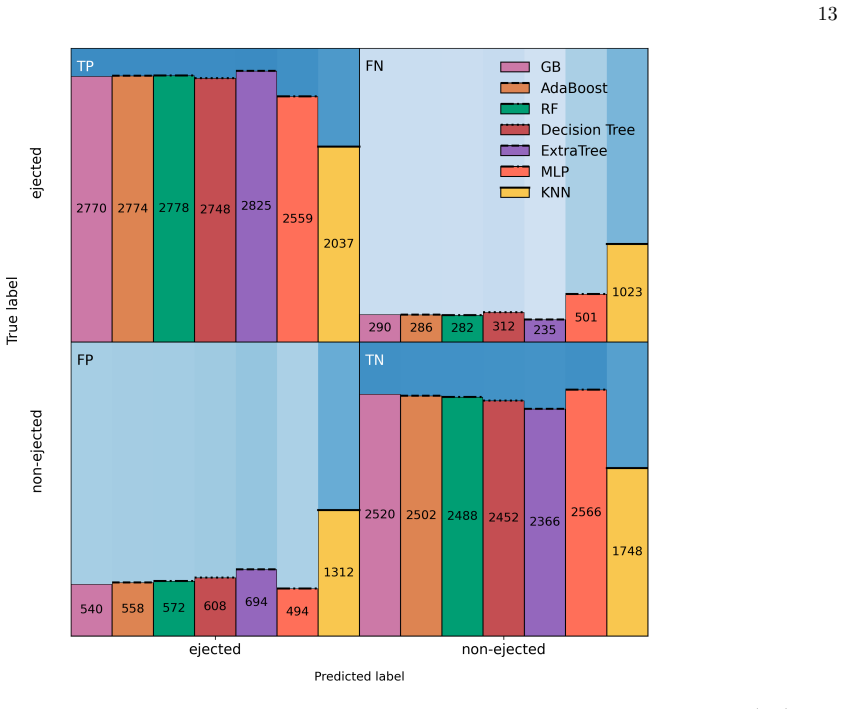
Ensemble tree classifiers on initial orbital elements and a convolutional neural network on recurrence plots from brief integrations classify long-term ejection of near-Earth asteroids at accuracy comparable to or exceeding full high-accuracy simulations, while backward runs expose time-asymmetric ejection and stable objects align with established dynamical families.
What carries the argument
Recurrence plots generated from short-period MERCURY integrations, fed to a convolutional neural network to extract temporal signatures of chaotic motion, alongside ensemble tree models trained directly on ephemeris inputs.
If this is right
- Non-ejected asteroids correspond to known dynamical groups, showing initial configuration strongly constrains long-term stability.
- Partial overlap between forward- and reverse-ejected sets indicates time-asymmetric behavior that full simulations must account for.
- The methods allow rapid screening to prioritize asteroids needing detailed numerical study.
- Scalable classification supports planetary-defense analyses by quickly identifying potential ejection or impact risks.
Where Pith is reading between the lines
- The same short-integration-plus-recurrence-plot pipeline could be tested on other small-body populations exhibiting chaos, such as centaurs or trans-Neptunian objects.
- If the models generalize, they might reduce the computational cost of mapping stability boundaries in resonant regions by orders of magnitude.
- Combining the tree and CNN outputs could yield an ensemble that flags cases where short-term data are insufficient, prompting targeted long integrations.
Load-bearing premise
Short integrations produce recurrence plots whose patterns suffice to forecast long-term ejection without overlooking rare chaotic transitions that only appear over much longer times.
What would settle it
Run full long-term integrations on a test set of asteroids and measure whether the model's ejection predictions match the actual outcomes at the reported accuracy level.
Figures




read the original abstract
Long-term integrations of asteroid orbits with high-accuracy numerical integrators are essential for understanding dynamical evolution and ejection from the Solar System, but are computationally expensive. Here, we investigate the dynamical behaviour of asteroids and explore machine-learning (ML) and deep-learning (DL) approaches as efficient, scalable alternatives for classifying long-term dynamical outcomes. While the ML classifiers are trained on initial orbital elements, the convolutional neural network is trained on recurrence plots derived from short-period numerical integrations generated with the MERCURY integrator. Ensemble tree models perform strongly on the ephemeris input, and the neural network captures temporal signatures of chaotic motion with comparable or slightly improved accuracy. Backward integrations reveal partial overlap between forward- and reverse-ejected sets, illustrating time-asymmetric behaviour in chaotic regions; these backward results are interpreted only as diagnostic probes rather than reconstructions of past histories. Non-ejected asteroids largely correspond to known dynamical groups, underscoring the constraining role of initial orbital configuration. These methods provide scalable frameworks to complement numerical integrations and inform prioritisation for detailed long-term dynamical studies, with implications for planetary-defence analyses.
Editorial analysis
A structured set of objections, weighed in public.
Referee Report
Summary. The manuscript proposes machine-learning classifiers (ensemble trees) trained on initial orbital elements and a convolutional neural network trained on recurrence plots generated from short-period MERCURY integrations as scalable alternatives to expensive long-term numerical integrations for classifying ejection outcomes of near-Earth asteroids. It reports that the tree models perform strongly on ephemeris input while the CNN captures temporal signatures of chaotic motion with comparable or slightly improved accuracy, notes partial overlap between forward- and backward-ejected sets, and concludes that non-ejected asteroids align with known dynamical groups.
Significance. If the performance claims are substantiated with quantitative validation against long-term integrations, the approach could offer a useful complement to direct N-body runs for prioritizing targets in planetary-defense studies and dynamical surveys. The recurrence-plot CNN is a potentially interesting way to encode short-term chaotic signatures, and the forward/backward asymmetry observation is a useful diagnostic reminder of time-irreversibility in chaotic regions.
major comments (3)
- [Abstract and §3] Abstract and §3 (training description): the claims that ensemble trees 'perform strongly' and the CNN achieves 'comparable or slightly improved accuracy' are presented without any numerical metrics, confusion matrices, ROC-AUC values, training-set sizes, or cross-validation details. Because the central claim is that these methods are efficient, scalable alternatives, the absence of these quantities makes the performance assertion impossible to evaluate.
- [§2.2 and §4] §2.2 and §4 (recurrence-plot construction and CNN results): no ablation on integration length, no direct comparison of CNN predictions against full long-term MERCURY runs for the same objects, and no discussion of how rare resonance crossings or close encounters occurring after the short integration window are captured. This leaves the weakest assumption—that short-window recurrence plots contain all outcome-determining chaotic features—untested and load-bearing for the generalization claim.
- [§5] §5 (backward-integration analysis): the partial overlap between forward- and reverse-ejected sets is reported, yet no quantitative measure (e.g., Jaccard index or contingency table) is supplied, nor is a control experiment shown that would demonstrate the overlap is not simply an artifact of the short integration length used for both directions.
minor comments (2)
- [§2.2] Notation for the recurrence-plot parameters (embedding dimension, delay, threshold) is introduced without a dedicated table or explicit listing of the values adopted for the full dataset.
- [Figures 2 and 4] Figure captions for the recurrence-plot examples and the CNN architecture diagram should explicitly state the integration length and number of asteroids represented.
Simulated Author's Rebuttal
We thank the referee for their constructive and detailed review. The comments identify important areas for improving the transparency and robustness of our claims. We address each major comment point by point below and describe the revisions we will implement.
read point-by-point responses
-
Referee: [Abstract and §3] Abstract and §3 (training description): the claims that ensemble trees 'perform strongly' and the CNN achieves 'comparable or slightly improved accuracy' are presented without any numerical metrics, confusion matrices, ROC-AUC values, training-set sizes, or cross-validation details. Because the central claim is that these methods are efficient, scalable alternatives, the absence of these quantities makes the performance assertion impossible to evaluate.
Authors: We agree that the absence of explicit quantitative metrics in the abstract and training description hinders evaluation of the central performance claims. We will revise the abstract to include key numerical results (overall accuracies, AUC scores, and a brief note on training-set size and cross-validation). In §3 we will add a dedicated summary table or subsection that reports training-set sizes, the cross-validation procedure, confusion matrices, and ROC-AUC values for both the ensemble-tree and CNN models. These changes will make the performance assertions directly verifiable. revision: yes
-
Referee: [§2.2 and §4] §2.2 and §4 (recurrence-plot construction and CNN results): no ablation on integration length, no direct comparison of CNN predictions against full long-term MERCURY runs for the same objects, and no discussion of how rare resonance crossings or close encounters occurring after the short integration window are captured. This leaves the weakest assumption—that short-window recurrence plots contain all outcome-determining chaotic features—untested and load-bearing for the generalization claim.
Authors: We acknowledge that an explicit ablation on integration length and a clearer statement of the validation procedure are needed to test the core assumption. We will add an ablation study in §4 that varies the short-integration length used to generate recurrence plots and reports the resulting change in CNN accuracy. We will also clarify that the CNN was trained and evaluated on a held-out test set for which independent long-term MERCURY integrations provided the ground-truth labels, and we will expand the discussion to address the possibility that rare late resonance crossings or encounters may not be captured, including the implications for generalization. revision: yes
-
Referee: [§5] §5 (backward-integration analysis): the partial overlap between forward- and reverse-ejected sets is reported, yet no quantitative measure (e.g., Jaccard index or contingency table) is supplied, nor is a control experiment shown that would demonstrate the overlap is not simply an artifact of the short integration length used for both directions.
Authors: We agree that quantitative measures and a control experiment would strengthen the backward-integration analysis. In the revised §5 we will report the Jaccard index together with a contingency table that quantifies the overlap between the forward- and backward-ejected sets. We will also add a control experiment that repeats the backward integrations with a longer short-integration window and compares the resulting overlap; this will test whether the observed partial overlap is robust or sensitive to integration length. revision: yes
Circularity Check
No significant circularity in ML/DL prediction of long-term asteroid outcomes
full rationale
The paper trains standard ensemble classifiers on initial orbital elements and a CNN on recurrence plots generated from short MERCURY integrations, using these features to predict labels for long-term ejection outcomes obtained from separate long-term simulations. This is a conventional supervised learning setup in which the target variable (long-term dynamical fate) is independent of the input features by construction; no equation, ansatz, or self-citation reduces the reported accuracy or classification performance to a tautology or to the fitted parameters themselves. No uniqueness theorems, self-referential definitions, or renaming of known results appear in the provided abstract or description. The work is therefore self-contained as an empirical approximation task rather than a closed derivation chain.
Axiom & Free-Parameter Ledger
axioms (1)
- domain assumption Short-period numerical integrations capture sufficient temporal signatures of chaotic motion to classify long-term ejection outcomes.
Reference graph
Works this paper leans on
-
[1]
2016, in 12th USENIX symposium on operating systems design and implementation (OSDI 16), 265–283
Abadi, M., Barham, P., Chen, J., et al. 2016, in 12th USENIX symposium on operating systems design and implementation (OSDI 16), 265–283
work page 2016
-
[2]
Aha, D. W., Kibler, D., & Albert, M. K. 1991, Machine learning, 6, 37 23
work page 1991
-
[3]
2025, in 2025 International Conference on New Trends in Computing Sciences (ICTCS), IEEE, 156–163
Almousa, L., Hamdan, L., Hammouri, T., & Abdel-Nabi, H. 2025, in 2025 International Conference on New Trends in Computing Sciences (ICTCS), IEEE, 156–163
work page 2025
-
[4]
2025, Planetary and Space Science, 106062
Alves, A., Carruba, V., Delfino, E., Silva, V., & Blasco, L. 2025, Planetary and Space Science, 106062
work page 2025
-
[5]
Concrete Problems in AI Safety
Amodei, D., Olah, C., Steinhardt, J., et al. 2016, arXiv preprint arXiv:1606.06565
work page internal anchor Pith review Pith/arXiv arXiv 2016
-
[6]
Bacu, V., Nandra, C., Sabou, A., Stefanut, T., & Gorgan, D. 2023, Aerospace, 10, 752
work page 2023
-
[7]
Gaikwad, M. 2021, in 2021 International Conference on Computational Intelligence and Computing Applications (ICCICA), IEEE, 1–4
work page 2021
-
[8]
2019, arXiv preprint arXiv:1904.07248
Baron, D. 2019, arXiv preprint arXiv:1904.07248
-
[9]
Bora, C. A., Kushvah, B. S., Mouli, G. C., & Yousuf, S. 2024, Monthly Notices of the Royal Astronomical Society, 534, 415 Bottke Jr, W., Nolan, M. C., & Greenberg, R. 1993, in In Lunar and Planetary Inst., Twenty-fourth Lunar and Planetary Science Conference. Part 1: AF p 159-160 (SEE N94-12015 01-91), Vol. 24 Bottke Jr, W. F., Jedicke, R., Morbidelli, A....
work page 2024
-
[10]
Box, G. E., Jenkins, G. M., Reinsel, G. C., & Ljung, G. M. 2015, Time series analysis: forecasting and control (John Wiley & Sons)
work page 2015
- [11]
- [12]
-
[13]
1966, Numerische Mathematik, 8, 1 Caritá, G., Aljbaae, S., Morais, M
Bulirsch, R., & Stoer, J. 1966, Numerische Mathematik, 8, 1 Caritá, G., Aljbaae, S., Morais, M. H. M., et al. 2024, Celestial Mechanics and Dynamical Astronomy, 136, 10
work page 1966
-
[14]
2024, Monthly Notices of the Royal Astronomical Society, 531, 4432
Carruba, V., Aljbaae, S., Domingos, R., et al. 2024, Monthly Notices of the Royal Astronomical Society, 531, 4432
work page 2024
-
[15]
2022, Celestial Mechanics and Dynamical Astronomy, 134, 36
Barletta, W. 2022, Celestial Mechanics and Dynamical Astronomy, 134, 36
work page 2022
-
[16]
2020, Monthly Notices of the Royal Astronomical Society, 496, 540
Furlaneto, P. 2020, Monthly Notices of the Royal Astronomical Society, 496, 540
work page 2020
-
[17]
Carruba, V., Aljbaae, S., Domingos, R. C., & Barletta, W. 2021, Monthly Notices of the Royal Astronomical Society, 504, 692
work page 2021
-
[18]
2019, Monthly Notices of the Royal Astronomical Society, 488, 1377
Carruba, V., Aljbaae, S., & Lucchini, A. 2019, Monthly Notices of the Royal Astronomical Society, 488, 1377
work page 2019
-
[19]
Chambers, J. E. 1999, Monthly Notices of the Royal Astronomical Society, 304, 793
work page 1999
-
[20]
2025, arXiv preprint arXiv:2508.15106
Chandra, S. 2025, arXiv preprint arXiv:2508.15106
-
[21]
Chapman, C. R. 2004, Earth and Planetary Science Letters, 222, 1
work page 2004
- [22]
- [23]
-
[24]
2025, The Astronomical Journal, 170, 120
Choudhary, A., Bandari, S., Kushvah, B., & Swastik, C. 2025, The Astronomical Journal, 170, 120
work page 2025
-
[25]
2006, in Proceedings of the 23rd international conference on Machine learning, 233–240
Davis, J., & Goadrich, M. 2006, in Proceedings of the 23rd international conference on Machine learning, 233–240
work page 2006
-
[26]
Dietterich, T. G. 2000, in International workshop on multiple classifier systems, Springer, 1–15
work page 2000
-
[27]
Duncan, M. J., Levison, H. F., & Lee, M. H. 1998, The Astronomical Journal, 116, 2067
work page 1998
-
[28]
1993, Astronomy and Astrophysics, vol
Dvorak, R., Muller, P., & Kallrath, J. 1993, Astronomy and Astrophysics, vol. 274, 627-641. Article., 274
work page 1993
-
[29]
Eckmann, J.-P., Kamphorst, S. O., Ruelle, D., et al. 1995, World Scientific Series on Nonlinear Science Series A, 16, 441
work page 1995
-
[30]
1985, in International Astronomical Union
Everhart, E. 1985, in International Astronomical Union
work page 1985
-
[31]
2020, Journal of Machine Learning Research, 21, 1
Faouzi, J., & Janati, H. 2020, Journal of Machine Learning Research, 21, 1
work page 2020
-
[32]
Gardner, M. W., & Dorling, S. 1998, Atmospheric environment, 32, 2627 Géron, A. 2022, Hands-on machine learning with
work page 1998
-
[33]
Geurts, P., Ernst, D., & Wehenkel, L. 2006, Machine learning, 63, 3
work page 2006
-
[34]
Gladman, B., Michel, P., & Froeschlé, C. 2000, Icarus, 146, 176
work page 2000
-
[35]
J., Migliorini, F., Morbidelli, A., et al
Gladman, B. J., Migliorini, F., Morbidelli, A., et al. 1997, Science, 277, 197
work page 1997
- [36]
-
[37]
Granvik, M., Morbidelli, A., Jedicke, R., et al. 2018, Icarus, 312, 181
work page 2018
-
[38]
Grimm, S. L., & Stadel, J. G. 2014, The Astrophysical Journal, 796, 23
work page 2014
-
[39]
2017, Deep learning with Keras (Packt Publishing Ltd) 24
Gulli, A., & Pal, S. 2017, Deep learning with Keras (Packt Publishing Ltd) 24
work page 2017
- [40]
-
[41]
Hastie, T., Tibshirani, R., & Friedman, J. H. 2009, Springer Series in Statistics, Vol. 2, The Elements of Statistical Learning: Data Mining, Inference, and Prediction (Springer)
work page 2009
-
[42]
2018, in Tenth international conference on machine vision (ICMV 2017), Vol
Hatami, N., Gavet, Y., & Debayle, J. 2018, in Tenth international conference on machine vision (ICMV 2017), Vol. 10696, SPIE, 242–249
work page 2018
-
[43]
2019, Energies, 12, 3221 Ismail Fawaz, H., Forestier, G., Weber, J., Idoumghar, L., & Muller, P.-A
Kuo, C.-C. 2019, Energies, 12, 3221 Ismail Fawaz, H., Forestier, G., Weber, J., Idoumghar, L., & Muller, P.-A. 2019, Data mining and knowledge discovery, 33, 917
work page 2019
-
[44]
2020, arXiv preprint arXiv:2010.11034
Izza, Y., Ignatiev, A., & Marques-Silva, J. 2020, arXiv preprint arXiv:2010.11034
-
[45]
2021, Electronic markets, 31, 685
Janiesch, C., Zschech, P., & Heinrich, K. 2021, Electronic markets, 31, 685
work page 2021
-
[46]
Adam: A Method for Stochastic Optimization
Kingma, D. P., & Ba, J. 2014, arXiv preprint arXiv:1412.6980
work page internal anchor Pith review Pith/arXiv arXiv 2014
-
[47]
Krizhevsky, A., Sutskever, I., & Hinton, G. E. 2012, Advances in neural information processing systems, 25
work page 2012
-
[48]
1998, The handbook of brain theory and neural networks
LeCun, Y., & Bengio, Y. 1998, The handbook of brain theory and neural networks
work page 1998
- [49]
-
[50]
2002, Proceedings of the IEEE, 86, 2278
LeCun, Y., Bottou, L., Bengio, Y., & Haffner, P. 2002, Proceedings of the IEEE, 86, 2278
work page 2002
- [51]
-
[52]
Levison, H. F., & Duncan, M. J. 2000, The Astronomical Journal, 120, 2117
work page 2000
-
[53]
2021, Monthly Notices of the Royal Astronomical Society, 502, 5362
Liu, C., Gong, S., & Li, J. 2021, Monthly Notices of the Royal Astronomical Society, 502, 5362
work page 2021
- [54]
-
[55]
2005, Studia Mathematica, 50, 85
Mako, Z., Szenkovits, F., Garda-Matyas, E., & Csillik, I. 2005, Studia Mathematica, 50, 85
work page 2005
-
[56]
Malakouti, S. M., Menhaj, M. B., & Suratgar, A. A. 2023, MethodsX, 11, 102337
work page 2023
-
[57]
Marwan, N., Romano, M. C., Thiel, M., & Kurths, J. 2007, Physics reports, 438, 237
work page 2007
-
[58]
M., Lin, Y.-T., Lin, C.-H., et al
Mathunjwa, B. M., Lin, Y.-T., Lin, C.-H., et al. 2022, Sensors, 22, 1660
work page 2022
-
[59]
Migliorini, F., Zappalà, V., Vio, R., & Cellino, A. 1995, Icarus, 118, 271
work page 1995
- [60]
-
[61]
1999, in International Astronomical Union
Morbidelli, A. 1999, in International Astronomical Union
work page 1999
-
[62]
2002, Annual Review of Earth and Planetary Sciences, 30, 89
Morbidelli, A. 2002, Annual Review of Earth and Planetary Sciences, 30, 89
work page 2002
- [63]
-
[64]
Morbidelli, A., Walsh, K. J., O’Brien, D. P., Minton, D. A., & Bottke, W. F. 2015, arXiv preprint arXiv:1501.06204 Nesvornỳ, D. 2002, Asteroids III, 379
- [65]
- [66]
-
[67]
2011, the Journal of machine Learning research, 12, 2825 Penttilä, A., Hietala, H., & Muinonen, K
Pedregosa, F., Varoquaux, G., Gramfort, A., et al. 2011, the Journal of machine Learning research, 12, 2825 Penttilä, A., Hietala, H., & Muinonen, K. 2021, Astronomy & Astrophysics, 649, A46
work page 2011
-
[68]
2013, The Astronomy and Astrophysics Review, 21, 65
Perna, D., Barucci, M., & Fulchignoni, M. 2013, The Astronomy and Astrophysics Review, 21, 65
work page 2013
-
[69]
Peterson, L. E. 2009, Scholarpedia, 4, 1883
work page 2009
-
[70]
2002, in Neural Networks: Tricks of the trade (Springer), 55–69
Prechelt, L. 2002, in Neural Networks: Tricks of the trade (Springer), 55–69
work page 2002
-
[71]
Quinlan, J. R. 1986, Machine learning, 1, 81 Quiñonero-Candela, J., Sugiyama, M., Schwaighofer, A., &
work page 1986
-
[72]
Lawrence, N. D. 2022, Dataset shift in machine learning (Mit Press)
work page 2022
-
[73]
2012, Astronomy & Astrophysics, 537, A128
Rein, H., & Liu, S.-F. 2012, Astronomy & Astrophysics, 537, A128
work page 2012
-
[74]
Rein, H., & Spiegel, D. S. 2015, Monthly Notices of the Royal Astronomical Society, 446, 1424
work page 2015
-
[75]
2009, Chaos: An Interdisciplinary Journal of Nonlinear Science, 19
Robinson, G., & Thiel, M. 2009, Chaos: An Interdisciplinary Journal of Nonlinear Science, 19
work page 2009
-
[76]
2019, PhD thesis, University of California, Berkeley
Roelofs, R. 2019, PhD thesis, University of California, Berkeley
work page 2019
-
[77]
Rosu, C., & Bacu, V. 2021, in 2021 IEEE 17th International Conference on Intelligent Computer Communication and Processing (ICCP), IEEE, 3–10
work page 2021
-
[78]
Sajid, S., Das, S., & Kokatnoor, S. A. 2024, in International Conference on Data Science, Computation and Security, Springer, 145–155
work page 2024
- [79]
-
[80]
Sharma, T., Sharma, S., Sharma, A., et al. 2023, in 2023 3rd International Conference on Advancement in Electronics & Communication Engineering (AECE), IEEE, 673–677
work page 2023
discussion (0)
Sign in with ORCID, Apple, or X to comment. Anyone can read and Pith papers without signing in.