Recognition: unknown
Transiently accelerating cosmological model with Gong-Zhang parametrization in f(T) teleparallel gravity
Pith reviewed 2026-05-10 06:29 UTC · model grok-4.3
The pith
A power-law f(T) model with Gong-Zhang dark energy parametrization produces transient cosmic acceleration followed by future deceleration.
A machine-rendered reading of the paper's core claim, the machinery that carries it, and where it could break.
Core claim
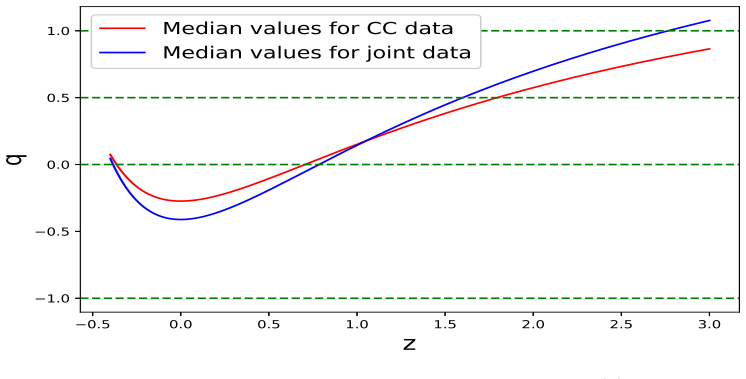
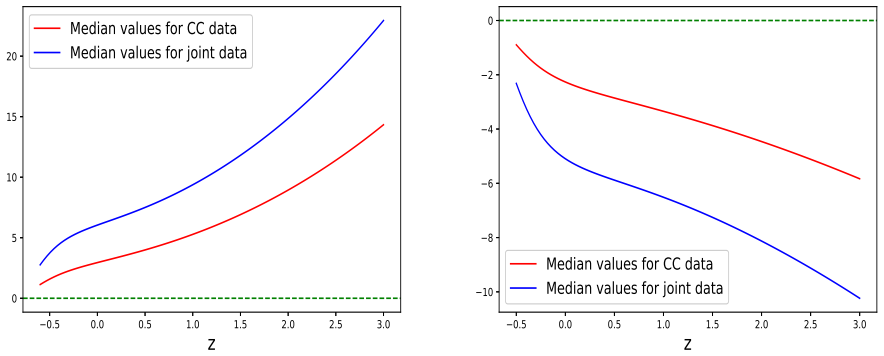
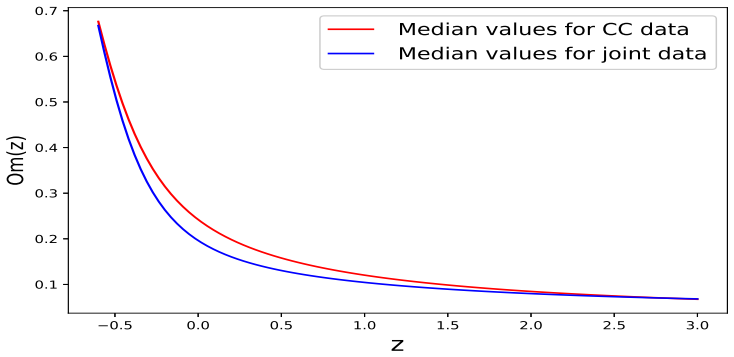
By adopting the power-law ansatz f(T) = α(-T)^n in conjunction with the Gong-Zhang parametrization of the dark energy equation of state, the derived Hubble parameter yields a deceleration parameter that changes sign twice: the universe is currently accelerating but will enter a decelerating phase in the future. Both geometrical and dynamical diagnostics indicate quintessence-like dark energy at the present epoch, while the model remains thermodynamically viable according to the generalized second law and produces an age of the universe consistent with observations.
What carries the argument
The power-law form f(T) = α(-T)^n in f(T) teleparallel gravity, combined with the Gong-Zhang parametrization of the dark energy equation of state, which together determine the redshift-dependent Hubble rate and all derived cosmological quantities.
If this is right
- The deceleration parameter crosses zero twice, marking a finite period of acceleration between two decelerating eras.
- The dark energy equation of state remains greater than -1 today, consistent with quintessence rather than phantom behavior.
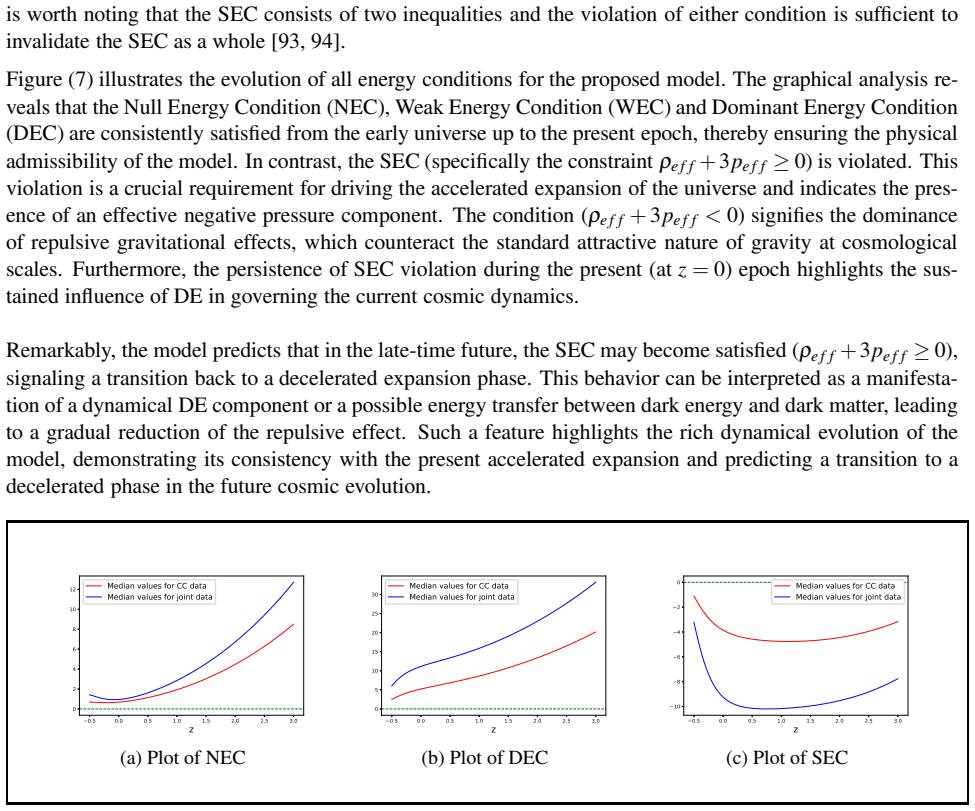
- Energy conditions for the dark energy component are satisfied in a manner compatible with observed expansion history.
- The model satisfies the generalized second law of thermodynamics at all times.
Where Pith is reading between the lines
- If the transient acceleration result holds, long-term cosmological forecasts would need to replace a perpetual de Sitter phase with an eventual return to matter-like deceleration.
- The same functional forms could be applied to other modified gravity theories to test whether transient acceleration is generic or specific to this f(T) choice.
- High-redshift surveys that tightly constrain the equation of state beyond z ≈ 2 would directly test whether the Gong-Zhang parametrization remains accurate far from the present epoch.
Load-bearing premise
The power-law ansatz for f(T) and the Gong-Zhang parametrization remain valid over the entire redshift range, including the extrapolated future.
What would settle it
Future measurements of the deceleration parameter or dark energy equation of state at low redshifts (z < 0) that show continued acceleration rather than a return to deceleration would rule out the model's central prediction.
Figures






read the original abstract
We present the cosmic expansion scenario in the framework of $f(T)$ gravity by employing a dark energy equation of state (EoS) parameter. Specifically, we proceed with the power-law form of the function $f(T) = \alpha$$(-T)^{n}$, in conjunction with the Gong-Zhang parametrization of the dark energy EoS. We derive the expansion rate in terms of the redshift for the considered model, providing deeper insights into the underlying cosmic dynamics. The model is further utilized to explore the expansion history of the universe and the evolution of several cosmological parameters. By using the Bayesian methods based on the $\chi^{2}$-minimization technique, the median values of the model parameters are determined for the cosmic chronometer (CC) and joint (CC+Pantheon) datasets. The evolution of the deceleration parameter, energy density, pressure, EoS parameter and the energy conditions for dark energy is analyzed in detail. The model captures the observed acceleration as a transient phenomenon, followed by future deceleration. Additionally, the nature of both geometrical and dynamical diagnostics robustly indicates a quintessence-like behavior at the present epoch. Finally, the thermodynamic viability of the model is confirmed through the generalized second law of thermodynamics and the estimated age of the universe further supports the model's compatibility with astronomical observations.
Editorial analysis
A structured set of objections, weighed in public.
Referee Report
Summary. The manuscript presents a cosmological model in f(T) teleparallel gravity employing the power-law ansatz f(T) = α(-T)^n together with the Gong-Zhang parametrization of the dark-energy equation of state. The authors derive an analytic expression for the Hubble rate H(z), determine the free parameters (α, n, w0, w1) by χ² minimization against cosmic-chronometer and Pantheon supernova data, and then examine the redshift evolution of the deceleration parameter q(z), energy density, pressure, EoS parameter, energy conditions, and thermodynamic quantities. They conclude that the present-day acceleration is transient and will be followed by deceleration at future times, while the present epoch exhibits quintessence-like behavior; thermodynamic viability is asserted via the generalized second law.
Significance. If the transient-acceleration result survives robustness checks, the work supplies a concrete, observationally calibrated example of how a simple f(T) modification can produce a temporary accelerated phase without a cosmological constant. The combination of analytic derivation, numerical fitting to two independent datasets, and multiple geometric/dynamical diagnostics is a positive feature. The significance is nevertheless reduced by the absence of quantified uncertainties on the future q(z) sign change and by the lack of tests against alternative parametrizations that fit the same data.
major comments (2)
- [Results / deceleration-parameter evolution] Results section on the deceleration parameter: the central claim that acceleration is transient (q0 < 0 followed by q(z) > 0 for some z < 0) is obtained by extrapolating the fitted Gong-Zhang wDE(z) and power-law f(T) beyond the redshift range of the data (z ≲ 2). No error bands, MCMC posterior samples, or prior-variation tests are shown for the future sign change in q(z), so it is impossible to assess whether the claimed transition is robust or an artifact of the chosen functional forms.
- [Model construction and fitting procedure] Parameter-fitting and model-construction paragraphs: the Gong-Zhang parameters w0, w1 and the exponents n, α are determined by minimizing χ² against the identical CC + Pantheon datasets that are later used to assert the transient behavior. Because the future evolution is a direct consequence of the fitted ansatz rather than an independent prediction, the manuscript must demonstrate that the sign change in q(z) persists under equally plausible alternative parametrizations that also fit the data.
minor comments (2)
- [Abstract and thermodynamic analysis] The abstract states that the model is “thermodynamically viable” but does not specify which form of the generalized second law is employed or whether the entropy production rate remains positive for all future times; a brief clarification would improve readability.
- [Notation throughout] Notation for the Gong-Zhang parameters (w0, w1) and the f(T) exponents (n, α) should be introduced once in the model section and used consistently thereafter; occasional redefinition of symbols in later figures is distracting.
Simulated Author's Rebuttal
We thank the referee for the thorough review and insightful comments on our manuscript. We address each major comment below and outline the revisions we will make to improve the presentation and robustness of our results.
read point-by-point responses
-
Referee: Results section on the deceleration parameter: the central claim that acceleration is transient (q0 < 0 followed by q(z) > 0 for some z < 0) is obtained by extrapolating the fitted Gong-Zhang wDE(z) and power-law f(T) beyond the redshift range of the data (z ≲ 2). No error bands, MCMC posterior samples, or prior-variation tests are shown for the future sign change in q(z), so it is impossible to assess whether the claimed transition is robust or an artifact of the chosen functional forms.
Authors: We agree with the referee that displaying uncertainties is crucial for assessing the robustness of the future deceleration. In the revised manuscript, we will include 1σ and 2σ confidence bands on the deceleration parameter q(z) derived from the covariance matrix of the best-fit parameters obtained via χ² minimization. This will allow readers to evaluate the statistical significance of the sign change in q(z) at negative redshifts. We will also mention the limitations of extrapolation beyond the data range. revision: yes
-
Referee: Parameter-fitting and model-construction paragraphs: the Gong-Zhang parameters w0, w1 and the exponents n, α are determined by minimizing χ² against the identical CC + Pantheon datasets that are later used to assert the transient behavior. Because the future evolution is a direct consequence of the fitted ansatz rather than an independent prediction, the manuscript must demonstrate that the sign change in q(z) persists under equally plausible alternative parametrizations that also fit the data.
Authors: The Gong-Zhang parametrization was selected for its ability to model the dark energy EoS with a simple form that accommodates both past and future evolution. We acknowledge that the transient acceleration is specific to this choice. In the revision, we will add a paragraph in the discussion section comparing briefly with the Chevallier-Polarski-Linder (CPL) parametrization using the same f(T) form, noting any differences in the predicted future behavior. However, an exhaustive test of all possible parametrizations is beyond the scope of this work, as our focus is on providing an analytic model with the Gong-Zhang form calibrated to observations. revision: partial
Circularity Check
No significant circularity; transient behavior follows from assumed forms and data fit without reduction to inputs by construction
full rationale
The paper adopts the power-law ansatz f(T) = α(-T)^n and Gong-Zhang parametrization for w_DE(z) by explicit assumption, derives H(z) from the f(T) Friedmann equation, fits the free parameters via χ² minimization to CC and Pantheon data, and then evaluates the resulting q(z) evolution. The statement that acceleration is transient (present q0 < 0 followed by future deceleration) is a direct consequence of extrapolating the fitted functional forms to z < 0, but this does not constitute a self-definitional loop, a fitted quantity renamed as prediction, or any other enumerated circular pattern. No load-bearing self-citations, uniqueness theorems, or ansatz smuggling are present. The derivation chain is self-contained given the stated assumptions and does not reduce any claimed result to equivalence with its inputs by construction.
Axiom & Free-Parameter Ledger
free parameters (3)
- α
- n
- w0, w1 (Gong-Zhang parameters)
axioms (2)
- standard math The universe is described by a flat FLRW metric with torsion scalar T = -6H².
- domain assumption The Gong-Zhang parametrization w(z) = w0 + w1 z/(1+z) remains valid at all redshifts.
Reference graph
Works this paper leans on
-
[1]
A. G. Riess, A. V . Filippenko, P . Challis, A. Clocchiatti , A. Diercks et al., Observational Evidence from Supernovae for an Accelerating Universe and a Cosmological Constant, Astronomical Journal, 116, 1009- 1038 (1998) https://doi.org/10.1086/300499
-
[2]
S. Perlmutter, G. Aldering, G. Goldhaber, R. A. Knop, P . N ugent et al., Measurements of Ω and Λ from 42 High-Redshift Supernovae, Astrophysical Journal, 517, 565–586 (1999) https://doi.org/10.1086/307221
work page internal anchor Pith review doi:10.1086/307221 1999
-
[3]
N. Aghanim, Y . Akrami, M. Ashdown, J. Aumont, C. Baccigal upi, et al., Planck 2018 results. VI. Cosmological parameters, Astronomy and Astro physics, 641, A6 (2020) https://doi.org/10.1051/0004-6361/201833910
-
[4]
Weinberg, The Cosmological Constant Problem, Rev
S. Weinberg, The cosmological constant problem, Review s of Modern Physics, 61, 1 (1989) https://doi.org/10.1103/RevModPhys.61.1
-
[5]
Classical and Quantum Gravity , keywords =
E. Di V alentino, O. Mena, S. Pan, L. Visinelli, W. Y ang, et al., In the realm of the Hubble tension—a review of solutions, Classical and Quantu m Gravity, 38, 153001 (2021) https://doi.org/10.1088/1361-6382/ac086d
-
[6]
S. M. Carroll, The cosmological constant, Living Review s in Relativity, 4, 1-56 (2001) https://doi.org/10.12942/lrr-2001-1
-
[7]
T. Padmanabhan, Cosmological constant—the weight of th e vacuum, Physics reports, 380, 235–320 (2003) https://doi.org/10.1016/S0370-1573(03)00120-0
-
[8]
E. J. Copeland, M. Sami, S. Tsujikawa, Dynamics of dark en ergy, International Journal of Modern Physics D, 15, 1753–1935 (2006) https://doi.org/10.1142/S021827180600942X 18
-
[9]
H. A. Buchdahl, Non-linear Lagrangians and cosmologica l theory, Monthly Notices of the Royal Astro- nomical Society, 150, 1-8 (1970) https://doi.org/10.1093/mnras/150.1.1
-
[10]
T. Harko, F. S. N. Lobo, S. Nojiri, S. D. Odintsov, f (R,T ) gravity, Physical Review D,84, 024020 (2011) https://doi.org/10.1103/PhysRevD.84.024020
-
[11]
Unified cosmic history in modified gravity: from F(R) theory to Lorentz non-invariant models,
S. Nojiri, S. D. Odintsov, Unified cosmic history in modi fied gravity: from f (R) theory to Lorentz non-invariant models, Physics Reports, 505, 59-144 (2011) https://doi.org/10.1016/j.physrep.2011.04.001
-
[12]
J. B. Jim´ enez, L. Heisenberg, T. Koivisto, Coincident general relativity, Physical Review D, 98, 044048 (2018) https://doi.org/10.1103/PhysRevD.98.044048
-
[13]
Modified Gravity Theories on a Nutshell: Inflation, Bounce and Late-time Evolution,
S. Nojiri, S. D. Odintsov, V . K. Oikonomou, Modified grav ity theories on a nut- shell: Inflation, bounce and late-time evolution, Physics R eports, 692, 1-104 (2017) https://doi.org/10.1016/j.physrep.2017.06.001
-
[14]
K. Bamba, S. D. Odintsov, L. Sebastiani, S. Zerbini, Fin ite-time future singularities in modified Gauss– Bonnet and f(R, G) gravity and singularity avoidance, The Eu ropean Physical Journal C, 67, 295–310 (2010) https://doi.org/10.1140/epjc/s10052-010-1292-8
-
[15]
E. Elizalde,and R. Myrzakulov, V . V . Obukhov, D. S´ aez- G´ omez,Λ CDM epoch reconstruction from F (R, G) and modified Gauss-Bonnet gravities, Classical and Q uantum Gravity, 27, 095007 (2010) https://doi.org/10.1088/0264-9381/27/9/095007
-
[16]
T. Harko, F. S. N. Lobo, f (R,Lm) gravity, The European Physical Journal C, 70, 373–379 (2010) https://doi.org/10.1140/epjc/s10052-010-1467-3
-
[17]
S. Capozziello, R. D’Agostino, O. Luongo, Extended gra vity cosmography, International Journal of Modern Physics D, 28, 1930016 (2019) https://doi.org/10.1142/S0218271819300167
-
[18]
S. Capozziello, V . De Falco, C. Ferrara, The role of the b oundary term in f (Q,B) symmetric teleparallel gravity,The European Physical Jou rnal C, 83, 915 (2023) https://doi.org/10.1140/epjc/s10052-023-12072-y
-
[19]
S. Kotambkar, G. P . Singh, R. Kelkar, B. K. Bishi, Anisot ropic Bianchi type I cosmological models with generalized Chaplygin gas and dynamical gravitational and cosmological constants, Communications in Theoretical Physics, 67, 222 (2017) https://doi.org/10.1088/0253-6102/67/2/222
-
[20]
A. R. Lalke, G. P . Singh, A. Singh, Late-time accelerati on from ekpyrotic bounce in f (Q,T ) gravity, International Journal of Geometric Methods in Mod ern Physics, 20, 2350131 (2023) doi:https://doi.org/10.1142/S0219887823501311
-
[21]
N. Hulke, G. P . Singh, B. K. Bishi, A. Singh, V ariable Cha plygin gas cosmolo- gies in f (R,T ) gravity with particle creation, New Astronomy, 77, 101357 (2020) https://doi.org/10.1016/j.newast.2020.101357
-
[22]
R. Garg, G. P . Singh, A. R. Lalke, S. Ray, Cosmological mo del with linear equa- tion of state parameter in f (R,Lm) gravity, Physics Letters A, 525, 129937 (2024) https://doi.org/10.1016/j.physleta.2024.129937
-
[23]
A. Singh, S. Mandal, R. Chaubey, R. Raushan, Observatio nal constraints on the expansion scalar and shear relation in the Locally rotationally symmetric Bianc hi I model, Physics of the Dark Universe, 47, 101798 (2025) https://doi.org/10.1016/j.dark.2024.101798 19
-
[24]
K. N. Singh, G. R. P . Teruel, S. K. Maurya, T. Chowdhury, F . Rahaman, Conservative worm- holes in generalized K(R,T ) function, Journal of High Energy Astrophysics, 44, 132–145 (2024) https://doi.org/10.1016/j.jheap.2024.09.009
-
[25]
H. Chaudhary, S. K. J. Pacif, G. Mustafa, F. Atamurotov, F. Javed, Extracting H0 and rd in q(t) parametrization models, Journal of High Energy Astrophysi cs, 45, 340–349 (2025) https://doi.org/10.1016/j.jheap.2025.01.001
-
[26]
G. K. Goswami, R. Rani, J. K. Singh, A. Pradhan, FLRW cosm ology in Weyl type f (Q) gravity and observational constraints, Journal of High Ene rgy Astrophysics, 43, 105–113 (2024) https://doi.org/10.1016/j.jheap.2024.06.011
-
[27]
B. K. Shukla, S. Sahlu, D. Sofuo˘ glu, P . Mishra, A. H. Alf edeel, Multi-components fluid in f (R,T ) gravity with observational constraints, The European Phys ical Journal Plus, 140, 1–14 (2025) https://doi.org/10.1140/epjp/s13360-025-06200-8
-
[28]
L. A. Escamilla, D. Fiorucci, G. Montani, E. Di V alentin o, Exploring the Hubble tension with a late time Modified Gravity scenario, Physics of the Dar k Universe, 46, 101652 (2024) https://doi.org/10.1016/j.dark.2024.101652
-
[29]
K. R. Patle, G. P . Singh, R. Garg, Dynamical constraints on variable vac- uum energy in Brans-Dicke theory, arXiv preprint arXiv:260 1.00419, (2026) https://doi.org/10.48550/arXiv.2601.00419
-
[30]
G. R. Bengochea, R. Ferraro, Dark torsion as the cosmic s peed-up, Physical Review D, 79, 124019 (2009) https://doi.org/10.1103/PhysRevD.79.124019
-
[31]
Yi-Fu Cai, S. Capozziello, M. De Laurentis, E. N. Sarida kis, f (T) teleparal- lel gravity and cosmology, Reports on Progress in Physics, 79, 106901 (2016) https://doi.org/10.1088/0034-4885/79/10/106901
-
[32]
A. Paliathanasis, J. D. Barrow, P . G. L. Leach, Cosmolog ical solutions of f (T) gravity, Physical Review D, 94, 023525 (2016) https://doi.org/10.1103/PhysRevD.94.023525
-
[33]
I. G. Salako, M. E. Rodrigues, A. V . Kpadonou, M. J. S. Hou ndjo, J. Tossa, Λ CDM model in f (T ) gravity: reconstruction, thermodynamics and stability, J ournal of Cosmology and Astroparticle Physics, 2013, 060–060 (2013) https://doi.org/10.1088/1475-7516/2013/11/060
-
[34]
S. Capozziello, V . F. Cardone, H. Farajollahi, A. Ravan pak, Cosmography in f (T ) gravity, Physical Review D, 84, 043527 (2011) https://doi.org/10.1103/PhysRevD.84.043527
-
[35]
Di Liu, M. J. Reboucas, Energy conditions bounds on f (T ) gravity, Physical Review D, 86, 083515 (2012) https://doi.org/10.1103/PhysRevD.86.083515
-
[36]
Yi-Fu Cai, Shih-Hung Chen, J. B. Dent, S. Dutta, E. N. Sar idakis, Matter bounce cosmology with the f (T ) gravity, Classical and Quantum Gravity, 28, 215011 (2011) https://doi.org/10.1088/0264-9381/28/21/215011
-
[37]
A. Zhadyranova, M. Koussour, S. Bekkhozhayev, V . Zhuma bekova, J. Rayimbaev, Exploring late-time cosmic acceleration: A study of a linear f (T ) cosmological model using observational data, Physics of the Dark Universe, 45, 101514 (2024) https://doi.org/10.1016/j.dark.2024.101514
-
[38]
K. Bamba, Chao-Qiang Geng, Chung-Chi Lee, Ling-Wei Luo , Equation of state for dark en- ergy in f (T ) gravity, Journal of Cosmology and Astroparticle Physics, 2011, 021–021 (2011) https://doi.org/10.1088/1475-7516/2011/01/021 20
-
[39]
A. Paliathanasis, S. Basilakos, E. N. Saridakis, S. Cap ozziello, K. Atazadeh, F. Darabi, M. Tsamparlis, New Schwarzschild-like solutions in f (T ) gravity through Noether symmetries, Physical Review D, 89, 104042 (2014) https://doi.org/10.1103/PhysRevD.89.104042
-
[40]
S. Capozziello, R. D’Agostino, O. Luongo, Model-indep endent reconstruction of f (T ) teleparallel cosmology, General Relativity and Gravitati on, 49, 141 (2017) https://doi.org/10.1007/s10714-017-2304-x
-
[41]
S. H. Shekh, A. Pradhan, A. Dixit, S. N. Bayaskar, S. C. Da runde, Cosmographical analysis for H(z) parametrization towards viscous f (T ) gravity, Modern Physics Letters A, 40, 2450187 (2025) https://doi.org/10.1142/S0217732324501876
-
[42]
L. K. Duchaniya, K. Gandhi, B. Mishra, Attractor behavi or of f (T ) modified grav- ity and the cosmic acceleration, Physics of the Dark Univers e, 44, 101461 (2024) https://doi.org/10.1016/j.dark.2024.101461
-
[43]
S. K. Maurya, A. Errehymy, M. Govender, G. Mustafa, N. Al -Harbi et al., Anisotropic compact stars in complexity formalism and isotropic stars made of anisotr opic fluid under minimal geometric de- formation (MGD) context in f (T ) gravity-theory, The European Physical Journal C, 83, 348 (2023) https://doi.org/10.1140/epjc/s10052-023-11507-w
-
[44]
D. C. Maurya, Accelerating scenarios of viscous fluid un iverse in modified f (T ) grav- ity, International Journal of Geometric Methods in Modern P hysics, 19, 2250144 (2022) https://doi.org/10.1142/S0219887822501444
-
[45]
K. Bamba, G. G. L. Nashed, W. El Hanafy, Sh. K. Ibraheem, B ounce inflation in f (T ) Cosmology: A unified inflaton-quintessence field, Physical R eview D, 94, 083513 (2016) https://doi.org/10.1103/PhysRevD.94.083513
-
[46]
P . Bhar, F. Rahaman, S. Das, S. Aktar, A. Errehymy, Aniso tropic quintessence compact star in f (T ) gravity with Tolman–Kuchowicz metric potentials, Communi cations in Theoretical Physics, 76, 015401 (2024) https://doi.org/10.1088/1572-9494/ad08ad
-
[47]
R. C. Nunes, S. Pan, E. N. Saridakis, New observational c onstraints on f (T ) gravity from cosmic chronometers, Journal of Cosmology and Astropartic le Physics, 2016, 011–011 (2016) https://doi.org/10.1088/1475-7516/2016/08/011
-
[48]
H. Chaudhary, U. Debnath, T. Roy, S. Maity, G. Mustafa et al., Constraints on the pa- rameters of modified Chaplygin–Jacobi and modified Chaplygi n–Abel gases in f (T ) grav- ity, International Journal of Geometric Methods in Modern P hysics, 21, 2450248 (2024) https://doi.org/10.1142/S0219887824502487
-
[49]
L. K. Duchaniya, S. V . Lohakare, B. Mishra, S. K. Tripath y, Dynamical stability analy- sis of accelerating f (T ) gravity models, The European Physical Journal C, 82, 448 (2022) https://doi.org/10.1140/epjc/s10052-022-10406-w
-
[50]
M. Chakraborty, S. Chakraborty, The classical and quan tum implications of the Ray- chaudhuri equation in f (T )-gravity, Classical and Quantum Gravity, 40, 155010 (2023) https://doi.org/10.1088/1361-6382/ace231
-
[51]
S. K. Maurya, J. Kumar, S. Kiroriwal, Role of decoupling process on the configurations of compact stars induced by Thomas-Fermi dark matter with null complex ity in f (T ) gravity, Journal of High Energy Astrophysics, 44, 194–209 (2024) https://doi.org/10.1016/j.jheap.2024.09.012
-
[52]
A. Dixit, A. Pradhan, D. C. Maurya, A probe of cosmologic al models in modified teleparal- 21 lel gravity, International Journal of Geometric Methods in Modern Physics, 18, 2150208 (2021) https://doi.org/10.1142/S021988782150208X
-
[53]
S. Bahamonde, K. F. Dialektopoulos, C. Escamilla-Rive ra, G. Farrugia, V . Gakis et al., Telepar- allel gravity: from theory to cosmology, Reports on Progres s in Physics, 86, 026901 (2023) https://doi.org/10.1088/1361-6633/ac9cef
-
[54]
K. R. Patle, G. P . Singh, Revisiting f (T ) Teleparallel Gravity with a Parametrized Hub- ble Parameter and Observational Constraints, arXiv prepri nt arXiv:2603.18971, (2026) https://doi.org/10.48550/arXiv.2603.18971
-
[55]
S. Das, A. Beesham, S. Chattopadhyay, Study of neutron s tar in f (T ) and f (G) grav- ity framework with polytropic gas background, Annals of Phy sics, 458, 169460 (2023) https://doi.org/10.1016/j.aop.2023.169460
-
[56]
X. Ren, S. F. Y an, Y . Zhao, Y . F. Cai, E. N. Saridakis, Gaus sian processes and effective field theory of f (T ) gravity under the H 0 tension, The Astrophysical Journal, 932, 131 (2023) https://doi.org/10.3847/1538-4357/ac6ba5
-
[57]
R. Aldrovandi, J. G. Pereira, Teleparallel gravity: an introduction, Springer Science & Business Media, volume 173, (2012) doi:https://doi.org/10.1007/978-94-007-5143-9
-
[58]
E. V . Linder, Einstein’s other gravity and the accelera tion of the universe, Physical Review D, 81, 127301 (2010) https://doi.org/10.1103/PhysRevD.81.127301
-
[59]
J. W. Maluf, The teleparallel equivalent of general rel ativity, Annalen der Physik, 525, 339–357 (2013) https://doi.org/10.1002/andp.201200272
-
[60]
K. Karami, A. Abdolmaleki, Generalized second law of th ermodynamics in f (T ) gravity, Journal of Cosmology and Astroparticle Physics, 2012, 007–007 (2012) https://doi.org/10.1088/1475-7516/2012/04/007
-
[61]
K. Rezazadeh, A. Abdolmaleki, K. Karami, Power-law and intermediate inflation- ary models in f (T )-gravity, Journal of High Energy Physics, 2016, 1–27 (2016) https://doi.org/10.1007/JHEP01(2016)131
-
[62]
S. Basilakos, Linear growth in power law f (T ) gravity, Physical Review D, 93, 083007 (2016) https://doi.org/10.1103/PhysRevD.93.083007
-
[63]
M. Malekjani, S. Basilakos, N. Heidari, Spherical coll apse model and cluster number counts in power-law f (T ) gravity, Monthly Notices of the Royal Astronomical Society , 466, 3488–3496 (2017) https://doi.org/10.1093/mnras/stw3367
-
[64]
R. D. Boko, M. J. S. Houndjo, Cosmological viscous fluid m odels describing infi- nite time singularities in f (T ) gravity, The European Physical Journal C, 80, 855 (2020) https://doi.org/10.1140/epjc/s10052-020-8252-8
-
[65]
S. Kumar, R. C. Nunes, P . Y adav, New cosmological constr aints on f (T ) gravity in light of full Planck-CMB and type Ia supernovae data, Physical Rev iew D, 107, 063529 (2023) https://doi.org/10.1103/PhysRevD.107.063529
-
[66]
S. Mandal, S. Pradhan, P . K. Sahoo, T. Harko, Cosmologic al observational constraints on the power law f (Q) type modified gravity theory, The European Physical Journal C, 83, 1141 (2023) https://doi.org/10.1140/epjc/s10052-023-12339-4
-
[67]
S. Arora, A. Parida, P . K. Sahoo, Constraining effectiv e equation of 22 state in f (Q,T ) gravity, The European Physical Journal C, 81, 555 (2021) https://doi.org/10.1140/epjc/s10052-021-09358-4
-
[68]
M. Koussour, A. De, Observational constraints on two co smological mod- els of f (Q) theory, The European Physical Journal C, 83, 400 (2023) https://doi.org/10.1140/epjc/s10052-023-11547-2
-
[69]
N. Myrzakulov, M. Koussour, A. H. A. Alfedeel, A. Abebe, Constrained evolution of effective equa- tion of state parameter in non-linear f (R,Lm) dark energy model: insights from Bayesian analysis of cosmic chronometers and Pantheon samples, The European P hysical Journal C, 138, 852 (2023) https://doi.org/10.1140/epjp/s13360-023-04483-3
-
[70]
Y . Gong, Y . Z. Zhang, Probing the curvature and dark ener gy, Physical Review D, 72, 043518 (2005) https://doi.org/10.1103/PhysRevD.72.043518
-
[71]
D. Foreman-Mackey, D. W. Hogg, D. Lang, J. Goodman, emce e: the MCMC hammer, Publications of the Astronomical Society of the Pacific, 125, 306 (2013) https://doi.org/10.1086/670067
-
[72]
Constraints on the redshift dependence of the dark energy potential
J. Simon, L. V erde, R. Jimenez, Constraints on the redsh ift dependence of the dark energy potential, Physical Review D, 71, 123001 (2005) https://doi.org/10.1103/PhysRevD.71.123001
-
[73]
G. S. Sharov, V . O. V asiliev, How predictions of cosmological models depend on Hubble parameter data sets, arXiv preprint arXiv:1807.07323 (2018) https://doi.org/10.26456/mmg/2018-611
-
[74]
D. Stern, R. Jimenez, L. V erde, M. Kamionkowski, S. A. St anford, Cosmic chronometers: constraining the equation of state of dark energy. I: H(z) measurements, Journal of Cosmology and Astroparticle Physics, 2010, 008 (2010) https://doi.org/10.1088/1475-7516/2010/02/008
-
[75]
M. Moresco, Raising the bar: new constraints on the Hubb le parameter with cosmic chronome- ters at z 2, Monthly Notices of the Royal Astronomical Society: Lette rs, 450, L16–L20 (2015) https://doi.org/10.1093/mnrasl/slv037
-
[76]
R. Jimenez, A. Loeb, Constraining cosmological parame ters based on relative galaxy ages, The Astro- physical Journal, 573, 37 (2002) https://doi.org/10.1086/340549
-
[77]
S. Mandal, A. Singh, R. Chaubey, Cosmic evolution of hol ographic dark energy in f (Q,T ) gravity, International Journal of Geometric Methods in Mod ern Physics, 20, 2350084 (2023) https://doi.org/10.1142/S0219887823500846
-
[78]
D. M. Scolnic, D. O. Jones, A. Rest, Y . C. Pan, R. Chornock et al., The complete light- curve sample of spectroscopically confirmed SNe Ia from Pan- STARRS1 and cosmological con- straints from the combined Pantheon sample, The Astrophysi cal Journal, 859, 101 (2018) https://doi.org/10.3847/1538-4357/aab9bb
-
[79]
A. G. Riess, R. P . Kirshner, B. P . Schmidt, S. Jha, P . Chal lis et al., BVRI light curves for 22 type Ia supernovae, The Astronomical Journal, 117, 707 (1999) https://doi.org/10.1086/300738
-
[80]
M. Hicken, W. M. Wood-V asey, S. Blondin, P . Challis, S. J ha et al., Improved dark energy con- straints from 100 new CfA supernova type Ia light curves, The Astrophysical Journal, 700, 1097 (2009) https://doi.org/10.1088/0004-637X/700/2/1097
discussion (0)
Sign in with ORCID, Apple, or X to comment. Anyone can read and Pith papers without signing in.