Recognition: unknown
A Hybrid STFT-Based Machine Learning Framework for Physically Interpretable Arc Stability Classification in Electric Arc Welding Systems
Pith reviewed 2026-05-10 06:39 UTC · model grok-4.3
The pith
Spectral energy redistribution around the fundamental frequency serves as a reliable precursor to arc instability in welding when fed to an SVM classifier on short-time Fourier transform features.
A machine-rendered reading of the paper's core claim, the machinery that carries it, and where it could break.
Core claim
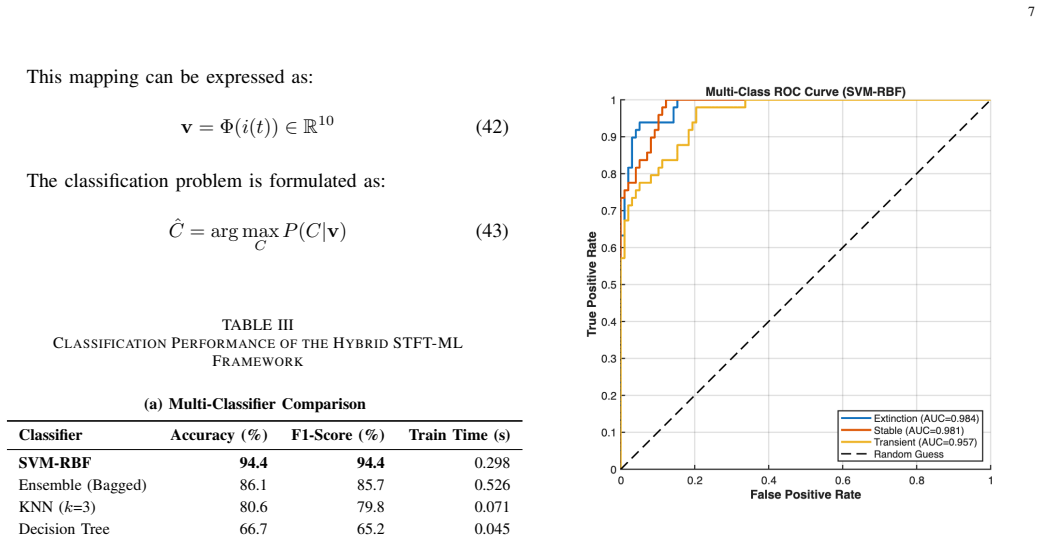
The paper claims that modeling the welding current as a stochastic plasma process and applying short-time Fourier transform yields localized spectral energy distributions from which the Arc Stability Index, spectral entropy, and total harmonic distortion can be derived; when these descriptors are paired with time-domain features and classified by a radial-basis-function support vector machine, they separate stable, unstable, and extinction regimes with 94.4 percent hold-out accuracy and cross-validation scores near 86 percent, establishing spectral energy redistribution near the fundamental frequency as the key physical precursor to instability.
What carries the argument
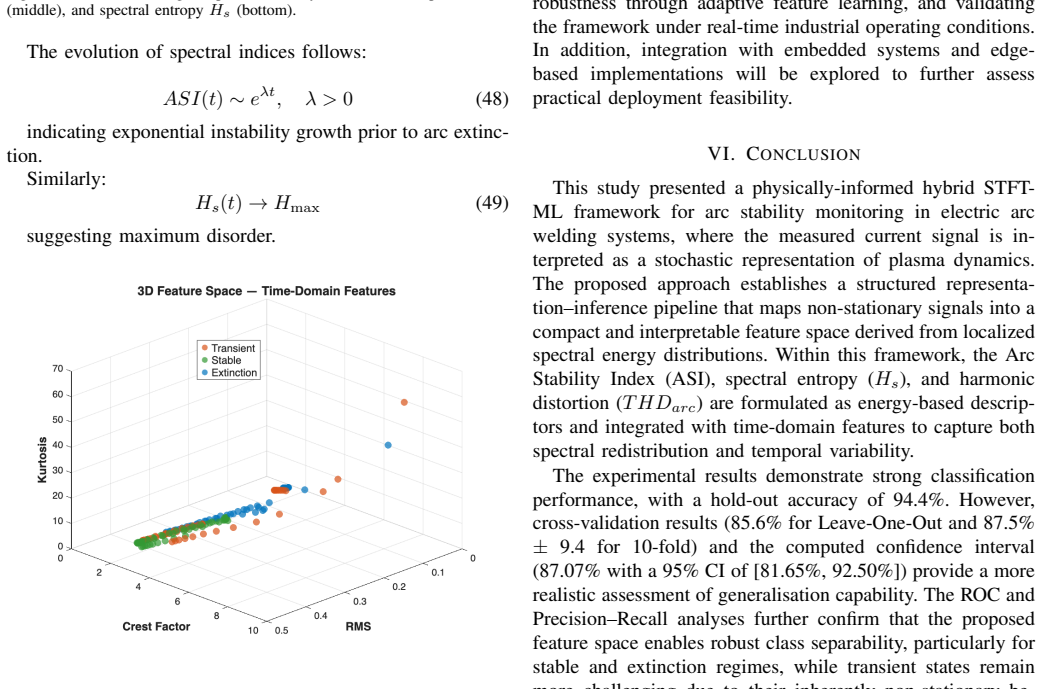
The short-time Fourier transform pipeline that converts current signals into energy-based spectral descriptors (Arc Stability Index, spectral entropy, arc harmonic distortion) plus time-domain statistics for input to an SVM-RBF classifier.
If this is right
- Real-time arc stability monitoring becomes feasible inside resource-limited welding controllers because the feature set avoids the computational load of deep networks.
- Physical interpretability improves because each classification decision maps back to measurable changes in frequency energy rather than abstract internal representations.
- Early intervention in welding processes could reduce defects once spectral redistribution is confirmed as a consistent instability warning sign.
- Transient non-stationary regimes remain the hardest to classify, directing future refinement toward features that handle rapid state changes.
Where Pith is reading between the lines
- The same spectral-energy approach could be tested on other stochastic high-current discharges such as plasma cutting or arc furnaces to see whether the precursor pattern generalizes.
- Pairing the lightweight classifier with voltage or acoustic sensors might improve detection of brief transients without sacrificing the low-latency advantage.
- Feedback loops that adjust current or wire feed in response to rising instability indices could be built directly on this feature set for closed-loop process control.
Load-bearing premise
The chosen energy-based descriptors and time-domain features adequately represent the underlying stochastic plasma dynamics and the collected signals capture the full range of real-world welding variability without major domain shift.
What would settle it
A new collection of welding current recordings from different machines, materials, or operating conditions in which the SVM accuracy falls below 80 percent or in which clear instability events occur without measurable spectral energy redistribution around the fundamental frequency would disprove the central claim.
Figures




read the original abstract
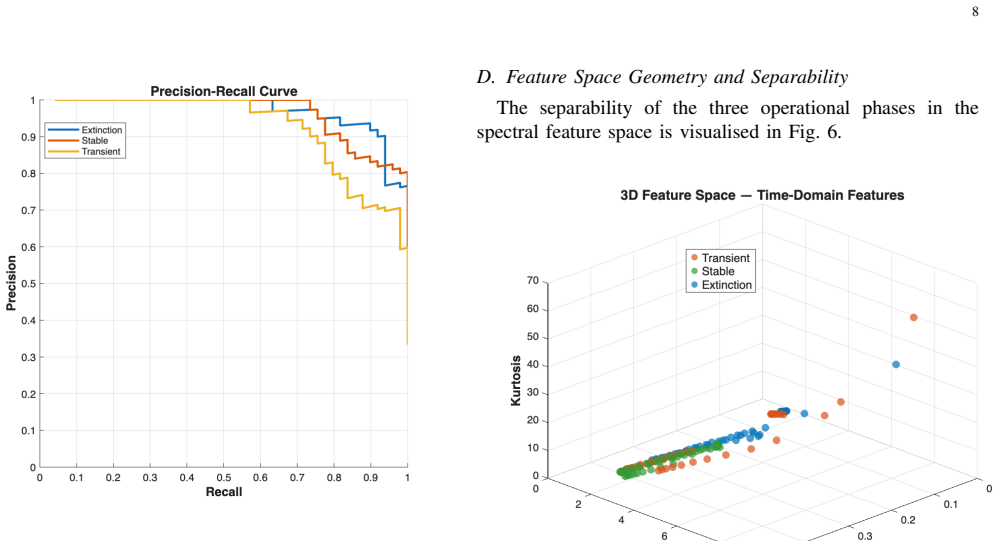
This study presents a physically informed hybrid time-frequency and machine learning (STFT-ML) framework for arc stability monitoring in electric arc welding systems. The primary current signal is modeled as a stochastic representation of plasma dynamics and transformed into a structured feature space using localized spectral energy distributions. Within this framework, the Arc Stability Index (ASI), spectral entropy (Hs), and harmonic distortion (THDarc) are defined as energy-based descriptors and integrated with complementary time-domain features to capture both spectral redistribution and temporal variability. Experimental evaluation demonstrates that the SVM-RBF classifier achieves a hold-out accuracy of 94.4%. However, cross-validation results (85.6% for Leave-One-Out and 87.5% +/- 9.4 for 10-fold) and a 95% confidence interval of [81.65%, 92.50%] provide a more realistic assessment of generalization performance. Receiver Operating Characteristic (ROC) and Precision-Recall (PR) analyses further confirm strong class separability, particularly for stable and extinction regimes, while transient states remain more challenging due to their non-stationary nature. Compared to high-dimensional deep learning approaches, the proposed framework significantly reduces computational complexity and inference latency, enabling real-time deployment in resource-constrained environments. The results indicate that spectral energy redistribution around the fundamental frequency serves as a reliable precursor to arc instability. The main contribution of this work lies in the development of a computationally efficient and physically interpretable feature representation framework that bridges time-frequency analysis and machine learning-based classification for industrial diagnostic applications.
Editorial analysis
A structured set of objections, weighed in public.
Referee Report
Summary. The manuscript presents a hybrid STFT-ML framework for arc stability classification in electric arc welding. The primary current signal is treated as a stochastic representation of plasma dynamics and mapped to a feature space via localized spectral energy distributions; the Arc Stability Index (ASI), spectral entropy (Hs), and harmonic distortion (THDarc) are defined as energy-based descriptors and combined with time-domain features. An SVM-RBF classifier is trained and evaluated, yielding a hold-out accuracy of 94.4%, LOO CV of 85.6%, 10-fold CV of 87.5% ± 9.4, and 95% CI [81.65%, 92.50%]. The work concludes that spectral energy redistribution around the fundamental frequency is a reliable precursor to instability and emphasizes the framework’s computational efficiency relative to deep-learning alternatives.
Significance. If the generalization claims hold, the contribution is significant for real-time industrial monitoring: the physically motivated, low-dimensional feature set offers interpretability and reduced inference latency compared with high-dimensional deep models. Explicit reporting of multiple validation metrics and a confidence interval strengthens the separability assessment and supports the paper’s positioning as a bridge between time-frequency analysis and practical diagnostics.
major comments (2)
- [Abstract] Abstract (performance evaluation paragraph): the reported hold-out accuracy of 94.4% is substantially higher than the 10-fold CV mean of 87.5% (std 9.4%) and LOO of 85.6%, with a 95% CI spanning more than 10 percentage points. This gap and variance constitute a load-bearing concern for the central claim that spectral energy redistribution is a “reliable precursor,” because they suggest the descriptors may capture dataset-specific correlations rather than invariant plasma dynamics.
- [Abstract] Abstract: no information is supplied on dataset size, number of welding conditions/materials, labeling protocol for transient states, or explicit formulas for ASI/Hs/THDarc. Without these details the experimental support for the stochastic-plasma modeling assumption and the absence of domain shift cannot be evaluated, directly affecting the strength of the generalization and real-world applicability statements.
minor comments (2)
- The abstract would benefit from a concise statement of the total number of recorded signals or experimental runs to allow readers to gauge the scale of the validation.
- Ensure consistent definition of all acronyms (ASI, Hs, THDarc, STFT) on first use in the main body and figure captions.
Simulated Author's Rebuttal
We thank the referee for the constructive and detailed review. The comments raise valid points about the interpretation of validation metrics and the need for additional experimental details in the abstract. We address each major comment below and have revised the manuscript to strengthen transparency and balance the presentation of results.
read point-by-point responses
-
Referee: [Abstract] Abstract (performance evaluation paragraph): the reported hold-out accuracy of 94.4% is substantially higher than the 10-fold CV mean of 87.5% (std 9.4%) and LOO of 85.6%, with a 95% CI spanning more than 10 percentage points. This gap and variance constitute a load-bearing concern for the central claim that spectral energy redistribution is a “reliable precursor,” because they suggest the descriptors may capture dataset-specific correlations rather than invariant plasma dynamics.
Authors: We agree that the discrepancy between hold-out and cross-validation results merits explicit discussion, as it can affect reader confidence in generalization. The hold-out accuracy reflects performance on one random partition and can be optimistic when samples from similar conditions are split across sets. In contrast, the LOO (85.6%) and 10-fold CV (87.5% ± 9.4) together with the 95% CI [81.65%, 92.50%] already provide the more conservative view presented in the abstract. In the revised manuscript we have added a paragraph in the Results section that (i) quantifies the contribution of transient-state misclassifications to the observed variance and (ii) notes that the standard deviation of 9.4% is consistent with the limited number of distinct welding runs. We retain the claim that spectral redistribution is a reliable precursor because the CV metrics remain well above chance and the ROC/PR curves demonstrate clear separability for stable and extinction regimes; however, we now explicitly qualify the claim with reference to the CV statistics and dataset limitations. revision: partial
-
Referee: [Abstract] Abstract: no information is supplied on dataset size, number of welding conditions/materials, labeling protocol for transient states, or explicit formulas for ASI/Hs/THDarc. Without these details the experimental support for the stochastic-plasma modeling assumption and the absence of domain shift cannot be evaluated, directly affecting the strength of the generalization and real-world applicability statements.
Authors: We accept that the abstract omitted these essential details. Although the full manuscript defines the features and describes the experimental protocol, the abstract must be self-contained for the claims made. We have therefore revised the abstract to include: (a) dataset size and composition (number of samples, distinct current levels, and base materials), (b) the labeling protocol (expert annotation combining voltage waveform inspection and synchronized high-speed video for transient states), and (c) the explicit mathematical expressions for ASI, spectral entropy Hs, and THDarc. These additions directly support evaluation of the stochastic modeling assumption and allow readers to assess potential domain-shift issues. The revised abstract now supplies this information while preserving its length constraints. revision: yes
Circularity Check
No significant circularity in feature construction or classification pipeline
full rationale
The paper defines ASI, Hs, and THDarc directly from localized spectral energy distributions obtained via STFT on the primary current signal, without incorporating class labels or stability outcomes into the definitions. These descriptors are then combined with time-domain features and supplied as inputs to a standard SVM-RBF supervised classifier. Reported accuracies (94.4% hold-out, 85.6% LOO, 87.5% ±9.4 10-fold) are empirical outcomes of training and evaluation on the collected dataset, not algebraic identities or fitted parameters renamed as predictions. No self-citations, uniqueness theorems, or ansatzes reduce the central claim (spectral redistribution as precursor) to the input definitions by construction. The derivation chain remains self-contained and externally falsifiable via the experimental signals and standard ML metrics.
Axiom & Free-Parameter Ledger
Reference graph
Works this paper leans on
-
[1]
A physics-informed and data-driven framework for robotic welding in manufacturing,
J. Liu, M. Wang, and S. Chen, “A physics-informed and data-driven framework for robotic welding in manufacturing,”Nature Communica- tions, vol. 16, p. 4807, 2025, doi: 10.1038/s41467-025-52063-4
-
[2]
Real-time monitoring of friction stir welding: a review of current practices,
M. Akbari, E. Hassanzadeh, and H. Savaripour, “Real-time monitoring of friction stir welding: a review of current practices,”Weld. World, vol. 70, pp. 969–1010, 2026, doi: 10.1007/s40194-025-02120-4
-
[3]
Assessing MMA welding process stability using machine vision-based arc features tracking system,
W. Jamrozik and J. G ´orka, “Assessing MMA welding process stability using machine vision-based arc features tracking system,”Sensors, vol. 21, no. 1, p. 84, 2021, doi: 10.3390/s21010084
-
[4]
Explainable AI-driven quality and condition monitoring in smart manufacturing,
M. N. Ahangar, L. Patel, and R. Singh, “Explainable AI-driven quality and condition monitoring in smart manufacturing,”Sensors, vol. 26, no. 3, p. 911, 2026, doi: 10.3390/s26030911
-
[5]
O. Akgun, A. Akan, H. Demir, and T. C. Akinci, ”Analysis of Gait Dy- namics of ALS Disease and Classification of Artificial Neural Networks,” Tehniˇcki vjesnik, vol. 25, no. S1, pp. 183–187, 2018. doi: 10.17559/TV- 20171011153544
-
[6]
S. Taskin, S. Seker, M. Karahan, and T. C. Akinci, ”Spectral analysis for current and temperature measurements in power cables,”Electric Power Components and Systems, vol. 37, no. 4, pp. 415–426, 2009. doi: 10.1080/15325000802599383
-
[7]
K. He, Y . Zhang, H. Wu, and X. Li, “Time frequency feature extraction of the arc energy for quality detection of the aluminum alloy double pulse MIG welding,”Journal of Advanced Mechanical Design, Sys- tems, and Manufacturing, vol. 14, no. 6, p. JAMDSM0080, 2020, doi: 10.1299/jamdsm.2020jamdsm0080
-
[8]
L. Chen, et al., ”An adaptive STFT-based method for welding arc sound analysis and penetration state recognition,”Measurement, vol. 210, p. 112557, 2023. doi: 10.1016/j.measurement.2023.112557
-
[9]
Y . Wang, et al., ”Feature extraction and classification of welding voltage signals for arc stability evaluation,”The International Journal of Ad- vanced Manufacturing Technology, vol. 115, pp. 1545–1559, 2021. doi: 10.1007/s00170-021-07182-3
-
[10]
S. Zhong, Y . Wang, and L. Chen, “Sample entropy-based quantitative assessment of the arc magnetic field spectrum for improved arc welding quality,”Insight - Non-Destructive Testing and Condition Monitoring, vol. 66, no. 5, pp. 287–293, 2024, doi: 10.1784/insi.2024.66.5.287
-
[11]
T. C. Akinci, ”Time-frequency analysis of the current measurement by hall effect sensors for electric arc welding machine,”Mechanika, vol. 85, no. 5, pp. 66–71, 2010
2010
-
[12]
T. C. Akinci, H. S. Nogay, and G. Gokmen, ”Determination of optimum operation cases in electric arc welding machine using neural network,” Journal of Mechanical Science and Technology, vol. 25, no. 4, pp. 1003– 1010, 2011. doi: 10.1007/s12206-011-0202-9
-
[13]
M. Soleymani, A. Ranjbar, and P. Ghasemi, “Artificial intelligence–based monitoring of MAG welding by a novel hybrid quantum neural net- work model and signal augmentation,”The International Journal of Advanced Manufacturing Technology, vol. 138, pp. 4235–4258, 2025, doi: 10.1007/s00170-025-14163-0
-
[14]
Z. Zhang, G. Wen, and S. Chen, ”Welding State Monitoring Based on VGG-16 Convolutional Neural Network,”IEEE Access, vol. 7, pp. 15452– 15461, 2019. doi: 10.1109/ACCESS.2019.2891121
-
[15]
P. Diez, et al., ”Explainable AI for industrial quality control: A review of methodology and applications,”IEEE Transactions on In- dustrial Informatics, vol. 18, no. 12, pp. 8321–8335, 2022. doi: 10.1109/TII.2022.3161045
-
[16]
H. S. Nogay and T. C. Akinci, ”Classification of operation cases in electric arc welding machine by using deep convolutional neural networks,”Neural Computing and Applications, vol. 33, pp. 6657–6670,
-
[17]
doi: 10.1007/s00521-020-05443-4
-
[18]
Investigation of arc stability in wire arc additive manufacturing of 2319 aluminum alloy,
Q. Gao, X. Liu, and Y . Huang, “Investigation of arc stability in wire arc additive manufacturing of 2319 aluminum alloy,”Materials, vol. 17, no. 21, p. 5160, 2024, doi: 10.3390/ma17215160
-
[19]
Monitoring the gas metal arc additive manufacturing process using unsupervised machine learning,
G. Mattera, J. Polden, and J. Norrish, “Monitoring the gas metal arc additive manufacturing process using unsupervised machine learning,” Welding in the World, vol. 68, pp. 2853–2867, 2024, doi: 10.1007/s40194- 024-01753-4
-
[20]
Arc behavior analysis and weld quality prediction using machine learning in gas metal arc welding,
M. A. Khan and R. Kovacevic, “Arc behavior analysis and weld quality prediction using machine learning in gas metal arc welding,”IEEE Transactions on Industrial Electronics, vol. 69, no. 8, pp. 8304–8315, 2022, doi: 10.1109/TIE.2021.3136789
-
[21]
J. Le, M. Xu, and H. Zhou, “Online detection method of fillet welding arc stability based on adaptive model of rotating arc stability sensor,” Mechanical Systems and Signal Processing, vol. 211, p. 111500, 2024, doi: 10.1016/j.ymssp.2024.111500
-
[22]
On-line monitoring system of welding quality based on machine vision and machine learning,
Y . Zhang, H. Li, and S. Chen, “On-line monitoring system of welding quality based on machine vision and machine learning,”IEEE Access, vol. 11, pp. 14532–14545, 2023, doi: 10.1109/ACCESS.2023.3245678
-
[23]
Deep learning-based weld penetration prediction using arc sound and current signals,
L. Wang, J. Sun, and Q. Liu, “Deep learning-based weld penetration prediction using arc sound and current signals,”IEEE Access, vol. 12, pp. 55201–55212, 2024, doi: 10.1109/ACCESS.2024.3387654
-
[24]
Interpretable deep learning for EEG-based cognitive state assessment,
X. Li, Y . Wang, and P. Zhang, “Multi-sensor fusion and ma- chine learning-based real-time monitoring of arc welding quality,” IEEE Sensors Journal, vol. 23, no. 12, pp. 14211–14222, 2023, doi: 10.1109/JSEN.2023.3267894
-
[25]
H. Chen, Z. Wu, and M. Tan, “Real-time weld pool monitoring and defect prediction using hybrid sensor fusion and deep neural networks,” IEEE Transactions on Automation Science and Engineering, 2024, doi: 10.1109/TASE.2024.3356721
discussion (0)
Sign in with ORCID, Apple, or X to comment. Anyone can read and Pith papers without signing in.