Recognition: unknown
Kramers-Kronig Relations and Causality in Non-Markovian Open Quantum Dynamics: Kernel, State, and Effective Kernel
Pith reviewed 2026-05-10 06:32 UTC · model grok-4.3
The pith
The Nakajima-Zwanzig memory kernel obeys Kramers-Kronig relations when the projected generator admits a real-axis spectral representation.
A machine-rendered reading of the paper's core claim, the machinery that carries it, and where it could break.
Core claim
Under a real-axis spectral-representation hypothesis for the projected generator, with a coupling-weighted spectral density in L¹ ∩ Lᵖ, the Nakajima-Zwanzig memory kernel belongs to the operator-valued Hardy space Hᵖ⁺ and obeys Kramers-Kronig or subtracted Kramers-Kronig relations. This yields a Hardy-space consistency criterion for CPTP reduced dynamics, a passivity-analyticity compatibility statement for passive bosonic baths, and a finite-truncation Carleman diagnostic for moment-based kernel reconstructions.
What carries the argument
Membership of the Laplace-transformed Nakajima-Zwanzig memory kernel in the operator-valued Hardy space Hᵖ⁺, which follows from the real-axis spectral hypothesis and directly implies the Kramers-Kronig relations via contour integration in the upper half-plane.
If this is right
- The memory kernel supplies a Hardy-space consistency criterion that any completely positive trace-preserving reduced dynamics must satisfy.
- The result gives a passivity-analyticity compatibility statement for dynamics driven by passive bosonic baths.
- Finite truncations of the kernel admit a Carleman-type diagnostic for moment-based reconstructions.
- Uncancelled zeros of the reduced-state transform can produce upper-half-plane poles in the force-fit effective kernel, creating apparent acausality only in that derived object.
Where Pith is reading between the lines
- Extracted kernels from numerical simulations or experiments can be validated for consistency with causality by checking Kramers-Kronig compliance within the reported numerical tolerance.
- The separation of the three objects indicates that inhomogeneous terms discarded in Born-order or effective-model approximations can contaminate force-fit kernels while leaving the underlying microscopic evolution causal.
- The analyticity of the state transform for correlated initial states suggests that initial correlations do not introduce new upper-half-plane singularities into the memory kernel itself.
Load-bearing premise
The projected generator must admit a spectral representation on the real axis and the coupling-weighted spectral density must lie in L¹ intersect Lᵖ.
What would settle it
An extracted 4-by-4 memory kernel from a Jaynes-Cummings model whose integrated relative residual against the Kramers-Kronig relation exceeds the calibrated 5 percent noise floor of the circular FFT-Hilbert protocol, while the underlying spectral density satisfies the stated integrability conditions.
Figures



read the original abstract
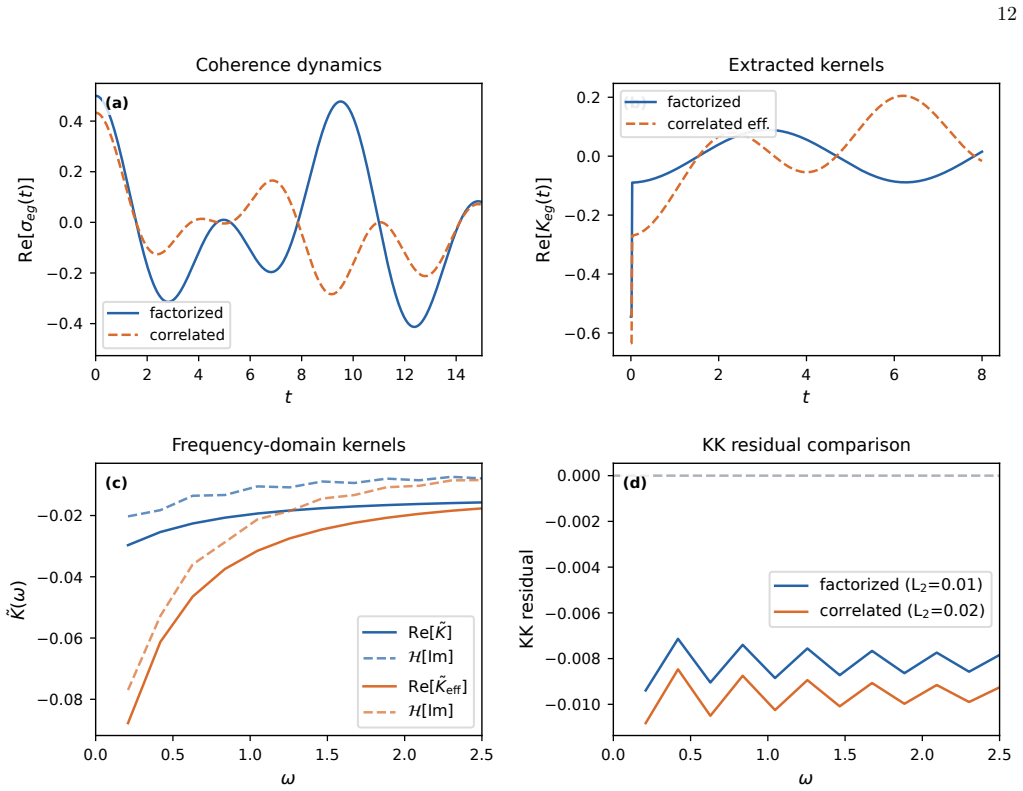
Kramers-Kronig (KK) relations are usually invoked for causal response functions, but their precise status for non-Markovian quantum memory kernels is less explicit. We separate three Laplace-domain objects: the Nakajima-Zwanzig memory kernel $\tilde{\mathcal K}(z)$, the reduced-state transform $\tilde{\sigma}(z)$, and the force-fit effective kernel $\tilde{\mathcal K}{\rm eff}(z)$. Under a real-axis spectral-representation hypothesis for the projected generator, with a coupling-weighted spectral density in $L^1 \cap L^p$, we show that $\tilde{\mathcal K}(z)$ belongs to the operator-valued Hardy space $H^p+$ and obeys KK or subtracted KK relations. This gives a Hardy-space consistency criterion for CPTP reduced dynamics, a passivity-analyticity compatibility statement for passive bosonic baths, and a finite-truncation Carleman diagnostic for moment-based kernel reconstructions. In contrast, $\tilde{\sigma}(z)$ is analytic in the upper half-plane for any initial system-bath state, including correlated states, because microscopic unitarity gives $|\sigma(t)| \leq 1$. Apparent acausality can therefore enter only through the force-fit object: in scalar channels, uncancelled zeros of $\tilde{\sigma}(z)$ can generate upper-half-plane poles of $\tilde{\mathcal K}_{\rm eff}(z)$. Numerically, we verify the full matrix-valued KK relation for an extracted $4 \times 4$ Jaynes-Cummings memory kernel. The measured integrated relative residual, $3.8%$, lies below the calibrated noise floor of the circular FFT-Hilbert protocol, about $5%$, and is therefore consistent with exact KK within numerical accuracy. We also present Born-order and correlated-state diagnostics showing how discarded inhomogeneous terms can contaminate force-fit kernels without violating microscopic causality.
Editorial analysis
A structured set of objections, weighed in public.
Referee Report
Summary. The paper claims to establish Kramers-Kronig relations for the Nakajima-Zwanzig memory kernel in non-Markovian open quantum dynamics under a real-axis spectral-representation hypothesis for the projected generator, assuming the coupling-weighted spectral density is in L^1 ∩ L^p. It demonstrates that the kernel belongs to the operator-valued Hardy space H^{p+} and obeys KK or subtracted KK relations. The reduced-state transform is shown to be analytic in the upper half-plane for any initial state due to microscopic unitarity, while the force-fit effective kernel can exhibit apparent acausality from uncancelled zeros. Numerical verification for a 4×4 Jaynes-Cummings kernel shows an integrated relative residual of 3.8%, below the 5% noise floor, consistent with the relations. Additional diagnostics for Born-order and correlated states are presented.
Significance. If the central claims hold, this work significantly clarifies the role of causality and analyticity in non-Markovian quantum memory kernels by carefully separating the Nakajima-Zwanzig kernel, the reduced-state transform, and the effective kernel. It provides a Hardy-space based consistency criterion for completely positive trace-preserving reduced dynamics and a passability-analyticity compatibility for passive bosonic baths. The finite-truncation Carleman diagnostic for moment-based reconstructions is a useful practical tool. The numerical verification and the isolation of acausality to the effective kernel are notable strengths, offering both theoretical insight and practical diagnostics for the field of open quantum systems.
major comments (2)
- [Abstract] The main result that the Nakajima-Zwanzig kernel belongs to H^{p+} and obeys KK relations rests entirely on the real-axis spectral-representation hypothesis for the projected generator (stated in the abstract); the manuscript should provide more discussion or references on when this hypothesis holds for general system-bath couplings beyond the Jaynes-Cummings case to assess the breadth of applicability.
- [Numerical verification] Numerical verification paragraph: the integrated relative residual of 3.8% for the 4×4 Jaynes-Cummings kernel is reported to lie below the 5% noise floor of the circular FFT-Hilbert protocol. The manuscript should specify the exact definition of the integrated relative residual and the calibration procedure for the noise floor to allow independent assessment of consistency with exact KK relations.
minor comments (3)
- The notation for the force-fit effective kernel should be introduced with a clear definition early in the paper to distinguish it unambiguously from the Nakajima-Zwanzig kernel.
- Consider adding a schematic diagram illustrating the relationships between the three Laplace-domain objects (kernel, state transform, effective kernel) to enhance readability for readers.
- The abstract mentions Born-order and correlated-state diagnostics; these should be explicitly cross-referenced to specific sections or equations in the main text.
Simulated Author's Rebuttal
We thank the referee for the careful reading, positive assessment of the work, and recommendation for minor revision. We address each major comment below and will incorporate the suggested clarifications into the revised manuscript.
read point-by-point responses
-
Referee: [Abstract] The main result that the Nakajima-Zwanzig kernel belongs to H^{p+} and obeys KK relations rests entirely on the real-axis spectral-representation hypothesis for the projected generator (stated in the abstract); the manuscript should provide more discussion or references on when this hypothesis holds for general system-bath couplings beyond the Jaynes-Cummings case to assess the breadth of applicability.
Authors: We agree that the breadth of applicability is determined by the validity of the real-axis spectral-representation hypothesis for the projected generator. The manuscript presents the main results conditionally on this hypothesis (with the coupling-weighted spectral density in L^1 ∩ L^p), which is sufficient to place the Nakajima-Zwanzig kernel in the operator-valued Hardy space H^{p+}. To address the referee's point, the revised manuscript will include an expanded discussion, either in the introduction or a new subsection, outlining the conditions under which the hypothesis is expected to hold for general system-bath couplings. This will reference relevant literature on spectral representations in open quantum systems, including structured bosonic baths and non-Jaynes-Cummings models, thereby clarifying the scope without altering the core theorems. revision: yes
-
Referee: [Numerical verification] Numerical verification paragraph: the integrated relative residual of 3.8% for the 4×4 Jaynes-Cummings kernel is reported to lie below the 5% noise floor of the circular FFT-Hilbert protocol. The manuscript should specify the exact definition of the integrated relative residual and the calibration procedure for the noise floor to allow independent assessment of consistency with exact KK relations.
Authors: We appreciate the referee's request for greater precision in the numerical section. The reported 3.8% integrated relative residual is intended to demonstrate consistency with the Kramers-Kronig relations within the accuracy of the circular FFT-Hilbert protocol. In the revised manuscript, we will explicitly define the integrated relative residual (as the frequency-integrated L1 norm of the pointwise relative deviation between the extracted kernel and its Kramers-Kronig reconstruction, normalized by the kernel's L1 norm) and provide a detailed description of the noise-floor calibration procedure, including the use of synthetic test kernels with known analytic properties to quantify the protocol's error under the same discretization and truncation parameters employed for the 4×4 Jaynes-Cummings example. revision: yes
Circularity Check
No significant circularity
full rationale
The derivation begins from an explicit hypothesis (real-axis spectral representation of the projected generator plus spectral density in L¹ ∩ Lᵖ) and from microscopic unitarity (|σ(t)| ≤ 1), then shows membership of the Nakajima-Zwanzig kernel in the operator-valued Hardy space H^{p+} together with the corresponding KK relations. The reduced-state transform is shown analytic in the upper half-plane for arbitrary initial states by the same unitarity bound. No equation equates a derived quantity to a fitted parameter by construction, no uniqueness theorem is imported from prior self-citation, and no ansatz is smuggled via citation. The numerical Jaynes-Cummings check is presented only as a consistency test whose residual lies inside the calibrated noise floor, not as a derivation. The argument therefore remains self-contained against the external mathematical benchmarks of Hardy-space theory and unitary evolution.
Axiom & Free-Parameter Ledger
axioms (3)
- domain assumption real-axis spectral-representation hypothesis for the projected generator
- domain assumption coupling-weighted spectral density belongs to L^1 ∩ L^p
- standard math microscopic unitarity implies |σ(t)| ≤ 1 for any initial state
Forward citations
Cited by 2 Pith papers
-
A symmetry-protected pseudo-Hermitian phase of quantum memory-kernel generators
The memory-kernel generator QLQ in the Jaynes-Cummings model is non-Hermitian yet possesses a strictly real spectrum for vacuum and thermal baths, protected by pseudo-Hermiticity with an explicit positive-definite metric.
-
A symmetry-protected pseudo-Hermitian phase of quantum memory-kernel generators
The Jaynes-Cummings projected Liouvillian is pseudo-Hermitian via a positive-definite metric eta that protects its real spectrum and reveals a U(1)-to-Z2 phase structure under deformation to the Rabi model.
Reference graph
Works this paper leans on
-
[1]
fragile regime
Connection to Gavassino Gavassino [3] showed that macroscopic acausal be- haviour can be entirely encoded in initial conditions when information is discarded. Theorem 9 shows that the quantum analogue is more restrictive:σ(t) inher- its boundedness from microscopic unitarity, preventing acausal leaks intoH + through the state transform itself. The paralle...
2000
-
[2]
Matrix representation of the Liouvillian and the NZ projection For a finite-dimensional total Hilbert spaceH=H s ⊗ Hb with dimH s =d s and dimH b =d b, the Hamiltonian 20 is ad×dHermitian matrix (d=d sdb). The Liouvillian superoperatorLρ= [ ˆH, ρ] is represented as ad 2 ×d 2 matrix in the vectorization (column-stacking) basis: Lmat =1 d ⊗ ˆH− ˆH T ⊗1 d.(C...
-
[3]
Algorithm The numerical test proceeds as follows
-
[4]
Build ˆHfor the chosen model and truncation
-
[5]
ConstructL mat via Eq. (C1)
-
[6]
Choose a bath reference stateρ ref b (vacuum, ther- mal, or other)
-
[7]
(C2) and verifyP 2 mat = Pmat to machine precision
ConstructP mat via Eq. (C2) and verifyP 2 mat = Pmat to machine precision
-
[8]
FormQ mat =1 d2 −P mat and computeM= QmatLmatQmat
-
[9]
Verify non-orthogonality:∥P mat −P † mat∥F >10 −10
-
[10]
Compute all eigenvalues{λ j}ofMusing standard dense eigensolvers
-
[11]
Report max j |Im(λ j)|. A threshold of 10 −10 is used to distinguish genuine com- plex eigenvalues from machine-precision noise; for the matrices tested (d 2 ≤42 2 = 1764), dense eigensolvers give imaginary parts below 10 −14 when the spectrum is truly real
-
[12]
Table II summarizes the results
Jaynes–Cummings model: real spectrum across all parameters The JC Hamiltonian ˆHJC = ω0 2 σz +ω ca†a+g σ+a+σ −a† (C4) is truncated to 0≤n≤N max Fock states, givingd= 2(Nmax + 1). Table II summarizes the results. For every com- bination ofN max = 3,5,10,15,20, couplingg= 0.1,0.3,0.5,1.0,2.0, and reference state (vacuum|0⟩⟨0|, thermalρ th b withβ= 1.0, and ...
-
[13]
Table III shows the results
Spin-boson model: complex eigenvalues at moderate-to-strong coupling The spin-boson Hamiltonian withσ z coupling to dis- crete bath modes, ˆHSB = ∆ 2 σx + NbathX k=1 ωka† kak +σ z NbathX k=1 gk(ak +a † k),(C5) 21 is truncated to 0≤n k ≤n max per mode, givingd= 2(nmax + 1)Nbath. Table III shows the results. At weak coupling (g k = 0.1), the eigenvalues are...
-
[14]
For the Jaynes–Cummings model — the setting of Fig
Implications These numerical tests support the conditional formula- tion adopted in the main text. For the Jaynes–Cummings model — the setting of Fig. 2 and Sec. VI — the real- spectrum part of the spectral hypothesis is satisfied in the tested finite truncations; strict Hardy membership still requires the continuous-density assumption stated in Theorem 2...
-
[15]
Gavassino, Can we make sense of dissipation without causality?, Phys
L. Gavassino, Can we make sense of dissipation without causality?, Phys. Rev. X12, 041001 (2022)
2022
-
[16]
Gavassino, M
L. Gavassino, M. M. Disconzi, and J. Noronha, Disper- sion relations alone cannot guarantee causality, Phys. Rev. Lett.132, 162301 (2024)
2024
-
[17]
How acausal equations emerge from causal dynamics
L. Gavassino, How acausal equations emerge from causal dynamics, Prog. Theor. Exp. Phys.2026, accepted (2026), arXiv:2604.07031
work page internal anchor Pith review Pith/arXiv arXiv 2026
-
[18]
R. E. Hoult and P. Kovtun, Causality and classical dis- persion relations, Phys. Rev. D109, 046018 (2024)
2024
-
[19]
Pechukas, Reduced dynamics need not be completely positive, Phys
P. Pechukas, Reduced dynamics need not be completely positive, Phys. Rev. Lett.73, 1060 (1994)
1994
-
[20]
C. A. Rodr´ ıguez-Rosario, K. Modi, A. Kuah, A. Shaji, and E. C. G. Sudarshan, Completely positive maps and classical correlations, J. Phys. A: Math. Theor.41, 205301 (2008)
2008
-
[21]
Shabani and D
A. Shabani and D. A. Lidar, Vanishing quantum discord is necessary and sufficient for completely positive maps, Phys. Rev. Lett.102, 100402 (2009)
2009
-
[22]
Buscemi, Complete positivity, Markovianity, and the quantum data-processing inequality, in the presence of initial system-environment correlations, Phys
F. Buscemi, Complete positivity, Markovianity, and the quantum data-processing inequality, in the presence of initial system-environment correlations, Phys. Rev. Lett. 113, 140502 (2014)
2014
-
[23]
F. A. Pollock, C. Rodr´ ıguez-Rosario, T. Frauenheim, M. Paternostro, and K. Modi, Operational Markov condi- tion for quantum processes, Phys. Rev. Lett.120, 040405 (2018)
2018
-
[24]
Colla, M
A. Colla, M. Neubrand, and H.-P. Breuer, Initial corre- lations in open quantum systems: Constructing linear dynamical maps and master equations, New J. Phys.24, 123005 (2022)
2022
-
[25]
Megier, A
N. Megier, A. Smirne, and B. Vacchini, On the use of to- tal system state for open quantum dynamics with initial correlations, Phys. Rev. A105, 042206 (2022)
2022
-
[26]
Nakajima, On quantum theory of transport phenom- ena, Prog
S. Nakajima, On quantum theory of transport phenom- ena, Prog. Theor. Phys.20, 948 (1958)
1958
-
[27]
Zwanzig, Ensemble method in the theory of irre- versibility, J
R. Zwanzig, Ensemble method in the theory of irre- versibility, J. Chem. Phys.33, 1338 (1960). 22
1960
-
[28]
Mori, Transport, collective motion, and brownian mo- tion, Prog
H. Mori, Transport, collective motion, and brownian mo- tion, Prog. Theor. Phys.33, 423 (1965)
1965
-
[29]
Breuer and F
H.-P. Breuer and F. Petruccione,The Theory of Open Quantum Systems(Oxford University Press, 2002)
2002
-
[30]
Weiss,Quantum Dissipative Systems, 4th ed
U. Weiss,Quantum Dissipative Systems, 4th ed. (World Scientific, 2012)
2012
-
[31]
Ivander, L
F. Ivander, L. P. Lindoy, and J. Lee, Unified framework for open quantum dynamics with memory, Nat. Com- mun.15, 8087 (2024)
2024
- [32]
- [33]
-
[34]
Vacchini and H.-P
B. Vacchini and H.-P. Breuer, Nakajima-Zwanzig ver- sus time-convolutionless master equation for the non- Markovian dynamics of a two-level system, Phys. Rev. A81, 042103 (2010)
2010
-
[35]
Koosis,Introduction toH p Spaces, 2nd ed
P. Koosis,Introduction toH p Spaces, 2nd ed. (Cambridge University Press, 1998)
1998
-
[36]
A. V. Bukhvalov and A. A. Danilevich, Boundary prop- erties of analytic and harmonic functions with values in a Banach space, Mat. Zametki31, 203 (1982)
1982
-
[37]
Diestel and J
J. Diestel and J. J. Uhl,Vector Measures, Mathematical Surveys and Monographs, Vol. 15 (American Mathemat- ical Society, 1977)
1977
-
[38]
Gesztesy and E
F. Gesztesy and E. Tsekanovskii, On matrix-valued Her- glotz functions, Math. Nachr.218, 61 (2000)
2000
-
[39]
D. L. Burkholder, A geometric condition that implies the existence of certain singular integrals of Banach-space- valued functions, Conf. on Harmonic Analysis in Honor of A. Zygmund (W. Beckner et al., eds.), Wadsworth , 270 (1983)
1983
-
[40]
Bourgain, Some remarks on Banach spaces in which martingale difference sequences are unconditional, Arkiv f¨ or Matematik21, 163 (1983)
J. Bourgain, Some remarks on Banach spaces in which martingale difference sequences are unconditional, Arkiv f¨ or Matematik21, 163 (1983)
1983
-
[41]
Hyt¨ onen, J
T. Hyt¨ onen, J. van Neerven, M. Veraar, and L. Weis, Analysis in Banach Spaces, Volume I: Martingales and Littlewood-Paley Theory(Springer, 2016)
2016
-
[42]
F. W. King,Hilbert Transforms, Vol. 1–2 (Cambridge University Press, 2009)
2009
-
[43]
J. S. Toll, Causality and the dispersion relation: Logical foundations, Phys. Rev.104, 1760 (1956)
1956
-
[44]
Kubo, Statistical-mechanical theory of irreversible processes
R. Kubo, Statistical-mechanical theory of irreversible processes. I. general theory and simple applications to magnetic and conduction problems, J. Phys. Soc. Jpn. 12, 570 (1957)
1957
-
[45]
Prevedelli, A
M. Prevedelli, A. Perinelli, and L. Ricci, Kramers-Kronig relations via Laplace formalism andl 1 integrability, Am. J. Phys.92, 859 (2024)
2024
-
[46]
G. A. Baker and P. Graves-Morris,Pad´ e Approximants, 2nd ed. (Cambridge University Press, 1996)
1996
-
[47]
N. I. Akhiezer,The Classical Moment Problem and Some Related Questions in Analysis(Oliver and Boyd, 1965)
1965
-
[48]
Constantinescu, On the structure of positive Toeplitz forms, Oper
T. Constantinescu, On the structure of positive Toeplitz forms, Oper. Theory Adv. Appl.11, 127 (1984)
1984
-
[49]
Breuer, E.-M
H.-P. Breuer, E.-M. Laine, and J. Piilo, Measure for the degree of non-Markovian behavior of quantum processes in open systems, Phys. Rev. Lett.103, 210401 (2009)
2009
-
[50]
Breuer, E.-M
H.-P. Breuer, E.-M. Laine, J. Piilo, and B. Vacchini, Colloquium: Non-Markovian dynamics in open quantum systems, Rev. Mod. Phys.88, 021002 (2016)
2016
-
[51]
A. J. Leggett, S. Chakravarty, A. T. Dorsey, M. P. A. Fisher, A. Garg, and W. Zwerger, Dynamics of the dissi- pative two-state system, Rev. Mod. Phys.59, 1 (1987)
1987
-
[52]
A. O. Caldeira and A. J. Leggett, Path integral ap- proach to quantum Brownian motion, Physica A121, 587 (1983)
1983
-
[53]
K. M¨ uller and W. T. Strunz, One-to-one correspon- dence between HEOM and pseudomodes, arXiv preprint (2026), arXiv:2604.06466
work page internal anchor Pith review Pith/arXiv arXiv 2026
-
[54]
Yang and W.-M
S.-K. Yang and W.-M. Zhang, Unveiling the dynamical genesis of quantum entanglement in linear systems: In- ternal causality breaking in the reduced subsystem evo- lution, J. Chem. Phys.163, 234107 (2025)
2025
-
[55]
Breuer, Extension of the Nakajima-Zwanzig ap- proach to multitime correlation functions, Phys
H.-P. Breuer, Extension of the Nakajima-Zwanzig ap- proach to multitime correlation functions, Phys. Rev. A 95, 012118 (2017)
2017
discussion (0)
Sign in with ORCID, Apple, or X to comment. Anyone can read and Pith papers without signing in.