Recognition: unknown
Automated Classification of Plasma Regions at Mars Using Machine Learning
Pith reviewed 2026-05-10 06:42 UTC · model grok-4.3
The pith
A convolutional neural network using only ion energy spectra reliably classifies solar wind, magnetosheath, and induced magnetosphere regions at Mars.
A machine-rendered reading of the paper's core claim, the machinery that carries it, and where it could break.
Core claim
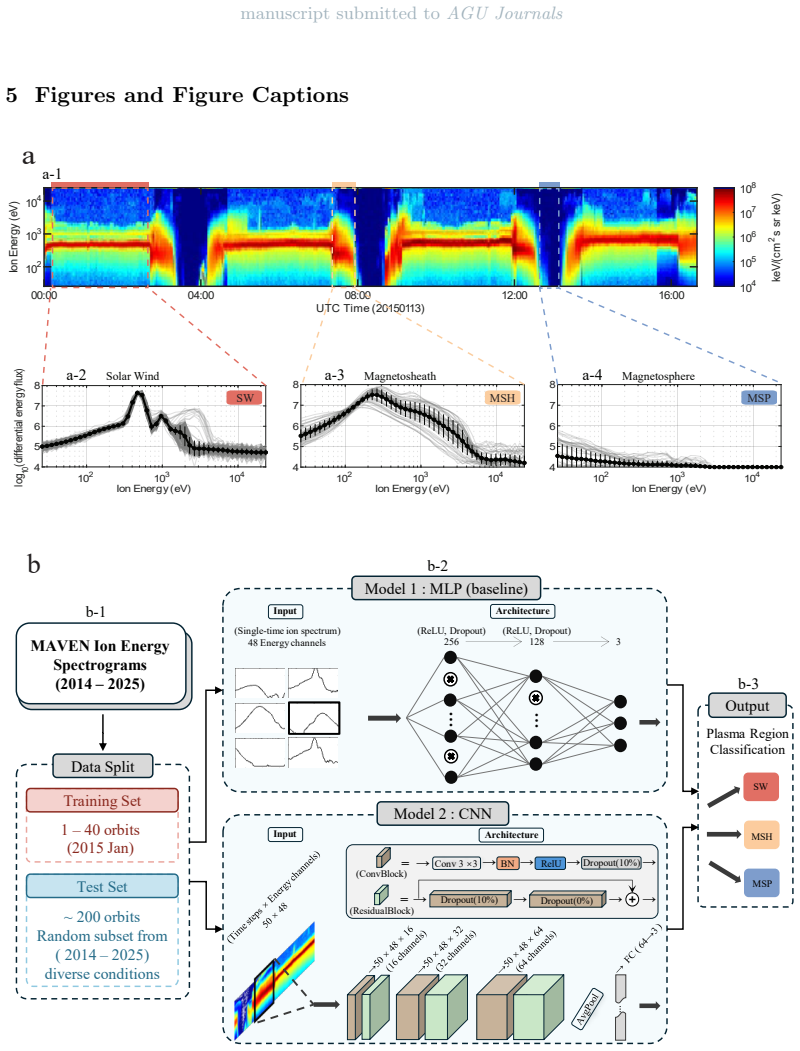
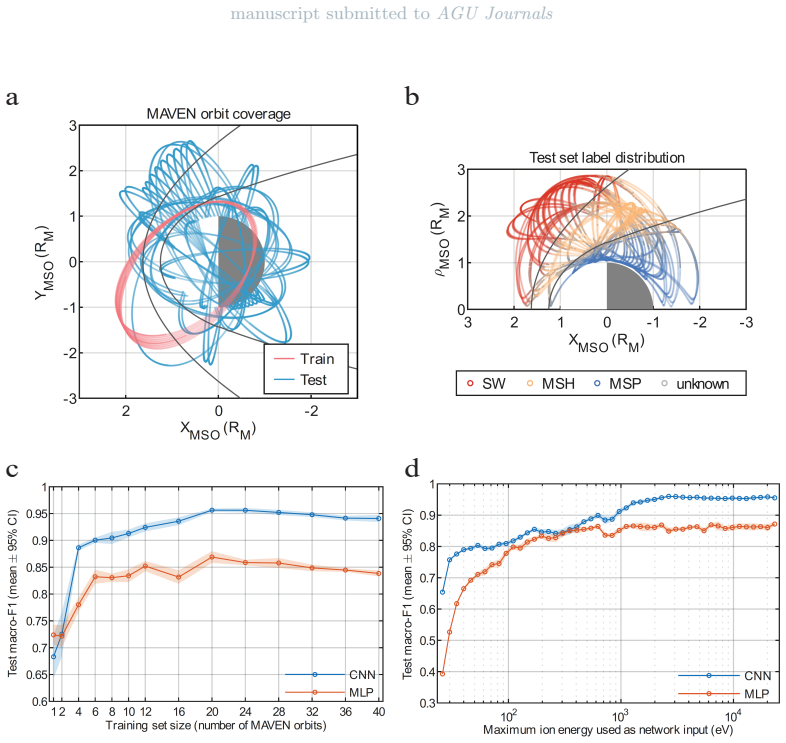
Using only ion omnidirectional energy spectra, the convolutional neural network reliably distinguishes the solar wind, magnetosheath, and induced magnetosphere, whereas the multilayer perceptron struggles to separate the solar wind and magnetosheath, thereby offering an efficient framework for large-scale plasma region identification at Mars.
What carries the argument
Convolutional neural network that processes short temporal sequences of ion omnidirectional energy spectra measured by SWIA.
Load-bearing premise
That ion omnidirectional energy spectra measured by SWIA alone contain sufficient information to accurately identify the plasma regions without magnetic field or electron data.
What would settle it
Direct comparison of the CNN classifications against expert manual labels derived from the full MAVEN instrument suite including magnetic field data on an independent test set.
Figures


read the original abstract
The plasma environment around Mars is highly variable because it is strongly influenced by the solar wind. Accurate identification of plasma regions around Mars is important for the community studying solar wind-Mars interactions, region-specific plasma processes, and atmospheric escape. In this study, we develop a machine-learning-based classifier to automatically identify three key plasma regions--solar wind, magnetosheath, and induced magnetosphere--using only ion omnidirectional energy spectra measured by the MAVEN Solar Wind Ion Analyzer (SWIA). Two neural network architectures are evaluated: a multilayer perceptron (MLP) and a convolutional neural network (CNN) that incorporates short temporal sequences. Our results show that the CNN can reliably distinguish the three plasma regions, whereas the MLP struggles to separate the solar wind and magnetosheath. Therefore, the CNN-based approach provides an efficient and accurate framework for large-scale plasma region identification at Mars and can be readily applied to future planetary missions.
Editorial analysis
A structured set of objections, weighed in public.
Referee Report
Summary. The manuscript develops and compares two neural network architectures—a multilayer perceptron (MLP) and a convolutional neural network (CNN) operating on short temporal sequences—to classify three plasma regions (solar wind, magnetosheath, induced magnetosphere) at Mars using only omnidirectional ion energy spectra from the MAVEN SWIA instrument. The central claim is that the CNN reliably distinguishes the regions while the MLP struggles to separate solar wind from magnetosheath, thereby providing an efficient framework for large-scale identification.
Significance. If the quantitative validation holds and the ion spectra are shown to be independently sufficient, the work would supply a practical, single-instrument tool for automated region identification in existing and future MAVEN-like datasets, facilitating studies of solar wind–Mars interactions and atmospheric escape without requiring simultaneous magnetic-field or electron measurements.
major comments (3)
- [Methods] Methods (label generation): The manuscript does not describe how the ground-truth labels for the three plasma regions were produced. Plasma boundaries at Mars are conventionally defined using magnetic-field draping, electron spectra, and ion moments together; if the training labels incorporated any of these auxiliary observables, the reported CNN performance only demonstrates correlation with multi-instrument labels rather than independent sufficiency of SWIA spectra alone. This information is load-bearing for the claim that ion spectra suffice.
- [Results] Results (quantitative support): The abstract asserts that the CNN “can reliably distinguish” the regions, yet neither the abstract nor the visible text supplies accuracy, precision, recall, F1 scores, or confusion matrices on held-out data. Without these metrics and a clear description of the validation procedure (e.g., orbit selection to avoid label leakage), the central empirical claim lacks visible quantitative grounding.
- [Discussion] Discussion (assumption test): The weakest assumption—that omnidirectional ion energy spectra contain sufficient distinguishing information without B-field or electron data—is not subjected to an explicit test (e.g., comparison against multi-instrument labels on a subset of orbits or ablation of temporal context). This leaves open the possibility that CNN success is driven by label leakage rather than intrinsic spectral features.
minor comments (2)
- [Abstract] The abstract and introduction should explicitly state the total number of orbits or spectra used for training, validation, and testing.
- [Methods] Notation for the CNN input (energy bins vs. time steps) is not defined before the architecture diagram; a brief equation or table would improve clarity.
Simulated Author's Rebuttal
We thank the referee for the detailed and constructive comments. We agree that the manuscript requires clarifications on label generation, quantitative metrics, and validation of the core assumption. We will revise the paper accordingly and respond to each major comment below.
read point-by-point responses
-
Referee: [Methods] Methods (label generation): The manuscript does not describe how the ground-truth labels for the three plasma regions were produced. Plasma boundaries at Mars are conventionally defined using magnetic-field draping, electron spectra, and ion moments together; if the training labels incorporated any of these auxiliary observables, the reported CNN performance only demonstrates correlation with multi-instrument labels rather than independent sufficiency of SWIA spectra alone. This information is load-bearing for the claim that ion spectra suffice.
Authors: We agree that the Methods section is missing this description. The ground-truth labels were generated using standard multi-instrument criteria from the MAVEN dataset, incorporating magnetic-field draping, electron spectra, and ion moments as described in prior literature on Mars plasma boundaries. We will add a dedicated subsection in Methods that fully details the labeling procedure and criteria for each region. This will make clear that, while labels rely on auxiliary data, the classifier is trained and deployed using only SWIA ion spectra as input, thereby demonstrating that the spectra contain sufficient information to reproduce the conventional classifications. revision: yes
-
Referee: [Results] Results (quantitative support): The abstract asserts that the CNN “can reliably distinguish” the regions, yet neither the abstract nor the visible text supplies accuracy, precision, recall, F1 scores, or confusion matrices on held-out data. Without these metrics and a clear description of the validation procedure (e.g., orbit selection to avoid label leakage), the central empirical claim lacks visible quantitative grounding.
Authors: We acknowledge that the abstract does not contain explicit numerical metrics and that the validation procedure needs more explicit description. The Results section includes performance figures and some supporting metrics, but we will revise the abstract to report key quantitative results (overall accuracy, per-class precision/recall/F1) for both models on held-out data. We will also expand the Methods and Results sections to detail the validation approach, including orbit-based splitting to avoid leakage and the composition of training/validation/test sets. revision: yes
-
Referee: [Discussion] Discussion (assumption test): The weakest assumption—that omnidirectional ion energy spectra contain sufficient distinguishing information without B-field or electron data—is not subjected to an explicit test (e.g., comparison against multi-instrument labels on a subset of orbits or ablation of temporal context). This leaves open the possibility that CNN success is driven by label leakage rather than intrinsic spectral features.
Authors: We will strengthen the Discussion by adding an explicit test of the assumption. This will include a comparison of CNN predictions against multi-instrument labels on a held-out set of orbits excluded from training, plus an ablation study that removes the temporal-sequence input to quantify its contribution. These additions will help confirm that performance arises from learned spectral and short-term temporal features rather than label leakage. revision: yes
Circularity Check
No significant circularity in the ML classification pipeline
full rationale
The paper trains supervised neural networks (MLP and CNN) on MAVEN SWIA ion spectra to classify plasma regions and reports accuracy on held-out test data. This is an empirical result grounded in external measurements rather than any derivation that reduces by construction to its own inputs, fitted parameters renamed as predictions, or self-citation chains. No equations or steps in the provided text exhibit self-definitional loops, uniqueness imported from prior author work, or ansatz smuggling. The evaluation protocol prevents the reported CNN performance from being forced by the training procedure itself.
Axiom & Free-Parameter Ledger
free parameters (1)
- CNN architecture and training hyperparameters
axioms (2)
- domain assumption Training labels correctly identify the three plasma regions
- domain assumption Ion omnidirectional energy spectra contain sufficient information for region classification
Reference graph
Works this paper leans on
-
[1]
Cheng, I. K., Achilleos, N., & Smith, A. (2022). Automated bow shock and mag- netopause boundary detection with Cassini using threshold and deep learn- ing methods.Frontiers in Astronomy and Space Sciences,9, 1016453. doi: 10.3389/fspas.2022.1016453
-
[2]
Cheng, Z., Zhang, C., Dong, C., Zhou, H., Gao, J., Tadlock, A., . . . Wang, L. (2025, December). Revisiting Mars’ Induced Magnetic Field and Clock An- gle Departures Under Real-Time Upstream Solar Wind Conditions.Jour- nal of Geophysical Research (Space Physics),130(12), e2025JA034688. doi: 10.1029/2025JA034688
-
[3]
Sheppard, D. (2015). The MAVEN magnetic field investigation.Space Science Reviews,195(1–4), 257–291. doi: 10.1007/s11214-015-0169-4
-
[4]
Dong, C., Bougher, S. W., Ma, Y., Toth, G., Nagy, A. F., & Najib, D. (2014). Solar wind interaction with mars upper atmosphere.Geophysical Research Letters, 41, 2708–2715. doi: 10.1002/2014GL059515
-
[5]
Dong, C., et al. (2015). Solar wind interaction with the martian upper atmo- sphere.Journal of Geophysical Research: Space Physics,120, 7857–7872. doi: 10.1002/2015JA020990
-
[6]
Dong, C., et al. (2018a). Modeling martian atmospheric losses over time.The Astro- physical Journal,859. doi: 10.3847/2041-8213/aac489
-
[7]
Dong, C., et al. (2018b). Solar wind interaction with the martian upper atmo- sphere.Journal of Geophysical Research: Space Physics,123, 6639–6654. doi: 10.1029/2018JA025543
-
[8]
Dubinin, E., et al. (2017). The effect of solar wind variations on the escape of oxy- gen ions from mars.Journal of Geophysical Research: Space Physics,122. doi: 10.1002/2017JA024741
-
[9]
S., et al
Halekas, J. S., et al. (2017). Structure, dynamics, and seasonal variability of the mars-solar wind interaction.Journal of Geophysical Research: Space Physics, 122, 547–578
2017
-
[10]
Halekas, J. S., et al. (2021). Induced magnetospheres.Magnetospheres in the Solar System. doi: 10.1002/9781119815624.ch25
-
[11]
He, K., Zhang, X., Ren, S., & Sun, J. (2016). Deep residual learning for image recognition. InProceedings of the ieee conference on computer vision and pat- tern recognition(pp. 770–778)
2016
-
[12]
Hollman, D. M., Jackman, C. M., Domijan, K., Bowers, C. F., Walker, S. J., Rutala, M. J., & Fogg, A. R. (2026). Identifying messenger magnetospheric bound- ary crossings using a random forest region classifier.Journal of Geophysical Research: Machine Learning and Computation,3(1), e2025JH000921. doi: 10.1029/2025JH000921
-
[13]
Inui, S., et al. (2018). Cold dense ion outflow observed in the martian-induced mag- netotail.Geophysical Research Letters,45. doi: 10.1029/2018GL077584
-
[14]
Jakosky, B. M., et al. (2015). The mars atmosphere and volatile evolution mission. Space Science Reviews,195, 3–48. doi: 10.1007/s11214-015-0139-x
-
[15]
Jakosky, B. M., et al. (2018). Loss of the martian atmosphere to space.Icarus,315, 146–157. doi: 10.1016/j.icarus.2018.05.030
-
[16]
LeCun, Y., Bottou, L., Bengio, Y., & Haffner, P. (1998). Gradient-based learning applied to document recognition.Proceedings of the IEEE,86(11), 2278–2324. doi: 10.1109/5.726791
-
[17]
Lillis, R. J., et al. (2015). Characterizing atmospheric escape from mars today and through time.Space Science Reviews,195, 357–422. doi: 10.1007/s11214-015 -0165-8
-
[18]
Linzmayer, V., Nemec, F., Nemecek, Z., & Safrankova, J. (2024). Martian bow shock and magnetic pileup boundary models based on machine learning.Advances in Space Research,73. doi: 10.1016/j.asr.2024.03.030 –13– manuscript submitted toAGU Journals
-
[19]
Loshchilov, I., & Hutter, F. (2017). Decoupled weight decay regularization.arXiv preprint arXiv:1711.05101
work page internal anchor Pith review Pith/arXiv arXiv 2017
-
[20]
Luhmann, J. G., Ledvina, S. A., & Russell, C. T. (2004). Induced magnetospheres. Advances in Space Research,33, 1905–1912. doi: 10.1016/j.asr.2003.03.031
-
[21]
Matsunaga, K., Terada, N., Harada, Y., Halekas, J. S., Brain, D. A., McFadden, J. P., & Jakosky, B. M. (2017). Statistical study of relations between the induced magnetosphere, ion composition, and pressure balance boundaries around mars based on maven observations.Journal of Geophysical Research: Space Physics,122(9), 9723–9737. doi: 10.1002/2017JA024217
-
[22]
F., et al
Nagy, A. F., et al. (2004). The plasma environment of mars.Space Science Reviews, 111, 33–114
2004
-
[23]
Nemec, F., et al. (2020). Martian bow shock and magnetic pileup boundary models based on an automated region identification.Journal of Geophysical Research: Space Physics,125. doi: 10.1029/2020JA028509
-
[24]
V., Lalti, A., Divin, A., Delzanno, G
Olshevsky, V., Khotyaintsev, Y. V., Lalti, A., Divin, A., Delzanno, G. L., Anderz´ en, S., . . . Markidis, S. (2021). Automated classification of plasma regions us- ing 3d particle energy distributions.Journal of Geophysical Research: Space Physics,126(10), e2021JA029620. doi: 10.1029/2021JA029620
-
[25]
Ramstad, R., et al. (2018). Ion escape from mars through time.Journal of Geophys- ical Research: Planets,123, 3051–3060. doi: 10.1029/2018JE005727
-
[26]
Ramstad, R., et al. (2020). The global current systems of the martian induced mag- netosphere.Nature Astronomy,4, 979–985. doi: 10.1038/s41550-020-1099-y
-
[27]
E., Hinton, G
Rumelhart, D. E., Hinton, G. E., & Williams, R. J. (1986). Learning representa- tions by back-propagating errors.Nature,323(6088), 533–536. doi: 10.1038/ 323533a0
1986
-
[28]
X., Bertucci, C
Trotignon, J.-G., Mazelle, C. X., Bertucci, C. L., & Acu˜ na, M. H. (2006). Martian shock and magnetic pile-up boundary positions and shapes determined from the phobos 2 and mars global surveyor data sets.Planet. Space Sci.,54(4), 357–369
2006
-
[29]
Zhang, C., Dong, C., Zhou, H., et al. (2025). Anomalous transient enhancement of planetary ion escape at mars.Nature Communications,16. doi: 10.1038/ s41467-025-58351-y
2025
-
[30]
Zhang, C., et al. (2022). Three-dimensional configuration of induced magnetic fields around mars.Journal of Geophysical Research: Planets,127. doi: 10.1029/ 2022JE007334
2022
-
[31]
Zhang, C., et al. (2024). Energetic oxygen ion beams in the martian magnetotail. Geophysical Research Letters
2024
-
[32]
Zhang, C., et al. (2025). Observational characteristics of electron distributions in the martian induced magnetotail.Geophysical Research Letters,52. doi: 10.1029/ 2024GL113030 –14–
2025
discussion (0)
Sign in with ORCID, Apple, or X to comment. Anyone can read and Pith papers without signing in.