Recognition: unknown
Thermodynamics of Coherence-Selective Quantum Reset Protocols
Pith reviewed 2026-05-10 06:20 UTC · model grok-4.3
The pith
Quantum reset protocols retain maximum coherence at a different point than maximum heat dissipation.
A machine-rendered reading of the paper's core claim, the machinery that carries it, and where it could break.
Core claim
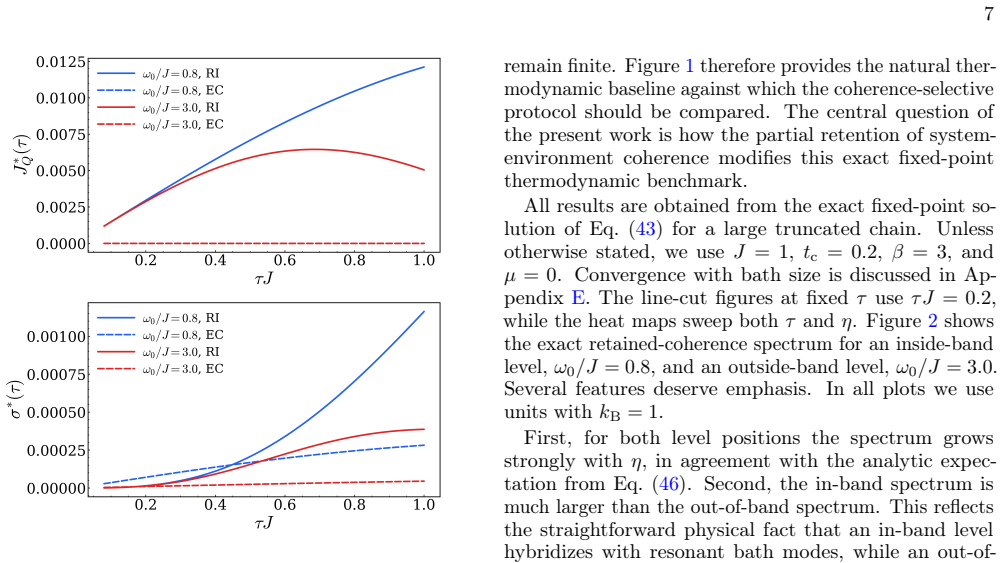
We introduce a one-parameter family of reset channels that continuously interpolates between complete coherence erasure and complete coherence preservation. For a single fermionic level coupled to a structured semi-infinite tight-binding bath, we derive the exact affine stroboscopic map, solve for its unique fixed point, and compute the retained coherence spectrum, the post-reset occupation, and the reset heat current. We find that retained coherence increases monotonically with the retention parameter, whereas the reset heat current is generically nonmonotonic and is maximized at an intermediate operating point. Thus the protocol that stores the most coherence is not the one that dissipates
What carries the argument
A one-parameter family of reset channels interpolating between complete coherence erasure and complete coherence preservation, realized through an affine stroboscopic map whose unique fixed point yields the retained coherence and reset heat current.
Load-bearing premise
The open quantum system must be quadratic so that it can be treated exactly within the single-particle density-matrix formalism, yielding an affine stroboscopic map with a unique fixed point.
What would settle it
Measure the reset heat current versus the retention parameter in a single fermionic level coupled to a tight-binding bath and check whether the current reaches its maximum at an intermediate retention value rather than at the coherence-preserving endpoint.
Figures


read the original abstract
We develop an exact theory of coherence-selective stroboscopic resetting for quadratic open quantum systems within the single-particle density-matrix formalism. We focus on the survival of coherences and the associated thermodynamic cost at the stroboscopic fixed point. To this end, we introduce a one-parameter family of reset channels that continuously interpolates between complete coherence erasure and complete coherence preservation. This unifies the reset-map description, the repeated-interaction and evolving-correlation endpoint channels, and the thermodynamic cost of environmental reinitialization. For a single fermionic level coupled to a structured semi-infinite tight-binding bath, we derive the exact affine stroboscopic map, solve for its unique fixed point, and compute the retained coherence spectrum, the post-reset occupation, and the reset heat current. We find that retained coherence increases monotonically with the retention parameter, whereas the reset heat current is generically nonmonotonic and is maximized at an intermediate operating point. Thus the protocol that stores the most coherence is not the one that dissipates the most heat. Exact operating diagrams further show that coherence-optimal and coherence-per-cost-optimal protocols are both driven toward the coherence-preserving endpoint, while the heat-optimal protocol depends strongly on the reset interval. We also show that this coherence-cost geometry survives at nonzero chemical potential as a filling-biased deformation of the same fixed-point tradeoff, rather than as an independent particle-current optimization problem. These results establish coherence-selective resetting as a distinct control principle for structured-bath open quantum systems and provide an exactly solvable benchmark for memory engineering and thermodynamic optimization under repeated environmental reinitialization.
Editorial analysis
A structured set of objections, weighed in public.
Referee Report
Summary. The manuscript develops an exact theory of coherence-selective stroboscopic resetting for quadratic open quantum systems in the single-particle density-matrix formalism. It introduces a one-parameter family of reset channels interpolating between full coherence erasure and preservation, derives the affine stroboscopic map for a single fermionic level coupled to a semi-infinite tight-binding bath, solves for the unique fixed point, and computes the retained coherence spectrum, post-reset occupation, and reset heat current. The central results are that retained coherence increases monotonically with the retention parameter while the reset heat current is generically nonmonotonic (maximized at an intermediate point), so that the most coherence-preserving protocol is not the one with highest heat dissipation; optimal-protocol diagrams and the persistence of the tradeoff at nonzero chemical potential are also reported.
Significance. If the derivations hold, the work supplies an exactly solvable benchmark for thermodynamic optimization under repeated environmental reinitialization in structured baths. The unification of reset-map, repeated-interaction, and evolving-correlation channels within a single parameterized family, together with the closed-form fixed-point analysis and parameter-free construction, constitutes a clear strength; the reported monotonicity/non-monotonicity geometry and the coherence-per-cost operating diagrams provide falsifiable predictions for memory engineering applications.
major comments (1)
- [§5] §5, after Eq. (28): the claim that the heat current is 'generically nonmonotonic' rests on numerical sampling of the fixed-point expressions over a range of reset intervals; an analytical demonstration that the derivative with respect to the retention parameter changes sign for arbitrary bath parameters would make the generality statement rigorous rather than observational.
minor comments (4)
- [Abstract] Abstract and §3: the term 'exact operating diagrams' is used without specifying whether the diagrams are obtained from closed-form expressions or from numerical root-finding of the fixed-point equations.
- [Eq. (15)] Eq. (15): the definition of the retained coherence spectrum should explicitly state its normalization and its relation to the off-diagonal elements of the single-particle density matrix.
- [Figure 4] Figure 4: the color bar for the coherence-per-cost quantity lacks units and the contour lines are difficult to read at the high-retention end; adding a second panel with line cuts would improve clarity.
- [§2.2] §2.2: several foundational references on repeated-interaction schemes and stroboscopic maps for open fermionic systems are missing from the bibliography.
Simulated Author's Rebuttal
We thank the referee for the positive evaluation and the constructive comment on our manuscript. We respond to the major comment point by point below.
read point-by-point responses
-
Referee: [§5] §5, after Eq. (28): the claim that the heat current is 'generically nonmonotonic' rests on numerical sampling of the fixed-point expressions over a range of reset intervals; an analytical demonstration that the derivative with respect to the retention parameter changes sign for arbitrary bath parameters would make the generality statement rigorous rather than observational.
Authors: We thank the referee for this observation. The fixed-point expressions for occupation, retained coherence, and heat current are closed-form but involve nontrivial integrals over the bath spectral density that depend on the retention parameter. This structure makes a general analytical proof that the derivative with respect to the retention parameter changes sign for completely arbitrary bath parameters and reset intervals technically involved. We have confirmed the non-monotonicity through extensive numerical sampling over wide ranges of bandwidths, reset intervals, and chemical potentials. In the revised manuscript we will (i) explicitly qualify the 'generically nonmonotonic' statement as being supported by comprehensive numerical evidence and (ii) add an analytical demonstration of sign change in the derivative for the wide-band limit, where the expressions reduce to algebraic forms whose derivative can be shown to change sign. This constitutes a partial revision. revision: partial
Circularity Check
No significant circularity; derivation is self-contained exact solution
full rationale
The paper derives the affine stroboscopic map directly from the quadratic Hamiltonian and the one-parameter family of reset channels within the single-particle density-matrix formalism for the specified fermionic model. It then solves for the unique fixed point of this map and computes retained coherence, occupation, and heat current as direct consequences of that fixed-point solution. The reported monotonic increase in retained coherence with the retention parameter and the non-monotonic heat current follow as numerical properties of the closed-form expressions without any parameter fitting, self-referential definitions, or load-bearing self-citations. The uniqueness of the fixed point is a standard property of affine maps in this context and is not imported via author-specific theorems. No ansatz is smuggled in via citation, and no known result is merely renamed. The central claims are therefore independent of the inputs by construction.
Axiom & Free-Parameter Ledger
free parameters (1)
- retention parameter
axioms (2)
- domain assumption Quadratic open quantum systems admit an exact single-particle density-matrix description.
- domain assumption Stroboscopic resetting reaches a unique fixed point whose properties determine retained coherence and reset heat current.
Reference graph
Works this paper leans on
-
[1]
Retained coherence and coherence spectrum The exact post-reset fixed-point SPDM has the block form ρfp = Pfp xfp yfp C0 ,(C1) where the row vectorxfp contains all system–environment coherences after the reset. In the bath eigenbasis ofMEE, its components are xfp k =⟨0|ρ fp|k⟩.(C2) Because each mode carries a distinct coherence ampli- tude, the most micros...
-
[2]
Exact pre-reset bath block To derive the heat current, we first need the exact pre- reset bath SPDM. Starting from the exact fixed-point post-reset stateρ fp, one cycle of unitary evolution gives ρ− fp =U(τ)ρ fpU †(τ).(C7) From the block multiplication derived in Appendix A, the bottom-right block is C − fp =wP fpw† +Xy fpw† +wx fpX † +XC 0X †.(C8) Each t...
-
[3]
Thus the exact pre-reset bath SPDM depends not only on the system occupation but also explicitly on the retained coherence block
wPfpw† is the bath population generated directly from the occupied system level during the unitary segment; 2.X yfpw† andwx fpX † are the two terms linear in the retained coherence; 3.XC 0X † is the dressed propagation of the reference bath block through the unitary segment. Thus the exact pre-reset bath SPDM depends not only on the system occupation but ...
-
[4]
The energy removed from the bath by that reset step is therefore Q∗ sup(τ, η) = TrE MEE(C − fp −C 0) ,(C9) which is Eq.(56)
Reset heat and heat current The reset operation restores the bath block fromC − fp to C0. The energy removed from the bath by that reset step is therefore Q∗ sup(τ, η) = TrE MEE(C − fp −C 0) ,(C9) which is Eq.(56). The corresponding heat current per cycle is obtained by dividing by the cycle length, J ∗ Q(τ, η) = Q∗ sup(τ, η) τ .(C10) This is Eq.(57). Bec...
-
[5]
Its role is to quantify how much retained coherence is obtained per unit reset-heat cost
Coherence efficiency and operating points The coherence-efficiency ratio is defined by R∗(τ, η) = C∗ SE(τ, η) J ∗ Q(τ, η) .(C18) This quantity has no independent microscopic derivation: it is a composite operational figure of merit built from the exact retained coherence and exact reset heat current. Its role is to quantify how much retained coherence is ...
-
[6]
Misra and E
B. Misra and E. C. G. Sudarshan, The zeno’s paradox in quantum theory, Journal of Mathematical Physics18, 756 (1977)
1977
-
[7]
L. S. Schulman, Continuous and pulsed measurements in the quantum zeno effect, Physical Review A57, 1509 (1998)
1998
-
[8]
M. C. Fischer, B. Gutiérrez-Medina, and M. G. Raizen, Observation of the quantum zeno and anti-zeno effects in an unstable system, Physical Review Letters87, 040402 (2001)
2001
-
[9]
Home and M
D. Home and M. A. B. Whitaker, A conceptual analysis of quantum zeno; paradox, measurement, and experiment, Annals of Physics258, 237 (1997)
1997
-
[10]
A. G. Kofman and G. Kurizki, Acceleration of quantum decay processes by frequent observations, Nature405, 546 (2000)
2000
-
[11]
A. G. Kofman and G. Kurizki, Dephasing of quantum evolution: Is it useful?, Fortschritte der Physik48, 447 (2000)
2000
-
[12]
Ruseckas and B
J. Ruseckas and B. Kaulakys, General expression for the quantum zeno and anti-zeno effects, Phys. Rev. A69, 032104 (2004)
2004
-
[13]
Facchi, H
P. Facchi, H. Nakazato, and S. Pascazio, From the quan- tum zeno to the inverse quantum zeno effect, Physical Review Letters86, 2699 (2001)
2001
-
[14]
Venugopalan, The quantum zeno effect — watched pots in the quantum world, Reson12, 52 (2007)
A. Venugopalan, The quantum zeno effect — watched pots in the quantum world, Reson12, 52 (2007)
2007
-
[15]
W. M. Itano, Perspectives on the quantum zeno paradox, Journal of Physics: Conference Series196, 012018 (2009)
2009
-
[16]
W. M. Itano, D. J. Heinzen, J. J. Bollinger, and D. J. Wineland, Quantum zeno effect, Physical Review A41, 2295 (1990)
1990
-
[17]
E. W. Streed, J. Mun, M. Boyd, G. K. Campbell, P. Med- ley, W. Ketterle, and D. E. Pritchard, Continuous and pulsed quantum zeno effect, Physical Review Letters97, 260402 (2006)
2006
-
[18]
Facchi and S
P. Facchi and S. Pascazio, Quantum zeno dynamics: Math- ematical and physical aspects, Journal of Physics A: Math- ematical and Theoretical41, 493001 (2008)
2008
-
[19]
Facchi and S
P. Facchi and S. Pascazio, Quantum zeno subspaces, Phys- ical Review Letters89, 080401 (2002)
2002
-
[20]
Z. Zhou, Z. Lü, H. Zheng, and H.-S. Goan, Quantum zeno and anti-zeno effects in open quantum systems, Phys. Rev. A96, 032101 (2017)
2017
-
[21]
Shaji, The quantum zeno effect: a solvable model for indirect pre-measurements, Journal of Physics A: Mathe- matical and General37, 11285 (2004)
A. Shaji, The quantum zeno effect: a solvable model for indirect pre-measurements, Journal of Physics A: Mathe- matical and General37, 11285 (2004)
2004
-
[22]
Alter and Y
O. Alter and Y. Yamamoto, Quantum zeno effect and the impossibility of determining the quantum state of a single system, Physical Review A55, R2499 (1997)
1997
-
[23]
Frerichs and A
V. Frerichs and A. Schenzle, Quantum zeno effect without collapse of the wave packet, Physical Review A44, 1962 (1991)
1962
-
[24]
M. J. Gagen and G. J. Milburn, Quantum zeno effect in- duced by quantum-nondemolition measurement of photon number, Phys. Rev. A45, 5228 (1992)
1992
-
[25]
Beige and G
A. Beige and G. C. Hegerfeldt, Projection postulate and atomic quantum zeno effect, Physical Review A53, 53 (1996)
1996
-
[26]
C. M. Chandrashekar, Zeno subspace in quantum-walk dynamics, Physical Review A82, 052108 (2010)
2010
-
[27]
Y. Li, D. A. Herrera-Martí, and L. C. Kwek, Quantum zeno effect of general quantum operations, Phys. Rev. A 88, 042321 (2013)
2013
-
[28]
Maniscalco, J
S. Maniscalco, J. Piilo, and K.-A. Suominen, Zeno and anti-zeno effects for quantum brownian motion, Physical Review Letters97, 130402 (2006)
2006
-
[29]
Becker, N
S. Becker, N. Datta, and R. Salzmann, Quantum zeno effect in open quantum systems, Annales Henri Poincaré 22, 3795 (2021)
2021
-
[30]
Ciccarello, S
F. Ciccarello, S. Lorenzo, V. Giovannetti, and G. M. Palma, Quantum collision models: Open system dynamics from repeated interactions, Physics Reports954, 1 (2022)
2022
-
[31]
Cusumano, Quantum collision models: A beginner’s guide, Entropy24, 1258 (2022)
S. Cusumano, Quantum collision models: A beginner’s guide, Entropy24, 1258 (2022)
2022
-
[32]
Giovannetti and G
V. Giovannetti and G. M. Palma, Master equations for correlated quantum channels, Physical Review Letters 108, 040401 (2012)
2012
-
[33]
Scarani, M
V. Scarani, M. Ziman, P. Stelmachovic, N. Gisin, and V. Buzek, Thermalizing quantum machines: Dissipation and entanglement, Physical Review Letters88, 097905 (2002). 18
2002
-
[34]
Strasberg, G
P. Strasberg, G. Schaller, T. Brandes, and M. Esposito, Quantum and information thermodynamics: A unifying framework based on repeated interactions, Physical Re- view X7, 021003 (2017)
2017
-
[35]
Strasberg, Repeated interactions and quantum stochas- tic thermodynamics at strong coupling, Physical Review Letters123, 180604 (2019)
P. Strasberg, Repeated interactions and quantum stochas- tic thermodynamics at strong coupling, Physical Review Letters123, 180604 (2019)
2019
-
[36]
Ciccarello, G
F. Ciccarello, G. M. Palma, and V. Giovannetti, Collision- model-based approach to non-markovian quantum dy- namics, Physical Review A87, 040103(R) (2013)
2013
-
[37]
Kretschmer, K
S. Kretschmer, K. Luoma, and W. T. Strunz, Collision model for non-markovian quantum dynamics, Physical Review A94, 012106 (2016)
2016
-
[38]
Lorenzo, F
S. Lorenzo, F. Ciccarello, G. M. Palma, and B. Vacchini, Quantum non-markovian piecewise dynamics from colli- sion models, Open Systems & Information Dynamics24, 1740011 (2017)
2017
-
[39]
Giovannetti, A dynamical model for quantum memory channels, Journal of Physics A: Mathematical and General 38, 10989 (2005)
V. Giovannetti, A dynamical model for quantum memory channels, Journal of Physics A: Mathematical and General 38, 10989 (2005)
2005
-
[40]
Burgarth and V
D. Burgarth and V. Giovannetti, Mediated homogeniza- tion, Physical Review A76, 062307 (2007)
2007
-
[41]
Cattaneo, G
M. Cattaneo, G. De Chiara, S. Maniscalco, R. Zambrini, and G. L. Giorgi, Collision models can efficiently simulate any multipartite markovian quantum dynamics, Physical Review Letters126, 130403 (2021)
2021
-
[42]
Cakmak, S
B. Cakmak, S. Campbell, B. Vacchini, O. E. Mustecapli- oglu, and M. Paternostro, Robust multipartite entangle- ment generation via a collision model, Physical Review A 99, 012319 (2019)
2019
- [43]
- [44]
-
[45]
Prositto, M
A. Prositto, M. Forbes, and D. Segal, Equilibrium and nonequilibrium steady states with the repeated interac- tion protocol: Relaxation dynamics and energetic cost, Quantum Science and Technology10, 025061 (2025)
2025
-
[46]
A. E. Allahverdyan, R. Balian, and T. M. Nieuwenhuizen, Quantum measurement as a driven phase transition: An exactly solvable model, Phys. Rev. A64, 032108 (2001)
2001
-
[47]
Guryanova, N
Y. Guryanova, N. Friis, and M. Huber, Ideal projective measurements have infinite resource costs, Quantum4, 222 (2020)
2020
-
[48]
Deffner, J
S. Deffner, J. P. Paz, and W. H. Zurek, Quantum work and the thermodynamic cost of quantum measurements, Physical Review E94, 010103 (R) (2016)
2016
-
[49]
K. Jacobs, Quantum measurement and the first law of thermodynamics: The energy cost of measurement is the work value of the acquired information, Physical Review E86, 040106 (R) (2012)
2012
-
[50]
K. Abdelkhalek, Y. Nakata, and D. Reeb, Funda- mental energy cost for quantum measurement (2016), arXiv:1609.06981 [quant-ph]
-
[51]
G. T. Landi and M. Paternostro, Irreversible entropy pro- duction: From classical to quantum, Reviews of Modern Physics93, 035008 (2021)
2021
-
[52]
W. A. Harrison,Electronic Structure and the Properties of Solids: The Physics of the Chemical Bond(Dover Publications, New York, 1989)
1989
-
[53]
Grosso and G
G. Grosso and G. Pastori Parravicini,Solid State Physics, 2nd ed. (Academic Press, Oxford, 2014)
2014
-
[54]
Colombo, Tight-binding molecular dynamics: A primer, La Rivista del Nuovo Cimento28, 1 (2005)
L. Colombo, Tight-binding molecular dynamics: A primer, La Rivista del Nuovo Cimento28, 1 (2005)
2005
-
[55]
D. G. Pettifor, A. J. Skinner, and R. A. Davies, The tight binding bond model, inAtomistic Simulation of Materials: Beyond Pair Potentials, edited by V. Vitek and D. J. Srolovitz (Springer, Boston, MA, 1989) pp. 317–326
1989
-
[56]
H. J. W. M. Hoekstra, On the tight-binding model for semi-infinite lattices, Surface Science205, 523 (1988)
1988
-
[57]
Sedlmayr, J
N. Sedlmayr, J. Ren, F. Gebhard, and J. Sirker, Closed and open system dynamics in a fermionic chain with a microscopically specified bath: Relaxation and thermal- ization, Physical Review Letters110, 100406 (2013)
2013
-
[58]
E. N. Economou,Green ’s Functions in Quantum Physics, 3rd ed., Springer Series in Solid-State Sciences, Vol. 7 (Springer, Berlin, Heidelberg, 2006)
2006
-
[59]
Spohn, Entropy production for quantum dynamical semigroups, Journal of Mathematical Physics19, 1227 (1978)
H. Spohn, Entropy production for quantum dynamical semigroups, Journal of Mathematical Physics19, 1227 (1978)
1978
-
[60]
Deffner and E
S. Deffner and E. Lutz, Nonequilibrium entropy produc- tion for open quantum systems, Physical Review Letters 107, 140404 (2011)
2011
-
[61]
Hackl and E
L. Hackl and E. Bianchi, Bosonic and fermionic gaussian states from kähler structures, SciPost Physics Core4, 025 (2021)
2021
-
[62]
N. J. Higham,Functions of Matrices: Theory and Compu- tation(Society for Industrial and Applied Mathematics, Philadelphia, PA, 2008)
2008
-
[63]
Ptaszyński and M
K. Ptaszyński and M. Esposito, Quantum and classi- cal contributions to entropy production in fermionic and bosonic gaussian systems, PRX Quantum4, 020353 (2023)
2023
-
[64]
Peschel and V
I. Peschel and V. Eisler, Reduced density matrices and entanglement entropy in free lattice models, Journal of Physics A: Mathematical and Theoretical42, 504003 (2009)
2009
-
[65]
Popovic, M
M. Popovic, M. T. Mitchison, and J. Goold, Thermody- namics of decoherence, Proceedings of the Royal Society A: Mathematical, Physical and Engineering Sciences479, 20230040 (2023)
2023
- [66]
-
[67]
Korzekwa, M
K. Korzekwa, M. Lostaglio, J. Oppenheim, and D. Jen- nings, The extraction of work from quantum coherence, New Journal of Physics18, 023045 (2016)
2016
discussion (0)
Sign in with ORCID, Apple, or X to comment. Anyone can read and Pith papers without signing in.