Recognition: unknown
Coherence Transfer in Quantum Networks
Pith reviewed 2026-05-10 06:43 UTC · model grok-4.3
The pith
A nonlinear criterion identifies coherence transfer in quantum networks using only two measurements regardless of size or node characterization.
A machine-rendered reading of the paper's core claim, the machinery that carries it, and where it could break.
Core claim
We use static and dynamic coherence features to introduce a nonlinear criterion for identifying coherence transfer. The criterion requires only two measurement settings for network-state populations in an experimental state basis, regardless of the network's size. It remains valid even when the verification capabilities of checkpoint nodes are uncharacterized. The principle and method are general, encompassing networks with different access levels and scenarios, from those requiring no input changes to those involving coherence dynamics in the time domain.
What carries the argument
The nonlinear criterion based on static and dynamic coherence features that detects transfer via two population measurements in an experimental state basis.
If this is right
- Enables coherence transfer detection in networks of arbitrary size using a fixed number of measurements.
- Applies across scenarios including static cases with no input changes and dynamic cases in the time domain.
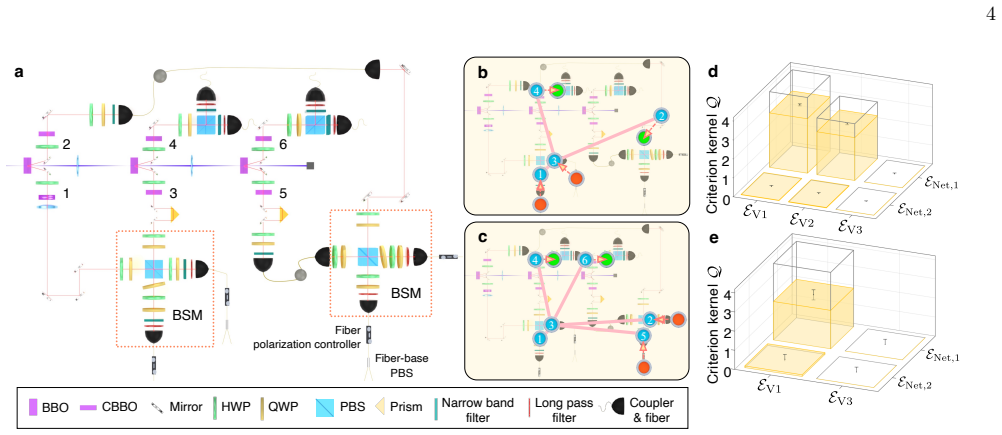
- Provides experimental evidence of coherence transfer in four- and six-photon entanglement networks via remote state preparation and entanglement swapping.
- Remains effective for networks with varying access levels and uncharacterized checkpoint nodes.
Where Pith is reading between the lines
- This approach could reduce the experimental overhead needed to verify resources in large-scale quantum networks.
- The criterion might be adapted to detect transfer of other quantum features like entanglement in partially known systems.
- Further experiments could test its performance in continuous-variable or solid-state quantum platforms.
Load-bearing premise
The nonlinear criterion remains valid even when the verification capabilities of checkpoint nodes are uncharacterized, allowing detection without full system knowledge.
What would settle it
An experiment in which coherence is transferred but the two-measurement nonlinear criterion fails to detect it, or falsely detects transfer when none occurs.
Figures



read the original abstract
Detecting coherence transfer in complex quantum networks can be challenging due to uncharacterized experimental conditions and limited system access. Here, we use static and dynamic coherence features to introduce a nonlinear criterion for identifying coherence transfer. The criterion requires only two measurement settings for network-state populations in an experimental state basis, regardless of the network's size. It remains valid even when the verification capabilities of checkpoint nodes are uncharacterized. The principle and method are general, encompassing networks with different access levels and scenarios, from those requiring no input changes to those involving coherence dynamics in the time domain. Experimentally, using remote state preparation and entanglement swapping, we transfer single polarization qubits and polarization-entangled pairs in four- and six-photon entanglement networks. The criterion provides experimental evidence of coherence transfer in multi-photon entanglement networks. Our findings offer a practical tool for coherence transfer in quantum information and open quantum systems in networks.
Editorial analysis
A structured set of objections, weighed in public.
Referee Report
Summary. The paper introduces a nonlinear criterion for identifying coherence transfer in quantum networks, derived from static and dynamic coherence features. It claims this criterion needs only two measurement settings on network-state populations in an experimental basis, works for arbitrary network size, and remains valid even with uncharacterized checkpoint nodes. The approach is presented as general across access levels, including no-input-change and time-domain dynamics cases. Experimentally, it demonstrates coherence transfer of single polarization qubits and polarization-entangled pairs in 4- and 6-photon entanglement networks via remote state preparation and entanglement swapping, offering evidence in multi-photon setups.
Significance. If the central derivation holds and the nonlinearity indeed excludes mimicry by uncharacterized node operations, this would be a useful practical advance for verifying coherence transfer in complex networks with minimal access and incomplete characterization. The experimental demonstration in multi-photon entanglement networks is a concrete strength, supporting applicability to quantum information tasks like entanglement distribution. The parameter-free aspect (two settings independent of size) and generality claims, if substantiated, add value for open quantum systems studies.
major comments (2)
- [Theoretical section on the nonlinear criterion] § on the nonlinear criterion derivation: the claim that the criterion 'remains valid even when the verification capabilities of checkpoint nodes are uncharacterized' is load-bearing for the central result, yet the manuscript provides no explicit inequality, bound on node operations, or proof that the two observed populations cannot arise from unknown unitaries or noise at checkpoints without coherence transfer. The skeptic concern on separating transfer from mimicry in two-population data is not addressed with a concrete model or counterexample exclusion.
- [Experimental results] Experimental section (4- and 6-photon networks): without the full data tables, error analysis, or details on how the two measurement settings were selected and applied (including any post-selection), it is impossible to verify if the reported evidence supports the criterion or if hidden assumptions about fixed bases affect the results. This directly impacts the experimental validation of the uncharacterized-node claim.
minor comments (2)
- [Abstract] The abstract is information-dense; separating the theoretical criterion claims from the experimental demonstration would improve readability.
- [Introduction] Notation for 'network-state populations in an experimental state basis' could be clarified with an explicit definition or example early in the text to aid readers unfamiliar with the setup.
Simulated Author's Rebuttal
We thank the referee for their careful reading of our manuscript and for the positive assessment of its significance. We address each major comment point by point below, with clarifications and commitments to revision where the manuscript requires strengthening.
read point-by-point responses
-
Referee: [Theoretical section on the nonlinear criterion] § on the nonlinear criterion derivation: the claim that the criterion 'remains valid even when the verification capabilities of checkpoint nodes are uncharacterized' is load-bearing for the central result, yet the manuscript provides no explicit inequality, bound on node operations, or proof that the two observed populations cannot arise from unknown unitaries or noise at checkpoints without coherence transfer. The skeptic concern on separating transfer from mimicry in two-population data is not addressed with a concrete model or counterexample exclusion.
Authors: We acknowledge that the manuscript's theoretical section derives the nonlinear criterion from static and dynamic coherence features but does not include an explicit bound or counterexample proof excluding mimicry by arbitrary local operations at uncharacterized checkpoints. The two-population data is shown to violate the criterion only under coherence transfer in the presented derivation, yet a dedicated subsection with a concrete model (e.g., showing that any unitary or depolarizing noise at checkpoints preserves the bound unless transfer occurs) is indeed missing. We will add this explicit inequality and exclusion argument in the revised version to directly address the skeptic concern. revision: yes
-
Referee: [Experimental results] Experimental section (4- and 6-photon networks): without the full data tables, error analysis, or details on how the two measurement settings were selected and applied (including any post-selection), it is impossible to verify if the reported evidence supports the criterion or if hidden assumptions about fixed bases affect the results. This directly impacts the experimental validation of the uncharacterized-node claim.
Authors: We agree that the experimental section in the main text is summarized and lacks the complete data tables, error analysis, and explicit details on measurement selection and post-selection. The two settings were chosen as the computational and diagonal bases for population measurements in the experimental state basis, with post-selection limited to standard four-fold and six-fold coincidence events. Full tables, error propagation, and basis justification are in the supplementary material. We will expand the main experimental section to include a summary of these elements and clarify that no hidden assumptions on fixed bases beyond the reported entanglement swapping protocol affect the uncharacterized-node validation. revision: yes
Circularity Check
No significant circularity in derivation of nonlinear coherence transfer criterion
full rationale
The paper presents a nonlinear criterion derived from static and dynamic coherence features for detecting transfer in quantum networks. It requires only two population measurements in an experimental basis and claims validity independent of network size or checkpoint characterization. No quoted equations or steps in the provided abstract reduce the criterion to a self-definition, fitted input renamed as prediction, or load-bearing self-citation chain. The derivation is presented as general and independent, with experimental validation via remote state preparation and entanglement swapping in multi-photon networks. This is a standard non-circular outcome for a criterion-introduction paper whose central claim does not collapse to its inputs by construction.
Axiom & Free-Parameter Ledger
Reference graph
Works this paper leans on
-
[1]
H. J. Kimble, The quantum internet, Nature453, 1023 (2008)
2008
-
[2]
Wehner, D
S. Wehner, D. Elkouss, and R. Hanson, Quantum inter- net: A vision for the road ahead, Science362, eaam9288 (2018)
2018
-
[3]
Lambert, Y.-N
N. Lambert, Y.-N. Chen, Y.-C. Cheng, C.-M. Li, G.-Y. Chen, and F. Nori, Quantum biology, Nature Physics9, 10 (2013)
2013
-
[4]
Ritter, C
S. Ritter, C. N¨ olleke, C. Hahn, A. Reiserer, A. Neuzner, M. Uphoff, M. M¨ ucke, E. Figueroa, J. Bochmann, and G. Rempe, An elementary quantum network of single atoms in optical cavities, Nature484, 195 (2012)
2012
-
[5]
T. D. Ladd, F. Jelezko, R. Laflamme, Y. Nakamura, C. Monroe, and J. L. O’Brien, Quantum computers, Na- ture464, 45 (2010)
2010
-
[6]
Gisin and R
N. Gisin and R. Thew, Quantum communication, Nature Photonics1, 165 (2007)
2007
-
[7]
H.-K. Lo, M. Curty, and K. Tamaki, Secure quantum key distribution, Nature Photonics8, 595 (2014)
2014
-
[8]
Couteau and S
C. Couteau and S. Lazi´ c, How to define quantum tech- nology, Nature Reviews Physics7, 234 (2025)
2025
-
[9]
Streltsov, G
A. Streltsov, G. Adesso, and M. B. Plenio, Colloquium: Quantum coherence as a resource, Rev. Mod. Phys.89, 041003 (2017)
2017
-
[11]
Gour and A
G. Gour and A. Winter, How to quantify a dynamical quantum resource, Phys. Rev. Lett.123, 150401 (2019)
2019
-
[12]
Liu and X
Y. Liu and X. Yuan, Operational resource theory of quan- tum channels, Phys. Rev. Res.2, 012035 (2020)
2020
-
[15]
Napoli, T
C. Napoli, T. R. Bromley, M. Cianciaruso, M. Piani, N. Johnston, and G. Adesso, Robustness of coherence: An operational and observable measure of quantum co- herence, Phys. Rev. Lett.116, 150502 (2016)
2016
-
[16]
Piani, M
M. Piani, M. Cianciaruso, T. R. Bromley, C. Napoli, N. Johnston, and G. Adesso, Robustness of asymme- try and coherence of quantum states, Phys. Rev. A93, 042107 (2016)
2016
-
[17]
Zheng, Z
W. Zheng, Z. Ma, H. Wang, S.-M. Fei, and X. Peng, Experimental demonstration of observability and oper- ability of robustness of coherence, Phys. Rev. Lett.120, 230504 (2018)
2018
-
[18]
Z. Ma, Z. Zhang, Y. Dai, Y. Dong, and C. Zhang, De- tecting and estimating coherence based on coherence wit- nesses, Phys. Rev. A103, 012409 (2021). 6
2021
-
[19]
M.-S. Li, W. Xu, S.-M. Fei, Z.-J. Zheng, and Y.-L. Wang, Witnessing quantum coherence with prior knowledge of observables, Phys. Rev. A109, 032422 (2024)
2024
-
[20]
A. J. Leggett and A. Garg, Quantum mechanics ver- sus macroscopic realism: Is the flux there when nobody looks?, Phys. Rev. Lett.54, 857 (1985)
1985
-
[21]
G. C. Knee, S. Simmons, E. M. Gauger, J. J. L. Morton, H. Riemann, N. V. Abrosimov, P. Becker, H.-J. Pohl, K. M. Itoh, M. L. W. Thewalt, G. A. D. Briggs, and S. C. Benjamin, Violation of a leggett-garg inequality with ideal non-invasive measurements, Nat Commun3, 606 (2012)
2012
-
[22]
Y.-Q. Nie, H. Zhou, J.-Y. Guan, Q. Zhang, X. Ma, J. Zhang, and J.-W. Pan, Quantum coherence witness with untrusted measurement devices, Phys. Rev. Lett. 123, 090502 (2019)
2019
-
[25]
Pompili, S
M. Pompili, S. L. N. Hermans, S. Baier, H. K. C. Beukers, P. C. Humphreys, R. N. Schouten, R. F. L. Vermeulen, M. J. Tiggelman, L. dos Santos Martins, B. Dirkse, S. Wehner, and R. Hanson, Realization of a multinode quantum network of remote solid-state qubits, Science 372, 259 (2021)
2021
-
[29]
Awschalom, K
D. Awschalom, K. K. Berggren, H. Bernien, S. Bhave, L. D. Carr, P. Davids, S. E. Economou, D. Englund, A. Faraon, M. Fejer, S. Guha, M. V. Gustafsson, E. Hu, L. Jiang, J. Kim, B. Korzh, P. Kumar, P. G. Kwiat, M. Lonˇ car, M. D. Lukin, D. A. Miller, C. Mon- roe, S. W. Nam, P. Narang, J. S. Orcutt, M. G. Raymer, A. H. Safavi-Naeini, M. Spiropulu, K. Srini- ...
2021
-
[36]
See Supplemental Material for the criterion’s general- ity regarding input and output state settings, a proof and an example for detecting coherence dynamics in the time domain, details of coherence-transfer experiments in multi-photon entanglement networks, and a descrip- tion of how these experiments illustrate key aspects of coherence transfer in entan...
-
[37]
I. L. Chuang and M. A. Nielsen, Prescription for ex- perimental determination of the dynamics of a quantum black box, Journal of Modern Optics44, 2455 (1997)
1997
-
[41]
Kao, C.-Y
W.-T. Kao, C.-Y. Huang, T.-J. Tsai, S.-H. Chen, S.-Y. Sun, Y.-C. Li, T.-L. Liao, C.-S. Chuu, H. Lu, and C.-M. Li, Scalable determination of multipartite entanglement in quantum networks, npj Quantum Information10, 73 (2024)
2024
-
[42]
Bouwmeester, J.-W
D. Bouwmeester, J.-W. Pan, K. Mattle, M. Eibl, H. We- infurter, and A. Zeilinger, Experimental quantum tele- portation, Nature390, 575 (1997)
1997
-
[46]
S.-H. Chen, C. Hsu, Y.-C. Kao, B.-Y. Lee, Y.-S. Liu, Y.-N. Chen, and C.-M. Li, Preparing remote states for genuine quantum networks, Communications Physics7, 352 (2024). Supplementary Material for Coherence Transfer in Quantum Networks Chun-Yang Lin,1, 2 Yu-Cheng Li, 1, 2 Shih-Hsuan Chen, 1, 2 Sheng-Yan Sun,1, 2 Ching-Jui Huang, 1, 2 Kuan-Jou Wang, 1, 2 a...
2024
-
[47]
at Alice, (b † 1, b† 2) at Bob, and (c † 1, c†
-
[48]
at Claire, which acts as the check- point operationE V. After the BSs and postselection onto the subspace with exactly one particle per party, the nor- malized state becomes: |ψpost⟩= 1 2 h a† 1 b† 1c† 1 +b † 2c† 2 +a † 2 b† 2c† 1 +b † 1c† 2 i |0⟩.(S4) Each party records which output port was clicked, iden- tifying detector 1 as having outcome 0 and detec...
-
[49]
(|H1V2H3V4⟩+|V 1H2V3H4⟩), where the subscripts represent the mode numbers, whereas the second photonic fusion process produced the state|G 4⟩= (1/ √
-
[50]
These four-photon state fidelities indicate the perfor- mance of coherence transfer in the multi-photon entan- gled networks we have created
(|H1V2V5H6⟩+|V 1H2H5V6⟩). These four-photon state fidelities indicate the perfor- mance of coherence transfer in the multi-photon entan- gled networks we have created. On the other hand, in order to verify that the source indeed generates gen- uine six-photon entanglement, we evaluate the entangle- ment witness associated with the six-qubit GHZ state |G6⟩= (1/ √
-
[51]
If the witness value is negative, specifically when tr(WGHZ6 ρG6)<0, it confirms the presence of genuine multipartite entanglement
(|H1V2H3V4V5H6⟩+|V 1H2V3H4H5V6⟩). If the witness value is negative, specifically when tr(WGHZ6 ρG6)<0, it confirms the presence of genuine multipartite entanglement. The witness [16] is defined as: WGHZ6 := 3I−2 " SGHZ6 1 +I 2 + 6Y k=2 SGHZ6 k +I 2 # ,(S15) where SGHZ6 1 = 6Y k=1 σk X , SGHZ6 k =σ k−1 Z σk Z,fork= 2,3, . . . ,6, (S16) whereσ X andσ Z deno...
-
[52]
Coherence input. We implement the RSP proto- col to input a stateρ in,k, which is the post-measurement state of the input node, performed by the input node holder Alice, who implements the processE RSP accord- ing to the target operationU † and the followedZmea- surement in the basis{|i⟩}={|0⟩=|H⟩,|1⟩=|V⟩}. Photons 2 and 6 are measured to determine the in...
-
[53]
To transmit the input state further in a four-photon entanglement network for N= 4 [Fig
The evolution of coherence. To transmit the input state further in a four-photon entanglement network for N= 4 [Fig. S5(a)], we perform a photonic fusion ˜Efusion of photon 1, which is in the state after RSP at node 2, and photon 3 at node 3, along with theXmeasurements in the basis{|+⟩,|−⟩}for both photons, considering the events where the post-measureme...
-
[54]
We measure photon 4 at the output checkpoint nodes 4 and 6 in the output states of the four-photon [Fig
Output of coherence. We measure photon 4 at the output checkpoint nodes 4 and 6 in the output states of the four-photon [Fig. S5(a)] and six-photon [Fig. S5(b)] entanglement networks,ρ out,k, respectively, according to the introduced criterion. We perform the population measurement (Zmeasurement) on the stateρ out,k to ob- tain the diagonal elements of th...
-
[55]
Detection of coherence transfer. With regarding the experimental probabilitiesρ (d) out,k andP EV(i|ρout,k) for both experimental coherence transfer processes in the cases ofN= 4 andN= 6, we analyze the experimental transfer process using the introduced criterion, Eq. (1) in the main text. To conduct a comprehensive transfer assessment, we employ the SDP ...
-
[56]
Onto the states:{|ϕ +⟩,|ϕ −⟩} A photonic fusion operation can effectively project onto the Bell basis [21, 27, 28]. However, in practical applications, implementing BSM with linear optics faces fundamental limitations: out of the four Bell states, only two can be reliably distinguished in a single setup us- ing a PBS and photon detectors. The PBS operator...
-
[57]
Onto the states:{|ψ +⟩,|ψ −⟩} We now examine a different configuration of the PBS that allows the BSM to project onto the Bell states|ψ +⟩ 12 HWPQWPPBSHWPQWPPBS (a) (b) FIG. S8. PBS-based BSM. (a) The first PBS configuration enables the BSM to project onto the Bell states|ϕ +⟩or |ϕ−⟩. The waveplates configuration at the output modes c and d, together with...
-
[58]
Meanwhile, the entanglement between nodes ensures the transfer of co- herence to a subsequent pair, even without direct inter- action between them
From a coherence-transfer perspective, the coherence of the Bell states is input via the BSM. Meanwhile, the entanglement between nodes ensures the transfer of co- herence to a subsequent pair, even without direct inter- action between them. This is an entanglement-swapping [20, 29, 30] process that confirms that entanglement has been successfully swapped...
-
[59]
We imple- ment the BSM protocol to input a stateρ in,k with Bell- state coherence, which is the post-measurement state of the input node, measured by two input node holders
Input and the evolution of coherence. We imple- ment the BSM protocol to input a stateρ in,k with Bell- state coherence, which is the post-measurement state of the input node, measured by two input node holders. BSMs are carried out on photons 1 and 3 [Fig. S9(a)]. We aim to input the following states in the ordering: ρin,1 =|ψ +⟩⟨ψ+|, ρin,2 =|ψ −⟩⟨ψ−|,(S...
-
[60]
In an ideal scenario, we an- ticipate observing the following output states
Output of coherence. In an ideal scenario, we an- ticipate observing the following output states. ρout,1 =|ψ +⟩⟨ψ+|, ρout,2 =|ψ −⟩⟨ψ−|,(S35) ρout,3 =|ϕ +⟩⟨ϕ+|, ρout,4 =|ϕ −⟩⟨ϕ−|. We measure photons (2,4) at the output checkpoint nodes (2,4), and photons (6,4) at the output checkpoint nodes (6,4) in the output states of the four-photon [Fig. S9(a)] and six...
-
[61]
Detection of coherence. With regarding the ex- perimental probabilitiesρ (d) out,k andP EV(i|ρout,k) for both experimental coherence transfer processes in the cases ofN= 4 andN= 6, we analyze the experimental transfer process using the introduced criterion. To con- duct a comprehensive transfer assessment, we employ the SDP technique to find the minimum v...
-
[62]
The transferred coherence of the Bell states of photons 2 and 4, introduced by BSM, is further disrupted by polarizers (Pol.) placed along their respective paths
Control experiments. The transferred coherence of the Bell states of photons 2 and 4, introduced by BSM, is further disrupted by polarizers (Pol.) placed along their respective paths. For bothN= 4 [Fig. S9(b)] andN= 6 [Fig. S10(b)], this process is considered incapable of co- herence transfer and is represented byE Net,2. See also Fig. S11 (N= 4) and Fig....
-
[63]
Coherence transfer in multi-photon entanglement networks. As previously discussed, the three entangled photon pairs are combined using Photonic fusion units 1 and 2 to create a six-photon GHZ state, which has been verified as a reliable backbone for a quantum net- work [14]. In this context, since the GHZ state and the star graph state are equivalent with...
-
[64]
Manipulations of state and process in entanglement networks. Using measurement-based approaches [31–33] common in entanglement network manipulation, our re- sults demonstrate the transfer of polarization-qubit co- herence in multi-photon entangled networks, where co- herence is both input and output via local measurements. Here, we apply the RSP and BSM o...
-
[65]
Our experiments demonstrate the general method of inputting quantum information used in entanglement networks [14]
Coherence of input and output in entanglement net- works. Our experiments demonstrate the general method of inputting quantum information used in entanglement networks [14]. For example, the network input quantum nodes are measured in states that contain the initial input coherence by performing BSMs on nodes (1,3) and (2,5). This coherence then undergoes...
-
[66]
Bibak, F
F. Bibak, F. Del Santo, and B. Daki´ c, Quantum coher- ence in networks, Phys. Rev. Lett.133, 230201 (2024)
2024
-
[67]
Kuo, S.-H
C.-C. Kuo, S.-H. Chen, W.-T. Lee, H.-M. Chen, H. Lu, and C.-M. Li, Quantum process capability, Scientific Re- ports9, 20316 (2019)
2019
-
[68]
Breuer, E.-M
H.-P. Breuer, E.-M. Laine, J. Piilo, and B. Vacchini, Col- loquium: Non-markovian dynamics in open quantum sys- tems, Rev. Mod. Phys.88, 021002 (2016)
2016
-
[69]
Lambert, C
N. Lambert, C. Emary, Y.-N. Chen, and F. Nori, Distin- guishing quantum and classical transport through nanos- tructures, Phys. Rev. Lett.105, 176801 (2010)
2010
-
[70]
Brandes, Coherent and collective quantum optical ef- fects in mesoscopic systems, Physics Reports408, 315 (2005)
T. Brandes, Coherent and collective quantum optical ef- fects in mesoscopic systems, Physics Reports408, 315 (2005)
2005
-
[71]
Fujisawa, T
T. Fujisawa, T. Hayashi, R. Tomita, and Y. Hirayama, Bidirectional counting of single electrons, Science312, 1634 (2006)
2006
-
[72]
Lofberg, Yalmip: A toolbox for modeling and opti- mization in matlab, in2004 IEEE International Con- ference on Robotics and Automation (IEEE Cat
J. Lofberg, Yalmip: A toolbox for modeling and opti- mization in matlab, in2004 IEEE International Con- ference on Robotics and Automation (IEEE Cat. No. 04CH37508)(IEEE, 2004) pp. 284–289
2004
-
[73]
K.-C. Toh, M. J. Todd, and R. H. T¨ ut¨ unc¨ u, Sdpt3—a matlab software package for semidefinite programming, version 1.3, Optimization Methods and Software11, 545 (1999)
1999
-
[74]
E. D. Andersen and K. D. Andersen, The mosek interior point optimizer for linear programming: an implementa- tion of the homogeneous algorithm, inHigh Performance Optimization(Springer, 2000) pp. 197–232
2000
-
[75]
C.-M. Li, N. Lambert, Y.-N. Chen, G.-Y. Chen, and F. Nori, Witnessing quantum coherence: from solid-state to biological systems, Scientific Reports2, 885 (2012)
2012
-
[76]
Kofler and i
J. Kofler and i. c. v. Brukner, Condition for macroscopic realism beyond the leggett-garg inequalities, Phys. Rev. A87, 052115 (2013)
2013
- [77]
-
[78]
P. G. Kwiat, K. Mattle, H. Weinfurter, A. Zeilinger, A. V. Sergienko, and Y. Shih, New high-intensity source of polarization-entangled photon pairs, Phys. Rev. Lett. 75, 4337 (1995)
1995
-
[79]
Pan, Z.-B
J.-W. Pan, Z.-B. Chen, C.-Y. Lu, H. Weinfurter, A. Zeilinger, and M. ˙Zukowski, Multiphoton entangle- ment and interferometry, Rev. Mod. Phys.84, 777 (2012)
2012
-
[80]
D.-G. Im, Y. Kim, and Y.-H. Kim, Dispersion cancella- tion in a quantum interferometer with independent single 17 photons, Optics Express29, 2348 (2021)
2021
-
[81]
T´ oth and O
G. T´ oth and O. G¨ uhne, Detecting genuine multipartite entanglement with two local measurements, Phys. Rev. Lett.94, 060501 (2005)
2005
-
[82]
A. K. Pati, Minimum classical bit for remote preparation and measurement of a qubit, Phys. Rev. A63, 014302 (2000)
2000
-
[83]
C. H. Bennett, D. P. DiVincenzo, P. W. Shor, J. A. Smolin, B. M. Terhal, and W. K. Wootters, Remote state preparation, Phys. Rev. Lett.87, 077902 (2001)
2001
-
[84]
S.-H. Chen, C. Hsu, Y.-C. Kao, B.-Y. Lee, Y.-S. Liu, Y.-N. Chen, and C.-M. Li, Preparing remote states for genuine quantum networks, Communications Physics7, 352 (2024)
2024
-
[85]
Pan and A
J.-W. Pan and A. Zeilinger, Greenberger-horne-zeilinger- state analyzer, Phys. Rev. A57, 2208 (1998)
1998
-
[86]
J.-W. Pan, C. Simon, ˇC. Brukner, and A. Zeilinger, En- tanglement purification for quantum communication, Na- ture410, 1067 (2001)
2001
-
[87]
J.-W. Pan, S. Gasparoni, R. Ursin, G. Weihs, and A. Zeilinger, Experimental entanglement purification of arbitrary unknown states, Nature423, 417 (2003)
2003
-
[88]
Lu, X.-Q
C.-Y. Lu, X.-Q. Zhou, O. G¨ uhne, W.-B. Gao, J. Zhang, Z.-S. Yuan, A. Goebel, T. Yang, and J.-W. Pan, Ex- perimental entanglement of six photons in graph states, Nature Physics3, 91 (2007)
2007
-
[89]
Wang, L.-K
X.-L. Wang, L.-K. Chen, W. Li, H.-L. Huang, C. Liu, C. Chen, Y.-H. Luo, Z.-E. Su, D. Wu, Z.-D. Li, H. Lu, Y. Hu, X. Jiang, C.-Z. Peng, L. Li, N.-L. Liu, Y.-A. Chen, C.-Y. Lu, and J.-W. Pan, Experimental ten-photon en- tanglement, Phys. Rev. Lett.117, 210502 (2016)
2016
-
[90]
Zhong, Y
H.-S. Zhong, Y. Li, W. Li, L.-C. Peng, Z.-E. Su, Y. Hu, Y.-M. He, X. Ding, W. Zhang, H. Li, L. Zhang, Z. Wang, L. You, X.-L. Wang, X. Jiang, L. Li, Y.-A. Chen, N.- L. Liu, C.-Y. Lu, and J.-W. Pan, 12-photon entan- glement and scalable scattershot boson sampling with optimal entangled-photon pairs from parametric down- conversion, Phys. Rev. Lett.121, 2505...
2018
-
[91]
B. Bell, A. S. Clark, M. S. Tame, M. Halder, J. Fulconis, W. J. Wadsworth, and J. G. Rarity, Experimental char- acterization of photonic fusion using fiber sources, New Journal of Physics14, 023021 (2012)
2012
-
[92]
D. E. Browne and T. Rudolph, Resource-efficient lin- ear optical quantum computation, Phys. Rev. Lett.95, 010501 (2005)
2005
-
[93]
T. P. Bodiya and L.-M. Duan, Scalable generation of graph-state entanglement through realistic linear optics, Phys. Rev. Lett.97, 143601 (2006)
2006
-
[94]
event-ready-detectors
M. ˙Zukowski, A. Zeilinger, M. A. Horne, and A. K. Ek- ert, “event-ready-detectors” bell experiment via entan- glement swapping, Phys. Rev. Lett.71, 4287 (1993)
1993
-
[95]
J.-W. Pan, D. Bouwmeester, H. Weinfurter, and A. Zeilinger, Experimental entanglement swapping: En- tangling photons that never interacted, Phys. Rev. Lett. 80, 3891 (1998)
1998
-
[96]
Raussendorf, D
R. Raussendorf, D. E. Browne, and H. J. Briegel, Measurement-based quantum computation on cluster states, Phys. Rev. A68, 022312 (2003)
2003
-
[97]
S. Barz, E. Kashefi, A. Broadbent, J. F. Fitzsimons, A. Zeilinger, and P. Walther, Demonstration of blind quantum computing, Science335, 303 (2012)
2012
-
[98]
C. M. Knaut, A. Suleymanzade, Y. C. Wei, D. R. As- sumpcao, P. J. Stas, Y. Q. Huan, B. Machielse, E. N. Knall, M. Sutula, G. Baranes, N. Sinclair, C. De- Eknamkul, D. S. Levonian, M. K. Bhaskar, H. Park, M. Lonˇ car, and M. D. Lukin, Entanglement of nanopho- tonic quantum memory nodes in a telecom network, Na- ture629, 573 (2024)
2024
discussion (0)
Sign in with ORCID, Apple, or X to comment. Anyone can read and Pith papers without signing in.