Recognition: unknown
Suppressed Magnetogenesis from Ultralight Dark Matter due to Finite Conductivity
Pith reviewed 2026-05-10 06:16 UTC · model grok-4.3
The pith
Finite conductivity in the plasma strongly suppresses magnetic field growth from ultralight pseudoscalar dark matter.
A machine-rendered reading of the paper's core claim, the machinery that carries it, and where it could break.
Core claim
When the finite conductivity of the plasma is included in the dynamics, the parametric resonance that would otherwise amplify electromagnetic fields from an oscillating ultralight pseudoscalar is strongly suppressed, so that viable couplings cannot produce magnetic fields strong enough to account for those inferred in cosmic voids.
What carries the argument
the conductivity term added to the Maxwell equations for the electromagnetic fields, which damps the growth induced by the pseudoscalar-photon coupling during parametric resonance.
If this is right
- This ultralight pseudoscalar mechanism cannot explain observed void magnetic fields.
- Any parametric resonance calculation for electromagnetic fields in the early universe must include conductivity damping.
- Limits on the pseudoscalar-photon coupling are tightened by the absence of sufficient magnetogenesis.
- Alternative magnetogenesis scenarios or later amplification processes would be required to match observations.
Where Pith is reading between the lines
- Similar conductivity suppression may affect other axion-like particle scenarios for generating primordial fields.
- Future high-redshift magnetic field observations could directly test whether any resonance-based mechanism survives damping.
- The result highlights the need to re-examine earlier proposals that neglected plasma conductivity.
Load-bearing premise
The conductivity of the plasma stays much larger than the Hubble parameter throughout the epochs when parametric resonance could operate.
What would settle it
A measurement showing that magnetic fields in cosmic voids exceed the suppressed strengths calculated here, or direct evidence that plasma conductivity drops below the Hubble rate during the relevant redshift range.
Figures


read the original abstract
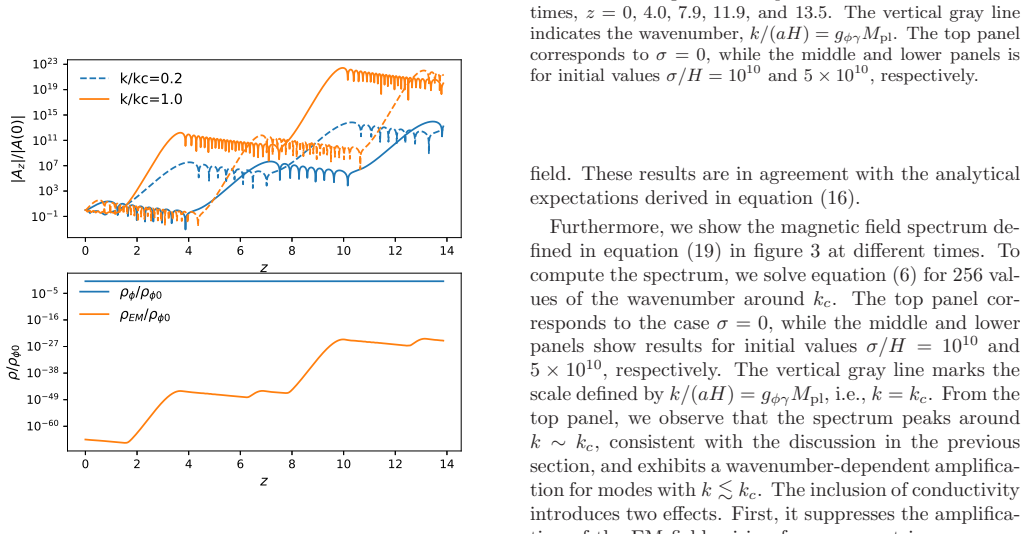
Recently, a mechanism for generating astrophysically relevant magnetic fields via ultralight pseudoscalar dark matter, through the coupling term $g_{\phi \gamma} \phi F_{\mu \nu}\tilde{F}^{\mu\nu}$ in the Lagrangian density, was proposed in Brandenberger et al (2026) (see Ref. 1). In this scenario, the electromagnetic fields are amplified through the phenomena of parametric resonance due to the oscillatory behaviour of the pseudoscalar field. However, the analysis presented in that work does not account for the effects of a conducting medium. In this paper, we incorporate the finite conductivity of the plasma into the dynamics of the pseudoscalar and electromagnetic fields. We show that, due to the large conductivity relative to the Hubble parameter, the amplification of the electromagnetic fields due to parametric resonance is significantly suppressed. Consequently, we find that, for observationally viable values of the coupling between the electromagnetic field and the ultralight pseudoscalar field, it is not possible to generate magnetic fields of sufficient strength to explain their presence in cosmic voids.
Editorial analysis
A structured set of objections, weighed in public.
Referee Report
Summary. The paper examines a proposed magnetogenesis mechanism in which ultralight pseudoscalar dark matter, coupled to the electromagnetic field via the term g_φγ φ F_μν F̃^μν, drives parametric resonance amplification of EM fields. It incorporates the finite conductivity of the early-universe plasma into the field equations and argues that the resulting dissipative term suppresses the resonance growth when conductivity greatly exceeds the Hubble rate, so that observationally allowed values of the coupling cannot produce magnetic fields strong enough to explain those observed in cosmic voids.
Significance. If the quantitative suppression is confirmed, the result would eliminate one class of ultralight-axion magnetogenesis models as an explanation for void magnetic fields and would underscore the necessity of including plasma dissipation in any early-universe parametric-resonance calculation.
major comments (2)
- [analysis of conductivity term and resonance equations] The central suppression claim rests on the statement that conductivity-driven dissipation dominates the parametric growth rate throughout the relevant epochs. The manuscript must provide the explicit time-dependent ratio σ(t)/H(t) (or the corresponding term in the mode equations) and demonstrate that this inequality holds for the parameter values used in the resonance analysis; without this, the degree of suppression remains unquantified.
- [conclusions and parameter scan] The final statement that viable couplings cannot generate sufficient B-field strength requires a direct comparison between the suppressed amplitude and the observational lower bound on void fields. The paper should report the resulting upper limit on |B| as a function of g_φγ (or equivalent) rather than a qualitative assertion.
minor comments (2)
- [introduction] The citation to Brandenberger et al. (2026) should be replaced by the published reference or arXiv number once available.
- [formalism] Notation for the conductivity term and the modified Maxwell equations should be introduced with an explicit equation number for later reference.
Simulated Author's Rebuttal
We thank the referee for their careful reading of the manuscript and for the constructive comments, which have helped us improve the quantitative presentation of our results. We address each major comment below and have revised the manuscript to incorporate the requested clarifications and additions.
read point-by-point responses
-
Referee: The central suppression claim rests on the statement that conductivity-driven dissipation dominates the parametric growth rate throughout the relevant epochs. The manuscript must provide the explicit time-dependent ratio σ(t)/H(t) (or the corresponding term in the mode equations) and demonstrate that this inequality holds for the parameter values used in the resonance analysis; without this, the degree of suppression remains unquantified.
Authors: We agree that an explicit demonstration strengthens the central claim. In the revised manuscript we have added the explicit dissipative term arising from finite conductivity to the mode equations (Eq. (12) in the new version) and included a new figure showing the time-dependent ratio σ(t)/H(t) evaluated for the fiducial parameter set used in the resonance analysis. The plot confirms that σ/H remains greater than 10^9 throughout the relevant epochs (from reheating to matter-radiation equality), which is sufficient to place the system deep in the overdamped regime and to suppress the parametric resonance growth rate by many orders of magnitude. revision: yes
-
Referee: The final statement that viable couplings cannot generate sufficient B-field strength requires a direct comparison between the suppressed amplitude and the observational lower bound on void fields. The paper should report the resulting upper limit on |B| as a function of g_φγ (or equivalent) rather than a qualitative assertion.
Authors: We accept the referee’s point that a quantitative upper bound is preferable to a purely qualitative statement. We have performed an additional scan over the coupling g_φγ within the observationally allowed range and now report the resulting upper limit on the comoving magnetic field strength |B| at the present epoch. This is displayed in a new figure together with the observational lower bound inferred from void observations (∼10^{-15} G). The revised text states that, even for the largest allowed couplings, the suppressed amplitude lies at least four orders of magnitude below the required threshold. revision: yes
Circularity Check
No significant circularity; derivation follows from standard conductivity term in Maxwell equations
full rationale
The paper starts from the known parametric resonance mechanism in Brandenberger et al. (2026) and augments the electromagnetic equations with the standard finite-conductivity term from plasma physics. It then shows suppression by direct comparison of conductivity σ to the Hubble rate H in the relevant epochs. This comparison is not a fitted parameter defined by the paper, nor does it rely on self-citation for the load-bearing step. No uniqueness theorem, ansatz, or renaming of known results is invoked; the central claim is an independent consequence of the modified equations. The derivation remains self-contained against external benchmarks.
Axiom & Free-Parameter Ledger
free parameters (1)
- conductivity-to-Hubble ratio
axioms (2)
- standard math Electromagnetic fields in a conducting plasma obey the modified Maxwell equations including a dissipative conductivity term.
- domain assumption The parametric resonance growth rate from the g_φγ φ F Ftilde coupling is smaller than the conductivity-induced damping rate when conductivity >> Hubble.
Reference graph
Works this paper leans on
-
[1]
68 (9) Here, xe denotes the ratio of the number density of electrons to that of the neutral particles
3eV ) − 0. 68 (9) Here, xe denotes the ratio of the number density of electrons to that of the neutral particles. In the last equality of the above equation, we take the collision rate of electron and neutral hydrogen, ⟨σnev⟩ ≈ 4. 8 × 10− 9(T / 102K)0. 68cm3s− 1 (see Eq. 2.41 in Ref. [31]) and have neglected the effects of the Helium atoms. Fur- thermore, ...
-
[2]
(11) Here, Teq denotes the temperature at radiation-matter equality
3eV ) 3/ 2 ( Teq 1eV ) 1/ 2 . (11) Here, Teq denotes the temperature at radiation-matter equality. Using this and equation (9), we get, σ H ∼ 7. 3 × 1026 xe 10− 4 ( T
-
[3]
18 (12) Furthermore in this section, we provide the simple esti- mates for the amplification of the EM field
3eV ) − 2. 18 (12) Furthermore in this section, we provide the simple esti- mates for the amplification of the EM field. From equa- tion (6), one can infer that there is an instability for the modes k < ag ˙φ. Since the φ field oscillates with time, the instability is only active during a fraction of each oscilla- tion period and this instability lead to the...
-
[4]
R. Brandenberger, J. Fr¨ ohlich, and H. Jiao, Phys. Rev. Lett. 136, 031001 (2026), arXiv:2502.19310 [hep-ph]
-
[5]
L. M. Widrow, Rev. Mod. Phys. 74, 775 (2002), arXiv:astro-ph/0207240
work page Pith review arXiv 2002
-
[6]
Beck,Galactic and Extragalactic Magnetic Fields, AIP Conf
R. Beck, AIP Conf. Proc. 1085, 83 (2009), arXiv:0810.2923 [astro-ph]
- [7]
- [8]
-
[9]
Evidence for strong extragalactic magnetic fields from Fermi observations of TeV blazars
A. Neronov and I. Vovk, Science 328, 73 (2010), arXiv:1006.3504 [astro-ph.HE]
work page Pith review arXiv 2010
- [10]
- [11]
- [12]
- [13]
-
[14]
Cosmological Magnetic Fields: Their Generation, Evolution and Observation
R. Durrer and A. Neronov, Astron. Astrophys. Rev. 21, 62 (2013), arXiv:1303.7121 [astro-ph.CO]
work page Pith review arXiv 2013
-
[15]
The origin, evolution and signatures of primordial magnetic fields
K. Subramanian, Rept. Prog. Phys. 79, 076901 (2016), arXiv:1504.02311 [astro-ph.CO]
work page Pith review arXiv 2016
-
[16]
Vachaspati, Progress on cosmological magnetic fields, Rept
T. Vachaspati, Rept. Prog. Phys. 84, 074901 (2021), arXiv:2010.10525 [astro-ph.CO]
-
[17]
N. Brahma and R. Brandenberger, arXiv e-prints , arXiv:2602.04285 (2026), arXiv:2602.04285 [astro- ph.CO]
-
[18]
M. S. Turner and L. M. Widrow, Phys. Rev. D 37, 2743 (1988)
1988
- [19]
- [20]
- [21]
-
[22]
Magnetogenesis from axion inflation
P. Adshead, J. T. Giblin, T. R. Scully, and E. I. Sfakianakis, JCAP 10, 039, arXiv:1606.08474 [astro- ph.CO]
- [23]
-
[24]
K. Yanagihara, F. Uchida, T. Fujita, and S. Tsujikawa, Phys. Rev. D 110, 083506 (2024), arXiv:2312.07938 [astro-ph.CO]
-
[25]
A. Brandenburg, O. Iarygina, E. I. Sfakianakis, and R. Sharma, JCAP 12, 057, arXiv:2408.17413 [astro- ph.CO]
- [26]
-
[27]
Schwinger effect in axion inflation on a lattice
O. Iarygina, E. I. Sfakianakis, and A. Brandenburg, arX iv e-prints , arXiv:2506.20538 (2025), arXiv:2506.20538 [astro-ph.CO]
work page internal anchor Pith review Pith/arXiv arXiv 2025
- [28]
- [29]
-
[30]
Altenm¨ ulleret al.(CAST), Phys
K. Altenm¨ uller et al. (CAST), Phys. Rev. Lett. 133, 221005 (2024), arXiv:2406.16840 [hep-ex]
- [31]
- [32]
-
[33]
Shukurov and K
A. Shukurov and K. Subramanian, Astrophysical Mag- netic Fields: From Galaxies to the Early Universe , Cam- bridge Astrophysics (Cambridge University Press, 2021)
2021
-
[34]
B. T. Draine, Physics of the Interstellar and Intergalactic Medium (2011)
2011
- [35]
-
[36]
The pencil code. doi:10.5281/zenodo.2315093. https://github.com/pencil-code
discussion (0)
Sign in with ORCID, Apple, or X to comment. Anyone can read and Pith papers without signing in.