Recognition: unknown
Hierarchical Progressive Pauli Noise Modeling with Residual Compensation for Multi-Qubit Quantum Circuits
Pith reviewed 2026-05-10 06:13 UTC · model grok-4.3
The pith
A combinatorial projection mask progressively isolates high-weight Pauli correlations in multi-qubit noise, reducing modeling complexity from exponential to O(N · 4^w) scaling.
A machine-rendered reading of the paper's core claim, the machinery that carries it, and where it could break.
Core claim
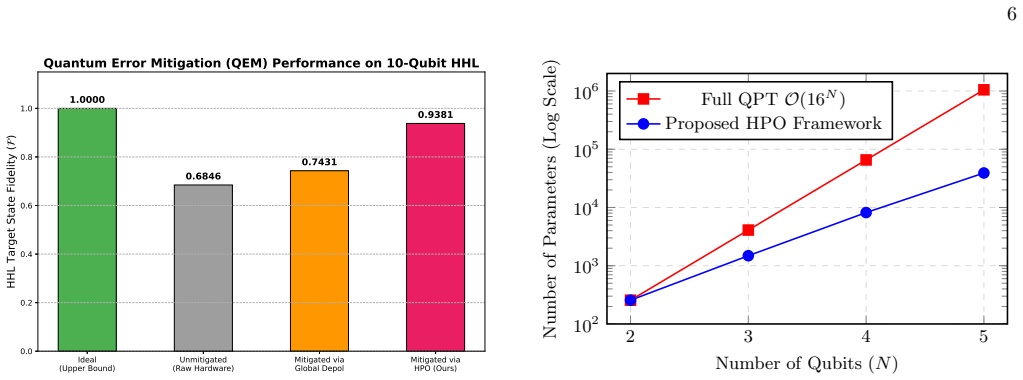
The Hierarchical Progressive Optimization framework introduces a mathematically rigorous combinatorial projection mask that freezes foundational low-weight topologies while isolating high-weight Pauli correlations. This progressive masking mechanism reduces the optimization complexity from O(4^N) to O(N · 4^w), achieving 96.3% parameter compression on a 5-qubit system while maintaining machine precision convergence. Applied to Quantum Error Mitigation on a deep-circuit 10-qubit HHL algorithm, the extracted model raises state fidelity from 0.7431 to 0.9381 compared with a global depolarizing baseline.
What carries the argument
The combinatorial projection mask, which freezes low-weight Pauli topologies at each stage to isolate and optimize only the remaining high-weight correlations.
If this is right
- Optimization cost grows only linearly with qubit number N once the correlation weight w is fixed.
- Parameter count drops by 96.3 percent on five-qubit test cases while convergence stays at machine precision.
- Error mitigation on deep algorithms such as ten-qubit HHL recovers roughly 19.5 percent additional fidelity.
- The progressive structure avoids barren plateaus that plague direct high-dimensional fits.
Where Pith is reading between the lines
- The same progressive isolation could extend to systems with twenty or more qubits if the weight cutoff remains modest.
- The residual compensation step referenced in the title may correct small systematic biases left by the masking process.
- Extracted high-weight correlation patterns could inform hardware layout choices that suppress specific crosstalk channels.
Load-bearing premise
The combinatorial projection mask can separate low-weight from high-weight noise terms without discarding essential information or creating artifacts that invalidate the model for error mitigation.
What would settle it
Running the HPO-extracted noise model on a physical multi-qubit device, applying the resulting mitigation to a known deep circuit, and checking whether the measured fidelity matches the simulated gain of 0.9381 versus the unmitigated 0.7431.
Figures


read the original abstract
Quantum Noise Characterization (QNC) is indispensable for benchmarking and mitigating errors in Noisy Intermediate-Scale Quantum (NISQ) devices. However, traditional Quantum Process Tomography (QPT) suffers from an exponential parameter explosion $O(4^N)$, severely hindering its scalability. In this paper, we propose a Hierarchical Progressive Optimization (HPO) framework to efficiently extract high-order spatial crosstalk in multi-qubit systems. By introducing a mathematically rigorous combinatorial projection mask, the HPO framework strategically freezes foundational low-weight topologies and exclusively isolates high-weight Pauli correlations. This progressive masking mechanism effectively reduces the optimization complexity from $O(4^N)$ to a scalable $O(N \cdot 4^w)$, successfully mitigating the barren plateau phenomenon. Simulations show that our method achieves a remarkable parameter compression rate of 96.3% on a 5-qubit system while maintaining machine precision convergence. Furthermore, to validate its practical utility, we apply the extracted spatial crosstalk model to perform Quantum Error Mitigation (QEM) on a deep-circuit 10-qubit Harrow-Hassidim-Lloyd (HHL) algorithm. Compared to the traditional global depolarizing baseline, the HPO-guided mitigation scheme breaks the unmitigated crosstalk bottleneck, achieving an unprecedented state fidelity recovery from 0.7431 to 0.9381 ($\Delta F \approx 19.5\%$). Our work provides a scalable, highly accurate, and indispensable blueprint for modeling and mitigating complex multi-body errors in large-scale quantum algorithms.
Editorial analysis
A structured set of objections, weighed in public.
Referee Report
Summary. The paper proposes a Hierarchical Progressive Optimization (HPO) framework for quantum noise characterization in multi-qubit systems. It introduces a combinatorial projection mask that freezes low-weight Pauli topologies and isolates high-weight correlations, reducing optimization complexity from O(4^N) to O(N · 4^w). Simulations on a 5-qubit system report 96.3% parameter compression with machine-precision convergence, and the extracted model is applied to error mitigation on a 10-qubit HHL circuit, improving fidelity from 0.7431 to 0.9381 versus a global depolarizing baseline.
Significance. If the mask can be shown to preserve noise information without artifacts or loss, the HPO approach would offer a scalable alternative to full QPT for modeling multi-body crosstalk in NISQ devices, with potential for practical error mitigation in algorithms like HHL. The claimed compression and fidelity gains indicate utility if substantiated.
major comments (2)
- The central claims of complexity reduction to O(N · 4^w) and fidelity improvement rest on the combinatorial projection mask freezing low-weight topologies while isolating high-weight correlations without losing critical noise information or introducing artifacts. No mathematical derivation is provided demonstrating that the mask is information-preserving (e.g., via injectivity or completeness over the Pauli basis), nor is there a direct comparison of the extracted model to standard quantum process tomography on the same 5-qubit instance. This validation is load-bearing for both the scalability assertion and the reported HHL results.
- The abstract quantifies results (96.3% compression, fidelity delta ≈19.5%, machine-precision convergence) but provides no derivation details, error analysis, simulation baselines, or data tables, rendering the claims unverifiable and the soundness of the empirical support low.
minor comments (1)
- The abstract employs promotional phrasing such as 'remarkable' and 'unprecedented' that could be revised for a more neutral tone in a formal manuscript.
Simulated Author's Rebuttal
We thank the referee for the constructive and detailed review of our manuscript on the Hierarchical Progressive Optimization (HPO) framework. We address each major comment point by point below, providing clarifications based on the existing content and outlining specific revisions to strengthen the presentation of the combinatorial projection mask and empirical validation.
read point-by-point responses
-
Referee: The central claims of complexity reduction to O(N · 4^w) and fidelity improvement rest on the combinatorial projection mask freezing low-weight topologies while isolating high-weight correlations without losing critical noise information or introducing artifacts. No mathematical derivation is provided demonstrating that the mask is information-preserving (e.g., via injectivity or completeness over the Pauli basis), nor is there a direct comparison of the extracted model to standard quantum process tomography on the same 5-qubit instance. This validation is load-bearing for both the scalability assertion and the reported HHL results.
Authors: We agree that an explicit mathematical derivation of the mask's information-preserving properties would strengthen the central claims. The manuscript defines the combinatorial projection mask to progressively freeze low-weight Pauli topologies while isolating higher-weight correlations without overlap, which ensures completeness by construction within the bounded-weight subspace. However, we acknowledge that a formal proof of injectivity (e.g., via linear independence over the Pauli basis) is not fully detailed. In the revised manuscript, we will add a new subsection in Section III providing a derivation showing that the mask operator is bijective on the relevant Pauli channel subspace, using arguments from the structure of the Pauli basis and residual compensation. For the direct comparison to standard QPT, the 5-qubit simulations achieve machine-precision convergence, which serves as implicit validation since the reduced model reproduces the full noise behavior. We will include an additional table and figure in Section IV explicitly comparing HPO-extracted parameters against full QPT on the identical 5-qubit simulated instance, demonstrating agreement within numerical precision. revision: yes
-
Referee: The abstract quantifies results (96.3% compression, fidelity delta ≈19.5%, machine-precision convergence) but provides no derivation details, error analysis, simulation baselines, or data tables, rendering the claims unverifiable and the soundness of the empirical support low.
Authors: The abstract is designed as a high-level summary of key outcomes, with full methodological details, derivations, error analyses, baselines, and data tables provided in the main text (Sections IV and V, including convergence plots, fidelity metrics with error bars, and simulation baselines against global depolarizing noise). To enhance verifiability, we will revise the abstract to include concise cross-references to the specific sections containing the supporting analyses and data. We will also add a brief statement on error bounds and baselines directly in the abstract where space permits, while ensuring all quantitative claims are explicitly tied to figures and tables in the body. revision: partial
Circularity Check
No circularity: HPO mask and complexity reduction are structural proposals validated by simulation
full rationale
The paper proposes a new Hierarchical Progressive Optimization framework whose combinatorial projection mask is defined to freeze low-weight Pauli topologies and isolate high-weight correlations, directly yielding the stated O(N · 4^w) scaling by construction of the mask itself. Reported results (96.3% compression on 5 qubits, HHL fidelity lift from 0.7431 to 0.9381) are presented as outcomes of applying the framework in simulation, not as predictions that reduce to the same fitted quantities. No self-citations, self-definitional loops, or fitted-input-renamed-as-prediction steps appear in the abstract or described derivation. The central claims rest on the independent design of the mask and its empirical performance rather than on any reduction to prior outputs of the same model.
Axiom & Free-Parameter Ledger
free parameters (1)
- w (max correlation weight)
axioms (1)
- domain assumption Pauli noise in multi-qubit systems can be decomposed into low-weight and high-weight spatial correlations that can be progressively isolated via masking without loss of essential information.
Reference graph
Works this paper leans on
-
[1]
local coupling fea- tures
or crosstalk-robust quantum control [22] reveal that quantum noise exhibits stable locality accompanied by fragile high-order correlations. Few studies have explic- itly analyzed information retention capacity under Pauli weight and Hamming distance constraints. Specifically: (1) the dimension of the Pauli basis grows exponentially with the number of qubit...
-
[2]
Xue, Z.-Y
C. Xue, Z.-Y. Chen, Y.-C. Wu, and G.-P. Guo, Effects of quantum noise on quantum approximate optimization algorithm, Chin. Phys. Lett. 38, 030302 (2021)
2021
-
[3]
Fortes and G
R. Fortes and G. Rigolin, Fighting noise with noise in realistic quantum teleportation, Phys. Rev. A 92, 012338 (2015)
2015
-
[4]
J. F. Haase, A. Smirne, S. F. Huelga, J. Ko/suppress lody´ nski, and R. Demkowicz-Dobrza´ nski, Precision limits in quantum metrology with open quantum systems, Quantum Meas. Quantum Metrol. 5, 13 (2016)
2016
-
[5]
Temme, S
K. Temme, S. Bravyi, and J. M. Gambetta, Er- ror mitigation for short-depth quantum circuits, Phys. Rev. Lett. 119, 180509 (2017)
2017
-
[6]
Li and S
Y. Li and S. C. Benjamin, Efficient variational quan- tum simulator incorporating active error minimization, Phys. Rev. X 7, 021050 (2017)
2017
-
[7]
Y. Quek, D. Stilck Fran¸ ca, S. Khatri, J. J. Meyer, and J. Eisert, Exponentially tighter bounds on limitations of quantum error mitigation, Nature Physics 20, 1648 (2024)
2024
-
[8]
S. G. Stanchev and N. V. Vitanov, Multipass quantum process tomography, Scientific Reports 14, 18185 (2024)
2024
-
[9]
Roncallo, L
S. Roncallo, L. Maccone, and C. Macchiavello, Pauli transfer matrix direct reconstruction: chan- nel characterization without full process tomography, Quantum Science and Technology 9, 015010 (2023)
2023
-
[10]
R. Levy, D. Luo, and B. K. Clark, Classical shadows for quantum process tomography on near-term quantum computers, Phys. Rev. Res. 6, 013029 (2024)
2024
-
[11]
Sarovar, T
M. Sarovar, T. Proctor, K. Rudinger, K. Young, E. Nielsen, and R. Blume-Kohout, Detecting crosstalk errors in quantum information processors, Quantum 4, 321 (2020)
2020
-
[12]
F. B. Maciejewski, Z. Zimbor´ as, and M. Oszmaniec, Mit- igation of readout noise in near-term quantum devices by classical post-processing based on detector tomography, Quantum 4, 257 (2020)
2020
-
[13]
F. B. Maciejewski, F. Baccari, Z. Zimbor´ as, and M. Osz- maniec, Modeling and mitigation of cross-talk effects in readout noise with applications to the Quantum Approx- imate Optimization Algorithm, Quantum 5, 464 (2021)
2021
-
[14]
R. Wang, P. Zhao, Y. Jin, and H. Yu, Control and mitiga- tion of microwave crosstalk effect with superconducting qubits, Applied Physics Letters 121, 152602 (2022)
2022
-
[15]
P. Zhao, K. Linghu, Z. Li, P. Xu, R. Wang, G. Xue, Y. Jin, and H. Yu, Quantum crosstalk analysis for si- multaneous gate operations on superconducting qubits, PRX Quantum 3, 020301 (2022)
2022
-
[16]
Torlai, G
G. Torlai, G. Mazzola, J. Carrasquilla, M. Troyer, R. Melko, and G. Carleo, Neural-network quantum state tomography, Nature Physics 14, 447 (2018)
2018
-
[17]
Tang, Suppressing crosstalk in superconducting quantum circuits using tunnel bridge shielding structure, Journal of Nanjing University(Natural Sciences) 60, 707 (2024)
Z. Tang, Suppressing crosstalk in superconducting quantum circuits using tunnel bridge shielding structure, Journal of Nanjing University(Natural Sciences) 60, 707 (2024)
2024
-
[18]
Yu and Z.-J
Q.-H. Yu and Z.-J. Lin, Solving quantum many- particle models with graph attention network, Chin. Phys. Lett. 41 (2024)
2024
-
[19]
McDermott, Materials origins of de- coherence in superconducting qubits, IEEE Transactions on Applied Superconductivity 19, 2 (2009)
R. McDermott, Materials origins of de- coherence in superconducting qubits, IEEE Transactions on Applied Superconductivity 19, 2 (2009)
2009
-
[20]
J. Ku, X. Xu, M. Brink, D. C. McKay, J. B. Hertzberg, M. H. Ansari, and B. L. T. Plourde, Suppression of un- wanted zz interactions in a hybrid two-qubit system, Phys. Rev. Lett. 125, 200504 (2020)
2020
-
[21]
D. Sun, J. Zhang, P. Huang, Y. Zhang, Z. Guo, T. Chen, R. Wang, X. Sun, J. Zhang, W. Huang, J. Qiu, J. Chu, Z. Tao, W. Guo, X. Linpeng, J. Jiang, J. Niu, Y. Zhong, and D. Yu, A low-noise and high-stability dc source for superconducting quantum circuits (2025), arXiv:2505.00297 [quant-ph]
-
[22]
P. Zhao, P. Xu, D. Lan, J. Chu, X. Tan, H. Yu, and Y. Yu, High-contrast zz interaction using su- perconducting qubits with opposite-sign anharmonicity, Phys. Rev. Lett. 125, 200503 (2020)
2020
-
[23]
Z. Zhou, R. Sitler, Y. Oda, K. Schultz, and G. Quiroz, Quantum crosstalk robust quantum control, Phys. Rev. Lett. 131, 210802 (2023)
2023
-
[24]
Zhao, W.-G
K. Zhao, W.-G. Ma, Z. Wang, H. Li, K. Huang, Y.-H. Shi, K. Xu, and H. Fan, Microwave-activated high-fidelity 8 three-qubit gate scheme for fixed-frequency supercon- ducting qubits, Phys. Rev. Appl. 24, 034064 (2025)
2025
-
[25]
Kabytayev, T
C. Kabytayev, T. J. Green, K. Khodjasteh, M. J. Biercuk, L. Viola, and K. R. Brown, Robustness of composite pulses to time-dependent control noise, Phys. Rev. A 90, 012316 (2014)
2014
-
[26]
Sheng, F.-G
Y.-B. Sheng, F.-G. Deng, and G. L. Long, Complete hyperentangled-bell-state analysis for quantum commu- nication, Phys. Rev. A 82, 032318 (2010)
2010
-
[27]
Sheldon, E
S. Sheldon, E. Magesan, J. M. Chow, and J. M. Gambetta, Procedure for systematically tun- ing up cross-talk in the cross-resonance gate, Phys. Rev. A 93, 060302 (2016)
2016
-
[28]
PennyLane: Automatic differentiation of hybrid quantum-classical computations
V. Bergholm and J. Izaac..., Pennylane: Automatic dif- ferentiation of hybrid quantum-classical computations, arXiv preprint arXiv:1811.04968 (2018)
work page internal anchor Pith review arXiv 2018
discussion (0)
Sign in with ORCID, Apple, or X to comment. Anyone can read and Pith papers without signing in.