Recognition: unknown
Weak Gravitational Lensing: A Brief Overview
Pith reviewed 2026-05-10 06:10 UTC · model grok-4.3
The pith
A unified geometrical framework using OIA and GW-OIA formalisms computes light deflection consistently in both static and rotating gravitational fields.
A machine-rendered reading of the paper's core claim, the machinery that carries it, and where it could break.
Core claim
The analysis is extended to axisymmetric spacetimes using the OIA and GW-OIA formalisms, providing a unified geometrical framework for computing light deflection in both static and rotating gravitational fields.
What carries the argument
The OIA and GW-OIA formalisms, which supply a unified geometrical procedure for calculating light deflection angles across static spherically symmetric and rotating axisymmetric spacetimes.
If this is right
- Photon trajectories in the equatorial plane of Kerr spacetime admit closed-form expressions for the closest approach distance and the critical parameters that separate captured and scattered orbits.
- The Rindler-Ishak method combined with the Gauss-Bonnet theorem applied to optical geometry recovers the light-bending angle for static and axisymmetric metrics alike.
- The same geometrical construction applies without modification to any axisymmetric spacetime, removing the need to treat static and rotating cases with separate formalisms.
Where Pith is reading between the lines
- The framework may simplify the construction of lensing maps for rotating compact objects in observational data analysis.
- Similar optical-geometry techniques could be tested on other relativistic effects such as time delay or polarization rotation around spinning sources.
- Because the method stays within standard general relativity, any observed mismatch with predictions would point to new physics rather than a defect in the lensing calculation itself.
Load-bearing premise
The OIA and GW-OIA derivations and geometric interpretations reproduce the known general-relativity results for light deflection when moving from static to rotating cases without introducing unnoticed approximations or inconsistencies.
What would settle it
A direct numerical comparison showing that the deflection angle for light grazing a Kerr black hole computed via the OIA formalism differs from the established Kerr deflection formula would falsify the claim of a consistent unified framework.
Figures




read the original abstract
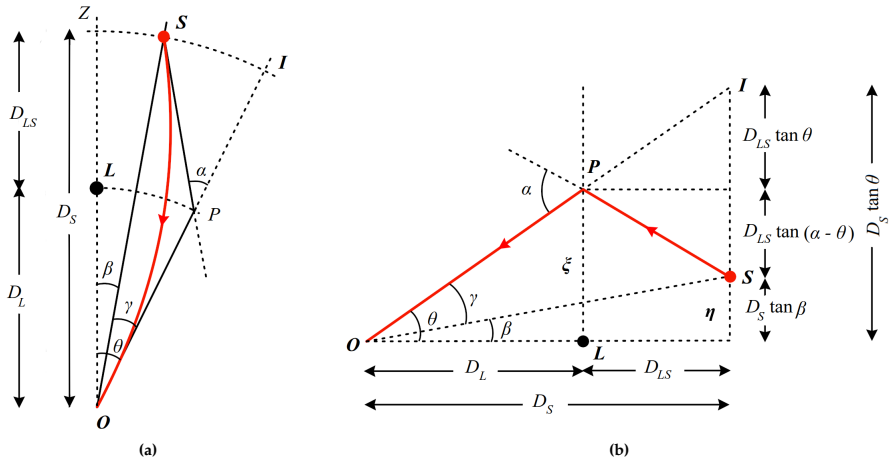
Gravitational lensing constitutes one of the most direct observational manifestations of spacetime curvature and provides a powerful probe of compact astrophysical objects. In this work, we present a comprehensive analysis of the bending of light in curved spacetime, beginning with the fundamental aspects of gravitational lensing and the Newtonian approximation to light deflection. The relativistic formulation of lensing is then developed through the lens equation, lensing potential, and a geometrical interpretation of Fermat's principle using an effective refractive index in curved spacetime. Photon trajectories and light deflection are subsequently investigated in static, spherically symmetric geometries, followed by a detailed study of photon motion in the equatorial plane of the Kerr spacetime. Analytical expressions for the closest approach distance and critical parameters governing photon orbits are derived. Furthermore, the bending angle is examined using the Rindler-Ishak method and the Gauss-Bonnet theorem within the optical geometry. Finally, the analysis is extended to axisymmetric spacetimes using the OIA and GW-OIA formalisms, providing a unified geometrical framework for computing light deflection in both static and rotating gravitational fields.
Editorial analysis
A structured set of objections, weighed in public.
Referee Report
Summary. The manuscript provides a comprehensive overview of weak gravitational lensing, beginning with Newtonian light deflection and the relativistic lens equation with Fermat's principle interpreted via an effective refractive index. It derives photon trajectories, closest-approach distances, and critical parameters in static spherically symmetric spacetimes and the equatorial plane of Kerr, then computes deflection angles via the Rindler-Ishak method and Gauss-Bonnet theorem applied to the optical geometry. The analysis concludes by extending these methods to axisymmetric spacetimes through the OIA and GW-OIA formalisms to yield a unified geometrical framework for light deflection in both static and rotating gravitational fields.
Significance. If the derivations accurately reproduce standard GR results without hidden approximations in the rotating case, the paper offers a pedagogically useful synthesis that unifies static and axisymmetric treatments under optical geometry and Gauss-Bonnet methods. This could serve as a reference for students and researchers working on lensing in compact objects. However, as a review-style overview without new quantitative predictions, machine-checked proofs, or falsifiable claims, its significance remains primarily educational rather than field-advancing.
major comments (1)
- [Abstract; section on OIA and GW-OIA formalisms] Abstract and the section extending the analysis to axisymmetric spacetimes via OIA/GW-OIA: the central claim of a unified geometrical framework for static and rotating fields assumes that the optical curvature scalar, area element, and boundary terms carry over directly from the static spherical case. The Kerr optical geometry is non-static due to frame-dragging; the manuscript must explicitly demonstrate how (or whether) the OIA/GW-OIA constructions incorporate the modified refractive index or metric components, and must compare the resulting deflection angle against known Kerr results to rule out systematic error.
Simulated Author's Rebuttal
We thank the referee for the careful reading and constructive feedback on our overview of weak gravitational lensing. The major comment raises a valid point about the need for explicit clarification in the axisymmetric extension, and we address it directly below.
read point-by-point responses
-
Referee: [Abstract; section on OIA and GW-OIA formalisms] Abstract and the section extending the analysis to axisymmetric spacetimes via OIA/GW-OIA: the central claim of a unified geometrical framework for static and rotating fields assumes that the optical curvature scalar, area element, and boundary terms carry over directly from the static spherical case. The Kerr optical geometry is non-static due to frame-dragging; the manuscript must explicitly demonstrate how (or whether) the OIA/GW-OIA constructions incorporate the modified refractive index or metric components, and must compare the resulting deflection angle against known Kerr results to rule out systematic error.
Authors: We agree that the non-static character of the Kerr optical geometry due to frame-dragging requires explicit treatment. In the OIA and GW-OIA sections, the constructions already incorporate the off-diagonal metric components of the Kerr spacetime into the effective refractive index for the equatorial plane, which modifies the optical metric, curvature scalar, and area element accordingly. However, to strengthen the presentation and directly address the concern, we will revise the manuscript to include a dedicated subsection that derives these quantities step by step from the Kerr optical metric, showing the explicit dependence on the frame-dragging terms. We will also add a direct numerical and analytical comparison of the resulting deflection angles with standard Kerr results obtained via geodesic integration (e.g., as in the literature on strong lensing in Kerr). This will confirm consistency and eliminate any possibility of systematic error in the unified framework. revision: yes
Circularity Check
No circularity: standard review of known lensing methods with no self-defined predictions
full rationale
The manuscript is an overview that reproduces standard GR results for light deflection in spherical and Kerr metrics using established techniques (Rindler-Ishak, Gauss-Bonnet in optical geometry, OIA/GW-OIA). No quantitative predictions are advanced that reduce to fitted parameters or self-citations by construction; closest-approach and critical-orbit expressions are derived from the Kerr geodesic equation in the usual way, and the extension to axisymmetric cases applies previously published formalisms without redefining inputs in terms of outputs. All load-bearing steps remain externally verifiable against textbook GR calculations, yielding a self-contained review with no circular reduction.
Axiom & Free-Parameter Ledger
axioms (2)
- standard math Standard general relativity governs light propagation in curved spacetime
- domain assumption Fermat's principle holds in an effective optical geometry with refractive index derived from the metric
Reference graph
Works this paper leans on
-
[1]
Lecture notes on general relativity,
S. M. Carroll, “Lecture notes on general relativity,” 1997. https://arxiv.org/abs/gr-qc/9712019
work page internal anchor Pith review arXiv 1997
-
[2]
Periodic relativity: the theory of gravity in flat space time
V . H. Zaveri, “Periodic relativity: the theory of gravity in flat space time,” 2025. https://arxiv.org/abs/0707.4539
work page internal anchor Pith review Pith/arXiv arXiv 2025
-
[3]
Lectures on Gravitational Lensing
R. Narayan and M. Bartelmann, “Lectures on gravitational lensing,” 1997. https://arxiv.org/abs/astro-ph/9606001
work page Pith review arXiv 1997
-
[4]
Dodelson,Gravitational Lensing
S. Dodelson,Gravitational Lensing. Cambridge University Press, 2017
2017
-
[5]
M. Bartelmann, “Gravitational lensing,”Classical and Quantum Gravity27no. 23, (Nov., 2010) 233001.http://dx.doi.org/10.1088/0264-9381/27/23/233001
-
[6]
New estimator for gravitational lensing using galaxy and intensity mapping surveys,
M. Jalilvand, E. Majerotto, C. Bonvin, F. Lacasa, M. Kunz, W. Naidoo, and K. Moodley, “New estimator for gravitational lensing using galaxy and intensity mapping surveys,”Physical Review Letters124no. 3, (Jan., 2020) .http://dx.doi.org/10.1103/PhysRevLett.124.031101
-
[7]
<scp>relensing</scp>: Reconstructing the mass profile of galaxy clusters from gravitational lensing,
D. A. Torres-Ballesteros and L. Castañeda, “<scp>relensing</scp>: Reconstructing the mass profile of galaxy clusters from gravitational lensing,”Monthly Notices of the Royal Astronomical Society518no. 3, (Nov., 2022) 4494–4516.http://dx.doi.org/10.1093/mnras/stac3253
-
[8]
Strong lensing by galaxy clusters,
P . Natarajan, L. L. Williams, M. Bradac, C. Grillo, A. Ghosh, K. Sharon, and J. Wagner, “Strong lensing by galaxy clusters,”arXiv:2403.06245 [astro-ph.CO]. https://arxiv.org/abs/2403.06245
-
[9]
A model for galaxy–galaxy strong lensing statistics in surveys,
G. Ferrami and J. S. B. Wyithe, “A model for galaxy–galaxy strong lensing statistics in surveys,” Monthly Notices of the Royal Astronomical Society532no. 2, (June, 2024) 1832–1848. http://dx.doi.org/10.1093/mnras/stae1607
-
[10]
Gravitational lensing from clusters of galaxies to test disformal couplings theories,
S. Zamani, V . Salzano, and D. Bettoni, “Gravitational lensing from clusters of galaxies to test disformal couplings theories,” 2024.https://arxiv.org/abs/2401.02221
-
[11]
Gravitational lensing of galaxy clustering,
B. Buncher, G. Holder, and S. Hotinli, “Gravitational lensing of galaxy clustering,” arXiv:2402.07988 [astro-ph.CO].https://arxiv.org/abs/2402.07988. 86
-
[12]
The dark matter of gravitational lensing,
R. Massey, T. Kitching, and J. Richard, “The dark matter of gravitational lensing,”Reports on Progress in Physics73no. 8, (July, 2010) 086901. http://dx.doi.org/10.1088/0034-4885/73/8/086901
-
[13]
Gravitational lensing: a unique probe of dark matter and dark energy,
R. S. Ellis, “Gravitational lensing: a unique probe of dark matter and dark energy,”Philosophical Transactions of the Royal Society A: Mathematical, Physical and Engineering Sciences368no. 1914, (2010) 967–987,https://royalsocietypublishing.org/doi/pdf/10.1098/rsta.2009.0209. https://royalsocietypublishing.org/doi/abs/10.1098/rsta.2009.0209
-
[14]
Gravitational lensing by a massive object in a dark matter halo. i. critical curves and caustics,
M. Karamazov, L. Timko, and D. Heyrovský, “Gravitational lensing by a massive object in a dark matter halo. i. critical curves and caustics,”The Astrophysical Journal922no. 1, (Nov, 2021) 72. https://dx.doi.org/10.3847/1538-4357/ac151c
-
[15]
Probing dark matter with strong gravitational lensing through an effective density slope,
A. C. Sengül and C. Dvorkin, “Probing dark matter with strong gravitational lensing through an effective density slope,”Monthly Notices of the Royal Astronomical Society516no. 1, (July, 2022) 336–357.http://dx.doi.org/10.1093/mnras/stac2256
-
[16]
S. Vegetti, S. Birrer, G. Despali, C. D. Fassnacht, D. Gilman, Y. Hezaveh, L. P . Levasseur, J. P . McKean, D. M. Powell, C. M. O’Riordan, and G. Vernardos, “Strong gravitational lensing as a probe of dark matter,” 2023.https://arxiv.org/abs/2306.11781
-
[17]
Probing dark matter via strong gravitational lensing by black holes,
A. Vachher, D. Baboolal, and S. G. Ghosh, “Probing dark matter via strong gravitational lensing by black holes,”Physics of the Dark Universe44(2024) 101493. https://www.sciencedirect.com/science/article/pii/S221268642400075X
2024
- [18]
-
[19]
2018, Geosciences, 8, 365, doi: 10.3390/geosciences8100365
Y. Tsapras, “Microlensing searches for exoplanets,”Geosciences8no. 10, (Sept., 2018) 365. http://dx.doi.org/10.3390/geosciences8100365
-
[20]
Image formation for extended sources with the solar gravitational lens,
S. G. Turyshev and V . T. Toth, “Image formation for extended sources with the solar gravitational lens,”Physical Review D102no. 2, (July, 2020) . http://dx.doi.org/10.1103/PhysRevD.102.024038
-
[21]
Resolved imaging of exoplanets with the solar gravitational lens,
S. G. Turyshev and V . T. Toth, “Resolved imaging of exoplanets with the solar gravitational lens,” Monthly Notices of the Royal Astronomical Society515no. 4, (July, 2022) 6122–6132. http://dx.doi.org/10.1093/mnras/stac2130
-
[22]
Imaging rotating and orbiting exoplanets with the solar gravitational lens,
V . T. Toth and S. G. Turyshev, “Imaging rotating and orbiting exoplanets with the solar gravitational lens,”Monthly Notices of the Royal Astronomical Society525no. 4, (Sept., 2023) 5846–5856.http://dx.doi.org/10.1093/mnras/stad2655. 87
-
[23]
P . Mróz and R. Poleski,Exoplanet Occurrence Rates from Microlensing Surveys, p. 1–23. Springer International Publishing, 2024. http://dx.doi.org/10.1007/978-3-319-30648-3_208-1
-
[24]
Gravitational lensing of gravitational waves: A statistical perspective
S.-S. Li, S. Mao, Y. Zhao, and Y. Lu, “Gravitational lensing of gravitational waves: a statistical perspective,”Monthly Notices of the Royal Astronomical Society476no. 2, (May, 2018) 2220–2229, arXiv:1802.05089 [astro-ph.CO]
work page Pith review arXiv 2018
-
[25]
Observational signatures of microlensing in gravitational waves at ligo/virgo frequencies,
Diego, J. M., Hannuksela, O. A., Kelly, P . L., Pagano, G., Broadhurst, T., Kim, K., Li, T. G. F., and Smoot, G. F., “Observational signatures of microlensing in gravitational waves at ligo/virgo frequencies,”A&A627(2019) A130.https://doi.org/10.1051/0004-6361/201935490
-
[26]
Lensinggw: a python package for lensing of gravitational waves,
Pagano, G., Hannuksela, O. A., and Li, T. G. F., “Lensinggw: a python package for lensing of gravitational waves,”A&A643(2020) A167. https://doi.org/10.1051/0004-6361/202038730
-
[27]
Lensing of gravitational waves: universal signatures in the beating pattern,
O. Bulashenko and H. Ubach, “Lensing of gravitational waves: universal signatures in the beating pattern,”Journal of Cosmology and Astroparticle Physics2022no. 07, (July, 2022) 022. http://dx.doi.org/10.1088/1475-7516/2022/07/022
-
[28]
Lensing of gravitational waves: Efficient wave-optics methods and validation with symmetric lenses,
G. Tambalo, M. Zumalacárregui, L. Dai, and M. H.-Y. Cheung, “Lensing of gravitational waves: Efficient wave-optics methods and validation with symmetric lenses,”Physical Review D108no. 4, (Aug., 2023) .http://dx.doi.org/10.1103/PhysRevD.108.043527
-
[29]
A. K. Meena, “Gravitational lensing of gravitational waves: prospects for probing intermediate-mass black holes in galaxy lenses with global minima image,”Monthly Notices of the Royal Astronomical Society532no. 3, (07, 2024) 3568–3581, https://academic.oup.com/mnras/article-pdf/532/3/3568/58652494/stae1707.pdf. https://doi.org/10.1093/mnras/stae1707
-
[30]
An interference-based method for the detection of strongly lensed gravitational waves,
X. Shan, B. Hu, X. Chen, and R.-G. Cai, “An interference-based method for the detection of strongly lensed gravitational waves,”Nature Astronomy(Mar, 2025) . https://doi.org/10.1038/s41550-025-02519-5
-
[31]
A. S. Bolton, S. Burles, L. V . E. Koopmans, T. Treu, and L. A. Moustakas, “The sloan lens acs survey. i. a large spectroscopically selected sample of massive early-type lens galaxies,”The Astrophysical Journal638no. 2, (Feb., 2006) 703–724.http://dx.doi.org/10.1086/498884
-
[32]
Strong 88 gravitational lensing’s ’external shear’ is not shear,
A. Etherington, J. W. Nightingale, R. Massey, S.-I. Tam, X. Cao, A. Niemiec, Q. He, A. Robertson, R. Li, A. Amvrosiadis, S. Cole, J. M. Diego, C. S. Frenk, B. L. Frye, D. Harvey, M. Jauzac, A. M. Koekemoer, D. J. Lagattuta, M. Limousin, G. Mahler, E. Sirks, and C. L. Steinhardt, “Strong 88 gravitational lensing’s ’external shear’ is not shear,” 2023. http...
- [33]
-
[34]
Searching for strong gravitational lenses,
C. Lemon, F. Courbin, A. More, P . Schechter, R. Cañameras, L. Delchambre, C. Leung, Y. Shu, C. Spiniello, Y. Hezaveh, J. Klüter, and R. McMahon, “Searching for strong gravitational lenses,” 2023.https://arxiv.org/abs/2310.13466
-
[35]
Essentials of strong gravitational lensing,
P . Saha, D. Sluse, J. Wagner, and L. L. R. Williams, “Essentials of strong gravitational lensing,” 2024.https://arxiv.org/abs/2401.04165
-
[36]
Strong gravitational lensing with upcoming wide-field radio surveys,
S. McCarty and L. Connor, “Strong gravitational lensing with upcoming wide-field radio surveys,” 2024.https://arxiv.org/abs/2412.01746
-
[37]
Method for Detecting a Cosmological Density of Condensed Objects,
W. H. Press and J. E. Gunn, “Method for Detecting a Cosmological Density of Condensed Objects,”The Astrophysical Journal185(Oct., 1973) 397–412
1973
-
[38]
Strong lensing by galaxies,
T. Treu, “Strong lensing by galaxies,”Annual Review of Astronomy and Astrophysics48no. Volume 48, 2010, (2010) 87–125.https://www.annualreviews.org/content/journals/10.1146/ annurev-astro-081309-130924
2010
-
[39]
Clash: Photometric redshifts with 16 hst bands in galaxy cluster fields,
Jouvel, S., Host, O., Lahav, O., Seitz, S., Molino, A., Coe, D., Postman, M., Moustakas, L., Benìtez, N., Rosati, P ., Balestra, I., Grillo, C., Bradley, L., Fritz, A., Kelson, D., Koekemoer, A. M., Lemze, D., Medezinski, E., Mercurio, A., Moustakas, J., Nonino, M., Scodeggio, M., Zheng, W., Zitrin, A., Bartelmann, M., Bouwens, R., Broadhurst, T., Donahue...
-
[40]
Clash: accurate photometric redshifts with 14 hst bands in massive galaxy cluster cores,
A. Molino, N. Benítez, B. Ascaso, D. Coe, M. Postman, S. Jouvel, O. Host, O. Lahav, S. Seitz, E. Medezinski, P . Rosati, W. Schoenell, A. Koekemoer, Y. Jimenez-Teja, T. Broadhurst, P . Melchior, I. Balestra, M. Bartelmann, R. Bouwens, L. Bradley, N. Czakon, M. Donahue, H. Ford, O. Graur, G. Graves, C. Grillo, L. Infante, S. W. Jha, D. Kelson, R. Lazkoz, D...
-
[41]
An evaluation of 10 lensing models of the frontier fields cluster macs j0416.1-2403,
J. D. R. González, K. Sharon, and G. Mahler, “An evaluation of 10 lensing models of the frontier fields cluster macs j0416.1-2403,”The Astrophysical Journal863no. 1, (Aug, 2018) 60. https://dx.doi.org/10.3847/1538-4357/aacf8e
-
[42]
The Hubble constant,
J. V . Narlikar, “The Hubble constant,”Bulletin of the Astronomical Society of India24(Dec., 1996) 835
1996
-
[43]
J. L. Bernal, L. Verde, and A. G. Riess, “The trouble with h0,”Journal of Cosmology and Astroparticle Physics2016no. 10, (Oct, 2016) 019. https://dx.doi.org/10.1088/1475-7516/2016/10/019
-
[44]
Über eine mögliche form fiktiver doppelsterne,
O. Chwolson, “Über eine mögliche form fiktiver doppelsterne,”Astronomische Nachrichten221 no. 20, (1924) 329–330, https://onlinelibrary.wiley.com/doi/pdf/10.1002/asna.19242212003. https://onlinelibrary.wiley.com/doi/abs/10.1002/asna.19242212003
-
[45]
Lens-like action of a star by the deviation of light in the gravitational field,
A. Einstein, “Lens-like action of a star by the deviation of light in the gravitational field,”Science 84no. 2188, (1936) 506–507, https://www.science.org/doi/pdf/10.1126/science.84.2188.506. https://www.science.org/doi/abs/10.1126/science.84.2188.506
-
[46]
Faint distorted structures in the core of A 370 : are they gravitationally lensed galaxies at z=1 ?,
B. Fort, J. L. Prieur, G. Mathez, Y. Mellier, and G. Soucail, “Faint distorted structures in the core of A 370 : are they gravitationally lensed galaxies at z=1 ?,”Astronomy & Astrophysics200(July, 1988) L17–L20
1988
-
[47]
Detection of Systematic Gravitational Lens Galaxy Image Alignments: Mapping Dark Matter in Galaxy Clusters,
J. A. Tyson, F. Valdes, and R. A. Wenk, “Detection of Systematic Gravitational Lens Galaxy Image Alignments: Mapping Dark Matter in Galaxy Clusters,”The Astrophysical Journal Letters349(Jan.,
-
[48]
Weak gravitational lensing,
M. Bartelmann and P . Schneider, “Weak gravitational lensing,”Physics Reports340no. 4–5, (Jan.,
-
[49]
291–472.http://dx.doi.org/10.1016/S0370-1573(00)00082-X
-
[50]
Weak gravitational lensing by large-scale structure,
A. Refregier, “Weak gravitational lensing by large-scale structure,”Annual Review of Astronomy and Astrophysics41no. 1, (Sept., 2003) 645–668. http://dx.doi.org/10.1146/annurev.astro.41.111302.102207
-
[51]
H. Hoekstra, “Weak gravitational lensing,” 2013.https://arxiv.org/abs/1312.5981
-
[52]
B. Giblin, C. Heymans, M. Asgari, H. Hildebrandt, H. Hoekstra, B. Joachimi, A. Kannawadi, K. Kuijken, C.-A. Lin, L. Miller, T. Tröster, J. L. van den Busch, A. H. Wright, M. Bilicki, C. Blake, 90 J. de Jong, A. Dvornik, T. Erben, F. Getman, N. R. Napolitano, P . Schneider, H. Shan, and E. Valentijn, “Kids-1000 catalogue: Weak gravitational lensing shear m...
-
[53]
X. Li, Y. Li, and R. Massey, “Weak gravitational lensing shear measurement with fpfs: analytical mitigation of noise bias and selection bias,”Monthly Notices of the Royal Astronomical Society511 no. 4, (Feb., 2022) 4850–4860.http://dx.doi.org/10.1093/mnras/stac342
-
[54]
Forklens: Accurate weak-lensing shear measurement with deep learning,
Z. Zhang, H. Shan, N. Li, C. Wei, J. Yao, Z. Ban, Y. Fang, Q. Guo, D. Liu, G. Li, L. Lin, M. Li, R. Li, X. Li, Y. Luo, X. Meng, J. Nie, Z. Qi, Y. Qiu, L. Shao, H. Tian, L. Wang, W. Wang, J. Xian, Y. Xu, T. Zhang, X. Zhang, and Z. Zhou, “Forklens: Accurate weak-lensing shear measurement with deep learning,”Astronomy & Astrophysics683(Mar., 2024) A209. http...
-
[55]
Probing the cosmological principle with weak lensing shear,
J. Adam, R. Maartens, J. Larena, and C. Clarkson, “Probing the cosmological principle with weak lensing shear,”Journal of Cosmology and Astroparticle Physics2025no. 02, (Feb., 2025) 016. http://dx.doi.org/10.1088/1475-7516/2025/02/016
-
[56]
Weak gravitational lensing of the cmb,
A. Lewis and A. Challinor, “Weak gravitational lensing of the cmb,”Physics Reports429no. 1, (2006) 1–65. https://www.sciencedirect.com/science/article/pii/S0370157306000810
2006
-
[57]
Weak Gravitational Lensing of Distant Galaxies,
N. Kaiser, “Weak Gravitational Lensing of Distant Galaxies,”The Astrophysical Journal388(Apr.,
-
[58]
Mapping the Dark Matter with Weak Gravitational Lensing,
N. Kaiser and G. Squires, “Mapping the Dark Matter with Weak Gravitational Lensing,”The Astrophysical Journal404(Feb., 1993) 441
1993
-
[59]
Kids-450: the tomographic weak lensing power spectrum and constraints on cosmological parameters,
F. Köhlinger, M. Viola, B. Joachimi, H. Hoekstra, E. van Uitert, H. Hildebrandt, A. Choi, T. Erben, C. Heymans, S. Joudaki, D. Klaes, K. Kuijken, J. Merten, L. Miller, P . Schneider, and E. A. Valentijn, “Kids-450: the tomographic weak lensing power spectrum and constraints on cosmological parameters,”Monthly Notices of the Royal Astronomical Society471no...
-
[60]
A. B. Congdon and C. R. Keeton,Principles of Gravitational Lensing: Light Deflection as a Probe of Astrophysics and Cosmology. 2018
2018
-
[61]
ParticleDataGroup, R. L. Workman, V . D. Burkert, V . Crede, E. Klempt, U. Thoma, L. Tiator, K. Agashe, G. Aielli, B. C. Allanach, C. Amsler, M. Antonelli, E. C. Aschenauer, D. M. Asner, H. Baer, S. Banerjee, R. M. Barnett, L. Baudis, C. W. Bauer, J. J. Beatty, V . I. Belousov, J. Beringer, 91 A. Bettini, O. Biebel, K. M. Black, E. Blucher, R. Bonventre, ...
-
[62]
A. Troja, I. Tutusaus, and J. G. Sorce, “Euclid in a nutshell,” 2022. https://arxiv.org/abs/2211.09668. [62]EuclidCollaboration, Y. Mellieret al., “Euclid. I. Overview of the Euclid mission,”Astron. Astrophys.697(2025) A1,arXiv:2405.13491 [astro-ph.CO]. 92
-
[63]
Research in Astronomy and Astrophysics , archivePrefix = "arXiv", eprint =
“Astrophysical applications of gravitational microlensing,”Research in Astronomy and Astrophysics 12no. 8, (Aug, 2012) 947.https://dx.doi.org/10.1088/1674-4527/12/8/005
-
[64]
, year = 2012, month = sep, volume =
B. S. Gaudi, “Microlensing surveys for exoplanets,”Annual Review of Astronomy and Astrophysics50 no. Volume 50, 2012, (2012) 411–453.https://www.annualreviews.org/content/ journals/10.1146/annurev-astro-081811-125518
-
[65]
Strong gravitational lensing and microlensing of supernovae,
S. H. Suyu, A. Goobar, T. Collett, A. More, and G. Vernardos, “Strong gravitational lensing and microlensing of supernovae,”Space Science Reviews220no. 1, (Feb, 2024) 13. https://doi.org/10.1007/s11214-024-01044-7
-
[66]
J. Michell, “Vii. on the means of discovering the distance, magnitude, &c. of the fixed stars, in consequence of the diminution of the velocity of their light, in case such a diminution should be found to take place in any of them, and such other data should be procured from observations, as would be farther necessary for that purpose. by the rev. joh...
-
[67]
Laplace,Exposition du systéme du monde
P .-S. Laplace,Exposition du systéme du monde. Cambridge Library Collection - Mathematics. Cambridge University Press, 2 ed., 2009
2009
-
[68]
Johann Georg von Soldner and the gravitational bending of light, with an English translation of his essay on it published in 1801,
S. L. Jaki, “Johann Georg von Soldner and the gravitational bending of light, with an English translation of his essay on it published in 1801,”Foundations of Physics8no. 11-12, (Dec., 1978) 927–950
1978
-
[69]
On Soldners Value of Newtonian Deflection of Light,
H. J. Treder and G. Jackisch, “On Soldners Value of Newtonian Deflection of Light,”Astronomische Nachrichten302no. 6, (Jan., 1981) 275
1981
-
[70]
¨Uber den Einfluß der Schwerkraft auf die Ausbreitung des Lichtes,
A. Einstein, “Über den einfluß der schwerkraft auf die ausbreitung des lichtes,”Annalen der Physik 340no. 10, (1911) 898–908, https://onlinelibrary.wiley.com/doi/pdf/10.1002/andp.19113401005. https://onlinelibrary.wiley.com/doi/abs/10.1002/andp.19113401005
-
[71]
Erklarung der Perihelionbewegung der Merkur aus der allgemeinen Relativitatstheorie,
A. Einstein, “Erklarung der Perihelionbewegung der Merkur aus der allgemeinen Relativitatstheorie,”Sitzungsberichte der Königlich Preussischen Akademie der Wissenschaften47 (Jan., 1915) 831–839
1915
-
[72]
A Determination of the Deflection of Light by the Sun’s Gravitational Field, from Observations Made at the Total Eclipse of May 29, 1919,
F. W. Dyson, A. S. Eddington, and C. Davidson, “A Determination of the Deflection of Light by the Sun’s Gravitational Field, from Observations Made at the Total Eclipse of May 29, 1919,” Jan., 1920. 93
1919
-
[73]
The Confrontation between General Relativity and Experiment
C. M. Will, “The confrontation between general relativity and experiment,”Living Reviews in Relativity17no. 1, (Jun, 2014) 4.https://doi.org/10.12942/lrr-2014-4
-
[74]
Meneghetti,Introduction to Gravitational Lensing: With Python Examples
M. Meneghetti,Introduction to Gravitational Lensing: With Python Examples. 2022
2022
-
[75]
J. W. Strutt,On the Electromagnetic Theory of Light, p. 518–536. Cambridge Library Collection - Mathematics. Cambridge University Press, 2009
2009
-
[76]
Born approximation in wave optics of gravitational lensing revisited,
H. Yarimoto and M. Oguri, “Born approximation in wave optics of gravitational lensing revisited,”Physical Review D111no. 8, (Apr., 2025) . http://dx.doi.org/10.1103/PhysRevD.111.083541
-
[77]
C. W. Misner, K. S. Thorne, and J. A. Wheeler,Gravitation. 1973
1973
-
[78]
Carroll,Spacetime and Geometry: An Introduction to General Relativity
S. Carroll,Spacetime and Geometry: An Introduction to General Relativity. Benjamin Cummings, 2003. https: //www.bibsonomy.org/bibtex/2a9db5ea9854d4856475d8a4254003365/random3f
2003
-
[79]
Schneider, J
P . Schneider, J. Ehlers, and E. E. Falco,Gravitational Lenses. 1992
1992
-
[80]
On fermat’s principle in general relativity. i. the general case,
V . Perlick, “On fermat’s principle in general relativity. i. the general case,”Classical and Quantum Gravity7no. 8, (Aug, 1990) 1319.https://dx.doi.org/10.1088/0264-9381/7/8/011
discussion (0)
Sign in with ORCID, Apple, or X to comment. Anyone can read and Pith papers without signing in.