Recognition: unknown
Observation of intrastate and interstate facilitation between Rydberg S, P and D levels
Pith reviewed 2026-05-10 05:28 UTC · model grok-4.3
The pith
Rydberg S, P and D levels in rubidium facilitate each other's off-resonant excitation through mutual interactions.
A machine-rendered reading of the paper's core claim, the machinery that carries it, and where it could break.
Core claim
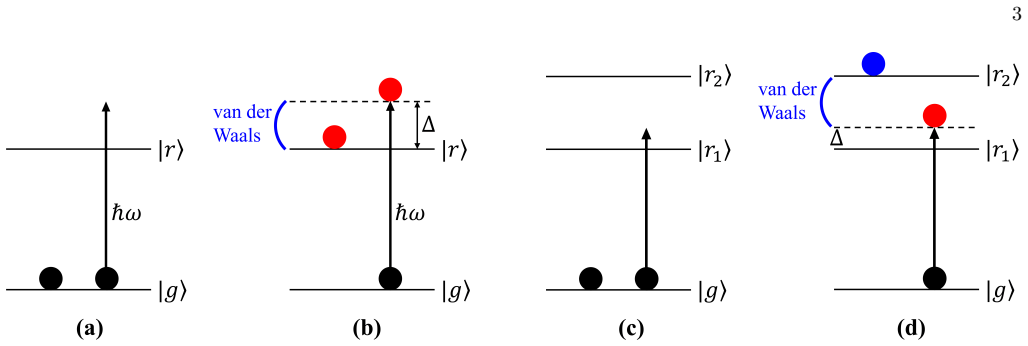
We report experimental results on Rydberg facilitation, whereby Rydberg levels can be excited off-resonantly in the presence of a nearby Rydberg atom because of Rydberg-Rydberg interactions, for high-lying S, P and D levels in rubidium. Facilitation is detected both through an enhancement of the number of excited atoms for off-resonant excitation (either blue or red detuning) and a positive Mandel Q parameter indicating correlated excitation events. We also calculate the pair-state potentials for the Rydberg states involved and find that our experimental results agree with the expected facilitation conditions for repulsive potentials (blue detuning) and attractive potentials (red detuning),
What carries the argument
The Rydberg-Rydberg interaction potentials between pairs of atoms that shift the collective excitation energies, enabling facilitation at specific detunings.
Load-bearing premise
The observed increase in excited atom numbers and positive Mandel Q parameter arise specifically from Rydberg-Rydberg interaction shifts rather than from other effects such as laser fluctuations or collisions.
What would settle it
If the positions of the observed facilitation peaks in detuning do not align with the calculated pair-state potential curves for the S, P and D levels, or if the same enhancements appear in regimes where no Rydberg-Rydberg interactions are possible, the interpretation would be falsified.
Figures


read the original abstract
We report experimental results on Rydberg facilitation, whereby Rydberg levels can be excited off-resonantly in the presence of a nearby Rydberg atom because of Rydberg-Rydberg interactions, for high-lying $S$, $P$ and $D$ levels in rubidium. Facilitation is detected both through an enhancement of the number of excited atoms for off-resonant excitation (either blue or red detuning) and a positive Mandel $Q$ parameter indicating correlated excitation events (super-Poissonian counting statistics). We also calculate the pair-state potentials for the Rydberg states involved and find that our experimental results agree with the expected facilitation conditions for repulsive potentials (blue detuning) and attractive potentials (red detuning), with $P$ and $D$ states exhibiting facilitation on both sides of the resonance. Finally, we investigate inter-state facilitation between two different Rydberg levels (70 $S$ and 70 $P$).
Editorial analysis
A structured set of objections, weighed in public.
Referee Report
Summary. The manuscript reports experimental observations of Rydberg facilitation for high-lying S, P, and D states in rubidium, detected via enhancement of excited atom numbers under off-resonant (blue or red) laser detuning and positive Mandel Q parameters indicating super-Poissonian statistics from correlated excitations. Pair-state potentials are calculated and stated to match the observed facilitation detuning windows for repulsive (blue) and attractive (red) interactions, with P and D states showing facilitation on both sides; interstate facilitation between 70S and 70P is also investigated.
Significance. If the signals are confirmed to arise from Rydberg-Rydberg interactions, the work provides useful data on facilitation across multiple angular-momentum manifolds and interstate couplings, complementing existing studies on Rydberg blockade and many-body effects. The dual use of mean enhancement and statistical measures, together with direct comparison to calculated potentials, offers a concrete test of interaction-induced off-resonant excitation.
major comments (3)
- [Experimental Setup and Results] Experimental Setup and Results sections: No density-scaling data or low-density control (where the interaction shift is negligible compared to the laser linewidth) is presented to demonstrate that the atom-number enhancement and positive Q disappear when Rydberg-Rydberg interactions are suppressed. This control is load-bearing for attributing the signals specifically to facilitation rather than laser fluctuations, collisions, or detection biases.
- [Results] Results section (comparison with theory): The statement that experimental results 'agree with the expected facilitation conditions' is qualitative only; no quantitative metric (overlap integral, rms deviation of detuning windows, or error bars on measured thresholds) is given for the match between observed facilitation ranges and the calculated pair potentials.
- [Interstate facilitation] Interstate facilitation subsection: The conditions under which 70S-70P facilitation is observed (specific detunings, densities, and relevant pair potentials) are not tabulated or plotted with the same detail as the intrastate cases, making it difficult to assess whether the interstate signal is subject to the same controls.
minor comments (3)
- [Results] The definition and background-subtraction procedure for the Mandel Q parameter should be stated explicitly (including any post-selection criteria) rather than referenced only by name.
- [Figures] Figure captions and axis labels should include the atomic density and laser linewidth values used in each dataset to allow direct comparison with the interaction strengths.
- [Introduction] A brief reference to prior Rydberg facilitation literature (e.g., works on S-state facilitation) would help situate the extension to P, D, and interstate cases.
Simulated Author's Rebuttal
We thank the referee for their careful reading and constructive comments on our manuscript. We address each major comment point by point below and have revised the manuscript to strengthen the evidence and presentation of our results.
read point-by-point responses
-
Referee: Experimental Setup and Results sections: No density-scaling data or low-density control (where the interaction shift is negligible compared to the laser linewidth) is presented to demonstrate that the atom-number enhancement and positive Q disappear when Rydberg-Rydberg interactions are suppressed. This control is load-bearing for attributing the signals specifically to facilitation rather than laser fluctuations, collisions, or detection biases.
Authors: We agree that explicit density dependence would provide stronger confirmation that the observed signals originate from Rydberg-Rydberg interactions. In the revised manuscript we have added density-scaling data to the Experimental Setup and Results sections. These measurements demonstrate that both the atom-number enhancement and the positive Mandel Q parameter decrease markedly at lower densities, where interaction shifts fall below the laser linewidth, thereby supporting the attribution to facilitation. revision: yes
-
Referee: Results section (comparison with theory): The statement that experimental results 'agree with the expected facilitation conditions' is qualitative only; no quantitative metric (overlap integral, rms deviation of detuning windows, or error bars on measured thresholds) is given for the match between observed facilitation ranges and the calculated pair potentials.
Authors: We acknowledge that the original comparison was qualitative. In the revised Results section we now include quantitative metrics: the root-mean-square deviation between the centers of the measured facilitation windows and the calculated pair-potential features, together with error bars on the experimentally determined detuning thresholds obtained from repeated measurements. These additions allow a more rigorous evaluation of the agreement. revision: yes
-
Referee: Interstate facilitation subsection: The conditions under which 70S-70P facilitation is observed (specific detunings, densities, and relevant pair potentials) are not tabulated or plotted with the same detail as the intrastate cases, making it difficult to assess whether the interstate signal is subject to the same controls.
Authors: We have expanded the Interstate facilitation subsection in the revised manuscript. A new figure now displays the facilitation signals for the 70S-70P case, and an accompanying table lists the specific detunings, atomic densities, and relevant pair-state potentials, bringing the presentation to the same level of detail as the intrastate results and enabling direct comparison of the applied controls. revision: yes
Circularity Check
No significant circularity: experimental observations cross-checked against independent pair-potential calculations
full rationale
The paper reports direct experimental measurements of atom-number enhancement and positive Mandel Q under off-resonant excitation for Rydberg S, P, and D states, together with interstate facilitation between 70S and 70P. Pair-state potentials are computed from standard Rydberg interaction formulas and shown to match the observed detuning windows; no equations or parameters are fitted to the present data set and then re-presented as predictions. No self-citations are load-bearing for the central claim, and no derivation reduces measured quantities to quantities defined by the same measurements.
Axiom & Free-Parameter Ledger
axioms (1)
- standard math Rydberg-Rydberg interaction potentials can be calculated from known atomic properties and dipole-dipole or van der Waals terms.
Reference graph
Works this paper leans on
-
[1]
Pérez-Espigares, M
C. Pérez-Espigares, M. Marcuzzi, R. Gutiérrez, and I. Lesanovsky, Physical Review Letters119, 140401 (2017)
2017
-
[2]
Saffman, T
M. Saffman, T. G. Walker, and K. Mølmer, Reviews of Modern Physics82, 2313 (2010)
2010
-
[3]
Kekic, Three-photon excitation of rydberg p-states (2015)
A. Kekic, Three-photon excitation of rydberg p-states (2015)
2015
-
[4]
D. J. Griffiths,Introduction to Electrodynamics(Pearson, Boston, MA, 2013)
2013
-
[5]
T. M. Wintermantel, M. Buchhold, S. Shevate, Y. Mor- gado, G. Wang, S. Lochead, S. Diehl, and S. Whitlock, Nature Communications12, 103 (2021)
2021
-
[6]
T. M. Wintermantel, Y. Wang, G. Lochead, S. Shevate, G. K. Brennen, and S. Whitlock, Physical Review Letters 124, 070503 (2020)
2020
-
[7]
Browaeys and T
A. Browaeys and T. Lahaye, Nature Physics16, 132 (2020)
2020
-
[8]
Weimer, M
H. Weimer, M. Müller, I. Lesanovsky, P. Zoller, and H. P. Büchler, Nature Physics6, 382 (2010)
2010
-
[9]
Bernien, S
H. Bernien, S. Schwartz, A. Keesling, H. Levine, A. Om- ran, H. Pichler, S. Choi, A. S. Zibrov, M. Endres, M. Greiner, V. Vuletić, and M. D. Lukin, Nature551, 579 (2017)
2017
-
[10]
Bloch, J
I. Bloch, J. Dalibard, and W. Zwerger, Reviews of Mod- ern Physics80, 885 (2008)
2008
-
[11]
R. Löw, H. Weimer, J. Nipper, J. B. Balewski, B. Butscher, H. P. Büchler, and T. Pfau, Journal of Physics B: Atomic, Molecular and Optical Physics45, 113001 (2012)
2012
-
[12]
M. M. Valado, C. Simonelli, M. D. Hoogerland, I. Lesanovsky, J. P. Garrahan, E. Arimondo, D. Ciampini, and O. Morsch, Physical Review A 93, 040701 (2016)
2016
-
[13]
Paris-Mandoki, C
A. Paris-Mandoki, C. Braun, and S. Hofferberth, AIP Conference Proceedings1950, 020001 (2018)
2018
-
[14]
Urban, T
E. Urban, T. A. Johnson, T. Henage, L. Isenhower, D. D. Yavuz, T. G. Walker, and M. Saffman, Nature Commu- nications1, 7 (2010)
2010
-
[15]
Letscher, O
F. Letscher, O. Thomas, T. Niederprüm, H. Ott, and M. Fleischhauer, Physical Review A95, 023410 (2017)
2017
-
[16]
Urvoy, F
A. Urvoy, F. Ripka, I. Lesanovsky, D. Booth, J. P. Shaf- fer, T. Pfau, and R. Löw, Physical Review Letters114, 203002 (2015)
2015
-
[17]
Morsch and I
O. Morsch and I. Lesanovsky, La Rivista del Nuovo Ci- mento41, 383 (2018)
2018
-
[18]
Simonelli, M
C. Simonelli, M. M. Valado, G. Masella, L. Asteria, E. Arimondo, D. Ciampini, and O. Morsch, Journal of Physics B: Atomic, Molecular and Optical Physics49, 154002 (2016)
2016
-
[19]
Liu, Z.-C
F. Liu, Z.-C. Yang, P. Bienias, T. Iadecola, and A. V. Gorshkov, Physical Review Letters128, 013603 (2022)
2022
-
[20]
R. Li, D. Yu, S.-L. Su, and J. Qian, Physical Review A 101, 042328 (2020)
2020
-
[21]
Marcuzzi, J
M. Marcuzzi, J. Minář, D. Barredo, S. de Léséleuc, H. Labuhn, T. Lahaye, A. Browaeys, E. Levi, and I. Lesanovsky, Physical Review Letters118, 063606 (2017)
2017
-
[22]
Archimi, C
M. Archimi, C. Simonelli, L. D. Virgilio, A. Greco, M. Ceccanti, E. Arimondo, D. Ciampini, I. I. Ryabtsev, I. I. Beterov, and O. Morsch, Physical Review A100, 030501 (2019)
2019
-
[23]
J.-S, X.-Y. X. Xu, C.-F. Li, C.-J. Zhang, X.-B. Zou, and G.-C. Guo, Nature Communications1, 7 (2010)
2010
-
[24]
T. M. Wintermantel,Complex systems dynamics in laser excited ensembles of Rydberg atoms, Doctoral thesis in physics, University of Heidelberg (2021)
2021
-
[25]
Fox,Quantum Optics: An Introduction(Oxford Uni- versity Press, 2006)
M. Fox,Quantum Optics: An Introduction(Oxford Uni- versity Press, 2006)
2006
-
[26]
Günter, H
G. Günter, H. Schempp, M. R. de Saint-Vincent, V. Gavryusev, S. Helmrich, C. S. Hofmann, S. Whitlock, and M. Weidemüller, Science342, 954 (2013)
2013
-
[27]
C. H. Townes and A. L. Schawlow,Microwave Spec- troscopy(McGraw-Hill, 1955)
1955
-
[28]
Šibalić, J
N. Šibalić, J. Pritchard, C. Adams, and K. Weatherill, Computer Physics Communications220, 319 (2017)
2017
-
[29]
Ostmann, M
M. Ostmann, M. Marcuzzi, J. P. Garrahan, and I. Lesanovsky, Physical Review A99, 060101 (2019)
2019
-
[30]
Thaicharoen, S
N. Thaicharoen, S. A. Miller, and G. Raithel, Physical Review A98, 023402 (2018)
2018
-
[31]
Gutiérrez, C
R. Gutiérrez, C. Simonelli, M. Archimi, F. Castellucci, E. Arimondo, D. Ciampini, M. Marcuzzi, I. Lesanovsky, and O. Morsch, Physical Review A96, 041602 (2017)
2017
-
[32]
R. C. Teixeira, C. Hermann-Avigliano, T. C.-M. T. L. Nguyen, J. M. Raimond, S. Haroche, S. Gleyzes, and M. Brune, Physical Review Letters115, 013001 (2015)
2015
-
[33]
Kazemi and H
J. Kazemi and H. Weimer, Physical Review Letters130, 163601 (2023)
2023
-
[34]
Kitson, T
P. Kitson, T. Haug, A. L. Magna, O. Morsch, and L. Am- ico, Phys. Rev. A110, 043304 (2024)
2024
-
[35]
Reiter and A
F. Reiter and A. S. Sørensen, Phys. Rev. A85, 032111 (2012)
2012
-
[36]
X. Shao, F. Liu, X. Xue, W. Mu, and W. Li, Phys. Rev. Appl.20, 014014 (2023)
2023
-
[37]
Schempp, G
H. Schempp, G. Günter, S. Wüster, M. Weidemüller, and S. Whitlock, Phys. Rev. Lett.115, 093002 (2015)
2015
-
[38]
Breuer and F
H.-P. Breuer and F. Petruccione,The Theory of Open Quantum Systems(Oxford University Press, Oxford, 2007)
2007
-
[39]
Krämer, D
S. Krämer, D. Plankensteiner, L. Ostermann, and H. Ritsch, Comput. Phys. Commun.227, 109 (2018)
2018
discussion (0)
Sign in with ORCID, Apple, or X to comment. Anyone can read and Pith papers without signing in.