Recognition: unknown
A short course in general relativity
Pith reviewed 2026-05-10 06:00 UTC · model grok-4.3
The pith
The Einstein field equations follow from varying the nonlinear gravitational action once curved geometry is introduced.
A machine-rendered reading of the paper's core claim, the machinery that carries it, and where it could break.
Core claim
Starting from the weak-field limit and gravitational waves, the geometry of curved space-time is developed through Riemannian methods; the nonlinear gravitational action is then varied to produce the Einstein field equations in their complete nonlinear form, which are applied to obtain black-hole metrics and cosmological dynamics.
What carries the argument
The nonlinear gravitational action, whose variation yields the Einstein field equations.
If this is right
- Spherically symmetric vacuum solutions of the derived equations give the Schwarzschild black-hole geometry.
- Homogeneous and isotropic solutions describe the expansion history of the universe.
- The same curved-space-time framework permits derivation of Hawking radiation from black-hole horizons.
- Linearized versions of the equations recover the gravitational waves introduced at the outset.
Where Pith is reading between the lines
- This order of presentation could let students reach nonlinear applications without first mastering the full tensor calculus in isolation.
- The initial weak-field treatment provides a natural bridge to precision tests of gravity that rely on post-Newtonian expansions.
- Extending the action-variation method shown here to other curvature invariants would test the uniqueness of Einstein gravity.
Load-bearing premise
The reader has already studied special relativity and electromagnetic waves.
What would settle it
Explicit variation of the stated gravitational action that produces field equations differing from the standard Einstein equations would show the derivation step is incorrect.
Figures
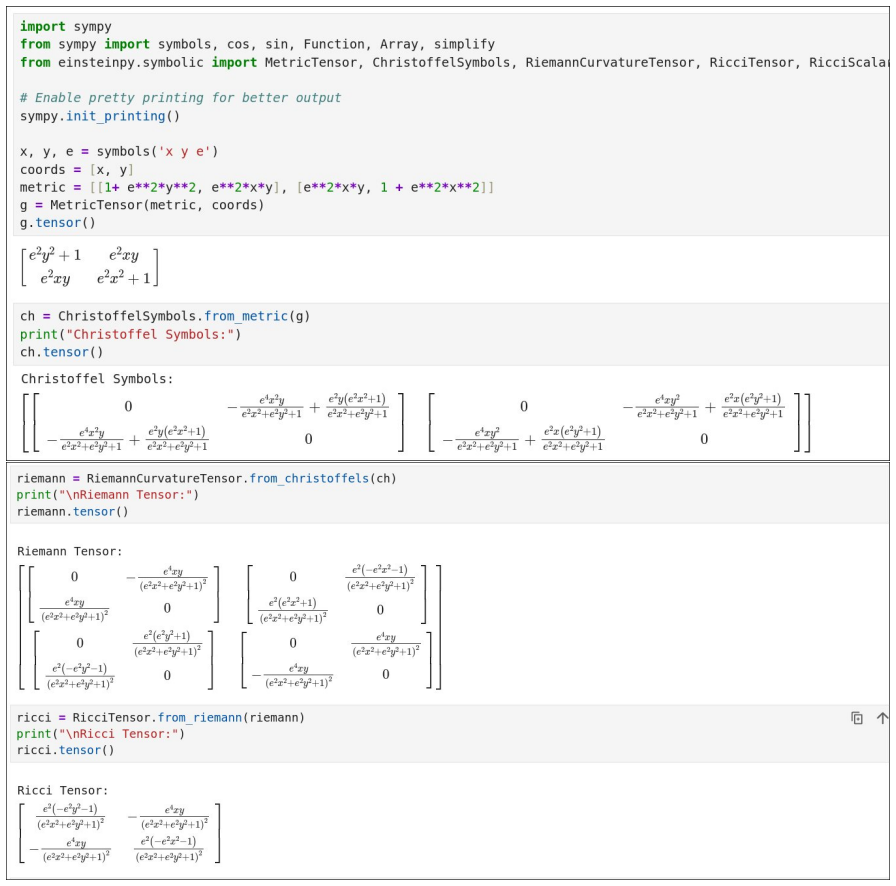


read the original abstract
These notes give a concise introduction to General Relativity at the advanced undergraduate level, starting from the weak field limit and gravitational waves, then introducing curved manifolds and Riemannian geometry. The nonlinear gravitational action is used to derive the nonlinear field equations, with applications to black holes and cosmology. It is assumed that special relativity and electromagnetic waves have been previously studied. Some advanced topics such as Rindler and Hawking radiation are derived, and recent developments in gravitational wave detection are briefly covered. Problems are included, both those suitable for homework, and simpler ones that could be worked out by students during class sessions.
Editorial analysis
A structured set of objections, weighed in public.
Referee Report
Summary. The manuscript consists of lecture notes providing a concise introduction to general relativity at the advanced undergraduate level. It begins with the weak-field limit and gravitational waves, introduces curved manifolds and Riemannian geometry, derives the nonlinear Einstein field equations from the gravitational action, and applies these to black holes and cosmology. Advanced topics including Rindler and Hawking radiation are derived, recent gravitational wave detection developments are briefly covered, and problems suitable for homework or in-class work are included. Prior knowledge of special relativity and electromagnetic waves is assumed.
Significance. If the derivations are presented accurately, the notes offer a streamlined pedagogical resource that follows a standard and effective progression from linearized gravity to the full nonlinear theory via the action principle. The inclusion of problems and coverage of modern applications such as gravitational wave detection adds teaching value. As the material reproduces well-established textbook content without novel claims or predictions, its primary contribution would be in conciseness and accessibility for students rather than advancing the scientific literature.
minor comments (2)
- Abstract: the reference to 'recent developments in gravitational wave detection' is too vague to be useful; naming specific examples (e.g., LIGO/Virgo events or particular observational results) would clarify the scope for readers.
- Problems section: the distinction between homework problems and simpler in-class exercises is stated in the abstract but not explicitly labeled or separated in the text; clear demarcation would assist instructors using the notes.
Simulated Author's Rebuttal
We thank the referee for their positive assessment of our lecture notes and for recommending minor revision. No specific major comments were raised in the report, so we have no individual points requiring direct rebuttal or clarification. We have reviewed the manuscript for any minor issues such as typographical errors or formatting inconsistencies that might warrant small updates prior to final publication.
Circularity Check
No significant circularity; standard pedagogical restatement of GR
full rationale
The manuscript presents a concise, standard introduction to general relativity at the advanced undergraduate level. It begins from the weak-field limit and gravitational waves, introduces curved manifolds and Riemannian geometry, derives the nonlinear Einstein equations from the gravitational action, and applies them to black holes and cosmology. All steps reproduce textbook derivations whose correctness is independently established in the literature and externally verifiable (e.g., via the Einstein-Hilbert action and its variation). No novel predictions, fitted parameters, or uniqueness theorems are introduced. The sole explicit assumption (prior knowledge of special relativity and electromagnetic waves) is a stated prerequisite and does not function as a load-bearing input that is redefined or fitted within the notes. No self-citations appear, and the derivation chain does not reduce to self-definition or renaming of known results.
Axiom & Free-Parameter Ledger
axioms (1)
- domain assumption Special relativity and electromagnetic waves have been previously studied.
Reference graph
Works this paper leans on
-
[1]
¨Uber die Ablenkung eines Lichtstrals von seiner geradlinigen Bewegung,
J. von Soldner, “ ¨Uber die Ablenkung eines Lichtstrals von seiner geradlinigen Bewegung,” Berliner Astronomisches Jahrbuch(1801) 161–172. https://en.wikisource.org/?curid=755966
-
[2]
A Determination of the Deflection of Light by the Sun’s Gravitational Field, from Observations Made at the Total Eclipse of May 29, 1919,
F. W. Dyson, A. S. Eddington, and C. Davidson, “A Determination of the Deflection of Light by the Sun’s Gravitational Field, from Observations Made at the Total Eclipse of May 29, 1919,” Phil. Trans. Roy. Soc. Lond. A220(1920) 291–333
1919
-
[3]
Hirata.http://www.tapir.caltech.edu/ ~chirata/ph236/lec08.pdf
C. Hirata.http://www.tapir.caltech.edu/ ~chirata/ph236/lec08.pdf
-
[5]
Scalar particle production in Schwarzschild and Rindler metrics,
P. C. W. Davies, “Scalar particle production in Schwarzschild and Rindler metrics,”J. Phys. A 8(1975) 609–616
1975
-
[6]
Particle Creation by Black Holes,
S. W. Hawking, “Particle Creation by Black Holes,”Commun. Math. Phys.43(1975) 199–220. [Erratum: Commun.Math.Phys. 46, 206 (1976)]
1975
-
[7]
Relativistic quantum fields,
J. D. Bjorken and S. D. Drell, “Relativistic quantum fields,”
-
[8]
N. D. Birrell and P. C. W. Davies,Quantum Fields in Curved Space. Cambridge Monographs on Mathematical Physics. Cambridge University Press, Cambridge, UK, 1982
1982
-
[9]
Gravitational Field of Vacuum Domain Walls,
A. Vilenkin, “Gravitational Field of Vacuum Domain Walls,”Phys. Lett. B133(1983) 177–179
1983
-
[10]
C. W. Misner, K. S. Thorne, and J. A. Wheeler,Gravitation. W. H. Freeman, San Francisco, 1973
1973
-
[11]
Wikipedia.https://en.wikipedia.org/wiki/Geodesics_in_general_relativity
-
[12]
The NANOGrav 15-year Data Set: Evidence for a Gravitational-Wave Background
V. Collaboration, “Catalog of gravitational wave events.”https: //www.virgo-gw.eu/science/gw-universe/catalog-of-gravitational-wave-events/, 2024. [13]NANOGravCollaboration, G. Agazieet al., “The NANOGrav 15 yr Data Set: Evidence for a Gravitational-wave Background,”Astrophys. J. Lett.951no. 1, (2023) L8,arXiv:2306.16213 [astro-ph.HE]. 76
work page internal anchor Pith review arXiv 2024
-
[13]
Observation of Gravitational Waves from a Binary Black Hole Merger
H. Ohanian and R. Ruffini,Gravitation and spacetime. 1995. [15]LIGO Scientific, VirgoCollaboration, B. P. Abbottet al., “Observation of Gravitational Waves from a Binary Black Hole Merger,”Phys. Rev. Lett.116no. 6, (2016) 061102, arXiv:1602.03837 [gr-qc]
work page internal anchor Pith review arXiv 1995
-
[14]
Upper limits on the isotropic gravitational radiation background from pulsar timing analysis,
R. W. Hellings and G. R. Downs, “Upper limits on the isotropic gravitational radiation background from pulsar timing analysis,”Astrophys. J. Lett.265(1983) L39–L42
1983
-
[15]
Massive black hole binaries in active galactic nuclei,
M. C. Begelman, R. D. Blandford, and M. J. Rees, “Massive black hole binaries in active galactic nuclei,”Nature287(1980) 307–309
1980
-
[16]
Dynamical Friction. I. General Considerations: the Coefficient of Dynamical Friction,
S. Chandrasekhar, “Dynamical Friction. I. General Considerations: the Coefficient of Dynamical Friction,”Astrophys. J.97(1943) 255
1943
-
[17]
Gravitational Waves from Core-Collapse Supernovae,
E. Abdikamalov, G. Pagliaroli, and D. Radice, “Gravitational Waves from Core-Collapse Supernovae,”arXiv:2010.04356 [astro-ph.SR]
-
[18]
Tao.https://terrytao.wordpress.com/wp-content/uploads/2008/03/ricci1.pdf
T. Tao.https://terrytao.wordpress.com/wp-content/uploads/2008/03/ricci1.pdf
2008
-
[19]
Wikipedia.https://en.wikipedia.org/wiki/Scalar_curvature
-
[20]
Wang.http://staff.ustc.edu.cn/ ~wangzuoq/Courses/16S-RiemGeom/Notes/Lec14.pdf
Z. Wang.http://staff.ustc.edu.cn/ ~wangzuoq/Courses/16S-RiemGeom/Notes/Lec14.pdf
-
[21]
Formighieri.https://library.wolfram.com/infocenter/MathSource/8847/
G. Formighieri.https://library.wolfram.com/infocenter/MathSource/8847/
-
[22]
Varela.https://library.wolfram.com/infocenter/ID/8329/
J. Varela.https://library.wolfram.com/infocenter/ID/8329/. [25]https://docs.einsteinpy.org/en/stable/
-
[23]
R. M. Wald,General Relativity. Chicago Univ. Pr., Chicago, USA, 1984
1984
-
[24]
Tong.http://www.damtp.cam.ac.uk/user/tong/gr/six.pdf
D. Tong.http://www.damtp.cam.ac.uk/user/tong/gr/six.pdf
-
[25]
T. Muller and F. Grave, “Catalogue of Spacetimes,”arXiv:0904.4184 [gr-qc]
-
[26]
Gravitational field of a spinning mass as an example of algebraically special metrics,
R. P. Kerr, “Gravitational field of a spinning mass as an example of algebraically special metrics,”Phys. Rev. Lett.11(1963) 237–238
1963
-
[27]
Maximal analytic extension of the Kerr metric,
R. H. Boyer and R. W. Lindquist, “Maximal analytic extension of the Kerr metric,”J. Math. Phys.8(1967) 265
1967
-
[28]
Gravitational collapse: The role of general relativity,
R. Penrose, “Gravitational collapse: The role of general relativity,”Riv. Nuovo Cim.1(1969) 252–276
1969
-
[29]
On the (im)possibility of electrically charged Planck relics,
S. Profumo, “On the (im)possibility of electrically charged Planck relics,”JCAP11(2025) 023, arXiv:2509.12520 [hep-ph]. [33]LIGO Scientific, VIRGO, KAGRACollaboration, A. G. Abacet al., “GWTC-4.0: Updating the Gravitational-Wave Transient Catalog with Observations from the First Part of the Fourth LIGO-Virgo-KAGRA Observing Run,”arXiv:2508.18082 [gr-qc]. ...
-
[30]
Cosmological Production of Superheavy Magnetic Monopoles,
J. Preskill, “Cosmological Production of Superheavy Magnetic Monopoles,”Phys. Rev. Lett.43 (1979) 1365
1979
-
[31]
The Inflationary Universe: A Possible Solution to the Horizon and Flatness Problems,
A. H. Guth, “The Inflationary Universe: A Possible Solution to the Horizon and Flatness Problems,”Phys. Rev. D23(1981) 347–356
1981
-
[32]
A New Inflationary Universe Scenario: A Possible Solution of the Horizon, Flatness, Homogeneity, Isotropy and Primordial Monopole Problems,
A. D. Linde, “A New Inflationary Universe Scenario: A Possible Solution of the Horizon, Flatness, Homogeneity, Isotropy and Primordial Monopole Problems,”Phys. Lett. B108(1982) 389–393. 77
1982
-
[33]
Planck 2018 results. VI. Cosmological parameters
A. D. Linde, “Chaotic Inflation,”Phys. Lett. B129(1983) 177–181. [39]PlanckCollaboration, N. Aghanimet al., “Planck 2018 results. VI. Cosmological parameters,” Astron. Astrophys.641(2020) A6,arXiv:1807.06209 [astro-ph.CO]. [Erratum: Astron.Astrophys. 652, C4 (2021)]. [40]PlanckCollaboration, Y. Akramiet al., “Planck 2018 results. X. Constraints on inflati...
work page Pith review arXiv 1983
-
[34]
Cluster abundance constraints on quintessence models,
L.-M. Wang and P. J. Steinhardt, “Cluster abundance constraints on quintessence models,” Astrophys. J.508(1998) 483–490,arXiv:astro-ph/9804015
-
[35]
Quintessence and the rest of the world,
S. M. Carroll, “Quintessence and the rest of the world,”Phys. Rev. Lett.81(1998) 3067–3070, arXiv:astro-ph/9806099
-
[36]
G. Guet al., “Dynamical Dark Energy in light of the DESI DR2 Baryonic Acoustic Oscillations Measurements,”arXiv:2504.06118 [astro-ph.CO]. [44]Supernova Search TeamCollaboration, A. G. Riesset al., “Observational evidence from supernovae for an accelerating universe and a cosmological constant,”Astron. J.116(1998) 1009–1038,arXiv:astro-ph/9805201. [45]Supe...
-
[37]
The Cosmological Constant Problem,
S. Weinberg, “The Cosmological Constant Problem,”Rev. Mod. Phys.61(1989) 1–23. A In-class problems A.1 Chapter 1 1.1. The Earth has mass 6×10 24 kg and radius 6400 km. Recalling thatg≈10 m/s 2, compute Newton’s constant in MKS units. (To one significant figure if you want.) 1.2. Suppose a civilization at a distanceRfrom Earth wanted to send gravitational ...
1989
discussion (0)
Sign in with ORCID, Apple, or X to comment. Anyone can read and Pith papers without signing in.