Recognition: unknown
Continuous-time quantum-walk centrality for protein residue interaction networks
Pith reviewed 2026-05-10 05:43 UTC · model grok-4.3
The pith
Continuous-time quantum walks on protein residue networks yield a centrality measure that matches classical eigenvector centrality while incorporating quantum interference effects.
A machine-rendered reading of the paper's core claim, the machinery that carries it, and where it could break.
Core claim
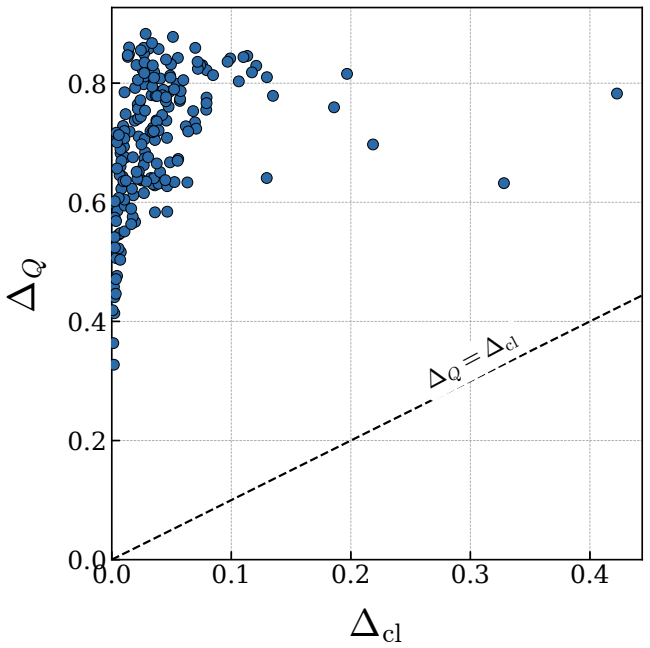
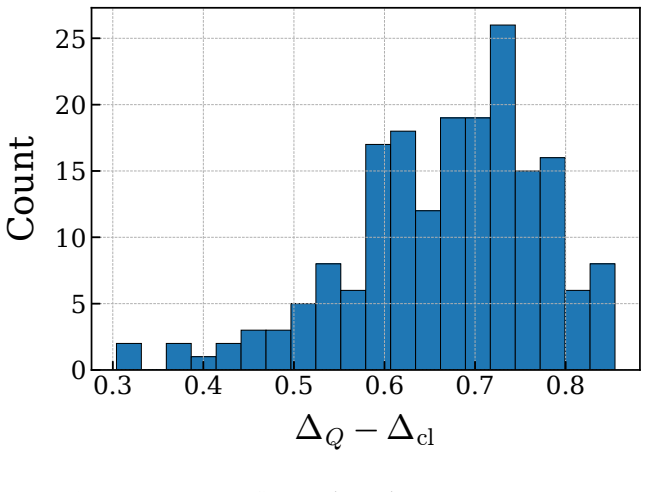
By constructing a Hamiltonian from the weighted adjacency matrix of a protein's residue interaction network and evolving a continuous-time quantum walk, the long-time averaged occupation probability serves as a centrality measure. This measure agrees with eigenvector centrality on a dataset of about 150 proteins while capturing quantum interference effects, as evidenced by larger spectral gaps in the time-averaged transition matrix. It successfully identifies experimentally verified functional residues in protein kinase A and oxytocin, and a small-scale implementation on IBM quantum hardware demonstrates its feasibility on near-term devices.
What carries the argument
The long-time averaged occupation probability obtained from the continuous-time quantum walk on the Hamiltonian derived from the protein's weighted residue interaction network.
Load-bearing premise
That the long-time averaged occupation probability from the continuous-time quantum walk accurately reflects the structural and functional importance of protein residues.
What would settle it
Observing that the CTQW centrality fails to rank experimentally important residues correctly in a new set of proteins or shows no advantage over classical methods in identifying functional sites would falsify the claim.
Figures



read the original abstract
We present a quantum-dynamical framework for identifying structurally important residues in proteins based on continuous time quantum walks (CTQWs) on weighted residue interaction networks constructed from experimentally resolved structures. By mapping the weighted adjacency matrix to a Hamiltonian, residue importance emerges from the long-time averaged occupation probability, confirmed analytically through its spectral decomposition. Across a dataset of approximately 150 proteins spanning diverse structural and functional classes, CTQW centrality exhibits consistently strong agreement with classical eigenvector centrality in identifying central residues, while extending beyond it through incorporating signatures of quantum interference. Analyzing the time-averaged quantum transition matrix reveals consistently larger spectral gaps than the classical random-walk operator. Furthermore, biological relevance is confirmed through recovery of experimentally established functional residues in proteins kinase A and oxytocin. CTQW-derived centrality rankings are accessible on near-term intermediate-scale quantum hardware, as we demonstrate through a proof-of-principle implementation on IBM superconducting quantum hardware. These results establish continuous-time quantum walks as a computationally tractable framework for protein network analysis, that connects network theoretical treatments of protein structural biology to continuous-time quantum walk dynamics.
Editorial analysis
A structured set of objections, weighed in public.
Referee Report
Summary. The paper proposes a centrality measure for identifying important residues in protein interaction networks using continuous-time quantum walks (CTQWs). The Hamiltonian is constructed from the weighted adjacency matrix of the network derived from protein structures; residue centrality is given by the long-time averaged occupation probability, which is analytically confirmed via spectral decomposition. The work reports strong agreement with classical eigenvector centrality on a dataset of ~150 proteins across structural classes, claims an extension beyond classical methods via quantum interference signatures, notes larger spectral gaps in the quantum transition matrix, validates biological relevance by recovering known functional residues in protein kinase A and oxytocin, and demonstrates a proof-of-principle implementation on IBM superconducting hardware.
Significance. If the central claims are substantiated, the framework offers a quantum-dynamical alternative for protein network analysis that is directly implementable on near-term quantum hardware and connects continuous-time quantum walk dynamics to structural biology. The reported agreement with eigenvector centrality combined with the hardware demonstration and recovery of experimentally verified residues would represent a concrete, reproducible application of quantum walks to a real-world network problem.
major comments (2)
- [Abstract] Abstract: the statement that CTQW centrality 'extends beyond [classical eigenvector centrality] through incorporating signatures of quantum interference' is not supported by the measure itself. The long-time averaged occupation probability admits the spectral decomposition sum_k |<i|k>|^2 |<k|j>|^2 (explicitly invoked in the abstract), which is phase-insensitive, contains no interference terms, and can be computed entirely from the eigenvectors of the Hamiltonian without reference to the unitary evolution operator.
- The manuscript provides insufficient detail on network construction (exact definition of the weighted adjacency matrix), weighting scheme for residue interactions, criteria for protein selection or data exclusion, and any error or statistical analysis of the reported agreement across the ~150-protein dataset. These omissions are load-bearing for evaluating the robustness of the claimed agreement and biological relevance.
minor comments (1)
- [Abstract] Abstract: 'protein kinase A' appears to be missing the word 'protein' before 'kinase A' in the phrase 'proteins kinase A and oxytocin'.
Simulated Author's Rebuttal
We thank the referee for their thorough review and constructive comments. We address each major comment point by point below and will revise the manuscript to improve clarity, accuracy, and completeness.
read point-by-point responses
-
Referee: [Abstract] Abstract: the statement that CTQW centrality 'extends beyond [classical eigenvector centrality] through incorporating signatures of quantum interference' is not supported by the measure itself. The long-time averaged occupation probability admits the spectral decomposition sum_k |<i|k>|^2 |<k|j>|^2 (explicitly invoked in the abstract), which is phase-insensitive, contains no interference terms, and can be computed entirely from the eigenvectors of the Hamiltonian without reference to the unitary evolution operator.
Authors: We agree with the referee's analysis. The long-time averaged occupation probability is indeed given by the phase-insensitive spectral decomposition and contains no explicit interference terms; it depends only on the eigenvectors of the Hamiltonian. While the underlying CTQW dynamics involve interference, this is not captured in the centrality measure itself. We will revise the abstract to remove the claim that the centrality measure extends beyond eigenvector centrality via quantum interference signatures. We will instead highlight the larger spectral gaps in the time-averaged quantum transition matrix and the direct accessibility on near-term quantum hardware as distinguishing features of the framework. revision: yes
-
Referee: [—] The manuscript provides insufficient detail on network construction (exact definition of the weighted adjacency matrix), weighting scheme for residue interactions, criteria for protein selection or data exclusion, and any error or statistical analysis of the reported agreement across the ~150-protein dataset. These omissions are load-bearing for evaluating the robustness of the claimed agreement and biological relevance.
Authors: We acknowledge that these methodological and analytical details are currently insufficient in the manuscript. In the revised version, we will add a dedicated subsection on network construction that specifies the exact definition of the weighted adjacency matrix, the weighting scheme for residue interactions (derived from structural data), the criteria for protein selection and any data exclusion rules, and a statistical analysis of the agreement with eigenvector centrality (including correlation coefficients and measures of variability across the dataset). This will support reproducibility and allow proper assessment of the results. revision: yes
Circularity Check
No significant circularity in the CTQW centrality derivation
full rationale
The paper defines residue centrality directly from the long-time averaged occupation probability of a continuous-time quantum walk on the Hamiltonian obtained by mapping the weighted residue interaction network. This follows standard CTQW formalism and is confirmed via explicit spectral decomposition into sums over eigenvector overlaps, which is a mathematical identity rather than a constructed equivalence or fit. Comparison to classical eigenvector centrality is an external empirical check across ~150 proteins, not a reduction of one to the other. No self-definitional loops, renamed fitted parameters, load-bearing self-citations, or smuggled ansatzes appear in the abstract or described chain. The framework remains self-contained with independent content from quantum dynamics applied to network data.
Axiom & Free-Parameter Ledger
axioms (1)
- domain assumption The weighted adjacency matrix of the residue interaction network can be directly mapped to a Hamiltonian governing the continuous-time quantum walk dynamics.
Reference graph
Works this paper leans on
-
[1]
M.; Wolfram, S
Martin, O.; Odlyzko, A. M.; Wolfram, S. Algebraic properties of cellular automata. Commun. Math. Phys. 1984, 93, 219–258
1984
-
[2]
Negre, C. F. A.; Morzan, U. J.; Hendrickson, H.; Pal, R.; Lisi, G.; Loria, J.; Beratan, R. P. L. C. R.; Batista, E. A. Eigenvector centrality for characterization of protein allosteric pathways. Proc. Natl. Acad. Sci. U.S.A. 2018, 115, E12201–E12208
2018
-
[3]
Mohtashim, S. I. RinQ: Towards predicting central sites in proteins on current quantum computers. Mater. Today Quant. 2025, 7, 100053
2025
-
[4]
R.; Akan, P.; Baysal, C
Atilgan, A. R.; Akan, P.; Baysal, C. Small-world communication of residues and significance for protein dynamics. Biophys. J. 2004, 86, 85–91
2004
-
[5]
A network representation of protein structures: implications for protein stability
K, B., V; Saraswathi, V. A network representation of protein structures: implications for protein stability. Biophys. J. 2005, 89, 4159–4170
2005
-
[6]
Protein contact networks: an emerging paradigm in chemistry
Di Paola, L.; De Ruvo, M.; Paci, P.; Santoni, D.; Giuliani, A. Protein contact networks: an emerging paradigm in chemistry. Chemical Reviews 2013, 113, 1598–1613
2013
-
[7]
Chea, E.; Livesay, D. R. How accurate and statistically robust are catalytic site predictions based on closeness centrality? BMC Bioinform. 2007, 8, 153
2007
-
[8]
Yang, L.; Song, G.; Jernigan, R. L. Protein elastic network models and the ranges of cooperativity. Proc. Natl. Acad. Sci. U. S. A. 2009, 106, 12347–12352
2009
-
[9]
T.; Soni, P.; Acevedo, J
Reetz, M. T.; Soni, P.; Acevedo, J. P.; Sanchis, J. Creation of an amino acid network of structurally coupled residues in the directed evolution of a thermostable enzyme. Angew. Chem. Int. Ed Engl. 2009, 48, 8268–8272
2009
-
[10]
Quantitative description and classification of protein structures by a novel robust amino acid network: interaction selective network (ISN)
Konno, S.; Namiki, T.; Ishimori, K. Quantitative description and classification of protein structures by a novel robust amino acid network: interaction selective network (ISN). Sci. Rep. 2019, 9, 16654
2019
-
[11]
Revealing unique properties of the ribosome using a network based analysis
David-Eden, H.; Mandel-Gutfreund, Y. Revealing unique properties of the ribosome using a network based analysis. Nucleic Acids Res. 2008, 36, 4641–4652
2008
-
[12]
Node-Weighted Amino Acid Network Strategy for Characterization and Identification of Protein Functional Residues
Yan, W.; Hu, G.; Liang, Z.; Zhou, J.; Yang, Y.; Chen, J.; Shen, B. Node-Weighted Amino Acid Network Strategy for Characterization and Identification of Protein Functional Residues. J. Chem. Inf. Model. 2018, 58, 2024–2032, PMID: 30107728. 21
2018
-
[13]
A.; Luthey-Schulten, Z
Sethi, A.; Eargle, J.; Black, A. A.; Luthey-Schulten, Z. Dynamical networks in tRNA:protein complexes. Proc. Natl. Acad. Sci. U.S.A. 2009, 106, 6620–6625
2009
-
[14]
Taylor, N. R. Small World Network Strategies for Studying Protein Structures and Binding. Comput. Struct. Biotechnol. J. 2013, 5, e201302006
2013
-
[15]
Estrada, E.; Higham, D. J. Network Properties Revealed through Matrix Functions. SIAM Review 2010, 52, 696–714
2010
-
[16]
Factoring and weighting approaches to status scores and clique identification
Bonacich, P. Factoring and weighting approaches to status scores and clique identification. J. Math. Sociol. 1972, 2, 113–120
1972
-
[17]
A.; Peeters, L.; Richter, S.; Tenfelde-Podehl, D.; Zlotowski, O
Koschützki, D.; Lehmann, K. A.; Peeters, L.; Richter, S.; Tenfelde-Podehl, D.; Zlotowski, O. Network Analysis; Lecture notes in computer science; Springer Berlin Heidelberg: Berlin, Heidelberg, 2005
2005
-
[18]
Quantifying network heterogeneity
Estrada, E. Quantifying network heterogeneity. Phys. Rev. E 2010, 82, 066102
2010
-
[19]
M.; Goldstone, J
Childs, A. M.; Goldstone, J. Spatial search by quantum walk. Phys. Rev. A 2004, 70, 022314
2004
-
[20]
W.; Childs, A
Berry, D. W.; Childs, A. M.; Cleve, R.; Kothari, R.; Somma, R. D. Simulating Hamiltonian Dynamics with a Truncated Taylor Series. Phys. Rev. Lett. 2015, 114, 090502
2015
-
[21]
Childs, A. M. Universal Computation by Quantum Walk. Phys. Rev. Lett. 2009, 102, 180501
2009
-
[22]
Quantum random walks
Aharonov, Y.; Davidovich, L.; Zagury, N. Quantum random walks. Phys. Rev. A 1993, 48, 1687–1690
1993
-
[23]
D.; Martin-Delgado, M
Paparo, G. D.; Martin-Delgado, M. A. Google in a Quantum Network. Sci. Rep. 2012, 2, 444
2012
-
[24]
Continuous-time quantum walk based centrality testing on weighted graphs
Wang, Y.; Xue, S.; Wu, J.; Xu, P. Continuous-time quantum walk based centrality testing on weighted graphs. Sci. Rep. 2022, 12, 6001
2022
-
[25]
N.; Xue, P
Wang, K.; Shi, Y.; Xiao, L.; Wang, J.; Joglekar, Y. N.; Xue, P. Experimental realization of continuous- time quantum walks on directed graphs and their application in PageRank. Optica 2020, 7, 1524–1530
2020
-
[26]
A.; Li, Z.-X.; Wang, K.; Chen, Z.-Z.; Zhu, S.; Wang, J
Wu, T.; Izaac, J. A.; Li, Z.-X.; Wang, K.; Chen, Z.-Z.; Zhu, S.; Wang, J. B.; Ma, X.-S. Experimental Parity-Time Symmetric Quantum Walks for Centrality Ranking on Directed Graphs. Phys. Rev. Lett. 2020, 125, 240501
2020
-
[27]
Quantum computing using continuous-time evolution
Kendon, V. Quantum computing using continuous-time evolution. Interface Focus 2020, 10
2020
-
[28]
Quantum computation and decision trees
Farhi, E.; Gutmann, S. Quantum computation and decision trees. Phys. Rev. A 1998, 58, 915–928
1998
-
[29]
Quantum computing and materials science: A practical guide to applying quantum annealing to the configurational analysis of materials
Camino, B.; Buckeridge, J.; Warburton, P.; Woodley, S. Quantum computing and materials science: A practical guide to applying quantum annealing to the configurational analysis of materials. J. Appl. Phys. 2023, 133, 221102
2023
-
[30]
Quantum Walks and Their Algorithmic Applications
Ambainis, A. Quantum Walks and Their Algorithmic Applications. Int. J. Quantum Inf. 2003, 1, 507–518
2003
-
[31]
W.; Rodriguez, J.; Small, M.; Wang, J
Loke, T.; Tang, J. W.; Rodriguez, J.; Small, M.; Wang, J. B. Comparing classical and quantum PageRanks. Quantum Information Processing 2016, 16, 25
2016
-
[32]
Quantum mechanics simulation of protein dynamics on long timescale
Liu, H.; Elstner, M.; Kaxiras, E.; Frauenheim, T.; Hermans, J.; Yang, W. Quantum mechanics simulation of protein dynamics on long timescale. Proteins 2001, 44, 484–489
2001
-
[33]
Dynamic energy landscape view of coupled binding and protein conformational change: induced-fit versus population-shift mechanisms
Okazaki, K.-i.; Takada, S. Dynamic energy landscape view of coupled binding and protein conformational change: induced-fit versus population-shift mechanisms. Proc. Natl. Acad. Sci. U.S.A. 2008, 105, 11182–11187
2008
-
[34]
D.; Chowdhury, F
Smith, L. D.; Chowdhury, F. T.; Glatthard, J.; Kattnig, D. R. Interradical motion can push magnetosensing precision toward quantum limits. Phys. Rev. Applied 2026, 25, 024074. 22
2026
-
[35]
M.; Westbrook, J.; Feng, Z.; Gilliland, G.; Bhat, T
Berman, H. M.; Westbrook, J.; Feng, Z.; Gilliland, G.; Bhat, T. N.; Weissig, H.; Shindyalov, I. N.; Bourne, P. E. The Protein Data Bank. Nucleic Acids Res. 2000, 28, 235–242
2000
-
[36]
Biopython: Python tools for computational biology
Project, B. Biopython: Python tools for computational biology. 2025; https://biopython.org/, A vailable athttps://biopython.org/
2025
-
[37]
W.; Desai, P
Glynn, P. W.; Desai, P. Y. A probabilistic proof of the PerronFrobenius theorem. Nav. Res. Logist. 2023, 70, 443–453
2023
-
[38]
A.; Schult, D
Hagberg, A. A.; Schult, D. A.; Swart, P. J. Exploring network structure, dynamics, and function using NetworkX. Proceedings of the 7th Python in Science Conference (SciPy 2008). 2008; pp 11–15
2008
-
[39]
A.; Schult, D
Hagberg, A. A.; Schult, D. A.; Swart, P. J. Exploring network structure, dynamics, and function using NetworkX. Proceedings of the Python in Science Conference. 2008; pp 11–15
2008
-
[40]
I.; Kundu, A
Chatterjee, T.; Mohtashim, S. I.; Kundu, A. Energy landscape structure of small graph isomorphism under variational optimization. AIP Adv. 2026, 16, 015322
2026
-
[41]
Spatial Search by Quantum Walk is Optimal for Almost all Graphs
Chakraborty, S.; Novo, L.; Ambainis, A.; Omar, Y. Spatial Search by Quantum Walk is Optimal for Almost all Graphs. Phys. Rev. Lett. 2016, 116, 100501
2016
-
[42]
Analog quantum algorithms for the mixing of Markov chains
Chakraborty, S.; Luh, K.; Roland, J. Analog quantum algorithms for the mixing of Markov chains. Phys. Rev. A 2020, 102, 022423
2020
-
[43]
J.; Bergholm, V.; Salomaa, M
Möttönen, M.; Vartiainen, J. J.; Bergholm, V.; Salomaa, M. M. Transformation of quantum states using uniformly controlled rotations. Quantum Info. Comput. 2005, 5, 467473
2005
-
[44]
PennyLane: Automatic differentiation of hybrid quantum-classical computations
Bergholm, V.; Izaac, J.; Schuld, M.; others PennyLane: Automatic differentiation of hybrid quantum- classical computations. arXiv:1811.04968 2022,
work page internal anchor Pith review arXiv 2022
-
[45]
On the quantum simulation of complex networks
Magano, D.; Moutinho, J.; Coutinho, B. On the quantum simulation of complex networks. SciPost Phys. Core 2023, 6, 058
2023
-
[46]
The Proof and Measurement of Association Between Two Things
Spearman, C. The Proof and Measurement of Association Between Two Things. Am. J. Psychol. 1904, 15, 72–101
1904
-
[47]
Kendall, M. G. A New Measure of Rank Correlation. Biometrika 1938, 30, 81–93
1938
-
[48]
Javadi-Abhari, A.; Treinish, M.; Krsulich, K.; Wood, C. J.; Lishman, J.; Gacon, J.; Martiel, S.; Nation, P. D.; Bishop, L. S.; Cross, A. W.; Johnson, B. R.; Gambetta, J. M. Quantum computing with Qiskit. arXiv:2405.08810 2024,
work page internal anchor Pith review arXiv 2024
-
[49]
Improved accuracy for Trotter simulations using Chebyshev interpolation
Rendon, G.; Watkins, J.; Wiebe, N. Improved accuracy for Trotter simulations using Chebyshev interpolation. Quantum 2024, 8, 1266
2024
-
[50]
H.; Chowdhury, F
Alvarez, P. H.; Chowdhury, F. T.; Smith, L. D.; Brokowski, T. J.; Aiello, C. D.; Kattnig, D. R.; de Oliveira, M. C. Simulating spin biology using a digital quantum computer: Prospects on a near-term quantum hardware emulator. APL Quantum 2024, 1, 036114
2024
-
[51]
Making Trotterization Adaptive and Energy-Self- Correcting for NISQ Devices and Beyond
Zhao, H.; Bukov, M.; Heyl, M.; Moessner, R. Making Trotterization Adaptive and Energy-Self- Correcting for NISQ Devices and Beyond. PRX Quantum 2023, 4, 030319
2023
-
[52]
Symmetric Trotterization in digital quantum simulation of quantum spin dynamics
Lee, Y. Symmetric Trotterization in digital quantum simulation of quantum spin dynamics. J. Korean Phys. Soc. 2023, 82, 479–485
2023
-
[53]
Dictionary-based Block Encoding of Sparse Matrices with Low Subnormalization and Circuit Depth
Yang, C.; Li, Z.; Yao, H.; Fan, Z.; Zhang, G.; Liu, J. Dictionary-based Block Encoding of Sparse Matrices with Low Subnormalization and Circuit Depth. Quantum 2025, 9, 1805
2025
-
[54]
M.; Lockless, S
Süel, G. M.; Lockless, S. W.; Wall, M. A.; Ranganathan, R. Evolutionarily conserved networks of residues mediate allosteric communication in proteins. Nat. Struct. Biol. 2003, 10, 59–69. 23
2003
-
[55]
Network Analysis of Protein Structures Identifies Functional Residues
Amitai, G.; Shemesh, A.; Sitbon, E.; Shklar, M.; Netanely, D.; Venger, I.; Pietrokovski, S. Network Analysis of Protein Structures Identifies Functional Residues. J. Mol. Biol. 2004, 344, 1135–1146
2004
-
[56]
P.; Aoto, P
Kornev, A. P.; Aoto, P. C.; Taylor, S. S. Calculation of centralities in protein kinase A. Proc. Natl. Acad. Sci. U.S.A. 2022, 119, e2215420119
2022
-
[57]
B.; Ehrler, O
Liu, D.; Seuthe, A. B.; Ehrler, O. T.; Zhang, X.; Wyttenbach, T.; Hsu, J. F.; Bowers, M. T. Oxytocin- receptor binding: Why divalent metals are essential. J. Am. Chem. Soc. 2005, 127, 2024–2025
2005
-
[58]
The oxytocin receptor system: Structure, function, and regulation
Gimpl, G.; Fahrenholz, F. The oxytocin receptor system: Structure, function, and regulation. Physiol. Rev. 2001, 81, 629–683
2001
-
[59]
Molecular dynamic study of the stability of oxytocin–divalent zinc complex in aqueous solution
Miladinova, E. Molecular dynamic study of the stability of oxytocin–divalent zinc complex in aqueous solution. SDRP J. Comput. Chem. Mol. Model. 2019, 3, 252–260
2019
-
[60]
C.; Sawyer, W
Manning, M.; Stoev, S.; Bankowski, K.; Misicka, A.; Lammek, B.; Wo, N. C.; Sawyer, W. H. Oxytocin- Receptor Binding: Why Divalent Metals Are Essential. J. Am. Chem. Soc. 2005, 127, 4664–4665
2005
-
[61]
J.; Wright, P
Dyson, H. J.; Wright, P. E. Intrinsically unstructured proteins and their functions. Nat. Rev. Mol. Cell Biol. 2005, 6, 197–208
2005
-
[62]
R.; Yadav, A
Yazdi, M.; Srinivas, K. R.; Yadav, A. Quantum Deep Learning Pipeline for Next Generation Network Biology. bioRxiv 2025,
2025
-
[63]
P.; Qin, J.; Blankenberg, D.; Shehab, O
Doga, H.; Raubenolt, B.; Cumbo, F.; Joshi, J.; DiFilippo, F. P.; Qin, J.; Blankenberg, D.; Shehab, O. A perspective on protein structure prediction using quantum computers. J. Chem. Theory Comput. 2024, 20, 3359–3378. 24
2024
discussion (0)
Sign in with ORCID, Apple, or X to comment. Anyone can read and Pith papers without signing in.