Recognition: unknown
Randomized Subsystem Descent for Fermion-to-Qubit Mapping
Pith reviewed 2026-05-10 05:13 UTC · model grok-4.3
The pith
Randomized Subsystem Descent reduces Pauli weights in fermion-to-qubit mappings for large systems
A machine-rendered reading of the paper's core claim, the machinery that carries it, and where it could break.
Core claim
The central discovery is that restricting optimization to randomly sampled subsystems at each iteration allows for efficient improvement of the global fermion-to-qubit mapping, resulting in appreciable reductions in weighted Pauli weight across a range of models including one- and two-dimensional lattices, Hubbard systems, and molecular electronic structures.
What carries the argument
Randomized Subsystem Descent, which iteratively samples a tractable subsystem from the Hamiltonian, optimizes the mapping within that subsystem under a fixed metric, and reintegrates the updated subsystem into the full operator.
If this is right
- The method scales effectively to Hamiltonians with more than 180,000 Pauli strings.
- It offers a practical framework for finding hardware-efficient encodings without full global search.
- Consistent reductions in Pauli weight translate to lower gate overhead in quantum simulations.
- It applies successfully to both lattice and molecular models.
Where Pith is reading between the lines
- This subsystem approach could be adapted to optimize other aspects of quantum circuit compilation beyond initial mappings.
- Further gains might come from varying the subsystem size or the optimization metric dynamically during the process.
- The reductions could be tested on actual quantum hardware to confirm translation into runtime savings.
Load-bearing premise
The method assumes that successive local optimizations on sampled subsystems will converge to a globally better mapping without getting stuck in suboptimal configurations, and that the chosen metric accurately reflects actual hardware resource costs.
What would settle it
A counterexample would be a Hamiltonian where the algorithm fails to reduce the Pauli weight after many iterations or where the resulting mapping performs worse on hardware than the initial one.
Figures




read the original abstract
We propose a versatile and efficient algorithmic framework for optimizing fermion-to-qubit mappings by generalizing the idea of randomized block coordinate descent. Our greedy approach, termed Randomized Subsystem Descent, iteratively samples a tractable subsystem from the full Hamiltonian, performs optimization within the subsystem under a given metric, and then reintegrates the updated subsystem into the global operator. Restricting the optimization to a subsystem at each iteration ensures computational efficiency, bypassing the dimensional bottlenecks that usually hinder global search heuristics. We benchmark our algorithm on one- and two-dimensional lattice hopping models, the Hubbard model with up to $16 \times 16$ sites, alongside a collection of molecular electronic-structure Hamiltonians with up to 54 modes and more than 180,000 Pauli strings. Across all benchmarks, our method consistently provides appreciable reduction in (weighted) Pauli weight, suggesting that Randomized Subsystem Descent is a practical and scalable framework for lowering the resource overhead of finding hardware-efficient Hamiltonian encodings.
Editorial analysis
A structured set of objections, weighed in public.
Referee Report
Summary. The paper proposes Randomized Subsystem Descent, a greedy algorithmic framework that generalizes randomized block coordinate descent for optimizing fermion-to-qubit mappings. At each iteration it samples a tractable subsystem from the Hamiltonian, performs local optimization of the mapping under a chosen metric (such as weighted Pauli weight), and reintegrates the updated subsystem. The method is benchmarked on 1D/2D lattice hopping models, the Hubbard model up to 16×16 sites, and molecular Hamiltonians with up to 54 modes and >180,000 Pauli strings, where it reports consistent reductions in the metric across all families.
Significance. If the reported empirical reductions are reproducible and exceed the baselines by the claimed margins, the work supplies a computationally tractable heuristic for lowering the Pauli-weight overhead of fermionic encodings. The subsystem restriction enables scaling to system sizes that defeat global search methods, which is a practical advantage for near-term quantum simulation of chemistry and condensed-matter models. The absence of a theoretical optimality guarantee is appropriate for the empirical claim being advanced.
major comments (2)
- [§3] §3 (algorithm description): the reintegration step after subsystem optimization is described at a high level but lacks an explicit procedure for resolving operator overlaps or preserving the global anticommutation relations of the original fermionic operators; this detail is load-bearing for verifying that the output remains a valid mapping.
- [Benchmark tables] Benchmark tables (e.g., Hubbard 16×16 and molecular results): the reported reductions are stated as 'appreciable' and 'consistent' but the manuscript does not tabulate effect sizes, standard deviations across random seeds, or statistical tests against the baseline mappings; without these the scalability claim cannot be quantitatively assessed.
minor comments (3)
- [Abstract] The abstract should state at least one concrete reduction percentage (with baseline) rather than the qualitative phrase 'appreciable reduction'.
- [§2] Notation for the weighted Pauli weight metric should be introduced with an equation in §2 before its use in the algorithm.
- [Figures] Figure captions for the lattice and molecular benchmarks should indicate the number of independent runs and any error bars shown.
Simulated Author's Rebuttal
We thank the referee for their positive assessment of the work and for the constructive major comments. We address each point below and have revised the manuscript accordingly to improve clarity and quantitative rigor.
read point-by-point responses
-
Referee: [§3] §3 (algorithm description): the reintegration step after subsystem optimization is described at a high level but lacks an explicit procedure for resolving operator overlaps or preserving the global anticommutation relations of the original fermionic operators; this detail is load-bearing for verifying that the output remains a valid mapping.
Authors: We agree that the reintegration procedure merits a more explicit description to allow readers to verify that the output mapping remains valid. In the revised manuscript we have expanded Section 3 with a detailed, step-by-step account of the reintegration process. The procedure substitutes the locally optimized subsystem operators back into the global set of Pauli strings, resolves overlaps by consistently updating the affected global terms while discarding redundant duplicates, and preserves the global anticommutation relations because the local optimization is performed on a subsystem whose fermionic operators already satisfy the required algebra; the global structure is therefore unchanged outside the subsystem. revision: yes
-
Referee: [Benchmark tables] Benchmark tables (e.g., Hubbard 16×16 and molecular results): the reported reductions are stated as 'appreciable' and 'consistent' but the manuscript does not tabulate effect sizes, standard deviations across random seeds, or statistical tests against the baseline mappings; without these the scalability claim cannot be quantitatively assessed.
Authors: We acknowledge that the current presentation of the benchmark results would benefit from additional quantitative detail. In the revised tables we now report mean percentage reductions together with standard deviations computed over multiple independent runs that employ different random seeds. We have also added effect-size measures and the results of appropriate statistical tests (paired Wilcoxon signed-rank tests) comparing the optimized mappings against the baseline encodings, thereby providing a quantitative basis for the scalability claims. revision: yes
Circularity Check
No significant circularity identified
full rationale
The paper introduces an algorithmic procedure called Randomized Subsystem Descent for optimizing fermion-to-qubit mappings and supports its utility through empirical benchmarks on lattice models, Hubbard models, and molecular Hamiltonians. The central claim is that the procedure yields consistent reductions in (weighted) Pauli weight; this is presented as an observed outcome of running the algorithm on concrete instances rather than as a closed-form derivation or uniqueness theorem. No load-bearing steps reduce by construction to fitted parameters, self-definitions, or prior self-citations whose validity depends on the present work. The method is described as a generalization of randomized block coordinate descent with explicit sampling, local optimization, and reintegration steps, all of which are independent of the target performance metric. Because the manuscript is self-contained against external benchmarks and contains no mathematical chain that collapses to its own inputs, the circularity score is 0.
Axiom & Free-Parameter Ledger
axioms (1)
- domain assumption Local optimization of sampled subsystems under a given metric produces globally improved mappings.
Reference graph
Works this paper leans on
-
[1]
Right: percentage reduction of PRΦConv and PRΦAnnealing
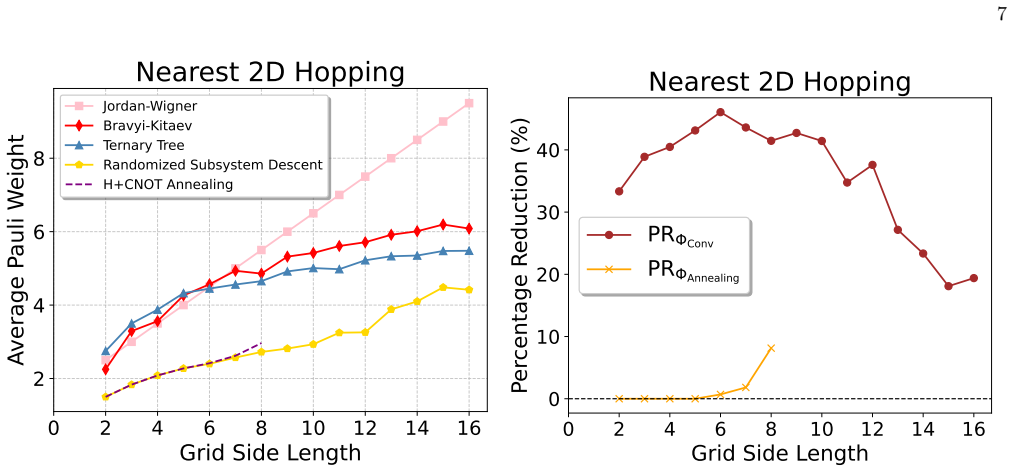
Left: average Pauli weight of Jordan-Wigner, Bravyi-Kitaev, ternary tree, H+CNOT annealing and randomized subsystem descent. Right: percentage reduction of PRΦConv and PRΦAnnealing. The results achieved by RSD perform at least equally well compared with H+CNOT annealing except for one data point atr= 17. 0 2 4 6 8 10 12 14 16 18 20 System Size 2 4 6 8Aver...
-
[2]
Right: percentage reduction of PRΦConv and PRΦAnnealing
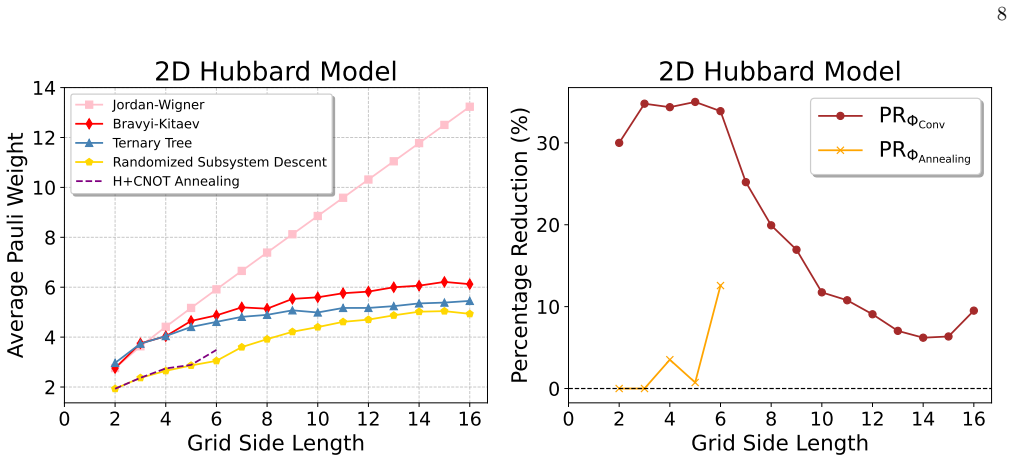
Left: average Pauli weight of Jordan-Wigner, Bravyi-Kitaev, ternary tree, H+CNOT annealing (Nranges from2to8) and randomized subsystem descent. Right: percentage reduction of PRΦConv and PRΦAnnealing. The results achieved by RSD perform equally well compared with H+CNOT annealing forN= 2,3,4,5,6, and achieves noticeable improvements forN= 7 and8. tice, th...
-
[3]
Right: percentage reduction of PRΦConv and PRΦAnnealing
Left: average Pauli weight of Jordan-Wigner, Bravyi-Kitaev, ternary tree, H+CNOT annealing (Nranges from2to6) and randomized subsystem descent. Right: percentage reduction of PRΦConv and PRΦAnnealing. The results achieved by RSD perform equally well compared with H+CNOT annealing forN= 2,3, and achieves more than10%improvement forN= 6. 2 3 4 5 6 7 8 9 10 ...
2000
-
[4]
R. P. Feynman, inFeynman and Computation(CRC Press, 2018) pp. 133–153
2018
-
[5]
Wecker, M
D. Wecker, M. B. Hastings, N. Wiebe, B. K. Clark, C. Nayak, and M. Troyer, Physical Review A92, 062318 (2015)
2015
- [6]
-
[7]
B. P. Lanyon, J. D. Whitfield, G. G. Gillett, M. E. Goggin, M. P. Almeida, I. Kassal, J. D. Biamonte, M. Mohseni, B. J. Powell, M. Barbieri,et al., Nature Chemistry2, 106 (2010)
2010
-
[8]
Chiew and S
M. Chiew and S. Strelchuk, Quantum7, 1145 (2023)
2023
-
[9]
Y. Liu, S. Che, J. Zhou, Y. Shi, and G. Li, inProceedings of the 29th ACM International Conference on Architec- tural Support for Programming Languages and Operating Systems, Volume 3(2024) pp. 382–397
2024
-
[10]
J. Yu, Y. Liu, S. Sugiura, T. Van Voorhis, and S. Zeytinoglu, Journal of Chemical Theory and Compu- tation21, 9430 (2025)
2025
-
[11]
Y. Liu, K. Yao, J. Hong, J. Froustey, E. Rrapaj, C. Ian- cull, G. Li, and Y. Shi, in2025 IEEE International Symposium on High Performance Computer Architecture (HPCA)(IEEE, 2025) pp. 143–157
2025
-
[12]
Setia, S
K. Setia, S. Bravyi, A. Mezzacapo, and J. D. Whitfield, Physical Review Research1, 033033 (2019)
2019
-
[13]
Derby, J
C. Derby, J. Klassen, J. Bausch, and T. Cubitt, Physical Review B104, 035118 (2021)
2021
-
[14]
Jordan and E
P. Jordan and E. Wigner, Zeitschrift für Physik47, 631 (1928)
1928
-
[15]
S. B. Bravyi and A. Y. Kitaev, Annals of Physics298, 210 (2002)
2002
-
[16]
Tranter, P
A. Tranter, P. J. Love, F. Mintert, and P. V. Coveney, Journal of Chemical Theory and Computation14, 5617 (2018)
2018
-
[17]
Jiang, A
Z. Jiang, A. Kalev, W. Mruczkiewicz, and H. Neven, Quantum4, 276 (2020)
2020
-
[18]
Verstraete and J
F. Verstraete and J. I. Cirac, Journal of Statistical Me- chanics: Theory and Experiment2005, P09012 (2005)
2005
- [19]
-
[20]
O’Brien and S
O. O’Brien and S. Strelchuk, Physical Review B109, 115149 (2024)
2024
-
[21]
Steudtner and S
M. Steudtner and S. Wehner, Physical Review A99, 022308 (2019)
2019
-
[22]
Nys and G
J. Nys and G. Carleo, Quantum6, 833 (2022)
2022
-
[23]
Miller, A
A. Miller, A. Glos, and Z. Zimborás, npj Quantum Infor- mation (2026)
2026
-
[24]
G. Li, A. Wu, Y. Shi, A. Javadi-Abhari, Y. Ding, and Y. Xie, inProceedings of the 27th ACM International Conference on Architectural Support for Programming Languages and Operating Systems(2022) pp. 554–569
2022
- [25]
- [26]
-
[27]
Phase Gadget Synthesis for Shallow Circuits,
A. Cowtan, S. Dilkes, R. Duncan, W. Simmons, and S. Sivarajah, arXiv preprint arXiv:1906.01734 (2019)
-
[28]
Van Den Berg and K
E. Van Den Berg and K. Temme, Quantum4, 322 (2020)
2020
-
[29]
Xu and W
Y. Xu and W. Yin, SIAM Journal on Imaging Sciences 6, 1758 (2013)
2013
-
[30]
Nesterov, SIAM Journal on Optimization22, 341 (2012)
Y. Nesterov, SIAM Journal on Optimization22, 341 (2012)
2012
-
[31]
Lu and L
Z. Lu and L. Xiao, Mathematical Programming152, 615 (2015)
2015
-
[32]
Necoara, Y
I. Necoara, Y. Nesterov, and F. Glineur, Journal of Op- timization Theory and Applications173, 227 (2017)
2017
-
[33]
A. K. Prasad, V. V. Shende, I. L. Markov, J. P. Hayes, and K. N. Patel, ACM Journal on Emerging Technologies in Computing Systems (JETC)2, 277 (2006)
2006
-
[34]
Bravyi, R
S. Bravyi, R. Shaydulin, S. Hu, and D. Maslov, Quantum 5, 580 (2021)
2021
-
[35]
J. Leng, J. Li, Y. Peng, and X. Wu, Quantum9, 1857 (2025)
2025
- [36]
-
[37]
Gilyén, Y
A. Gilyén, Y. Su, G. H. Low, and N. Wiebe, inProceed- ings of the 51st Annual ACM SIGACT Symposium on Theory of Computing(2019) pp. 193–204
2019
-
[38]
D. An, D. Fang, and L. Lin, Quantum5, 459 (2021)
2021
-
[39]
D. W. Berry, A. M. Childs, R. Cleve, R. Kothari, and R. D. Somma, inProceedings of the 46th Annual ACM Symposium on Theory of Computing(2014) pp. 283–292
2014
-
[40]
D. W. Berry, A. M. Childs, R. Cleve, R. Kothari, and R. D. Somma, Physical Review Letters114, 090502 (2015)
2015
-
[41]
Kieferová, A
M. Kieferová, A. Scherer, and D. W. Berry, Physical Re- view A99, 042314 (2019)
2019
-
[42]
A. M. Childs, Y. Su, M. C. Tran, N. Wiebe, and S. Zhu, Physical Review X11, 011020 (2021)
2021
-
[43]
Pauli, Zeitschrift für Physik31, 765 (1925)
W. Pauli, Zeitschrift für Physik31, 765 (1925)
1925
- [44]
-
[45]
D. An, D. Fang, and L. Lin, Quantum6, 690 (2022)
2022
-
[46]
Campbell, A random compiler for fast hamiltonian simulation, arXiv preprint arXiv:1811.08017 (2018)
E. Campbell, arXiv preprint arXiv:1811.08017 (2018)
-
[47]
Li, H.-Y
Q.-S. Li, H.-Y. Liu, Q. Wang, Y.-C. Wu, and G.-P. Guo, Chinese Physics Letters42, 100001 (2025)
2025
-
[48]
M. W. de la Bastida, T. M. Bickley, and P. V. Coveney, arXiv preprint arXiv:2512.13580 (2025)
work page internal anchor Pith review Pith/arXiv arXiv 2025
-
[49]
d’Esopo, Naval Research Logistics Quarterly6, 33 (1959)
D. d’Esopo, Naval Research Logistics Quarterly6, 33 (1959)
1959
- [50]
-
[51]
S. J. Wright, Mathematical Programming151, 3 (2015)
2015
-
[52]
Q. Lei, K. Zhong, and I. S. Dhillon, Advances in Neural Information Processing Systems29(2016)
2016
-
[53]
Y. Li, J. Lu, and Z. Wang, SIAM Journal on Scientific Computing41, A2681 (2019)
2019
-
[54]
J.Han, K.S.Song, J.Kim,andM.G.Kang,IEEETrans- actions on Image Processing27, 3556 (2018)
2018
-
[55]
I. M. Ross, inOperations Research Forum, Vol. 4 (Springer, 2023) p. 31
2023
-
[56]
M. Wu, C. Dick, J. R. Cavallaro, and C. Studer, in2016 IEEE International Symposium on Circuits and Systems (ISCAS)(IEEE, 2016) pp. 1894–1897
2016
-
[57]
M. Wu, C. Dick, J. R. Cavallaro, and C. Studer, IEEE Transactions on Circuits and Systems I: Regular Papers 63, 2357 (2017)
2017
-
[58]
Z. Wang, Y. Li, and J. Lu, Journal of Chemical Theory and Computation15, 3558 (2019). 12
2019
-
[59]
Zhang, W
Y. Zhang, W. Gao, and Y. Li, Journal of Chemical The- ory and Computation21, 2325 (2025)
2025
-
[60]
D. P. Bertsekas, Journal of the Operational Research So- ciety48, 334 (1997)
1997
-
[61]
G. Yuan, L. Shen, and W.-S. Zheng, inProceedings of the 26th ACM SIGKDD International Conference on Knowl- edge Discovery & Data Mining(2020) pp. 275–285
2020
-
[62]
Patrascu and I
A. Patrascu and I. Necoara, in2015 20th International Conference on Control Systems and Computer Science (IEEE, 2015) pp. 909–914
2015
-
[63]
Liu, Y.-X
B.-D. Liu, Y.-X. Wang, B. Shen, Y.-J. Zhang, and Y.-J. Wang, in2014 IEEE International Conference on Acous- tics, Speech and Signal Processing (ICASSP)(IEEE,
-
[64]
A. Javadi-Abhari, M. Treinish, K. Krsulich, C. J. Wood, J. Lishman, J. Gacon, S. Martiel, P. D. Na- tion, L. S. Bishop, A. W. Cross,et al., arXiv preprint arXiv:2405.08810 (2024)
work page internal anchor Pith review arXiv 2024
-
[65]
Fradkin,Field theories of condensed matter physics (Cambridge University Press, 2013)
E. Fradkin,Field theories of condensed matter physics (Cambridge University Press, 2013)
2013
-
[66]
E. Lieb, T. Schultz, and D. Mattis, Annals of Physics16, 407 (1961)
1961
-
[67]
J. P. LeBlanc, A. E. Antipov, F. Becca, I. W. Bulik, G. K.-L. Chan, C.-M. Chung, Y. Deng, M. Ferrero, T. M. Henderson, C. A. Jiménez-Hoyos,et al., Physical Review X5, 041041 (2015)
2015
-
[68]
Spinelli, M
A. Spinelli, M. Rebergen, and A. Otte, Journal of Physics: Condensed Matter27, 243203 (2015)
2015
-
[69]
Altman, K
E. Altman, K. R. Brown, G. Carleo, L. D. Carr, E. Dem- ler, C. Chin, B. DeMarco, S. E. Economou, M. A. Eriks- son, K.-M. C. Fu,et al., PRX Quantum2, 017003 (2021)
2021
-
[70]
Fowler, A
R.Barends, L.Lamata, J.Kelly, L.García-Álvarez, A.G. Fowler, A. Megrant, E. Jeffrey, T. C. White, D. Sank, J. Y. Mutus,et al., Nature Communications6, 7654 (2015)
2015
-
[71]
Szabo and N
A. Szabo and N. S. Ostlund,Modern quantum chem- istry: introduction to advanced electronic structure theory (Courier Corporation, 2012)
2012
-
[72]
Babbush, P
R. Babbush, P. J. Love, and A. Aspuru-Guzik, Scientific Reports4, 6603 (2014)
2014
-
[73]
Q. Sun, T. C. Berkelbach, N. S. Blunt, G. H. Booth, S. Guo, Z. Li, J. Liu, J. D. McClain, E. R. Sayfutyarova, S. Sharma,et al., Wiley Interdisciplinary Reviews: Com- putational Molecular Science8, e1340 (2018)
2018
-
[74]
Q. Sun, X. Zhang, S. Banerjee, P. Bao, M. Barbry, N. S. Blunt, N. A. Bogdanov, G. H. Booth, J. Chen, Z.-H. Cui, et al., The Journal of Chemical Physics153(2020)
2020
-
[75]
Q. Sun, M. R. Hermes, X. Wu, H. Zhai, X. Zhang, A. M. Ahmed, J. J. Aucar, O. J. Backhouse, S. Banerjee, P. Bao,et al., arXiv preprint arXiv:2603.14155 (2026)
work page internal anchor Pith review Pith/arXiv arXiv 2026
-
[76]
Leone, S
L. Leone, S. F. Oliviero, L. Cincio, and M. Cerezo, Quan- tum8, 1395 (2024)
2024
-
[77]
D’Cunha, T
R. D’Cunha, T. D. Crawford, M. Motta, and J. E. Rice, The Journal of Physical Chemistry A127, 3437 (2023)
2023
- [78]
-
[79]
Xu and W
Y. Xu and W. Yin, Journal of Scientific Computing72, 700 (2017)
2017
-
[80]
Chen and C
T. Chen and C. Guestrin, inProceedings of the 22nd ACM SIGKDD International Conference on Knowledge Discovery and Data Mining(2016) pp. 785–794. SUPPLEMENT AR Y MA TERIALS Appendix A: Clifford transformations One important type of unitary operators is the set of Pauli operators, namely I= 1 1 , X= 1 1 , Y= −ı ı , Z= 1 −1 . (A1) They form a basis of all th...
2016
discussion (0)
Sign in with ORCID, Apple, or X to comment. Anyone can read and Pith papers without signing in.