Recognition: unknown
New physics in the ZZh vertex: One-loop contributions from a radiative seesaw model
Pith reviewed 2026-05-10 05:04 UTC · model grok-4.3
The pith
In a radiative seesaw model, one-loop contributions from Majorana neutrinos generate CP-conserving anomalous couplings in the ZZh vertex at the 10^{-3} level.
A machine-rendered reading of the paper's core claim, the machinery that carries it, and where it could break.
Core claim
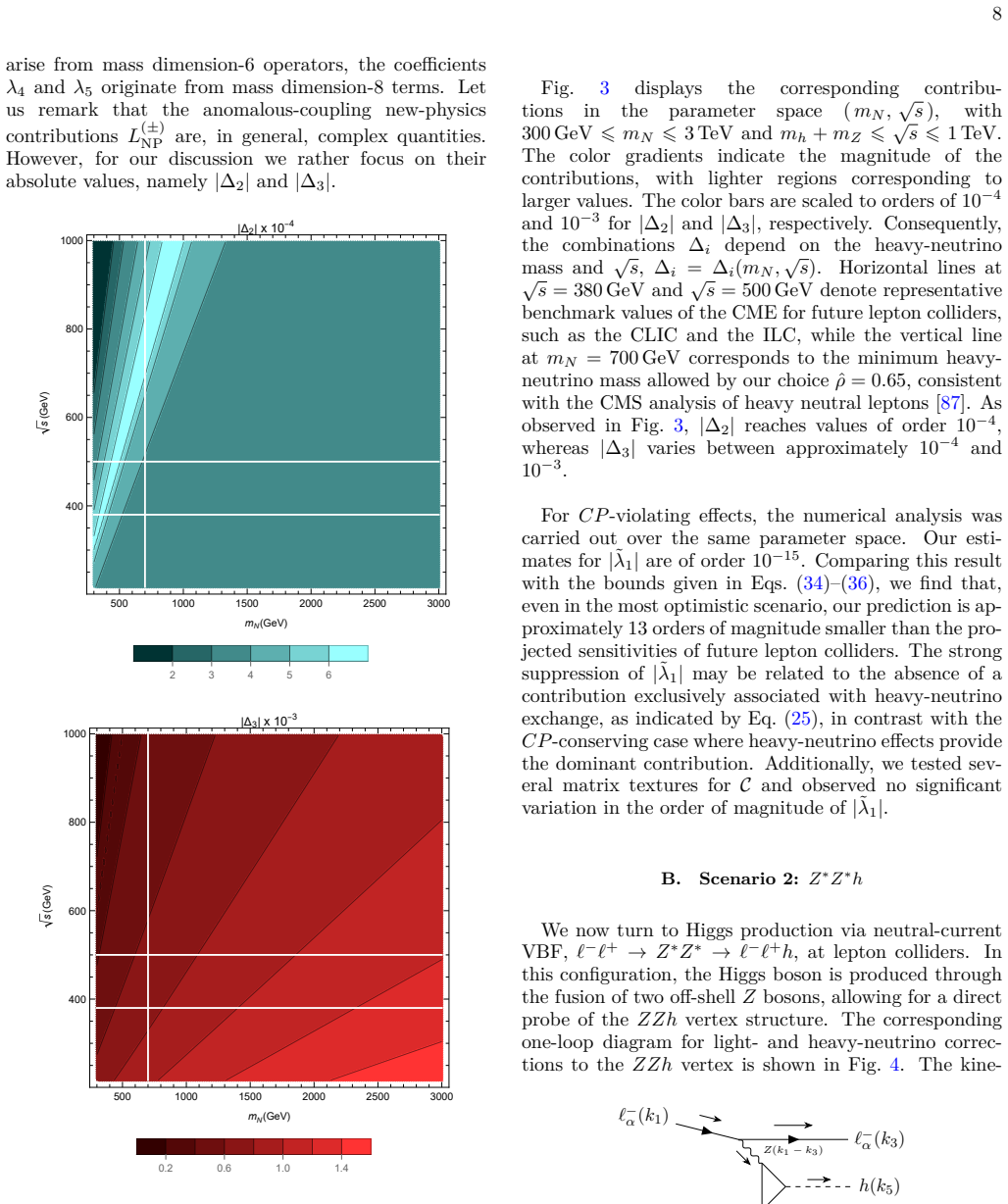
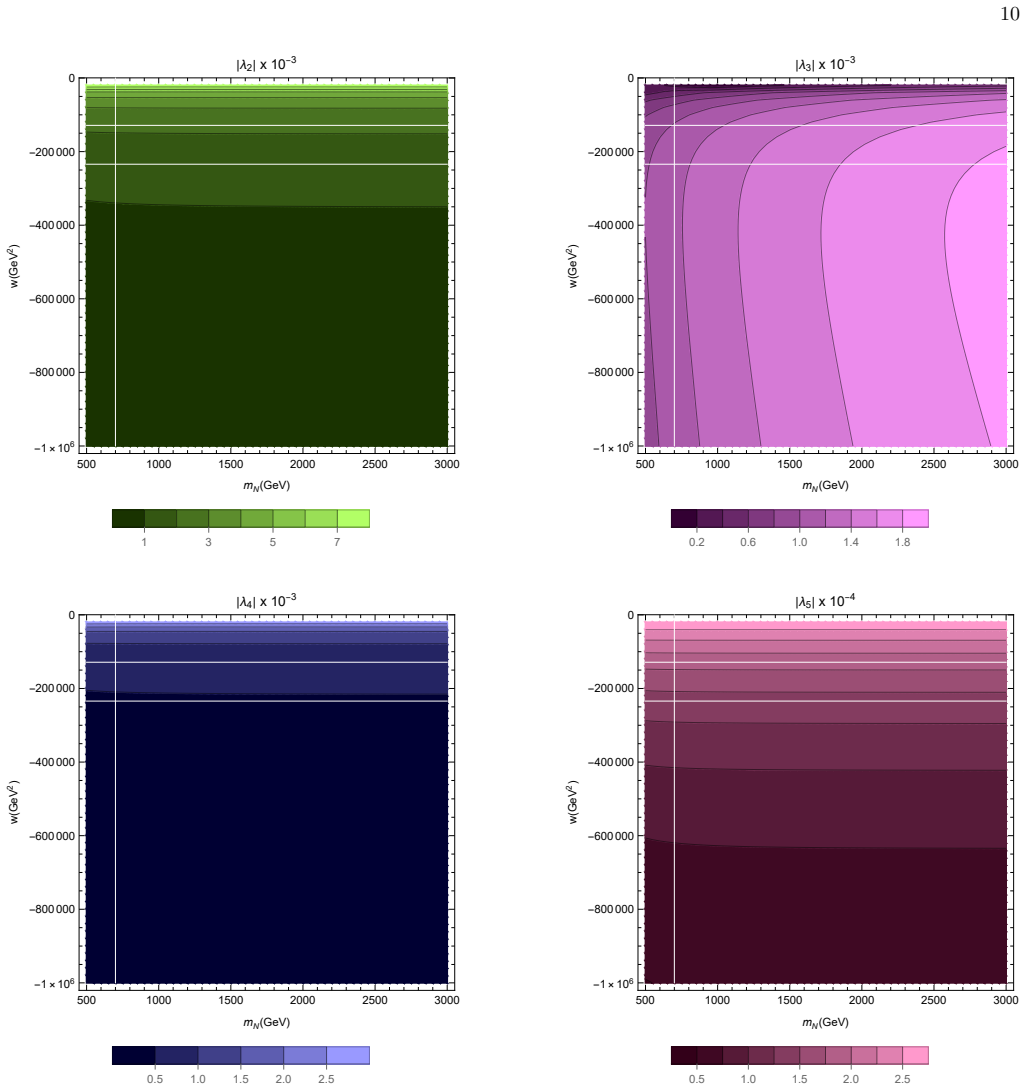
The one-loop contributions from light and heavy Majorana neutrinos in the radiative type-I seesaw model generate anomalous CP-conserving and CP-violating couplings in the ZZh vertex. In the kinematic scenarios of Higgsstrahlung production and neutral-current vector-boson fusion at future lepton colliders, the CP-conserving effects can attain magnitudes of order 10^{-3}, which may lie within projected experimental sensitivities, whereas the CP-violating contributions are strongly suppressed and lie well beyond such projections.
What carries the argument
One-loop Feynman diagrams from the radiative type-I seesaw mechanism with Majorana neutrinos, which induce anomalous couplings at the ZZh vertex.
Load-bearing premise
The model's parameters can be chosen to produce one-loop ZZh corrections of order 10^{-3} while remaining consistent with neutrino oscillation data and other existing bounds.
What would settle it
A precision measurement at a future lepton collider that finds all CP-conserving anomalous ZZh couplings smaller than 10^{-4} in the viable parameter regions allowed by neutrino data would contradict the paper's result.
Figures


read the original abstract
Precision Higgs physics offers a sensitive window into physics beyond the Standard Model. In parallel, neutrino-oscillation experiments have established the existence of nonzero neutrino masses, thus implying the presence of new physics. Motivated by these facts, we investigate the one-loop contributions of light and heavy Majorana neutrinos to the $ZZh$ vertex within a variant of the type-I seesaw mechanism in which light-neutrino masses vanish at tree level and are then generated radiatively. We analyze the $CP$-conserving and $CP$-violating anomalous couplings which characterize the $ZZh$ vertex and study their phenomenological implications in two relevant kinematic scenarios at future lepton colliders: Higgsstrahlung production and Higgs production via neutral-current vector-boson fusion. We find that $CP$-conserving effects can reach magnitudes of order $10^{-3}$, potentially within projected future experimental sensitivities, whereas $CP$-violating contributions are strongly suppressed, lying well beyond such projections.
Editorial analysis
A structured set of objections, weighed in public.
Referee Report
Summary. The manuscript computes the one-loop contributions of light and heavy Majorana neutrinos to the ZZh vertex in a radiative variant of the type-I seesaw model (tree-level neutrino masses set to zero). It extracts the CP-conserving and CP-violating form factors, evaluates them in two collider processes (Higgsstrahlung and neutral-current VBF), and reports that CP-conserving effects can reach O(10^{-3}) for viable parameter choices while CP-violating effects remain far smaller.
Significance. If the numerical benchmarks survive a joint fit to neutrino oscillation data, the work supplies a concrete, falsifiable link between the radiative neutrino-mass mechanism and precision Higgs observables at future lepton colliders. The strong suppression of the CP-odd sector is a sharp, model-specific prediction.
major comments (1)
- [Numerical results / parameter benchmarks] The central claim that O(10^{-3}) CP-conserving effects are attainable rests on the existence of parameter points (Yukawa couplings, heavy Majorana masses, and scalar vevs) that simultaneously generate the observed Delta m^2_{21}, Delta m^2_{31}, and PMNS angles at one loop while producing the quoted ZZh corrections. The numerical section must demonstrate this explicitly (e.g., via a table or scan plot) rather than stating that such choices exist; the loop functions entering the neutrino mass matrix and the ZZh vertex are closely related, so an enhancement in one can easily push the other outside experimental bounds.
Simulated Author's Rebuttal
We thank the referee for the careful reading of our manuscript and the constructive suggestion to strengthen the presentation of our numerical results. We address the major comment in detail below and have prepared a revision that incorporates the requested explicit benchmarks.
read point-by-point responses
-
Referee: [Numerical results / parameter benchmarks] The central claim that O(10^{-3}) CP-conserving effects are attainable rests on the existence of parameter points (Yukawa couplings, heavy Majorana masses, and scalar vevs) that simultaneously generate the observed Delta m^2_{21}, Delta m^2_{31}, and PMNS angles at one loop while producing the quoted ZZh corrections. The numerical section must demonstrate this explicitly (e.g., via a table or scan plot) rather than stating that such choices exist; the loop functions entering the neutrino mass matrix and the ZZh vertex are closely related, so an enhancement in one can easily push the other outside experimental bounds.
Authors: We agree that an explicit demonstration is required to substantiate the claim, particularly because the relevant loop integrals share structural similarities. In the revised manuscript we have added a new table of benchmark points together with a short accompanying discussion. Each point specifies the input Yukawa couplings, heavy Majorana masses and scalar vevs; the resulting one-loop neutrino mass matrix reproduces the observed mass-squared splittings and PMNS angles to within current 3-sigma experimental uncertainties, while the CP-conserving ZZh form factors simultaneously reach O(10^{-3}). The scan was performed by varying the relevant parameters over ranges consistent with the radiative-seesaw framework and checking that no additional experimental constraints are violated. This directly addresses the concern that an enhancement in one observable might force the other outside allowed ranges. revision: yes
Circularity Check
No significant circularity: explicit one-loop computation of ZZh corrections is independent of neutrino mass fitting
full rationale
The paper derives the anomalous ZZh couplings via explicit one-loop Feynman diagrams involving Majorana neutrinos in the radiative seesaw model. The neutrino mass matrix is generated radiatively from the same Yukawa couplings and scalar vevs, but the ZZh vertex corrections are computed separately from triangle and self-energy diagrams; the resulting form factors are not algebraically identical to the mass matrix elements or defined in terms of them. Parameter benchmarks are chosen to satisfy oscillation data, yet the vertex magnitudes (order 10^{-3} for CP-even parts) emerge from the loop integrals rather than being fitted or renamed. No self-citation is load-bearing for the central result, and the calculation remains a standard perturbative evaluation without self-definitional steps or imported uniqueness theorems.
Axiom & Free-Parameter Ledger
free parameters (2)
- Masses of heavy Majorana neutrinos
- Yukawa coupling strengths
axioms (2)
- standard math Perturbative quantum field theory applies to the one-loop level in this model.
- domain assumption No other new physics contributes to the ZZh vertex at one-loop order.
invented entities (1)
-
Radiative seesaw variant with vanishing tree-level neutrino masses
no independent evidence
Reference graph
Works this paper leans on
-
[1]
Aad and et al
G. Aad and et al. (ATLAS Collaboration), Physics Let- ters B 716, 1–29 (2012)
2012
-
[2]
Chatrchyan and et al
S. Chatrchyan and et al. (CMS Collaboration), Physics Letters B 716, 30–61 (2012)
2012
-
[3]
Djouadi, Physics Reports 457, 1–216 (2008)
A. Djouadi, Physics Reports 457, 1–216 (2008)
2008
-
[4]
Measurement of the properties of a Higgs boson in the four-lepton final state
S. Chatrchyan and et. al. (CMS Collaboration), Physical Review D 89, 10.1103/physrevd.89.092007 (2014)
-
[5]
G. Aad and et. al (ATLAS Collaboration), Physical Re- view D 90, 10.1103/physrevd.90.052004 (2014)
-
[6]
G. Aad and et. al (ATLAS and CMS Collab- oration), Journal of High Energy Physics 2016, 10.1007/jhep08(2016)045 (2016)
-
[7]
Aadet al.(ATLAS), JHEP04, 075, arXiv:2410.19611 [hep-ex]
G. Aad and et. al (ATLAS Collaboration), JHEP 2504, 075, arXiv:2410.19611
-
[8]
Aaboud and et
M. Aaboud and et. al (ATLAS Collaboration), J. High Energ. Phys
-
[9]
G. Aad and et. al (ATLAS Collaboration), The Euro- pean Physical Journal C 81, 10.1140/epjc/s10052-020- 08677-2 (2021)
-
[10]
Tumasyan and et
A. Tumasyan and et. al (CMS Collaboration), Nature Physics 18, 1329–1334 (2022)
2022
-
[11]
G. Aad and et. al (ATLAS Collaboration), The Euro- pean Physical Journal C 75, 10.1140/epjc/s10052-015- 3542-2 (2015)
-
[12]
G. Aad and et. al (ATLAS Collaboration), Physi- cal Review Letters 116, 10.1103/physrevlett.116.101801 (2016)
-
[13]
M. J. Boland et al. (CLIC, CLICdp), CERN Yellow Rep. 4, 1 (2016) , arXiv:1608.07537 [physics.acc-ph]
work page Pith review arXiv 2016
-
[14]
H. Baer, T. Barklow, K. Fujii, Y. Gao, A. Hoang, S. Kanemura, J. List, H. E. Logan, A. Nomerotski, M. Perelstein, M. E. Peskin, R. Pöschl, J. Reuter, S. Riemann, A. Savoy-Navarro, G. Servant, T. M. P. Tait, and J. Yu, arXiv e-prints , arXiv:1306.6352 (2013) , arXiv:1306.6352 [hep-ph]
-
[15]
Asner, T
D. Asner, T. Barklow, C. Calancha, K. Fujii, N. Graf, H. Haber, A. Ishikawa, S. Kanemura, S.-i. Kawada, M. Kurata, A. Miyamoto, H. Neal, H. Ono, C. Potter, J. Strube, T. Suehara, T. Tanabe, J. Tian, K. Tsumura, and H. Yokoya, (2013)
2013
-
[16]
F. Borzumati and E. Kato, Frontiers in Physics 2, 10.3389/fphy.2014.00032 (2014)
-
[17]
J. Tian and K. Fujii (ILD), PoS EPS-HEP2013, 316 (2013), arXiv:1311.6528 [hep-ph]
-
[18]
Fleischer and F
J. Fleischer and F. Jegerlehner, Phys. Rev. D 23, 2001 (1981)
2001
-
[19]
B. A. Kniehl, Nuclear Physics B 352, 1 (1991)
1991
- [20]
-
[21]
A. I. Hernández-Juárez, A. Fernández-Téllez, and G. Tavares-Velasco, Phys. Rev. D 107, 115031 (2023)
2023
-
[22]
F. Arco, D. Domenech, M. J. Herrero, and R. A. Morales, Phys. Rev. D 108, 095013 (2023)
2023
-
[23]
Kikuchi, Nuclear and Particle Physics Proceedings 273-275, 807 (2016) , 37th International Conference on High Energy Physics (ICHEP)
M. Kikuchi, Nuclear and Particle Physics Proceedings 273-275, 807 (2016) , 37th International Conference on High Energy Physics (ICHEP)
2016
-
[24]
Kanemura, M
S. Kanemura, M. Kikuchi, and K. Yagyu, Nuclear Physics B 907, 286 (2016)
2016
-
[25]
Kanemura, M
S. Kanemura, M. Kikuchi, K. Sakurai, and K. Yagyu, Phys. Rev. D 96, 035014 (2017)
2017
-
[26]
J. Baglio, T. N. Dao, and M. Mühlleitner, The European Physical Journal C 80, 10.1140/epjc/s10052-020-08520- 8 (2020)
-
[27]
C. Englert, Y. Soreq, and M. Spannowsky, JHEP 05, 145, arXiv:1410.5440 [hep-ph]
-
[28]
Arhrib, R
A. Arhrib, R. Benbrik, J. El Falaki, and A. Jueid, Jour- nal of High Energy Physics 2015, 1–23 (2015)
2015
-
[29]
Kanemura, M
S. Kanemura, M. Kikuchi, and K. Sakurai, Phys. Rev. D 94, 115011 (2016)
2016
-
[30]
M. Aoki, S. Kanemura, M. Kikuchi, and K. Yagyu, Phys. Rev. D 87, 015012 (2013)
2013
-
[31]
Chiang, A.-L
C.-W. Chiang, A.-L. Kuo, and K. Yagyu, Physics Let- ters B 774, 119–122 (2017)
2017
-
[32]
Grossman, Nuclear Physics B 426, 355–384 (1994)
Y. Grossman, Nuclear Physics B 426, 355–384 (1994)
1994
-
[33]
Pilaftsis, Zeitschrift für Physik C Particles and Fields 55, 275–282 (1992)
A. Pilaftsis, Zeitschrift für Physik C Particles and Fields 55, 275–282 (1992)
1992
-
[34]
E. Martínez, J. Montaño-Domínguez, H. Novales- Sánchez, and M. Salinas, Phys. Rev. D 107, 035025 (2023), arXiv:2211.04629 [hep-ph]
-
[35]
H. Novales-Sánchez and M. Salinas, Phys. Rev. D 108, 075032 (2023) , arXiv:2309.02400 [hep-ph] . 12
-
[36]
H. Novales-Sánchez, M. Salinas, and H. Vázquez-Castro, Phys. Rev. D 110, 035025 (2024) , arXiv:2404.08205 [hep-ph]
-
[37]
E. Ramírez, H. Novales-Sánchez, H. Vázquez-Castro, and M. Salinas, J. Phys. G 52, 105004 (2025) , arXiv:2505.09051 [hep-ph]
-
[38]
H. Novales-Sánchez, E. Ramírez, M. Salinas, and H. Vázquez-Castro, JHEP 11, 009 , arXiv:2507.05574 [hep-ph]
-
[39]
Wudka, International Journal of Modern Physics A 09, 2301–2361 (1994)
J. Wudka, International Journal of Modern Physics A 09, 2301–2361 (1994)
1994
-
[40]
Dobado, A
A. Dobado, A. Gomez-Nicola, A. L. Maroto, and J. R. Pelaez, (1997)
1997
-
[41]
C. G. Knetter, Phys. Rev. D 49, 6709 (1994)
1994
-
[42]
Babu and C
K. Babu and C. Leung, Nuclear Physics B 619, 667–689 (2001)
2001
-
[43]
Weinberg, Phys
S. Weinberg, Phys. Rev. Lett. 43, 1566 (1979)
1979
-
[44]
C. N. Leung, S. T. Love, and S. Rao, Z. Phys. C 31, 433 (1986)
1986
-
[45]
Buchmüller and D
W. Buchmüller and D. Wyler, Nuclear Physics B 268, 621 (1986)
1986
-
[46]
B. Grzadkowski, M. Iskrzyński, M. Misiak, and J. Rosiek, Journal of High Energy Physics 2010, 10.1007/jhep10(2010)085 (2010)
-
[47]
Handbook of LHC Higgs Cross Sections: 4. Deciphering the Nature of the Higgs Sector
D. de Florian et al. (LHC Higgs Cross Section Work- ing Group), CERN Yellow Rep. Monogr. 2, 1 (2017) , arXiv:1610.07922 [hep-ph]
work page Pith review arXiv 2017
-
[48]
A. Azatov et al. 10.17181/LHCHWG-2022-001 (2022), arXiv:2203.02418 [hep-ph]
-
[49]
Marzocca, F
D. Marzocca, F. Riva, J. C. Criado, S. Dawson, J. de Blas, B. Q. Henning, D. Liu, C. W. Murphy, M. Pérez-Victoria, J. M. C. Santiago, L. Vecchi, and L. tao Wang, arXiv: High Energy Physics - Phe- nomenology (2020)
2020
-
[50]
A. Falkowski, B. Fuks, K. Mawatari, K. Mimasu, F. Riva, and V. Sanz, Eur. Phys. J. C 75, 583 (2015) , arXiv:1508.05895 [hep-ph]
-
[51]
Falkowski and A
A. Falkowski and A. Falkowski, (2015)
2015
-
[52]
Q.-H. Cao, Y. Liu, and S.-R. Yuan, Nuclear Physics B 1010, 116781 (2025)
2025
-
[53]
G. F. Giudice, C. Grojean, A. Pomarol, and R. Rattazzi, Journal of High Energy Physics 2007, 045–045 (2007)
2007
-
[54]
G. Buchalla, O. Cata, and C. Krause, Nucl. Phys. B 894, 602 (2015) , arXiv:1412.6356 [hep-ph]
- [55]
-
[56]
Englert and R
F. Englert and R. Brout, Phys. Rev. Lett. 13, 321 (1964)
1964
-
[57]
P. W. Higgs, Phys. Rev. Lett. 13, 508 (1964)
1964
-
[58]
G. C. Wick, Phys. Rev. 80, 268 (1950)
1950
-
[59]
R. P. Feynman, Phys. Rev. 76, 769 (1949)
1949
-
[60]
Gluza and M
J. Gluza and M. Zraek, Phys. Rev. D 45, 1693 (1992)
1992
-
[61]
Denner, H
A. Denner, H. Eck, O. Hahn, and J. Kublbeck, Phys. Lett. B 291, 278 (1992)
1992
-
[62]
E. I. Gates and K. L. Kowalski, Phys. Rev. D 37, 938 (1988)
1988
-
[63]
H. E. Haber and G. L. Kane, Phys. Rept. 117, 75 (1985)
1985
-
[64]
Denner, H
A. Denner, H. Eck, O. Hahn, and J. Küblbeck, Nuclear Physics B 387, 467 (1992)
1992
-
[65]
C. G. Bollini and J. J. Giambiagi, Nuovo Cim. B 12, 20 (1972)
1972
-
[66]
’t Hooft and M
G. ’t Hooft and M. Veltman, Nuclear Physics B 44, 189 (1972)
1972
-
[67]
Passarino and M
G. Passarino and M. Veltman, Nuclear Physics B 160, 151 (1979)
1979
-
[68]
Devaraj and R
G. Devaraj and R. G. Stuart, Nuclear Physics B 519, 483 (1998)
1998
-
[69]
Mertig, M
R. Mertig, M. Böhm, and A. Denner, Computer Physics Communications 64, 345 (1991)
1991
-
[70]
Shtabovenko, R
V. Shtabovenko, R. Mertig, and F. Orellana, Computer Physics Communications 207, 432–444 (2016)
2016
-
[71]
Shtabovenko, R
V. Shtabovenko, R. Mertig, and F. Orellana, Computer Physics Communications 256, 107478 (2020)
2020
-
[72]
H. H. Patel, Computer Physics Communications 197, 276–290 (2015)
2015
-
[73]
Alam and et
S. Alam and et. al (eBOSS), Phys. Rev. D 103, 083533 (2021)
2021
-
[74]
Aghanim, N. and et. al (Plank), A&A 641, A6 (2020)
2020
-
[75]
Aker and et
M. Aker and et. al (KATRIN), Science 388, 180–185 (2025)
2025
-
[76]
K. Abe and et. al (Super Kamiokand), Physical Review D 109, 10.1103/physrevd.109.092001 (2024)
-
[77]
P. Adamson and et. al (MINOS+), Physical Review Let- ters 125, 10.1103/physrevlett.125.131802 (2020)
-
[78]
M. A. Acero and et. al (NOvA), Physical Review D 106, 10.1103/physrevd.106.032004 (2022)
-
[79]
K. Abe and et. al (T2K), The European Physical Jour- nal C 83, 10.1140/epjc/s10052-023-11819-x (2023)
-
[80]
R. Abbasi and et. al (IceCube Collaboration), Physical Review D 108, 10.1103/physrevd.108.012014 (2023)
discussion (0)
Sign in with ORCID, Apple, or X to comment. Anyone can read and Pith papers without signing in.