Recognition: unknown
Thermodynamic behavior of cosmological models with fractional entropy
Pith reviewed 2026-05-10 04:48 UTC · model grok-4.3
The pith
Fractional entropy on the apparent horizon produces thermodynamically stable models for late-time cosmic acceleration that align with data near the general relativity case.
A machine-rendered reading of the paper's core claim, the machinery that carries it, and where it could break.
Core claim
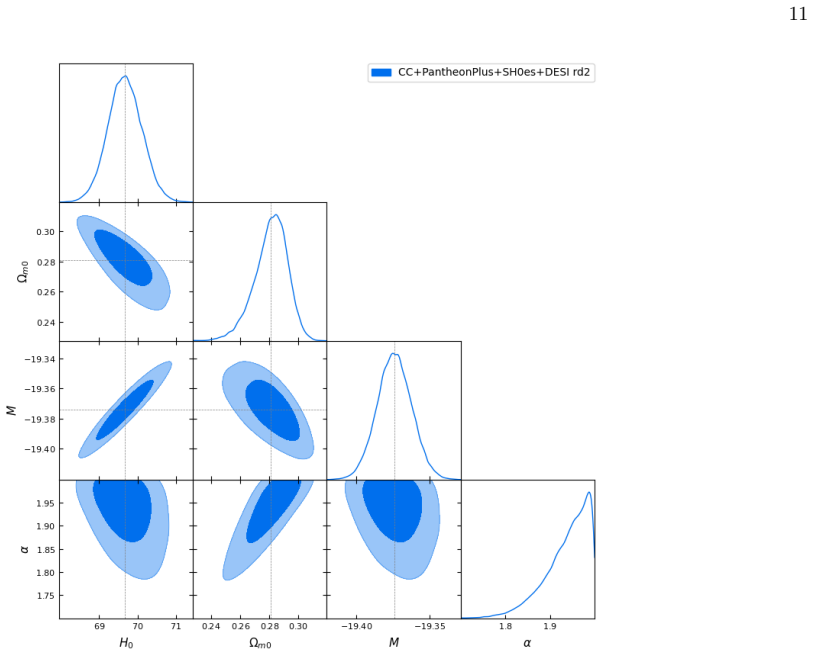
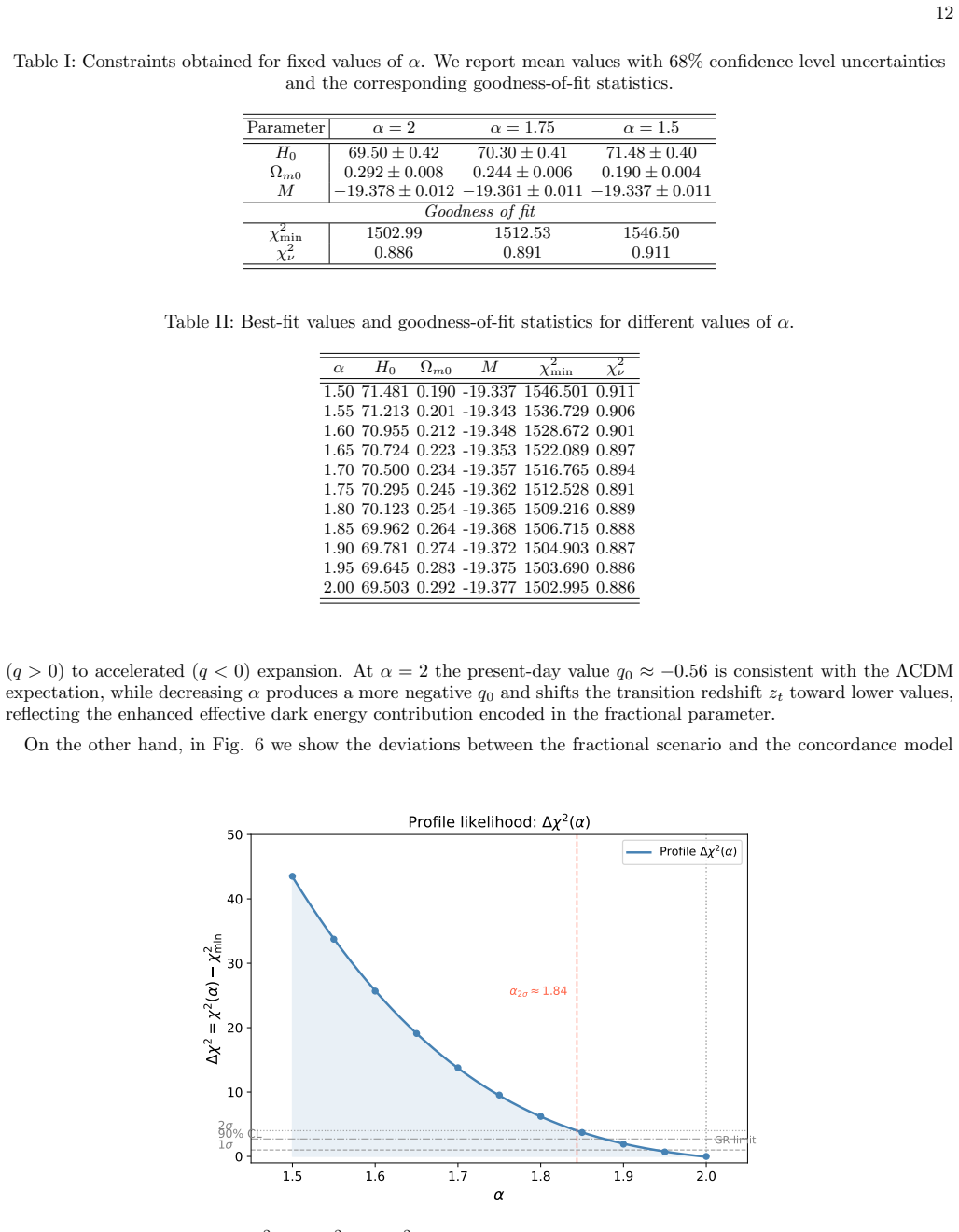
The central discovery is that applying fractional entropy to the apparent horizon yields generalized Friedmann equations via the unified first law of thermodynamics and Kodama-Hayward temperature for alpha in (1,2]. The specific heats C_V and C_p have identical signs and depend only on the deceleration parameter, establishing thermodynamic stability during late-time acceleration without phase transitions. Fitting to Cosmic Chronometers, Pantheon+SH0ES, and DESI DR2 data shows monotonic degradation in fit quality as alpha decreases from 2, with the data preferring alpha near 2 and producing H0 = 69.50 ± 0.42 km/s/Mpc and Ωm0 = 0.292 ± 0.008, where smaller alpha raises H0 and lowers Ωm0.
What carries the argument
fractional entropy on the apparent horizon combined with the unified first law of thermodynamics and the Kodama-Hayward temperature
Load-bearing premise
Fractional entropy applies consistently to the apparent horizon in a flat FLRW universe, enabling derivation of generalized Friedmann equations from the unified first law and Kodama-Hayward temperature.
What would settle it
Observational data from a larger sample or different probes indicating better fits for alpha less than 2 would falsify the finding that data favor alpha close to 2.
Figures



read the original abstract
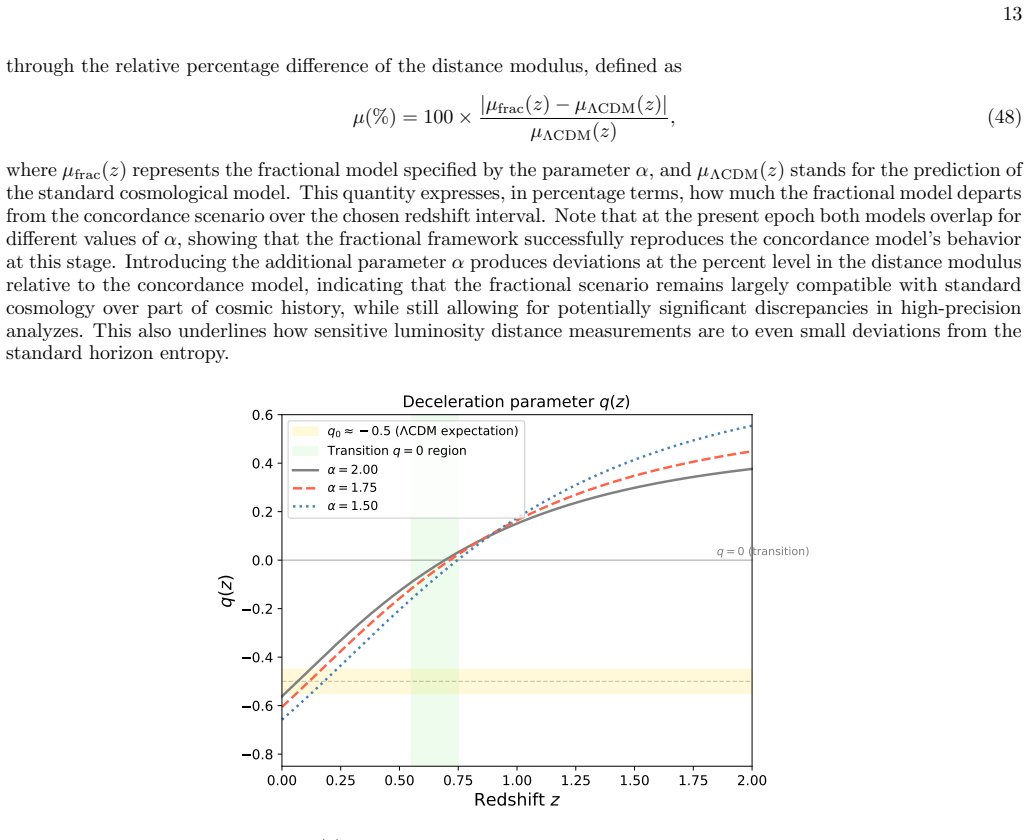
We investigate the thermodynamic and phenomenological implications of a cosmological model governed by fractional entropy applied to the apparent horizon of a flat Friedmann-Lema\^{i}tre-Robertson-Walker (FLRW) universe. By utilizing the unified first law of thermodynamics alongside the Kodama-Hayward temperature, we derive a generalized set of Friedmann equations characterized by a fractional parameter $\alpha \in (1,2]$. The thermodynamic analysis reveals that the specific heats $C_V$ and $C_p$ share the same sign and depend solely on the deceleration parameter, demonstrating that the fractional model is thermodynamically stable during the late-time accelerated expansion and does not exhibit phase transitions. To constrain the background dynamics, we confront the truncated fractional model with a joint sample of late-time observational data, including Cosmic Chronometers, Pantheon+SH0ES supernovae, and the latest DESI DR2 Baryon Acoustic Oscillations. Exploring the physically motivated range $ 1 < \alpha \leq 2 $, we find that the fit quality degrades monotonically as $\alpha$ decreases from the General Relativity limit, with the data favoring $\alpha$ close to $2$ while yielding $H_0 = 69.50 \pm 0.42$ km/s/Mpc and $\Omega_{m0} = 0.292 \pm 0.008 $ at $\alpha = 2$. Decreasing $\alpha$ coherently shifts $H_0$ upward and $\Omega_{m0} $ downward, revealing that the fractional parameter modulates the background expansion in a physically nontrivial and observationally distinguishable way.
Editorial analysis
A structured set of objections, weighed in public.
Referee Report
Summary. The manuscript applies a fractional entropy S_α (with α ∈ (1,2]) to the apparent horizon of a flat FLRW universe, inserts it into the unified first law together with the Kodama-Hayward temperature, and obtains a one-parameter family of generalized Friedmann equations. It then shows that the specific heats C_V and C_p have the same sign and depend only on the deceleration parameter, implying thermodynamic stability and absence of phase transitions during late-time acceleration. Finally, the truncated model is confronted with Cosmic Chronometers, Pantheon+SH0ES, and DESI DR2 BAO data, which favor α close to the GR limit 2 and yield H_0 = 69.50 ± 0.42 km s^{-1} Mpc^{-1}, Ω_{m0} = 0.292 ± 0.008 at α = 2, with lower α shifting H_0 upward and Ω_{m0} downward.
Significance. If the generalized equations are dynamically consistent, the work supplies a thermodynamically motivated, observationally testable modification of cosmology whose stability properties are controlled solely by the deceleration parameter. The monotonic degradation of fit quality with decreasing α and the coherent shifts in H_0 and Ω_{m0} constitute falsifiable predictions. The use of the latest DESI DR2 sample is a positive feature.
major comments (2)
- [§2] §2 (derivation of generalized Friedmann equations): Replacing the standard entropy with S_α in δQ = T dS while keeping the Kodama-Hayward temperature fixed does not automatically preserve the matter continuity equation. The manuscript does not demonstrate that the resulting effective stress-energy tensor satisfies ∇_μ T^μν = 0; an α-dependent source term would render the late-time stability analysis and the reported parameter constraints internally inconsistent.
- [§4] §4 (thermodynamic stability): The claim that C_V and C_p share the same sign and depend only on the deceleration parameter is asserted without the explicit expressions derived from the generalized Friedmann equations. It is therefore unclear whether this property survives the truncation used for the observational fits or holds for all α ∈ (1,2].
minor comments (2)
- The truncation procedure applied to the fractional model before the data analysis is not defined in the main text, making it impossible to reproduce the reported best-fit values.
- The abstract states that fit quality degrades monotonically with decreasing α, but no table or figure quantifies χ² or information criteria for the sequence of α values.
Simulated Author's Rebuttal
We thank the referee for the careful reading and constructive comments on our manuscript. We address each major comment below, providing clarifications where needed and indicating revisions that will strengthen the presentation.
read point-by-point responses
-
Referee: [§2] §2 (derivation of generalized Friedmann equations): Replacing the standard entropy with S_α in δQ = T dS while keeping the Kodama-Hayward temperature fixed does not automatically preserve the matter continuity equation. The manuscript does not demonstrate that the resulting effective stress-energy tensor satisfies ∇_μ T^μν = 0; an α-dependent source term would render the late-time stability analysis and the reported parameter constraints internally inconsistent.
Authors: We appreciate the referee pointing out this consistency requirement. Our derivation in §2 applies the unified first law with the fractional entropy S_α and Kodama-Hayward temperature to obtain the generalized Friedmann equations. The resulting effective stress-energy tensor is constructed such that the standard matter component obeys the usual continuity equation ∇_μ T^μν_m = 0, with the fractional modification absorbed into an effective dark-energy sector that satisfies its own continuity equation. No α-dependent source term appears in the matter sector. We will add an explicit verification of the divergence in the revised §2 to demonstrate this explicitly. revision: yes
-
Referee: [§4] §4 (thermodynamic stability): The claim that C_V and C_p share the same sign and depend only on the deceleration parameter is asserted without the explicit expressions derived from the generalized Friedmann equations. It is therefore unclear whether this property survives the truncation used for the observational fits or holds for all α ∈ (1,2].
Authors: We agree that including the explicit expressions will improve clarity. In §4 the specific heats are obtained by direct differentiation from the generalized Friedmann equations of §2. Upon substitution, all α-dependent contributions cancel, leaving C_V and C_p with identical signs that depend only on the deceleration parameter q. This cancellation holds for the full model and therefore also for the truncated version employed in the observational analysis, for every α ∈ (1,2]. We will insert the intermediate steps and final expressions in the revised §4. revision: yes
Circularity Check
No significant circularity: derivation and stability analysis are independent of data fits and self-citations
full rationale
The paper begins with the stated assumption that fractional entropy S_α is applied to the apparent horizon in the unified first law while retaining the Kodama-Hayward temperature, yielding generalized Friedmann equations containing α. Thermodynamic quantities C_V and C_p are then shown algebraically to share sign and depend only on the deceleration parameter q (itself obtained from the derived Hubble evolution). This stability conclusion follows directly from the model equations without reference to fitted parameter values. Observational constraints on α, H_0 and Ω_m0 are obtained by confronting the truncated model with independent external datasets (Cosmic Chronometers, Pantheon+SH0ES, DESI DR2), which are not used to define the entropy or temperature inputs. No load-bearing step reduces to a self-citation, no fitted quantity is relabeled as a prediction, and no uniqueness theorem or ansatz is imported from prior author work to close the central argument. The chain therefore remains self-contained against external benchmarks.
Axiom & Free-Parameter Ledger
free parameters (1)
- α =
best fit near 2
axioms (1)
- domain assumption Fractional entropy can be applied to the apparent horizon of flat FLRW
Reference graph
Works this paper leans on
-
[1]
J. D. Bekenstein, Phys. Rev. D7, 2333-2346 (1973)
1973
-
[2]
J. M. Bardeen, B. Carter and S. W. Hawking, Commun. Math. Phys.31, 161-170 (1973)
1973
-
[3]
S. W. Hawking, Commun. Math. Phys.43, 199-220 (1975). [erratum: Commun. Math. Phys.46, 206 (1976)]
1975
-
[4]
G. W. Gibbons and S. W. Hawking, Phys. Rev. D15, 2752-2756 (1977)
1977
-
[5]
Kodama, Prog
H. Kodama, Prog. Theor. Phys.63, 1217 (1980)
1980
-
[6]
S. A. Hayward, Phys. Rev. D49, 6467 (1994). doi:10.1103/PhysRevD.49.6467 15
-
[7]
S. A. Hayward, Phys. Rev. D53, 1938 (1996)
1938
-
[8]
Jacobson, Phys
T. Jacobson, Phys. Rev. Lett.75, 1260 (1995)
1995
-
[9]
Zhang, Phys
J. Zhang, Phys. Lett. B668, 353-356 (2008)
2008
-
[10]
Kaniadakis, Phys
G. Kaniadakis, Phys. Rev. E66, 056125 (2002)
2002
-
[11]
Kaniadakis, Phys
G. Kaniadakis, Phys. Rev. E72, 036108 (2005)
2005
-
[12]
J. D. Barrow, Phys. Lett. B808, 135643 (2020)
2020
-
[13]
Sheykhi, Eur
A. Sheykhi, Eur. Phys. J. C69, 265 (2010)
2010
-
[14]
Sheykhi, Phys
A. Sheykhi, Phys. Rev. D103, no.12, 123503 (2021)
2021
-
[15]
Sheykhi, Phys
A. Sheykhi, Phys. Lett. B850, 138495 (2024)
2024
-
[16]
S. A. Hayward, Class. Quant. Grav.15, 3147 (1998)
1998
-
[17]
R. G. Cai and S. P. Kim, JHEP02, 050 (2005)
2005
-
[18]
R. G. Cai and L. M. Cao, Nucl. Phys. B785, 135 (2007)
2007
-
[19]
R. G. Cai and L. M. Cao, Phys. Rev. D75, 064008 (2007)
2007
- [20]
- [21]
-
[22]
Cosmological and Black Hole Apparent Horizons
V. Faraoni,“Cosmological and Black Hole Apparent Horizons”, Springer (2015)
2015
-
[23]
Jalalzadeh, F
S. Jalalzadeh, F. Rodrigues da Silva and P. V. Moniz, Eur. Phys. J. C81, 632 (2021)
2021
-
[24]
Laskin, Phys
N. Laskin, Phys. Rev. E66, 056108 (2002)
2002
-
[25]
Jalalzadeh, S
R. Jalalzadeh, S. Jalalzadeh, A. S. Jahromi and H. Moradpour, Phys. Dark Univ.44, 101498 (2024)
2024
-
[26]
J. R. Mureika, JCAP05, 021 (2007)
2007
-
[27]
H. Li and Y. Zhang, Commun. Theor. Phys.60, 28 (2013). doi:10.1088/0253-6102/60/1/05
-
[28]
Sebastiani, Phys
L. Sebastiani, Phys. Dark Univ.42, 101296 (2023)
2023
-
[29]
S. D. Odintsov, T. Paul and S. SenGupta, Phys. Rev. D109, 103515 (2024)
2024
-
[30]
C ¸ oker,¨O
Z. C ¸ oker,¨O. ¨Okc¨ u and E. Aydiner, Eur. Phys. Lett.143, 59001 (2023)
2023
-
[31]
Causal Thermodynamics in Relativity
R. Maartens, arXiv:astro-ph/9609119
work page internal anchor Pith review arXiv
-
[32]
Duary, N
T. Duary, N. Banerjee and A. Dasgupta, Eur. Phys. J. C83, 815 (2023)
2023
-
[33]
Luongo and H
O. Luongo and H. Quevedo, Gen. Rel. Grav.46, 1649 (2014)
2014
-
[34]
S. Saha, S. Saha and N. Mahata, Class. Quantum Grav.42, 055018 (2025)
2025
-
[35]
M. Moresco, R. Jimenez, L. Verde, A. Cimatti, L. Pozzetti, Setting the Stage for Cosmic Chronometers. II. Impact of Stellar Population Synthesis Models Systematics and Full Covariance Matrix, Astrophys. J. 898 (1) (2020) 82.arXiv:2003.07362, doi:10.3847/1538-4357/ab9eb0
-
[36]
Cao, X.-W
S.-L. Cao, X.-W. Duan, X.-L. Meng, T.-J. Zhang, Cosmological model-independent test of\varlambdaλcdm with two-point diagnostic by the observational hubble parameter data, The European Physical Journal C 78 (2018) 1–16
2018
-
[37]
Farooq, B
O. Farooq, B. Ratra, Hubble parameter measurement constraints on the cosmological deceleration–acceleration transition redshift, The Astrophysical Journal Letters 766 (1) (2013) L7
2013
-
[38]
S. R. Brownsberger, D. Brout, D. Scolnic, C. W. Stubbs, A. G. Riess, Dependence of Cosmological Constraints on Gray Photometric Zero-point Uncertainties of Supernova Surveys, Astrophys. J. 944 (2) (2023) 188.arXiv:2110.03486, doi:10.3847/1538-4357/acad80
-
[39]
2022 a , , 938, 110, 10.3847/1538-4357/ac8e04
D. Brout, et al., The Pantheon+ Analysis: Cosmological Constraints, Astrophys. J. 938 (2) (2022) 110.arXiv:2202.04077, doi:10.3847/1538-4357/ac8e04
-
[40]
2022, ApJ, 938, 113, doi: 10.3847/1538-4357/ac8b7a
D. Scolnic, et al., The Pantheon+ Analysis: The Full Data Set and Light-curve Release, Astrophys. J. 938 (2) (2022) 113. arXiv:2112.03863,doi:10.3847/1538-4357/ac8b7a
-
[41]
M. Abdul Karim, et al., DESI DR2 results. II. Measurements of baryon acoustic oscillations and cosmological constraints, Phys. Rev. D 112 (8) (2025) 083515.arXiv:2503.14738,doi:10.1103/tr6y-kpc6
-
[42]
Abdul Karim, et al., DESI DR2 results
M. Abdul Karim, et al., DESI DR2 results. I. Baryon acoustic oscillations from the Lyman alpha forest, Phys. Rev. D 112 (8) (2025) 083514.arXiv:2503.14739,doi:10.1103/2wwn-xjm5
-
[43]
N. Aghanim, et al., Planck 2018 results. VI. Cosmological parameters, Astron. Astrophys. 641 (2020) A6, [Erratum: Astron.Astrophys. 652, C4 (2021)].arXiv:1807.06209,doi:10.1051/0004-6361/201833910
discussion (0)
Sign in with ORCID, Apple, or X to comment. Anyone can read and Pith papers without signing in.