Recognition: unknown
Searching for dark photons in J/psi decays
Pith reviewed 2026-05-10 05:17 UTC · model grok-4.3
The pith
J/ψ decays mediated by a light dark photon produce up to 172 events in four-body invisible channels at BESIII for masses below 0.2 GeV.
A machine-rendered reading of the paper's core claim, the machinery that carries it, and where it could break.
Core claim
In the NRQCD framework the authors compute the partial widths for J/ψ → γ U, J/ψ → γ U γ, and related channels, where U is the dark photon that mixes kinetically with the photon via parameter ε and couples to a dark fermion χ via g_χ. They report that below m_U = 2 m_χ the two-body channels give 0–37 events with significances 10^{-5}–10^{-6}, the four-body channel gives 94–172 events when m_U < 0.2 GeV, while above threshold the invisible two-body channel yields 0–12 events (significance 10^{-1}–10^{-3}) and the invisible four-body channel yields 0–129 events, with all visible modes strongly suppressed.
What carries the argument
Non-relativistic QCD (NRQCD) factorization applied to the J/ψ → U-mediated amplitudes, with the dark photon propagator and kinetic-mixing parameter ε controlling the coupling to the electromagnetic current.
If this is right
- Four-body invisible decays supply the largest expected signal below 0.2 GeV and should be prioritized in analysis.
- Two-body invisible decays become the only viable channel once m_U exceeds twice the dark-matter mass.
- All visible decay modes are suppressed above the 2 m_χ threshold, narrowing the experimental search strategy.
- The p_T distributions and significance estimates provide concrete cuts for background rejection at BESIII.
Where Pith is reading between the lines
- The same NRQCD machinery could be applied to other charmonium states such as ψ(2S) to enlarge the mass coverage of dark-photon searches.
- If the predicted events are observed, the measured rates would directly constrain the product of ε and g_χ at the 10^{-4}–10^{-3} level.
- Absence of signal would tighten existing limits on light dark photons in a mass window complementary to beam-dump and collider searches.
Load-bearing premise
The calculations assume that NRQCD accurately describes the charmonium wave function and that the dark photon interacts only through the stated kinetic mixing and g_χ coupling without additional model-dependent vertices.
What would settle it
A null result (zero events above background) in the four-body invisible final state for m_U < 0.2 GeV after the full BESIII J/ψ data sample would contradict the predicted 94–172 events.
Figures

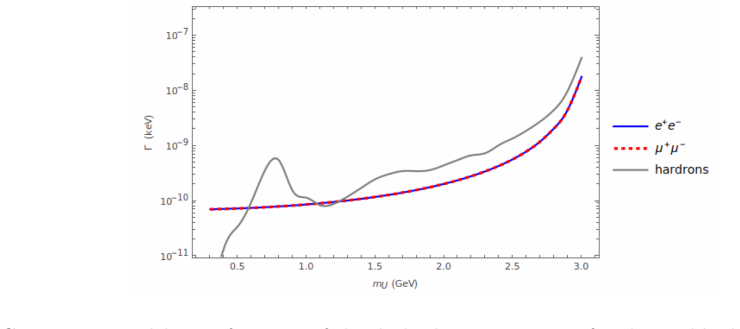


read the original abstract
A dark photon is an Abelian gauge boson from a new $U(1)_D$ gauge symmetry, coupled to the Standard Model via kinetic mixing, with $\varepsilon$ inducing an effective coupling to the electromagnetic current and $g_\chi$ to a stable dark matter particle $\chi$. We study $J/\psi$ two-body and four-body decays via a light-mass dark photon ($m_U < 3.0$ GeV) in the framework of non-relativistic QCD (NRQCD), considering both visible and invisible decays of the dark photon into SM fermions or dark sector particles. Numerical results for the decay ratios $\Gamma/\Gamma_{J/\psi}$ and expected event numbers at BESIII are presented, along with the significance $S/\sqrt{B}$ and $p_T$ distributions where applicable. Our results show that, for $m_U < 2m_\chi$, the two-body final state decay channels of the $J/\psi$ mediated by a dark photon have event yields $0\sim 37$ with significances of $10^{-5}\sim10^{-6}$, while the four-body final state channel yields about $94\sim172$ events in the very low mass region $m_U < 0.2\ \text{GeV}$. For $m_U \ge 2m_\chi$, the invisible two-body final state decay channel yields $0\sim12$ events with better significance $10^{-1}\sim10^{-3}$, and the invisible four-body final state decay channel yields $0\sim129$ events, whereas visible decays are all severely suppressed.
Editorial analysis
A structured set of objections, weighed in public.
Referee Report
Summary. The manuscript calculates branching ratios and expected BESIII event yields for J/ψ decays mediated by a light dark photon U (m_U < 3 GeV) within NRQCD, for both two-body and four-body final states. It distinguishes visible decays (U → SM fermions) from invisible decays (U → χχ̄), presenting results separately for m_U < 2m_χ and m_U ≥ 2m_χ regimes, including significances S/√B and p_T distributions.
Significance. If the numerical predictions hold, the work supplies concrete, falsifiable targets for dark-photon searches in charmonium at BESIII, with event yields up to ~172 and significances reaching 10^{-1} in selected invisible channels. The use of established NRQCD factorization for J/ψ decays and the provision of p_T spectra constitute clear strengths for experimental follow-up.
minor comments (3)
- The abstract quotes event ranges (0∼37, 94∼172, etc.) and significances without stating the specific benchmark values of ε, g_χ, m_U, or the assumed total number of J/ψ events used to generate each interval; this reduces reproducibility and should be clarified in §4 or a dedicated parameter table.
- Theoretical uncertainties from NRQCD higher-order corrections, scale choices, or wave-function inputs are not quantified; adding a brief error-band discussion would strengthen the central numerical claims.
- Figure captions and legends for p_T distributions should explicitly note the mass and coupling values at which each curve is evaluated.
Simulated Author's Rebuttal
We thank the referee for the careful reading and positive assessment of our manuscript on searching for dark photons in J/ψ decays. The summary accurately captures our NRQCD-based calculations of branching ratios, event yields at BESIII, significances, and p_T distributions for both visible and invisible channels across the relevant mass regimes. We appreciate the recommendation for minor revision and will incorporate improvements to presentation and clarity in the revised version.
Circularity Check
No significant circularity
full rationale
The paper performs a standard forward phenomenological calculation of branching ratios and expected BESIII event yields for J/ψ decays mediated by a kinetically mixed dark photon, using the established NRQCD framework with input parameters ε, g_χ, and m_U. All quoted event numbers (0–37, 94–172, etc.) and significances follow directly once those parameters and the total J/ψ sample size are fixed; no step fits parameters to the target search data and then renames the output as a prediction, no self-citation chain bears the central result, and no ansatz or uniqueness claim is smuggled in. The derivation is self-contained against external benchmarks.
Axiom & Free-Parameter Ledger
free parameters (3)
- ε (kinetic mixing parameter)
- m_U (dark photon mass)
- g_χ (coupling to dark matter)
axioms (1)
- domain assumption NRQCD factorization applies to J/ψ decays with dark photon emission
invented entities (1)
-
dark photon U from U(1)_D
no independent evidence
Reference graph
Works this paper leans on
-
[1]
− 2m2 l −4s2s3 + M 2 J/ψ(s2 + s3) /3 M 3 J/ψ(m2 l − s2)2(m2 l − s3)2 . (A6) f. Γ(U → l+l−) ϵ2 α p m2 U − 4 m2 l (m2 U + 2 m2 l ) 3 m2 U . (A7) 21 g. Γ(U → ¯χDχD) αχ q m2 U − 4 m2 χ (m2 U + 2 m2 χ) 3 m2 U . (A8) h. Γ(U → ¯χM χM) αχ (m2 U − 4 m2 χ)3/2 6 m2 U . (A9) i. Γ(U → φ†φ) αχ (m2 U − 4 m2 χ)3/2 12 m2 U . (A10)
-
[2]
Planck 2018 results. VI. Cosmological parameters
N. Aghanim et al. [Planck], “Planck 2018 results. VI. Cosmological parameters,” Astron. Astrophys. 641 (2020), A6 [erratum: Astron. Astrophys. 652 (2021), C4] [arXiv:1807.06209 [astro-ph.CO]]
work page Pith review arXiv 2018
-
[3]
Alexanderet al.(2016) arXiv:1608.08632 [hep-ph]
J. Alexander, M. Battaglieri, B. Echenard, R. Essig, M. Graham, E. Izaguirre, J. Jaros, G. Krnjaic, J. Mardon and D. Morrissey,et al. “Dark Sectors 2016 Workshop: Community Report,” [arXiv:1608.08632 [hep-ph]]
-
[4]
M. Battaglieri, A. Belloni, A. Chou, P. Cushman, B. Echenard, R. Essig, J. Estrada, J. L. Feng, B. Flaugher and P. J. Fox, et al. “US Cosmic Visions: New Ideas in Dark Matter 2017: Community Report,” [arXiv:1707.04591 [hep-ph]]
-
[5]
Feebly-interacting particles: FIPs 2020 workshop report,
P. Agrawal, M. Bauer, J. Beacham, A. Berlin, A. Boyarsky, S. Cebrian, X. Cid-Vidal, D. d’Enterria, A. De Roeck and M. Drewes, et al. “Feebly-interacting particles: FIPs 2020 workshop report,” Eur. Phys. J. C 81 (2021) no.11, 1015 [arXiv:2102.12143 [hep- ph]]
-
[6]
G. W. Yuan, Z. Q. Shen, Y. L. S. Tsai, Q. Yuan and Y. Z. Fan, “Constraining ultralight bosonic dark matter with Keck observations of S2’s orbit and kinematics,” Phys. Rev. D 106 (2022) no.10, 103024 [arXiv:2205.04970 [astro-ph.HE]]
-
[7]
Review of particle physics,
S. Navas et al. [Particle Data Group], “Review of particle physics,” Phys. Rev. D 110 (2024) no.3, 030001
2024
-
[8]
Observation of J/ψ decays to e+e-e+e- and e+e-µ+µ-,
M. Ablikim et al. [BESIII], “Observation of J/ψ decays to e+e-e+e- and e+e-µ+µ-,” Phys. Rev. D 109 (2024) no.5, 052006 [arXiv:2111.13881 [hep-ex]]
-
[9]
Physics Program of the Super Tau-Charm Factory,
X. R. Lyu [STCF Working Group], “Physics Program of the Super Tau-Charm Factory,” PoS BEAUTY2020 (2021), 060
2021
-
[10]
Rigorous QCD Analysis of Inclusive Annihilation and Production of Heavy Quarkonium
G. T. Bodwin, E. Braaten and G. P. Lepage, “Rigorous QCD analysis of inclusive an- nihilation and production of heavy quarkonium,” Phys. Rev. D 51, 1125-1171 (1995), [erratum: Phys. Rev. D 55, 5853 (1997)], [arXiv:hep-ph/9407339 [hep-ph]]. 22
work page Pith review arXiv 1995
-
[11]
A. Petrelli, M. Cacciari, M. Greco, F. Maltoni and M. L. Mangano, “NLO production and decay of quarkonium,” Nucl. Phys. B 514, 245-309 (1998), [arXiv:hep-ph/9707223 [hep-ph]]
-
[12]
Search for a heavy dark photon at future e+e− colliders,
M. He, X. G. He, C. K. Huang and G. Li, “Search for a heavy dark photon at future e+e− colliders,” JHEP 03, 139 (2018) [arXiv:1712.09095 [hep-ph]]
-
[13]
Search for Dark Photon in e+e− → A′A′ Using Future Collider Experiments,
K. Park, K. Kim, A. Sytov and K. Cho, “Search for Dark Photon in e+e− → A′A′ Using Future Collider Experiments,” J. Astron. Space Sci. 40, no.4, 259-266 (2023)
2023
-
[14]
Polesello, arXiv:2511.23337 [hep-ph]
G. Polesello, “Sensitivity of the FCC-ee to the decay of a dark photon into a µ+µ− pair,” [arXiv:2511.23337 [hep-ph]]
-
[15]
Production and constraints for a massive dark photon at electron-positron colliders,
J. Jiang, C. Y. Li, S. Y. Li, S. D. Pathak, Z. G. Si and X. H. Yang, “Production and constraints for a massive dark photon at electron-positron colliders,” Chin. Phys. C 44, no.2, 023105 (2020) [arXiv:1910.07161 [hep-ph]]
-
[16]
Searching for dark photons from dark-scalar decays at CEPC and FCC-ee,
K. Cheung, F. T. Chung and Z. S. Wang, “Searching for dark photons from dark-scalar decays at CEPC and FCC-ee,” Phys. Rev. D 113, no.1, 015013 (2026) [arXiv:2511.02318 [hep-ph]]
-
[17]
Seeking massless dark photons in the decays of charmed hadrons,
J. Y. Su and J. Tandean, “Seeking massless dark photons in the decays of charmed hadrons,” Phys. Rev. D 102, no.11, 115029 (2020) [arXiv:2005.05297 [hep-ph]]
-
[18]
Searching for dark photons in hyperon decays,
J. Y. Su and J. Tandean, “Searching for dark photons in hyperon decays,” Phys. Rev. D 101, no.3, 035044 (2020) [arXiv:1911.13301 [hep-ph]]
-
[19]
E. Gabrielli, B. Mele, M. Raidal and E. Venturini, Phys. Rev. D 94, no.11, 115013 (2016) doi:10.1103/PhysRevD.94.115013 [arXiv:1607.05928 [hep-ph]]
-
[20]
Dark Z at the International Linear Collider,
Y. C. San, M. Perelstein and P. Tanedo, “Dark Z at the International Linear Collider,” Phys. Rev. D 106, no.1, 015027 (2022) [arXiv:2205.10304 [hep-ph]]
-
[21]
Generating Feynman Diagrams and Amplitudes with FeynArts 3
T. Hahn, “Generating Feynman diagrams and amplitudes with FeynArts 3,” Comput. Phys. Commun. 140 (2001), 418-431 [arXiv:hep-ph/0012260 [hep-ph]]
work page Pith review arXiv 2001
-
[22]
V. Shtabovenko, R. Mertig and F. Orellana, “FeynCalc 9.3: New features and improve- ments,” Comput. Phys. Commun. 256 (2020), 107478 [arXiv:2001.04407 [hep-ph]]
-
[23]
Quarkonium decay matrix elements from quenched lattice QCD,
G. T. Bodwin, D. K. Sinclair and S. Kim, “Quarkonium decay matrix elements from quenched lattice QCD,” Phys. Rev. Lett. 77 (1996), 2376-2379 [arXiv:hep-lat/9605023 [hep-lat]]
-
[24]
Quarkonium wave functions at the origin,
E. J. Eichten and C. Quigg, “Quarkonium wave functions at the origin,” Phys. Rev. D 52 (1995), 1726-1728 [arXiv:hep-ph/9503356 [hep-ph]]
-
[25]
Two U(1)’s and Epsilon Charge Shifts,
B. Holdom, “Two U(1)’s and Epsilon Charge Shifts,” Phys. Lett. B 166 (1986), 196-198
1986
-
[26]
Exploring Portals to a Hidden Sector Through Fixed Targets
B. Batell, M. Pospelov and A. Ritz, “Exploring Portals to a Hidden Sector Through Fixed Targets,” Phys. Rev. D 80 (2009), 095024 [arXiv:0906.5614 [hep-ph]]
work page Pith review arXiv 2009
-
[27]
Working Group Report: New Light Weakly Coupled Particles,
R. Essig, J. A. Jaros, W. Wester, P. Hansson Adrian, S. Andreas, T. Averett, O. Baker, B. Batell, M. Battaglieri and J. Beacham, et al. “Working Group Report: New Light Weakly Coupled Particles,” [arXiv:1311.0029 [hep-ph]]
-
[28]
Testing Thermal-Relic Dark Matter with a Dark Photon Mediator,
G. Krnjaic, “Testing Thermal-Relic Dark Matter with a Dark Photon Mediator,” [arXiv:2505.04626 [hep-ph]]
-
[29]
Effects of the Spin 1 Partner of the Goldstino (Gravitino) on Neutral Current Phenomenology,
P. Fayet, “Effects of the Spin 1 Partner of the Goldstino (Gravitino) on Neutral Current Phenomenology,” Phys. Lett. B 95 (1980), 285-289 23
1980
-
[30]
Light spin 1/2 or spin 0 dark matter particles,
P. Fayet, “Light spin 1/2 or spin 0 dark matter particles,” Phys. Rev. D70 (2004), 023514 [arXiv:hep-ph/0403226 [hep-ph]]
-
[31]
C. Boehm and P. Fayet, “Scalar dark matter candidates,” Nucl. Phys. B 683 (2004), 219-263 [arXiv:hep-ph/0305261 [hep-ph]]
-
[32]
M. Pospelov, A. Ritz and M. B. Voloshin, “Secluded WIMP Dark Matter,” Phys. Lett. B 662 (2008), 53-61 [arXiv:0711.4866 [hep-ph]]
work page Pith review arXiv 2008
- [33]
-
[34]
Searching a Dark Photon with HADES,
G. Agakishiev et al. [HADES], “Searching a Dark Photon with HADES,” Phys. Lett. B 731, 265-271 (2014) [arXiv:1311.0216 [hep-ex]]
-
[35]
I. Schmidt, E. Bratkovskaya, M. Gumberidze and R. Holzmann, “Constraints on the kinetic mixing parameter ε2 for the light dark photons from dilepton production in heavy- ion collisions in the few-GeV energy range,” Phys. Rev. D 104, no.1, 015008 (2021) [arXiv:2105.00569 [hep-ph]]
-
[36]
Ablikimet al.(BESIII), Number ofJ/ψevents at BE- SIII, Chin
M. Ablikim et al. [BESIII], “Number of J/ψ events at BESIII,” Chin. Phys. C 46 (2022) no.7, 074001 [arXiv:2111.07571 [hep-ex]]
-
[37]
Search for an axion-like particle in radiative J/ ψ decays,
M. Ablikim et al. [BESIII], “Search for an axion-like particle in radiative J/ ψ decays,” Phys. Lett. B 838 (2023), 137698 [arXiv:2211.12699 [hep-ex]]
-
[38]
Lattice determination of the neutrino background for J/ψ → γ + invisible,
Y. Meng, N. Li, C. Liu, H. Yan, K. L. Zhang and X. Z. Zhang, “Lattice determination of the neutrino background for J/ψ → γ + invisible,” [arXiv:2601.18209 [hep-lat]]. 24
discussion (0)
Sign in with ORCID, Apple, or X to comment. Anyone can read and Pith papers without signing in.