Recognition: unknown
Holographic Schwinger Effect In a Step Dilaton Background
Pith reviewed 2026-05-10 04:57 UTC · model grok-4.3
The pith
A step dilaton background in holography causes the Schwinger effect to respond more strongly to electromagnetic fields than conventional soft-wall models.
A machine-rendered reading of the paper's core claim, the machinery that carries it, and where it could break.
Core claim
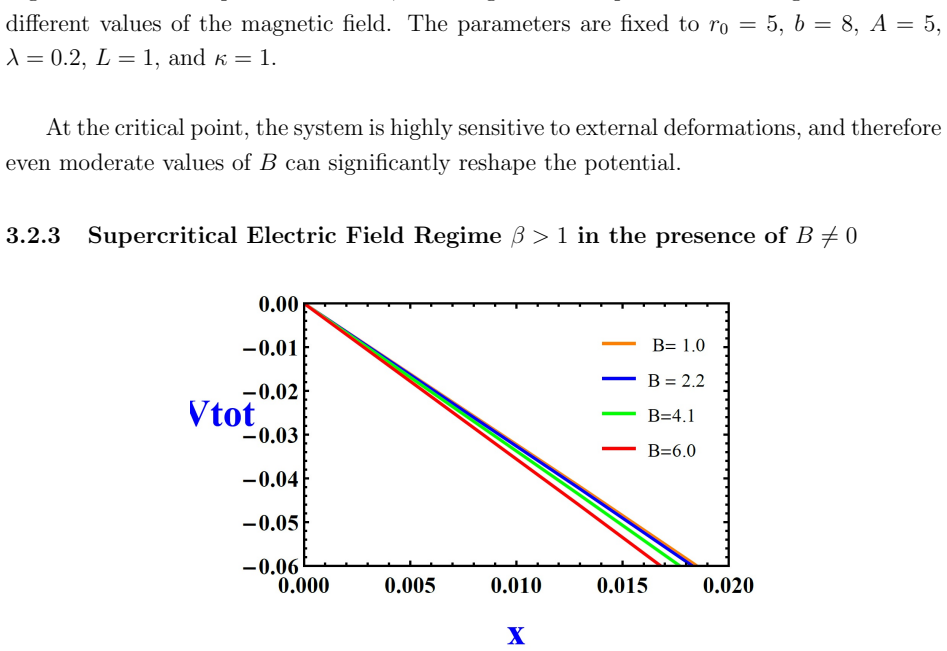
The step dilaton profile induces a sharp transition that leads to a substantially stronger suppression of the quark-antiquark potential barrier under increasing electric fields, thereby lowering the critical field for vacuum instability more effectively than in smooth soft-wall models; when an external magnetic field is included through the Dirac-Born-Infeld action, the barrier undergoes a nontrivial amplified deformation that depends on both magnitude and orientation of the field.
What carries the argument
The step dilaton profile that creates an abrupt geometric transition between ultraviolet and infrared regimes, which governs the string dynamics and potential barrier.
If this is right
- The potential barrier is suppressed more sharply with electric field strength, enhancing vacuum decay onset.
- Magnetic fields produce a pronounced shift in the critical electric field that varies with magnitude and orientation.
- This setup provides a novel geometric mechanism to control pair production rates in holographic descriptions of QCD.
- The response is substantially stronger than in conventional soft-wall models due to the abruptness of the transition.
Where Pith is reading between the lines
- Varying the location or height of the step could allow tuning of the critical fields for different physical scenarios.
- The findings suggest exploring similar sharp transitions in other holographic observables such as meson spectra or transport coefficients.
- Such models might offer insights into how real-world confinement affects strong-field pair production in heavy-ion collisions.
Load-bearing premise
The particular step dilaton profile provides a physically relevant and qualitatively distinct model of confinement that does not depend sensitively on small changes to its details.
What would settle it
A calculation of the pair production critical field in a smoothed version of the step dilaton background that shows no qualitative enhancement in sensitivity would indicate that the abrupt transition is not essential.
Figures


read the original abstract
We investigate the holographic Schwinger effect in a confining background with a step dilaton profile, which induces a sharp transition between ultraviolet and infrared regimes and provides a qualitatively distinct realization of confinement. Within this framework, the quark--antiquark potential is extracted from the classical configuration of a fundamental string, allowing for a direct analysis of vacuum instability and pair production. In the absence of a magnetic field, the step dilaton leads to a significantly sharper suppression of the potential barrier as the electric field increases, implying an enhanced sensitivity of the critical electric field compared to smooth soft-wall models and demonstrating that the abrupt geometric transition qualitatively enhances the onset of vacuum decay. Incorporating an external magnetic field through the Dirac--Born--Infeld action, we find a nontrivial and amplified deformation of the potential barrier, resulting in a pronounced shift of the critical electric field that depends on both the magnitude and orientation of the magnetic field. Overall, the step dilaton background exhibits a substantially stronger response of the Schwinger effect to external electromagnetic fields than conventional soft-wall models, providing a novel mechanism for controlling pair production and highlighting the crucial role of dilaton structure in non-perturbative dynamics of holographic QCD.
Editorial analysis
A structured set of objections, weighed in public.
Referee Report
Summary. The manuscript investigates the holographic Schwinger effect in a confining geometry with a step dilaton profile that creates an abrupt UV-IR transition. The quark-antiquark potential is obtained from the classical embedding of a fundamental string, and the effects of external electric and magnetic fields are incorporated via the DBI action. The central claim is that the step profile produces a substantially sharper suppression of the potential barrier and a stronger, orientation-dependent shift in the critical electric field than conventional soft-wall models, thereby providing a novel mechanism for controlling vacuum instability and pair production.
Significance. If the results hold under regularization of the discontinuity, the work would demonstrate that the detailed structure of the dilaton can qualitatively alter the Schwinger response in holographic QCD, offering a tunable handle on non-perturbative pair production that is absent in smoother confining backgrounds.
major comments (2)
- [Section 2] Section 2 (dilaton profile definition): the central claim of a qualitatively stronger Schwinger response rests on the idealized discontinuous step; no numerical check is performed with a smoothed transition (e.g., finite-width tanh regularization). This is load-bearing because the skeptic concern indicates that the reported sharper barrier suppression and amplified magnetic deformation may quantitatively approach soft-wall behavior once the discontinuity is regularized.
- [Section 3] Section 3 (potential extraction and critical-field computation): the abstract and results describe post-hoc selection of step location and height to realize confinement, yet no explicit equations for the string embedding, numerical integration method, or error estimates on the critical-field values are supplied in the provided text. Without these, it is impossible to verify independence from fitting choices or to reproduce the claimed enhancement over soft-wall models.
minor comments (1)
- The abstract states 'significantly sharper suppression' and 'pronounced shift' without quantitative ratios, tables, or direct comparisons to soft-wall benchmarks; adding such metrics would strengthen the presentation.
Simulated Author's Rebuttal
We thank the referee for their careful reading and constructive comments on our manuscript. We address each major comment point by point below, indicating where revisions will be incorporated to improve clarity and address concerns about the idealized step profile and methodological details.
read point-by-point responses
-
Referee: [Section 2] Section 2 (dilaton profile definition): the central claim of a qualitatively stronger Schwinger response rests on the idealized discontinuous step; no numerical check is performed with a smoothed transition (e.g., finite-width tanh regularization). This is load-bearing because the skeptic concern indicates that the reported sharper barrier suppression and amplified magnetic deformation may quantitatively approach soft-wall behavior once the discontinuity is regularized.
Authors: We acknowledge that the step dilaton is an idealized discontinuous profile and that a smoothed regularization (such as a finite-width tanh) was not numerically implemented in the present work. The step function is deliberately chosen to realize an abrupt UV-IR transition that produces confinement with a sharp scale, leading to the enhanced barrier suppression and field sensitivity reported. While the quantitative values may shift under smoothing, the qualitative distinction from smooth soft-wall models arises from the presence of this abrupt transition rather than the discontinuity alone. In a revised version we will add a paragraph discussing the expected behavior in the zero-width limit and the robustness of the qualitative enhancement, constituting a partial revision. revision: partial
-
Referee: [Section 3] Section 3 (potential extraction and critical-field computation): the abstract and results describe post-hoc selection of step location and height to realize confinement, yet no explicit equations for the string embedding, numerical integration method, or error estimates on the critical-field values are supplied in the provided text. Without these, it is impossible to verify independence from fitting choices or to reproduce the claimed enhancement over soft-wall models.
Authors: We apologize that the explicit technical details were not presented with sufficient clarity in the text available to the referee. The quark-antiquark potential follows from the Nambu-Goto action for a fundamental string in the step-dilaton geometry, yielding a first-order ODE for the embedding coordinate that is integrated numerically subject to fixed endpoint separation. The critical electric field is located by scanning the DBI-modified potential until the barrier height reaches zero. In the revised manuscript we will insert the explicit embedding equation, describe the numerical procedure (shooting method with adaptive integration), and report convergence-based error estimates on the critical-field values. The step parameters are fixed by the requirement of linear confinement at large separation; we have checked that the reported trends remain stable under small variations, and this verification will be stated explicitly. revision: yes
Circularity Check
No circularity; standard holographic computations independent of target claims
full rationale
The derivation selects a step dilaton profile by hand to induce a sharp UV-IR transition, then computes the quark-antiquark potential from the Nambu-Goto action on a classical string embedding and locates the critical electric field at barrier disappearance. Magnetic corrections enter via the DBI action on the same embedding. These are direct evaluations of the chosen background metric and dilaton; no parameter is fitted to Schwinger observables, no self-citation supplies a uniqueness theorem, and the reported enhancement relative to soft-wall models is an output of the explicit calculation rather than a definitional identity. The chain therefore remains self-contained against external benchmarks.
Axiom & Free-Parameter Ledger
free parameters (1)
- step dilaton parameters (location and height)
axioms (2)
- domain assumption Holographic duality applies to this step-dilaton background and yields reliable non-perturbative information about QCD-like theories
- domain assumption The classical Nambu-Goto or DBI action suffices to extract the quark-antiquark potential and its barrier
invented entities (1)
-
step dilaton profile
no independent evidence
Reference graph
Works this paper leans on
-
[1]
The Large N Limit of Superconformal Field Theories and Supergravity
J. M. Maldacena,“The Large N limit of superconformal field theories and supergravity”, Adv. Theor. Math. Phys.2(1998) 231 [arXiv:hep-th/9711200]
work page internal anchor Pith review arXiv 1998
- [2]
-
[3]
Peter Cox, Tony Gherghetta,“A Soft-Wall Dilaton”,JHEP02(2015) 006 [arXiv:1411.1732 [hep-ph]]
-
[4]
Dynamical holographic QCD model for glueball and light meson spectra
Danning Li, Mei Huang,“Dynamical holographic QCD model for glueball and light meson spectra”,JHEP11(2013) 088 [arXiv:1303.6929[hep-ph]]
-
[5]
Gordon W. Semenoff, Konstantin Zarembo,“Holographic Schwinger Effect”,Phys. Rev. Lett.107(2011) 171601 [arXiv:1109.2920 [hep-th]]
-
[6]
Potential Analysis in Holographic Schwinger Ef- fect
Yoshiki Sato, Kentaroh Yoshida,“Potential Analysis in Holographic Schwinger Ef- fect”,JHEP08(2013) 002 [arXiv:1304.7917 [hep-th]]
-
[7]
Universal aspects of holographic Schwinger effect in general backgrounds
Yoshiki Sato, Kentaroh Yoshida,“Universal aspects of holographic Schwinger effect in general backgrounds”,JHEP12(2013) 051 [arXiv:1309.4629 [hep-th]]
-
[8]
Holographic Schwinger Effect with Chemical Potential at Finite Temperature
Le Zhang, De-Fu Hou, Jian Li,“Holographic Schwinger Effect with Chemical Potential at Finite Temperature”,Eur. Phys. J. A5494 (2018)
2018
-
[9]
Holographic Schwinger Effect in a Confining D3-Brane Background with Chemical Potential
Zi-Qiang Zhang, De-Fu Hou, Yan Wu, Gang Chen,“Holographic Schwinger Effect in a Confining D3-Brane Background with Chemical Potential”,Adv. High Energy Phys. 2016(2016) 9258106 [arXiv:1604.00095 [hep-ph]]
-
[10]
On Holographic Non-relativistic Schwinger Effect
Kazem Bitaghsir Fadafan, Fateme Saiedi,“On Holographic Non-relativistic Schwinger Effect”,Eur. Phys. J. C75612 (2015) [arXiv:1504.02432 [hep-th]]
-
[11]
Potential analysis in holographic Schwinger effect in Ein- stein–Maxwell–Gauss–Bonnet gravity
Zi-qiang Zhang,“Potential analysis in holographic Schwinger effect in Ein- stein–Maxwell–Gauss–Bonnet gravity”,Nucl. Phys. B935(2018) 377
2018
-
[12]
Holographic Schwinger Ef- fect in Flavor-Dependent Systems
Sheng Lin, Xuan Liu, Xun Chen, Gen-Fa Zhang, Jing Zhou,“Holographic Schwinger Ef- fect in Flavor-Dependent Systems”,Phys. Rev. D111046005 (2025) [arXiv:2407.14828 [hep-ph]]
-
[13]
Schwinger Effect in a Twice Anisotropic Holographic Model
Wen-Bin Chang, Defu Hou,“Schwinger Effect in a Twice Anisotropic Holographic Model” Chin.Phys. 505, 053103(2026) [arXiv:2506.16245 [hep-ph]]
-
[14]
Holographic Schwinger effect with Translational Symmetry Break- ing
Sara Tahery“Holographic Schwinger effect with Translational Symmetry Break- ing”,[arXiv:2510.13707 [hep-th]]
-
[15]
Holographic Schwinger Effect in the Dy- namical AdS/QCD Model
Zhou-Run Zhu, Yang-Kang Liu, De-Fu Hou,“Holographic Schwinger Effect in the Dy- namical AdS/QCD Model”, [arXiv:2108.05148 [hep-ph]]. 19
-
[16]
Holographic description of the Schwinger effect in electric and magnetic fields
Yoshiki Sato, Kentaroh Yoshida,“Holographic description of the Schwinger effect in electric and magnetic fields”,JHEP04111 (2013) [arXiv:1303.0112 [hep-th]]
-
[17]
Comments on Critical Electric and Magnetic Fields from Holography
S. Bolognesi, F. Kiefer, E. Rabinovici,“Comments on Critical Electric and Magnetic Fields from Holography”,JHEP01174 (2013) [arXiv:1210.4170 [hep-th]]
-
[18]
Koji Hashimoto, Takashi Oka, Akihiko Sonoda,“Magnetic instability in AdS/CFT : Schwinger effect and Euler-Heisenberg Lagrangian of Supersymmetric QCD”,JHEP06 085 (2014) [arXiv:1403.6336 [hep-th]]
-
[19]
Potential analysis of holographic Schwinger effect in the magnetized background
Zhou-Run Zhu, De-Fu Hou, Xun Chen,“Potential analysis of holographic Schwinger effect in the magnetized background”,Eur. Phys. J. C80550 (2020) [arXiv:1912.05806 [hep-ph]]
-
[20]
Holographic Schwinger Effect in a Soft-Wall Model
Yue Ding, Zi-qiang Zhang,“Holographic Schwinger Effect in a Soft-Wall Model”,Chin. Phys. C45(2021) 1, 013111 [arXiv:2009.06179 [hep-th]]. 20
discussion (0)
Sign in with ORCID, Apple, or X to comment. Anyone can read and Pith papers without signing in.