Recognition: unknown
Scale invariance of the polaron energy at the Mott-superfluid critical point
Pith reviewed 2026-05-10 03:43 UTC · model grok-4.3
The pith
The polaron energy remains unchanged with system size at the Mott-superfluid critical point.
A machine-rendered reading of the paper's core claim, the machinery that carries it, and where it could break.
Core claim
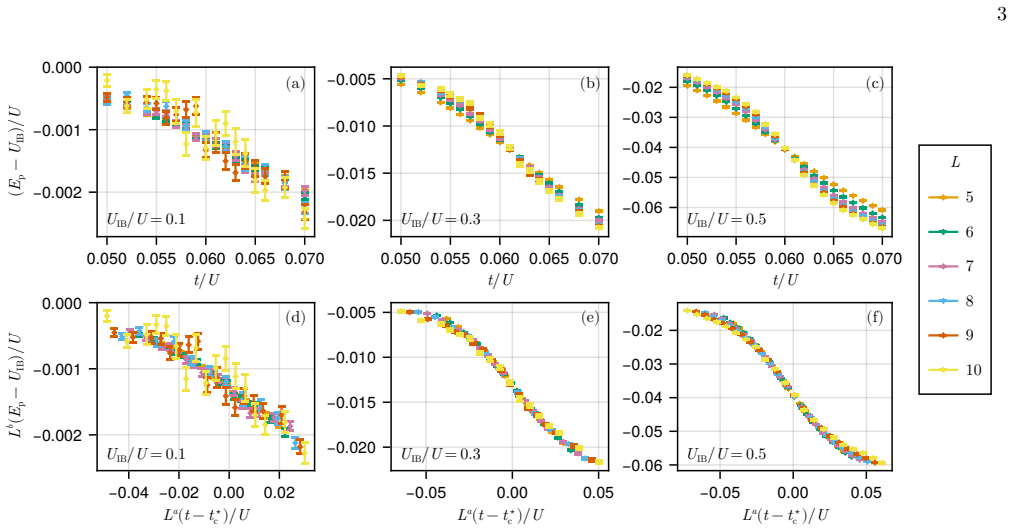
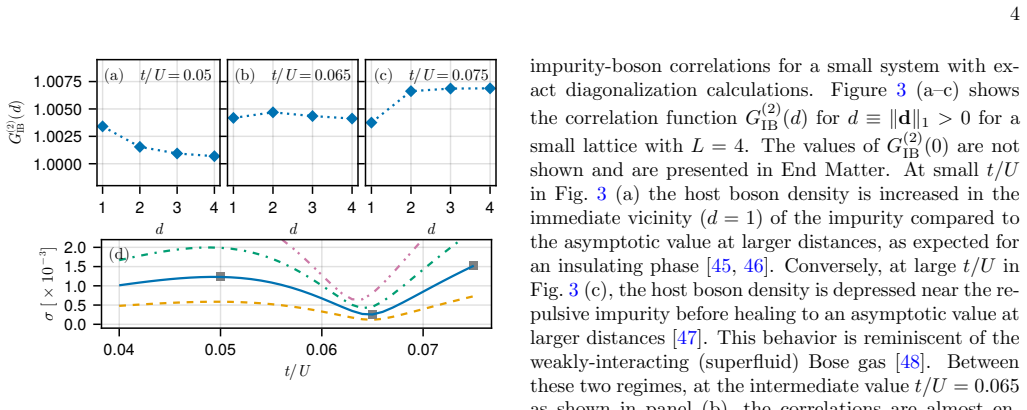
We provide evidence from ground-state quantum Monte Carlo calculations that the energy of a mobile impurity interacting weakly with a surrounding lattice Bose gas provides access to the critical behavior of the Mott insulator-superfluid phase transition. Finite-size scaling of the energy reveals that its value is scale invariant at the critical point of the quantum phase transition, and we extract a scaling exponent that is currently unexplained by theory. For a small lattice we further observe a flattening of the impurity-boson density-density correlations at the critical point, which hints at a divergence of a corresponding length scale in the thermodynamic limit.
What carries the argument
Finite-size scaling of the polaron energy, which isolates scale invariance at the quantum critical point and extracts an unexplained scaling exponent while serving as a proxy for critical behavior.
Load-bearing premise
The weak impurity-boson interaction leaves the location of the Mott-superfluid critical point unchanged so that finite-size scaling on accessible lattices captures pure critical scaling without contamination from other length scales.
What would settle it
A simulation or measurement in which the polaron energy still varies systematically with lattice size when the system parameters are set to the independently known critical point would disprove the scale invariance.
Figures

read the original abstract
Continuous quantum phase transitions are characterized by an order parameter and correlation functions that are often challenging to access experimentally or in direct numerical simulations. The energy of an added impurity can on the other hand be probed by established polaron spectroscopy, or numerically with Monte Carlo methods. We provide evidence from ground-state quantum Monte Carlo calculations that the energy of a mobile impurity interacting weakly with a surrounding lattice Bose gas provides access to the critical behavior of the Mott insulator-superfluid phase transition. Finite-size scaling of the energy reveals that its value is scale invariant at the critical point of the quantum phase transition, and we extract a scaling exponent that is currently unexplained by theory. For a small lattice we further observe a flattening of the impurity-boson density-density correlations at the critical point, which hints at a divergence of a corresponding length scale in the thermodynamic limit. Our results suggest that impurity spectroscopy represents a useful way to probe the critical properties of quantum phase transitions in general.
Editorial analysis
A structured set of objections, weighed in public.
Referee Report
Summary. The manuscript reports ground-state quantum Monte Carlo evidence that the energy of a weakly coupled mobile impurity (polaron) in a lattice Bose gas is scale-invariant at the Mott-insulator to superfluid critical point of the Bose-Hubbard model. Finite-size scaling of this energy is used to extract a scaling exponent, and impurity-boson density-density correlations are shown to flatten at criticality on small lattices, interpreted as a hint of a diverging length scale.
Significance. If the numerical result holds, the work demonstrates that polaron energy provides experimental and numerical access to critical properties of quantum phase transitions that are otherwise difficult to probe directly. The finding of scale invariance and the unexplained scaling exponent constitute a concrete, falsifiable prediction that could stimulate further analytic theory on impurity criticality.
major comments (2)
- [Finite-size scaling analysis] The critical hopping (or chemical potential) is determined from the pure Bose-Hubbard model and then used with the added impurity. Even weak impurity-boson coupling can shift the effective critical point through density correlations on the small lattices (L=4-16) accessible to QMC. The manuscript must show that the quoted critical point remains unshifted once the impurity is present, or quantify the shift, because the central claim of L-independent energy at criticality is load-bearing on this assumption.
- [Methods and results sections] No lattice sizes, interaction strengths, error bars, or explicit procedure for locating the critical point in the presence of the impurity are supplied. Without these, it is impossible to judge whether the reported L-independence truly reflects scale invariance rather than finite-size rounding or off-critical sampling.
minor comments (1)
- [Abstract] The abstract states that the scaling exponent is 'currently unexplained by theory'; a short paragraph contrasting it with standard hyperscaling or impurity scaling relations would clarify the novelty.
Simulated Author's Rebuttal
We thank the referee for their thorough review and positive evaluation of our manuscript. We address the major comments point by point below and will revise the manuscript accordingly to incorporate the suggested improvements.
read point-by-point responses
-
Referee: [Finite-size scaling analysis] The critical hopping (or chemical potential) is determined from the pure Bose-Hubbard model and then used with the added impurity. Even weak impurity-boson coupling can shift the effective critical point through density correlations on the small lattices (L=4-16) accessible to QMC. The manuscript must show that the quoted critical point remains unshifted once the impurity is present, or quantify the shift, because the central claim of L-independent energy at criticality is load-bearing on this assumption.
Authors: We agree that this is an important point to address. In the original manuscript, we used the critical parameters from the pure Bose-Hubbard model as established in the literature. Given the weak impurity-boson coupling, we expect any shift in the critical point to be minimal. However, to rigorously confirm this, we will perform additional QMC simulations to determine the critical point in the presence of the impurity by monitoring the superfluid density or compressibility. The revised manuscript will include a discussion and possibly a supplementary figure quantifying any shift and demonstrating that the scale invariance of the polaron energy holds at the adjusted critical point. revision: yes
-
Referee: [Methods and results sections] No lattice sizes, interaction strengths, error bars, or explicit procedure for locating the critical point in the presence of the impurity are supplied. Without these, it is impossible to judge whether the reported L-independence truly reflects scale invariance rather than finite-size rounding or off-critical sampling.
Authors: We apologize for not including these technical details in the submitted manuscript. The revised version will contain an expanded Methods section that specifies the lattice sizes used (L=4 to 16), the range of interaction strengths (U/t values), the QMC error bars, and the procedure for identifying the critical point. Regarding the critical point in the presence of the impurity, as noted above, we will clarify that we initially used the pure-system value and will add the analysis to check for shifts. revision: yes
Circularity Check
Numerical QMC finite-size scaling establishes scale invariance without any reduction to fitted inputs or self-citations by construction
full rationale
The central claim rests on ground-state quantum Monte Carlo computations of the impurity energy for the Bose-Hubbard model plus a weak mobile impurity, followed by standard finite-size scaling analysis across lattices L=4–16 to extract L-independence at the critical point identified from the pure system. No derivation chain equates the reported scale invariance or extracted exponent to a parameter fit or prior self-citation; the energies are computed independently, the critical hopping is taken from the known pure-model value, and the scaling is a direct numerical observation rather than an algebraic identity. The weak-impurity assumption is an external modeling choice open to falsification, not a definitional loop.
Axiom & Free-Parameter Ledger
free parameters (1)
- scaling exponent
axioms (1)
- domain assumption The impurity interacts weakly with the lattice Bose gas without shifting the critical point location
Reference graph
Works this paper leans on
-
[1]
Sachdev,Quantum Phase Transitions, 2nd ed
S. Sachdev,Quantum Phase Transitions, 2nd ed. (Cam- bridge University Press, Cambridge, 2011)
2011
-
[2]
M. E. Fisher and M. N. Barber, Scaling Theory for Finite- Size Effects in the Critical Region, Physical Review Let- ters28, 1516 (1972)
1972
-
[3]
Cardy, ed.,Finite-Size Scaling, Current Physics – Sources and Comments, Vol
J. Cardy, ed.,Finite-Size Scaling, Current Physics – Sources and Comments, Vol. 2 (North-Holland, 2012)
2012
-
[4]
Vojta, Quantum phase transitions, Reports on Progress in Physics66, 2069 (2003)
M. Vojta, Quantum phase transitions, Reports on Progress in Physics66, 2069 (2003)
2069
-
[5]
Camacho-Guardian, N
A. Camacho-Guardian, N. Goldman, P. Massignan, and G. M. Bruun, Dropping an impurity into a chern insula- tor: A polaron view on topological matter, Phys. Rev. B 99, 081105 (2019)
2019
-
[6]
Alhyder and G
R. Alhyder and G. M. Bruun, Mobile impurity probing a two-dimensional superfluid phase transition, Physical Review A105, 063303 (2022)
2022
-
[7]
V. E. Colussi, F. Caleffi, C. Menotti, and A. Recati, Lattice Polarons across the Superfluid to Mott Insulator Transition, Physical Review Letters130, 173002 (2023)
2023
-
[8]
Vashisht, I
A. Vashisht, I. Amelio, L. Vanderstraeten, G. M. Bruun, O. K. Diessel, and N. Goldman, Chiral polaron forma- tion on the edge of topological quantum matter, Nature Communications16, 4918 (2025)
2025
-
[9]
R. Alhyder, V. Colussi, M. ˇCufar, J. Brand, A. Re- cati, and G. M. Bruun, Lattice Bose polarons at strong coupling and quantum criticality, SciPost Physics19, 10.21468/scipostphys.19.1.002 (2025)
-
[10]
Polarons in atomic gases and two-dimensional semiconductors
P. Massignan, R. Schmidt, G. E. Astrakharchik, A. ˙Imamoglu, M. Zwierlein, J. J. Arlt, and G. M. Bruun, Polarons in atomic gases and two-dimensional semicon- ductors (2025), arXiv:2501.09618 [cond-mat]
work page internal anchor Pith review Pith/arXiv arXiv 2025
-
[11]
Hartweg, T
T. Hartweg, T. Gupta, and G. Pupillo, Bose-hubbard polaron from weak to strong coupling, Phys. Rev. B112, L220201 (2025)
2025
-
[12]
M. G. Skou, T. G. Skov, N. B. Jørgensen, K. K. Nielsen, A. Camacho-Guardian, T. Pohl, G. M. Bruun, and J. J. Arlt, Non-equilibrium quantum dynamics and formation of the Bose polaron, Nature Physics17, 731 (2021)
2021
-
[13]
Etrych, G
J. Etrych, G. Martirosyan, A. Cao, C. J. Ho, Z. Hadz- ibabic, and C. Eigen, Universal quantum dynamics of bose polarons, Physical Review X15, 021070 (2025)
2025
- [14]
-
[15]
Alhyder, G
R. Alhyder, G. M. Bruun, T. Pohl, M. Lemeshko, and A. G. Volosniev, Phenomenological model of decaying bose polarons, Phys. Rev. Res.8, L012034 (2026)
2026
-
[16]
M. P. A. Fisher, P. B. Weichman, G. Grinstein, and D. S. Fisher, Boson localization and the superfluid-insulator transition, Physical Review B40, 546 (1989)
1989
-
[17]
Greiner, O
M. Greiner, O. Mandel, T. Esslinger, T. W. H¨ ansch, and I. Bloch, Quantum phase transition from a superfluid to a Mott insulator in a gas of ultracold atoms, Nature415, 39 (2002)
2002
-
[18]
J¨ ordens, N
R. J¨ ordens, N. Strohmaier, K. G¨ unter, H. Moritz, and T. Esslinger, A Mott insulator of fermionic atoms in an optical lattice, Nature455, 204 (2008)
2008
-
[19]
J. F. Sherson, C. Weitenberg, M. Endres, M. Cheneau, I. Bloch, and S. Kuhr, Single-atom-resolved fluorescence imaging of an atomic Mott insulator, Nature467, 68 (2010)
2010
-
[20]
L. Su, A. Douglas, M. Szurek, A. H. H´ ebert, A. Krahn, R. Groth, G. A. Phelps, O. Markovi´ c, and M. Greiner, Fast single atom imaging for optical lattice arrays, Nature Communications16, 1017 (2025)
2025
-
[21]
Krauth and N
W. Krauth and N. Trivedi, Mott and Superfluid Tran- sitions in a Strongly Interacting Lattice Boson System, Europhysics Letters (EPL)14, 627 (1991)
1991
-
[22]
Capello, F
M. Capello, F. Becca, M. Fabrizio, and S. Sorella, Su- perfluid to Mott-Insulator Transition in Bose-Hubbard Models, Physical Review Letters99, 056402 (2007)
2007
-
[23]
Capogrosso-Sansone, S ¸
B. Capogrosso-Sansone, S ¸. G. S¨ oyler, N. Prokof’ev, and B. Svistunov, Monte Carlo study of the two-dimensional Bose-Hubbard model, Physical Review A77, 015602 (2008)
2008
-
[24]
Pollet and N
L. Pollet and N. Prokof’ev, Higgs Mode in a Two- 6 Dimensional Superfluid, Physical Review Letters109, 010401 (2012)
2012
-
[25]
Gazit, D
S. Gazit, D. Podolsky, and A. Auerbach, Fate of the Higgs Mode Near Quantum Criticality, Physical Review Letters 110, 140401 (2013)
2013
-
[26]
Ran¸ con and N
A. Ran¸ con and N. Dupuis, Nonperturbative renormaliza- tion group approach to strongly correlated lattice bosons, Physical Review B84, 174513 (2011)
2011
-
[27]
Ran¸ con and N
A. Ran¸ con and N. Dupuis, Quantum XY criticality in a two-dimensional Bose gas near the Mott transition, EPL (Europhysics Letters)104, 16002 (2013)
2013
-
[28]
Ran¸ con and N
A. Ran¸ con and N. Dupuis, Higgs amplitude mode in the vicinity of a ( 2 + 1 ) -dimensional quantum critical point, Physical Review B89, 180501 (2014)
2014
-
[29]
F. Rose, F. L´ eonard, and N. Dupuis, Higgs amplitude mode in the vicinity of a ( 2 + 1 ) -dimensional quantum critical point: A nonperturbative renormalization-group approach, Physical Review B91, 224501 (2015)
2015
-
[30]
Sengupta and N
K. Sengupta and N. Dupuis, Mott-insulator–to– superfluid transition in the Bose-Hubbard model: A strong-coupling approach, Physical Review A71, 033629 (2005)
2005
-
[31]
Podolsky and S
D. Podolsky and S. Sachdev, Spectral functions of the Higgs mode near two-dimensional quantum critical points, Physical Review B86, 054508 (2012)
2012
-
[32]
Hinrichs, A
D. Hinrichs, A. Pelster, and M. Holthaus, Perturbative calculation of critical exponents for the Bose–Hubbard model, Applied Physics B113, 57 (2013)
2013
-
[33]
L¸ acki, B
M. L¸ acki, B. Damski, and J. Zakrzewski, Locating the quantum critical point of the Bose-Hubbard model through singularities of simple observables, Scientific Re- ports6, 38340 (2016)
2016
-
[34]
Sanders and M
S. Sanders and M. Holthaus, Quantum critical properties of Bose–Hubbard models, Journal of Physics A: Mathe- matical and Theoretical52, 255001 (2019)
2019
-
[35]
W. S. Bakr, J. I. Gillen, A. Peng, S. F¨ olling, and M. Greiner, A quantum gas microscope for detecting sin- gle atoms in a Hubbard-regime optical lattice, Nature 462, 74 (2009)
2009
-
[36]
G. H. Booth, A. J. W. Thom, and A. Alavi, Fermion Monte Carlo without fixed nodes: A game of life, death, and annihilation in Slater determinant space, The Jour- nal of Chemical Physics131, 054106 (2009)
2009
- [37]
-
[38]
M. Yang, E. Pahl, and J. Brand, Improved walker pop- ulation control for full configuration interaction quan- tum Monte Carlo, The Journal of Chemical Physics153, 174103 (2020)
2020
-
[39]
Brand, M
J. Brand, M. Yang, and E. Pahl, Stochastic differential equation approach to understanding the population con- trol bias in full configuration interaction quantum Monte Carlo, Physical Review B105, 235144 (2022)
2022
-
[40]
Ghanem, N
K. Ghanem, N. Liebermann, and A. Alavi, Population control bias and importance sampling in full configura- tion interaction quantum Monte Carlo, Physical Review B103, 155135 (2021)
2021
-
[41]
Houdayer and A
J. Houdayer and A. K. Hartmann, Low-temperature be- havior of two-dimensional Gaussian Ising spin glasses, Physical Review B70, 014418 (2004)
2004
-
[42]
Bigu´ e, F
A. Bigu´ e, F. Chevy, and X. Leyronas, Mean field versus random-phase approximation calculation of the energy of an impurity immersed in a spin-1/2 superfluid, Physical Review A105, 033314 (2022)
2022
-
[43]
Alhyder, F
R. Alhyder, F. Chevy, and X. Leyronas, Exploring beyond-mean-field logarithmic divergences in Fermi- polaron energy, Physical Review A: Atomic, Molecular, and Optical Physics109, 033315 (2024)
2024
-
[44]
Punk and S
M. Punk and S. Sachdev, Mobile impurity near the superfluid–mott-insulator quantum critical point in two dimensions, Phys. Rev. A87, 033618 (2013)
2013
-
[45]
Kobayashi, Scattering theory of subsurface impurities observed in scanning tunneling microscopy, Physical Re- view B54, 17029 (1996)
K. Kobayashi, Scattering theory of subsurface impurities observed in scanning tunneling microscopy, Physical Re- view B54, 17029 (1996)
1996
-
[46]
Shiino, T
O. Shiino, T. Endo, W. Yamaguchi, H. Sugawara, K. Ki- tazawa, and T. Hasegawa, Enhancement of Friedel oscil- lation in the insulating phases of 1T-TaS2 and 1T-TaSe2, Applied Physics A66, S175 (1998)
1998
-
[47]
Note that the asymptote being larger than 1 is a result of the small size of the system combined with the strong suppression of the host boson density at the same site as the impurity (d= 0, not shown)
-
[48]
Pitaevskii and S
L. Pitaevskii and S. Stringari,Bose-Einstein Condensa- tion and Superfluidity(Oxford University Press, 2016)
2016
-
[49]
Quantum-gas microscopy and Talbot interferometry of the Bose-glass phase
L. Koehn, C. Parsonage, C. W. Duncan, P. Kirton, A. J. Daley, T. Hilker, E. Haller, A. L. Rooij, and S. Kuhr, Quantum-gas microscopy of the Bose-glass phase (2025), arXiv:2504.13040 [cond-mat]
work page internal anchor Pith review Pith/arXiv arXiv 2025
-
[50]
L´ eonard, S
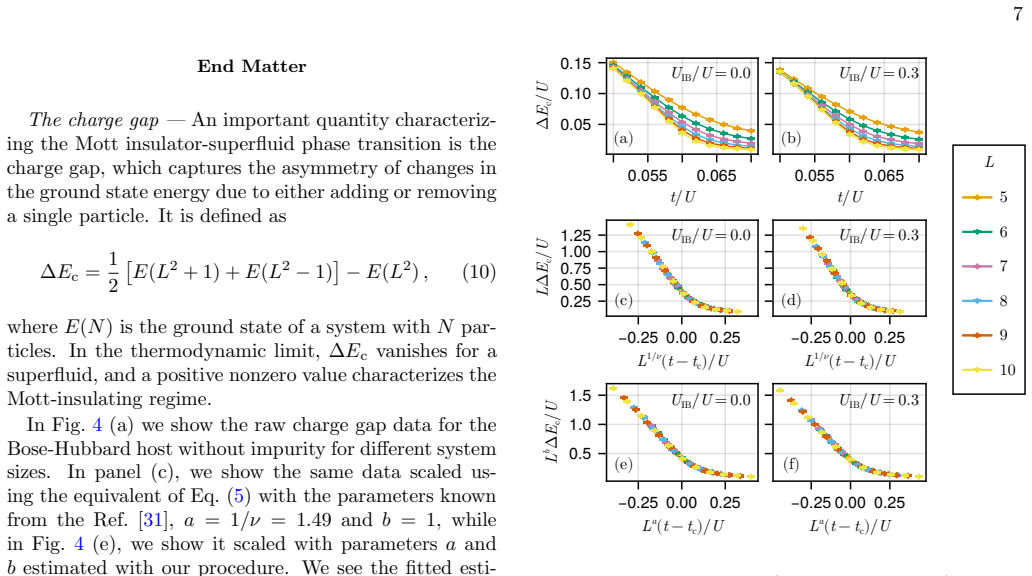
J. L´ eonard, S. Kim, J. Kwan, P. Segura, F. Grusdt, C. Repellin, N. Goldman, and M. Greiner, Realization of a fractional quantum Hall state with ultracold atoms, Nature619, 495 (2023). 7 End Matter The charge gap —An important quantity characteriz- ing the Mott insulator-superfluid phase transition is the charge gap, which captures the asymmetry of chang...
2023
discussion (0)
Sign in with ORCID, Apple, or X to comment. Anyone can read and Pith papers without signing in.