Recognition: unknown
Optimal linear-payment auction design with aftermarket collaboration
Pith reviewed 2026-05-10 03:50 UTC · model grok-4.3
The pith
The optimal auction allocates the asset to the bidder with highest virtual surplus and uses linear payments with proportional value sharing, delivering strictly higher seller revenue when the seller takes the pivotal post-auction role.
A machine-rendered reading of the paper's core claim, the machinery that carries it, and where it could break.
Core claim
The optimal direct mechanism allocates the asset to the bidder with the highest virtual surplus, employs a deterministic value-sharing rule, and achieves full type revelation through the signal realization rule. Under seller-pivotal collaboration the seller extracts the entire value from low-type winners and always secures a strictly higher share than under winner-pivotal rules; the pivotal party exerts more effort than the supporting party in either structure; and seller-pivotal collaboration yields strictly higher seller revenue than winner-pivotal collaboration for any type distribution. These mechanisms can be implemented through ascending auctions with endogenously determined linear pro
What carries the argument
Linear payment schemes that combine cash transfers with proportional value sharing between seller and winner, which simultaneously screen types and induce efficient post-auction efforts under either winner-pivotal or seller-pivotal role assignments.
If this is right
- The seller secures a strictly higher value share under seller-pivotal collaboration, extracting the full value from sufficiently low-type winners.
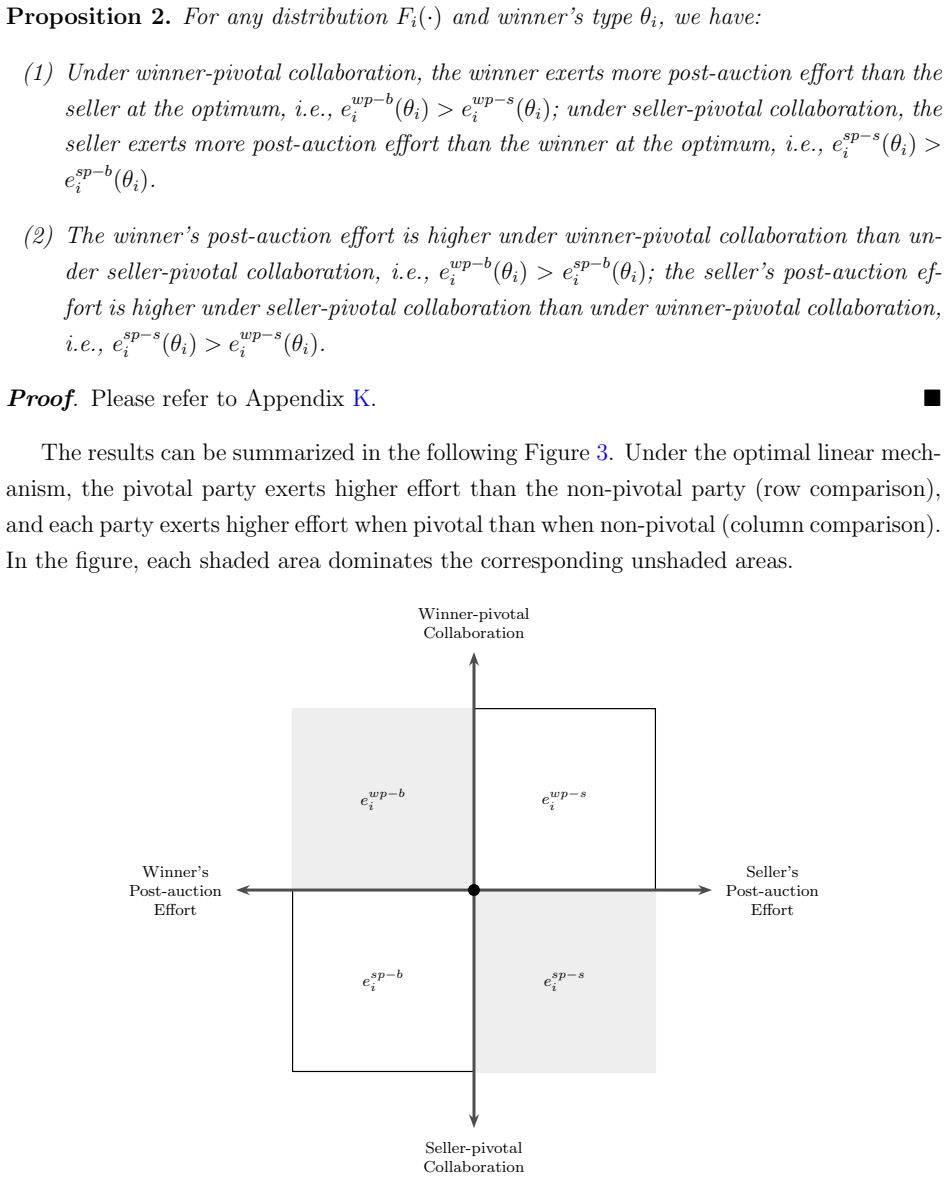
- The pivotal party always exerts higher post-auction effort than the supporting party, and each party works harder when pivotal than when supporting.
- Seller-pivotal collaboration yields strictly higher seller revenue than winner-pivotal collaboration for any bidder type distribution.
- The optimal mechanisms can be implemented by ascending auctions with endogenously chosen linear contracts.
Where Pith is reading between the lines
- Designers facing ongoing partnerships after sale could assign the lead collaboration role to the seller to raise revenue without changing the allocation rule.
- The same linear-contract approach may extend to other aftermarket settings such as technology licensing where effort remains non-contractible.
- If value creation were nonlinear in efforts, the deterministic sharing rule might no longer be optimal and revenue rankings could reverse.
Load-bearing premise
Post-auction efforts are non-contractible and the value generated is linear in the two parties' efforts.
What would settle it
A type distribution in which seller-pivotal collaboration produces weakly lower seller revenue than winner-pivotal collaboration would falsify the revenue comparison.
Figures


read the original abstract
This paper studies optimal auction design when valuations depend endogenously on post-auction collaboration between the seller and the winning bidder. Both parties exert non-contractible efforts after the auction, generating a double moral hazard problem alongside adverse selection. We analyze two role structures -- winner-pivotal and seller-pivotal collaboration -- and characterize optimal direct mechanisms using linear payment schemes that combine cash transfers with proportional value sharing. The optimal mechanism allocates the asset to the bidder with the highest virtual surplus, employs a deterministic value-sharing rule, and achieves full type revelation through the signal realization rule. Comparing the two scenarios yields three main findings. First, regarding value sharing, the seller secures a strictly higher share under seller-pivotal collaboration: for sufficiently low-type winners, the seller extracts the entire value, whereas under winner-pivotal collaboration every winner must retain a positive share to sustain his critical effort. Second, regarding effort exertion, the pivotal party always exerts higher post-auction effort than the supporting party, and each party exerts greater effort when pivotal than when providing support. Third, seller-pivotal collaboration yields strictly higher seller revenue than winner-pivotal collaboration for any type distribution. Finally, these optimal mechanisms can be implemented through ascending auctions with endogenously determined linear contracts.
Editorial analysis
A structured set of objections, weighed in public.
Referee Report
Summary. The paper studies optimal auction design when the winner's valuation is endogenous to post-auction collaboration with the seller, creating a double moral-hazard problem in addition to adverse selection. It examines two role structures (winner-pivotal and seller-pivotal collaboration) and characterizes optimal direct mechanisms restricted to linear payment schemes that combine cash transfers with proportional value sharing. The optimal mechanism allocates the asset to the bidder with the highest virtual surplus, employs a deterministic value-sharing rule, and induces full type revelation via the signal realization rule. Comparative analysis yields three findings: the seller obtains a strictly higher share (extracting the entire value for low-type winners) under seller-pivotal collaboration; the pivotal party always exerts higher effort than the supporting party, with each exerting more when pivotal; and seller-pivotal collaboration generates strictly higher seller revenue than winner-pivotal collaboration for any type distribution. The mechanisms are implementable via ascending auctions with endogenous linear contracts.
Significance. If the derivations hold, the paper makes a meaningful contribution to mechanism design by extending the virtual-surplus approach to settings with endogenous values and double moral hazard. The revenue ranking between collaboration structures is robust (holding for arbitrary type distributions) and the implementation result via ascending auctions with linear contracts adds practical value. The restriction to linear payments enables a tractable characterization while still delivering clear comparative statics on shares and efforts.
minor comments (3)
- The abstract states that the analysis 'characterizes optimal direct mechanisms using linear payment schemes,' but it would be useful to clarify early whether the restriction to linear schemes is without loss of generality or a maintained modeling choice that could be relaxed in future work.
- In the model section, the effort cost functions and the precise form of the linear value-production technology should be stated explicitly with notation (e.g., c_w(e_w), c_s(e_s), v(e_w, e_s)) before the mechanism-design analysis begins, to aid readability.
- The three comparative findings are clearly listed, yet the implementation result via ascending auctions is presented separately; consider whether it can be folded into the main findings or given its own numbered result for structural clarity.
Simulated Author's Rebuttal
We thank the referee for their positive summary of the paper, recognition of its contribution to mechanism design under endogenous values and double moral hazard, and recommendation for minor revision. The referee correctly identifies the key results on virtual-surplus allocation, deterministic value sharing, full type revelation, the revenue ranking between collaboration structures, and implementability via ascending auctions with linear contracts. No specific major comments were raised in the report.
Circularity Check
No significant circularity; derivation self-contained
full rationale
The paper constructs the model from explicit first-principles assumptions on non-contractible post-auction efforts, linear value production in the two efforts, and double moral hazard. It then applies standard virtual-surplus maximization to characterize the optimal linear-payment direct mechanism, derives the deterministic value-sharing rule and signal realization rule by solving the resulting optimization program, and obtains the revenue ranking between seller-pivotal and winner-pivotal regimes by direct comparison of the induced effort levels and seller shares under those same assumptions. No equation reduces to a self-definition, no fitted parameter is relabeled as a prediction, and no load-bearing step relies on a self-citation chain or imported uniqueness theorem. The central claims therefore remain independent of the paper's own outputs.
Axiom & Free-Parameter Ledger
free parameters (2)
- type distribution
- effort cost functions
axioms (2)
- standard math Quasi-linear utilities and independent private values
- domain assumption Efforts are non-contractible and chosen after the auction
Reference graph
Works this paper leans on
-
[1]
Vineet Abhishek and Bruce Hajek and Steven R. Williams , keywords =. Auctions with a profit sharing contract , journal =. 2013 , issn =. doi:https://doi.org/10.1016/j.geb.2012.10.007 , url =
-
[2]
The Journal of Finance , volume =
Liu, Tingjun and Bernhardt, Dan , title =. The Journal of Finance , volume =. doi:https://doi.org/10.1111/jofi.13018 , url =. https://onlinelibrary.wiley.com/doi/pdf/10.1111/jofi.13018 , abstract =
-
[3]
Romano , journal =
Richard E. Romano , journal =. Double Moral Hazard and Resale Price Maintenance , urldate =
-
[4]
Optimal equity auctions with two-dimensional types , journal =
Tingjun Liu and Dan Bernhardt , keywords =. Optimal equity auctions with two-dimensional types , journal =. 2019 , issn =. doi:https://doi.org/10.1016/j.jet.2019.06.009 , url =
-
[5]
1987 , journal =
Competition for Agency Contracts , author =. 1987 , journal =
1987
-
[6]
DeMarzo and Ilan Kremer and Andrzej Skrzypacz , title =
Peter M. DeMarzo and Ilan Kremer and Andrzej Skrzypacz , title =. The American Economic Review , year =
-
[7]
Working Paper , year =
Zongbo Huang and Yunan Li , title =. Working Paper , year =
-
[8]
Optimal equity auctions with heterogeneous bidders , year =
Tingjun Liu , journal =. Optimal equity auctions with heterogeneous bidders , year =. doi:http://dx.doi.org/10.1016/j.jet.2016.08.005 , keywords =
-
[9]
Preston McAfee and John McMillan , journal =
R. Preston McAfee and John McMillan , journal =. Bidding for Contracts: A Principal-Agent Analysis , urldate =
-
[10]
and Srinivasan, Shubashri , title =
Rao, Ram C. and Srinivasan, Shubashri , title =. Journal of Economics & Management Strategy , year =
-
[11]
Optimal equity auction with interdependent valuations , journal =
Dazhong Wang and Xinyi Xu , keywords =. Optimal equity auction with interdependent valuations , journal =. 2022 , issn =. doi:https://doi.org/10.1016/j.jmateco.2021.102623 , url =
-
[12]
Optimal auction design with aftermarket Cournot competition , journal =
Yanlin Chen and Audrey Hu and Jun Zhang , keywords =. Optimal auction design with aftermarket Cournot competition , journal =. 2024 , issn =. doi:https://doi.org/10.1016/j.geb.2024.02.003 , url =
-
[13]
Comparisons of standard royalty auctions with seller post-auction effort , journal =
Dazhong Wang and Xinyi Xu and Xianjie Zeng , keywords =. Comparisons of standard royalty auctions with seller post-auction effort , journal =. 2023 , issn =. doi:https://doi.org/10.1016/j.jmateco.2023.102864 , url =
-
[14]
Mechanism Design With Aftermarkets: Cutoff Mechanisms , year =
Piotr Dworczak , journal =. Mechanism Design With Aftermarkets: Cutoff Mechanisms , year =. doi:https://doi.org/10.3982/ECTA15768 , eprint =
-
[15]
Auctioning Incentive Contracts , volume =
Jean-Jacques Laffont and Jean Tirole , journal =. Auctioning Incentive Contracts , volume =
-
[16]
A Theory of Contractual Structure in Agriculture , urldate =
Mukesh Eswaran and Ashok Kotwal , journal =. A Theory of Contractual Structure in Agriculture , urldate =
-
[17]
Double-Sided Moral Hazard and the Nature of Share Contracts , urldate =
Sugato Bhattacharyya and Francine Lafontaine , journal =. Double-Sided Moral Hazard and the Nature of Share Contracts , urldate =
-
[18]
Costly auction entry, royalty payments, and the optimality of asymmetric designs , journal =
Dan Bernhardt and Tingjun Liu and Takeharu Sogo , keywords =. Costly auction entry, royalty payments, and the optimality of asymmetric designs , journal =. 2020 , issn =. doi:https://doi.org/10.1016/j.jet.2020.105041 , url =
-
[19]
Hagiu, Andrei and Wright, Julian , title =. Management Science , volume =. 2019 , doi =. https://doi.org/10.1287/mnsc.2018.3180 , abstract =
-
[20]
The Dynamics of Incentive Contracts , year =
Jean-Jacques Laffont and Jean Tirole , journal =. The Dynamics of Incentive Contracts , year =
-
[21]
Contracting with imperfect commitment and noisy communication , year =
Helmut Bester and Roland Strausz , journal =. Contracting with imperfect commitment and noisy communication , year =. doi:https://doi.org/10.1016/j.jet.2006.07.009 , keywords =
-
[22]
Doval, Laura and Skreta, Vasiliki , title =. Econometrica , volume =. doi:https://doi.org/10.3982/ECTA16846 , url =. https://onlinelibrary.wiley.com/doi/pdf/10.3982/ECTA16846 , abstract =
-
[23]
Theoretical Economics , year=2023, volume=
Carroll, Gabriel and Bolte, Lukas , title=. Theoretical Economics , year=2023, volume=. doi:, abstract=
2023
-
[24]
Optimal auction design under non-commitment , year =
Vasiliki Skreta , journal =. Optimal auction design under non-commitment , year =. doi:https://doi.org/10.1016/j.jet.2015.04.007 , keywords =
-
[25]
Journal of Mathematical Economics , year =
Myerson, Roger B , title =. Journal of Mathematical Economics , year =
-
[26]
The Theory of Incentives: The Principal-Agent Model , urldate =
Jean-Jacques Laffont and David Martimort , publisher =. The Theory of Incentives: The Principal-Agent Model , urldate =
-
[27]
Milgrom, Paul and Segal, Ilya , title =. Econometrica , volume =. doi:https://doi.org/10.1111/1468-0262.00296 , url =. https://onlinelibrary.wiley.com/doi/pdf/10.1111/1468-0262.00296 , abstract =
-
[28]
2005 , month=
Patrick Bolton and Mathias Dewatripont , title=. 2005 , month=. doi:None , url=
2005
-
[29]
Aggregation and Linearity in the Provision of Intertemporal Incentives , urldate =
Bengt Holmstrom and Paul Milgrom , journal =. Aggregation and Linearity in the Provision of Intertemporal Incentives , urldate =
-
[30]
The Journal of Law, Economics, and Organization , volume =
Holmstrom, Bengt and Milgrom, Paul , title =. The Journal of Law, Economics, and Organization , volume =. 1991 , month =. doi:10.1093/jleo/7.special_issue.24 , url =
-
[31]
1984 , publisher =
The Economics of Agency , author =. 1984 , publisher =
1984
-
[32]
Economic Theory , year =
Bagnoli, Mark and Bergstrom, Ted , title =. Economic Theory , year =
-
[33]
American Economic Review , volume =
Kamenica, Emir and Gentzkow, Matthew , title =. American Economic Review , volume =. 2011 , pages =
2011
-
[34]
Murphy , journal =
Robert Gibbons and Kevin J. Murphy , journal =. Optimal Incentive Contracts in the Presence of Career Concerns: Theory and Evidence , volume =
-
[35]
A Mechanism Design Approach to Ranking Asymmetric Auctions , volume =
Ren\'. A Mechanism Design Approach to Ranking Asymmetric Auctions , volume =. Econometrica , number =
-
[36]
Myerson , journal =
Roger B. Myerson , journal =. Optimal Auction Design , volume =
-
[37]
Schmidt , title =
Klaus D. Schmidt , title =. Insurance: Mathematics and Economics , volume =. 2014 , doi =
2014
-
[38]
Stiglitz , journal =
Joseph E. Stiglitz , journal =. Incentives and Risk Sharing in Sharecropping , volume =
-
[39]
The Quarterly Journal of Economics , volume =
Weitzman, Martin , title =. The Quarterly Journal of Economics , volume =
-
[40]
Gorbenko and Andrey Malenko , title =
Alexander S. Gorbenko and Andrey Malenko , title =. American Economic Review , year =
-
[41]
Journal of Mathematical Economics , year =
Takeharu Sogo , title =. Journal of Mathematical Economics , year =
-
[42]
Journal of Economic Theory , year =
Son Ku Kim and Susheng Wang , title =. Journal of Economic Theory , year =
-
[43]
Goeree , title =
Jacob K. Goeree , title =. Journal of Economic Theory , year =
-
[44]
Haile , title =
Philip A. Haile , title =. Journal of Economic Theory , year =
-
[45]
International Economic Review , year =
Francesco Giovannoni and Miltiadis Makris , title =. International Economic Review , year =
-
[46]
Games and Economic Behavior , year =
Olivier Bos and Martin Pollrich , title =. Games and Economic Behavior , year =
discussion (0)
Sign in with ORCID, Apple, or X to comment. Anyone can read and Pith papers without signing in.