Recognition: unknown
State-Averaged Quantum Algorithms for Multiconfigurational Surface Chemistry: A Benchmark on Rh@TiO2(110)
Pith reviewed 2026-05-10 05:34 UTC · model grok-4.3
The pith
The adaptive state-averaged quantum ansatz reaches near-CASSCF accuracy on a multiconfigurational NO adsorption model using far fewer operators than fixed-depth alternatives.
A machine-rendered reading of the paper's core claim, the machinery that carries it, and where it could break.
Core claim
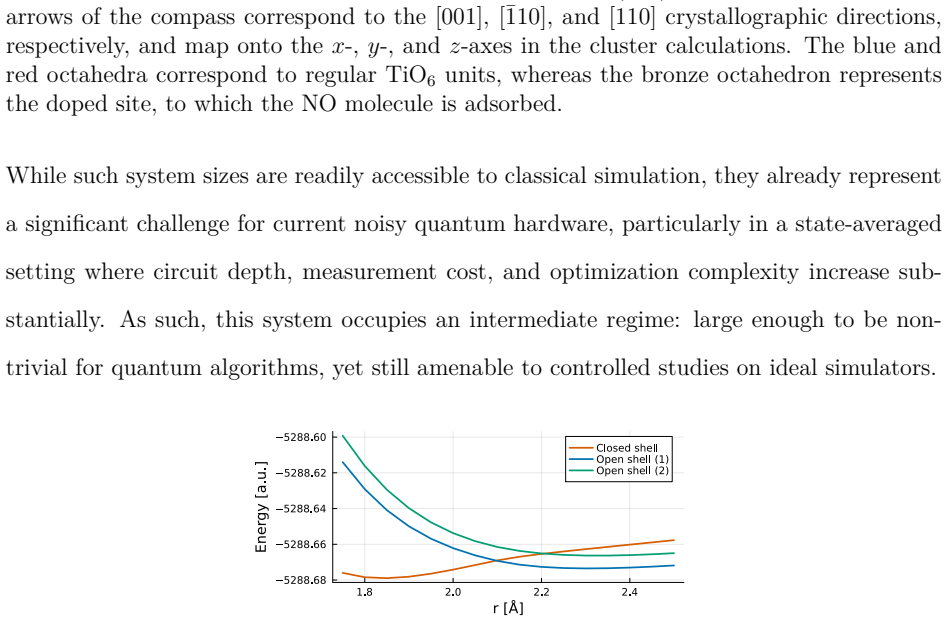
On the embedded Rh@TiO2(110) cluster with fixed orbitals from state-averaged CASSCF, SA-fUCCSD improves as circuit depth grows yet demands many parameters and remains sensitive to initialization, whereas SA-ADAPT reaches near-CASSCF accuracy with substantially fewer operators and a modified scheme that incorporates multiple operators per iteration speeds convergence markedly.
What carries the argument
State-averaged adaptive problem-tailored ansatz (SA-ADAPT) equipped with a multi-operator selection rule per iteration, used to solve the CASCI problem inside a fixed orbital basis taken from classical state-averaged CASSCF.
Load-bearing premise
The embedded cluster model of NO adsorption on Rh@TiO2(110) together with a fixed orbital basis from state-averaged CASSCF is sufficient to represent the multiconfigurational character and state crossings that would appear in the full periodic surface system.
What would settle it
Direct computation of state energies and crossing locations for the same active space on a periodic supercell model of the Rh@TiO2(110) surface, followed by comparison of energy errors and crossing geometries against the embedded-cluster results.
Figures



read the original abstract
Accurate modeling of surface catalytic processes often requires methods capable of describing strong correlation, charge transfer, and multiple closely lying electronic states. While density functional theory remains widely used, its limitations for localized electronic states motivate the use of wavefunction-based approaches and, more recently, quantum computing algorithms. However, the performance of quantum ans\"atze in chemically motivated, multistate settings remains largely unexplored. Here, we benchmark state-averaged factorized unitary coupled cluster with singles and doubles (SA-fUCCSD) and the adaptive, problem-tailored ansatz (SA-ADAPT) using an embedded cluster model of NO adsorption on Rh-doped TiO2(110). The system exhibits pronounced multiconfigurational character and multiple state crossings, providing a stringent test. State-averaged CASSCF serves as a reference, and the quantum ans\"atze are evaluated as solvers for the corresponding CASCI problem within a fixed orbital basis. We find that SA-fUCCSD improves with increasing circuit depth but requires many parameters and shows sensitivity to initialization. In contrast, SA-ADAPT achieves near-CASSCF accuracy with significantly fewer operators. A modified operator selection scheme, incorporating multiple operators per iteration, substantially accelerates convergence. Our results demonstrate the efficiency of adaptive ans\"atze for multistate problems and establish a controlled benchmark for quantum algorithms in chemically motivated systems beyond minimal models.
Editorial analysis
A structured set of objections, weighed in public.
Referee Report
Summary. The paper benchmarks state-averaged factorized unitary coupled cluster (SA-fUCCSD) and the adaptive SA-ADAPT ansatz as solvers for the CASCI problem within a fixed orbital basis taken from state-averaged CASSCF. Using an embedded cluster model of NO adsorption on Rh@TiO2(110) chosen for its multiconfigurational character and state crossings, the work claims that SA-ADAPT reaches near-CASSCF accuracy with substantially fewer operators than SA-fUCCSD and that a modified operator selection scheme (multiple operators per iteration) accelerates convergence.
Significance. If the reported numerical comparisons hold, the work is significant as a controlled benchmark of adaptive quantum ansatze on a chemically motivated multistate system beyond minimal models. It directly demonstrates resource advantages of problem-tailored adaptive constructions over fixed ansatze such as fUCCSD for state-averaged problems, which is relevant for quantum algorithms targeting catalysis and strong-correlation surface chemistry.
minor comments (3)
- The abstract asserts 'near-CASSCF accuracy' and 'significantly fewer operators' without quoting concrete energy deviations, operator counts, or circuit depths; these quantitative metrics should appear in the abstract or be highlighted in the first paragraph of the results section to allow immediate evaluation of the central claim.
- The modified multi-operator selection scheme is described only qualitatively; a precise algorithmic statement (pseudocode or explicit rule for choosing and adding multiple operators per iteration) should be added to the methods section so that the reported acceleration can be reproduced.
- All energy tables or convergence plots should report both absolute and relative errors to the CASSCF reference together with the number of variational parameters or operators at each point, to make the 'fewer operators' comparison unambiguous.
Simulated Author's Rebuttal
We thank the referee for their positive evaluation of the manuscript, accurate summary of our benchmark, and recommendation for minor revision. We appreciate the recognition that this work provides a controlled test of adaptive state-averaged quantum ansatze on a chemically relevant multistate surface system.
Circularity Check
No significant circularity detected
full rationale
The paper benchmarks SA-fUCCSD and SA-ADAPT quantum ansatze against an independent state-averaged CASSCF reference for a fixed CASCI problem in an explicitly defined embedded cluster model of NO on Rh@TiO2(110). All reported accuracies, operator counts, and convergence behaviors are direct numerical comparisons within that space; no equations reduce the results to fitted parameters, self-definitions, or self-citation chains. The embedded-cluster setup is presented as the test system itself rather than an approximation whose validity is derived from the quantum results. No load-bearing steps match the enumerated circularity patterns.
Axiom & Free-Parameter Ledger
axioms (1)
- domain assumption State-averaged CASSCF supplies an accurate reference for the multiconfigurational CASCI problem in the embedded cluster.
Reference graph
Works this paper leans on
-
[1]
Self-interaction correction to density-functional approximations for many-electron systems , volume =
J P Perdew and Alex Zunger , issue =. Self-interaction correction to density-functional approximations for many-electron systems , volume =. Physical Review B , month =
-
[2]
Van De Walle , doi =
Christoph Freysoldt and Blazej Grabowski and Tilmann Hickel and Jörg Neugebauer and Georg Kresse and Anderson Janotti and Chris G. Van De Walle , doi =. First-principles calculations for point defects in solids , volume =. Reviews of Modern Physics , month =
-
[3]
Bartlett and Monika Musiał , doi =
Rodney J. Bartlett and Monika Musiał , doi =. Coupled-cluster theory in quantum chemistry , volume =. Reviews of Modern Physics , month =
-
[4]
B. O. Roos and P. R. Taylor and P. E. M. Siegbahn , issue =. A Complete Active Space SCF Method (CASSCF) Using A Density Matrix Formulated Super-CI Approach , volume =. Chemical Physics , pages =
-
[5]
Dutoi and Peter J
Alán Aspuru-Guzik and Anthony D. Dutoi and Peter J. Love and Martin Head-Gordon , doi =. Simulated Quantum Computation of Molecular Energies , volume =. Science , keywords =
-
[6]
E. D. Larsson and M. Krośnicki and V. Veryazov , doi =. A program system for self-consistent embedded potentials for ionic crystals , volume =. Chemical Physics , keywords =
-
[7]
The ab initio model potential representation of the crystalline environment
Zoila Barandiarán and Luis Seijo , doi =. The ab initio model potential representation of the crystalline environment. Theoretical study of the local distortion on NaCl:Cu+ , volume =. The Journal of Chemical Physics , pages =
-
[8]
Sushko and Igor V
Peter V. Sushko and Igor V. Abarenkov , doi =. General purpose electrostatic embedding potential , volume =. Journal of Chemical Theory and Computation , pages =
-
[9]
Implementation of frozen density embedding in CP2K and OpenMolcas: CASSCF wavefunctions embedded in a Gaussian and plane wave DFT environment , volume =
Lukas Schreder and Sandra Luber , doi =. Implementation of frozen density embedding in CP2K and OpenMolcas: CASSCF wavefunctions embedded in a Gaussian and plane wave DFT environment , volume =. Journal of Chemical Physics , month =
-
[10]
Frozen Density Functional Approach for ab Initio Calculations of Solvated Molecules , volume =
Tomasz Adam Wesolowski and Arieh Warshel , journal =. Frozen Density Functional Approach for ab Initio Calculations of Solvated Molecules , volume =
-
[11]
Density matrix embedding: A simple alternative to dynamical mean-field theory , volume =
Gerald Knizia and Garnet Kin Lic Chan , doi =. Density matrix embedding: A simple alternative to dynamical mean-field theory , volume =. Physical Review Letters , pages =
-
[12]
Pham and Dingshun Lv , doi =
Changsu Cao and Jinzhao Sun and Xiao Yuan and Han Shi Hu and Hung Q. Pham and Dingshun Lv , doi =. Ab Initio Quantum Simulation of Strongly Correlated Materials with Quantum Embedding , volume =. npj Computational Materials , month =. 2023 , pages =
2023
-
[13]
Quantum cluster theories , volume =
Thomas Maier and Mark Jarrell and Thomas Pruschke and Matthias H Hettler , issue =. Quantum cluster theories , volume =. Reviews of Modern Physics , month =
-
[14]
Lavroff and Daniel Kats and Lorenzo Maschio and Nikolay A
Robert H. Lavroff and Daniel Kats and Lorenzo Maschio and Nikolay A. Bogdanov and Ali Alavi and Anastassia N. Alexandrova and Denis Usvyat , doi =. Aperiodic defects in periodic solids , volume =. Journal of Chemical Physics , month =. 2025 , pages =
2025
-
[15]
Carter , doi =
Florian Libisch and Chen Huang and Emily A. Carter , doi =. Embedded correlated wavefunction schemes: Theory and applications , volume =. Accounts of Chemical Research , month =
-
[16]
Stein , doi =
Elena Kolodzeiski and Christopher J. Stein , doi =. Efficient Electronic-Structure Methods Toward Catalyst Screening: Projection-Based Embedding Theory for CO _2 Reduction Reaction Intermediates , volume =. Angewandte Chemie - International Edition , keywords =. 2025 , pages =
2025
-
[17]
Effective Hamiltonian of crystal field method for periodic systems containing transition metals , volume =
Ilya Popov and Evgeny Plekhanov and Andrei Tchougréeff and Elena Besley , doi =. Effective Hamiltonian of crystal field method for periodic systems containing transition metals , volume =. Molecular Physics , keywords =. 2023 , pages =
2023
-
[18]
Rybkin and Ivano Tavernelli and Jürg Hutter , doi =
Stefano Battaglia and Max Rossmannek and Vladimir V. Rybkin and Ivano Tavernelli and Jürg Hutter , doi =. A General Framework for Active Space Embedding Methods with Applications in Quantum Computing , volume =. npj Computational Materials , month =. 2024 , pages =
2024
-
[19]
Separable dual-space Gaussian pseudopotentials , author =. Physical Review B , volume =. 1996 , month =. doi:10.1103/PhysRevB.54.1703 , url =
-
[20]
CC-GRB BASIS , howpublished =
Hutter, J. CC-GRB BASIS , howpublished =. 2024 , note =
2024
-
[21]
Aquilante, Francesco and Autschbach, Jochen and Baiardi, Alberto and Battaglia, Stefano and Borin, Veniamin A. and Chibotaru, Liviu F. and Conti, Irene and De Vico, Luca and Delcey, Mickaël and Fdez. Galván, Ignacio and Ferré, Nicolas and Freitag, Leon and Garavelli, Marco and Gong, Xuejun and Knecht, Stefan and Larsson, Ernst D. and Lindh, Roland and Lun...
-
[22]
Galván, Ignacio and Vacher, Morgane and Alavi, Ali and Angeli, Celestino and Aquilante, Francesco and Autschbach, Jochen and Bao, Jie J
Fdez. Galván, Ignacio and Vacher, Morgane and Alavi, Ali and Angeli, Celestino and Aquilante, Francesco and Autschbach, Jochen and Bao, Jie J. and Bokarev, Sergey I. and Bogdanov, Nikolay A. and Carlson, Rebecca K. and Chibotaru, Liviu F. and Creutzberg, Joel and Dattani, Nike and Delcey, Mickaël G. and Dong, Sijia S. and Dreuw, Andreas and Freitag, Leon ...
2019
-
[23]
arXiv , author =:2003.03868 , issn =
Journal of Chemical Physics , number =. arXiv , author =:2003.03868 , issn =
-
[24]
Segmented Contracted Error-Consistent Basis Sets of Double- and Triple‑Zeta Valence Quality for One- and Two-Component Relativistic All-Electron Calculations , pages =
Pollak, Patrik and Weigend, Florian , address =. Segmented Contracted Error-Consistent Basis Sets of Double- and Triple‑Zeta Valence Quality for One- and Two-Component Relativistic All-Electron Calculations , pages =. Journal of Chemical Theory and Computation , keywords =. 2017 , abstract =
2017
-
[25]
Dirac-Fock Atomic Electronic Structure Calculations Using Different Nuclear Charge Distributions , volume =
L Visscher and K G Dyall , issue =. Dirac-Fock Atomic Electronic Structure Calculations Using Different Nuclear Charge Distributions , volume =. Atomic Data And Nuclear Data Tables , pages =
-
[26]
Grimsley and Sophia E
Harper R. Grimsley and Sophia E. Economou and Edwin Barnes and Nicholas J. Mayhall , doi =. An adaptive variational algorithm for exact molecular simulations on a quantum computer , volume =. Nature Communications , month =. 2019 , pages =
2019
-
[27]
Alternative Coupled-Cluster Ansätze II
Rodney J Bartlett and Stanislaw A Kucharski and Jozef Noga , issue =. Alternative Coupled-Cluster Ansätze II. The Unitary Coupled-Cluster Method , volume =. Chemical Physics Letters , month =
-
[28]
Huggins and Martin Head-Gordon and K
Joonho Lee and William J. Huggins and Martin Head-Gordon and K. Birgitta Whaley , doi =. Generalized Unitary Coupled Cluster Wave functions for Quantum Computation , volume =. Journal of Chemical Theory and Computation , month =
-
[29]
Evangelista and Garnet Kin Lic Chan and Gustavo E
Francesco A. Evangelista and Garnet Kin Lic Chan and Gustavo E. Scuseria , doi =. Exact parameterization of fermionic wave functions via unitary coupled cluster theory , volume =. Journal of Chemical Physics , month =
-
[30]
Graham and Xiaoqing Pan and Phillip Christopher and Jun Li and Philippe Sautet , doi =
Yan Tang and Chithra Asokan and Mingjie Xu and George W. Graham and Xiaoqing Pan and Phillip Christopher and Jun Li and Philippe Sautet , doi =. Rh single atoms on TiO _2 dynamically respond to reaction conditions by adapting their site , volume =. Nature Communications , month =. 2019 , pages =
2019
-
[31]
Ho Lun Tang and V. O. Shkolnikov and George S. Barron and Harper R. Grimsley and Nicholas J. Mayhall and Edwin Barnes and Sophia E. Economou , doi =. Qubit-ADAPT-VQE: An Adaptive Algorithm for Constructing Hardware-Efficient Ansätze on a Quantum Processor , volume =. PRX Quantum , month =
-
[32]
Quantum Science and Technology Strategies for quantum computing molecular energies using the unitary coupled cluster ansatz , volume =
Jonathan Romero and Ryan Babbush and Jarrod R McClean and Cornelius Hempel and Peter Love and Alán Aspuru-Guzik , journal =. Quantum Science and Technology Strategies for quantum computing molecular energies using the unitary coupled cluster ansatz , volume =
-
[33]
McClean and Sergio Boixo and Vadim N
Jarrod R. McClean and Sergio Boixo and Vadim N. Smelyanskiy and Ryan Babbush and Hartmut Neven , doi =. Barren plateaus in quantum neural network training landscapes , volume =. Nature Communications , month =. 2018 , pages =
2018
-
[34]
Overlap-ADAPT-VQE: practical quantum chemistry on quantum computers via overlap-guided compact Ansätze , volume =
César Feniou and Muhammad Hassan and Diata Traoré and Emmanuel Giner and Yvon Maday and Jean Philip Piquemal , doi =. Overlap-ADAPT-VQE: practical quantum chemistry on quantum computers via overlap-guided compact Ansätze , volume =. Communications Physics , month =. 2023 , pages =
2023
-
[35]
doi:10.22331/q-2021-01-28-391 , url =
Structure optimization for parameterized quantum circuits , author =. doi:10.22331/q-2021-01-28-391 , url =
-
[36]
Nakanishi and Kosuke Mitarai and Keisuke Fujii , doi =
Ken M. Nakanishi and Kosuke Mitarai and Keisuke Fujii , doi =. Subspace-search variational quantum eigensolver for excited states , volume =. Physical Review Research , month =
-
[37]
Parrish and Edward G
Robert M. Parrish and Edward G. Hohenstein and Peter L. McMahon and Todd J. Martínez , doi =. Quantum Computation of Electronic Transitions Using a Variational Quantum Eigensolver , volume =. Physical Review Letters , month =
-
[38]
Ollitrault and Abhinav Kandala and Chun Fu Chen and Panagiotis Kl Barkoutsos and Antonio Mezzacapo and Marco Pistoia and Sarah Sheldon and Stefan Woerner and Jay M
Pauline J. Ollitrault and Abhinav Kandala and Chun Fu Chen and Panagiotis Kl Barkoutsos and Antonio Mezzacapo and Marco Pistoia and Sarah Sheldon and Stefan Woerner and Jay M. Gambetta and Ivano Tavernelli , doi =. Quantum equation of motion for computing molecular excitation energies on a noisy quantum processor , volume =. Physical Review Research , month =
-
[39]
Docken, Kate K. and Hinze, Juergen , title =. The Journal of Chemical Physics , volume =. 1972 , month =. doi:10.1063/1.1678164 , url =
-
[40]
The Journal of Chemical Physics , volume =
Werner, Hans‐Joachim and Meyer, Wilfried , title =. The Journal of Chemical Physics , volume =. 1981 , month =. doi:10.1063/1.440892 , url =
-
[41]
Grimsley and Nicholas J
Harper R. Grimsley and Nicholas J. Mayhall and George S. Barron and Edwin Barnes and Sophia E. Economou , doi =. Adaptive, problem-tailored variational quantum eigensolver mitigates rough parameter landscapes and barren plateaus , volume =. npj Quantum Information , month =. 2023 , pages =
2023
-
[42]
An initialization strategy for addressing barren plateaus in parametrized quantum circuits , volume =
Edward Grant and Mateusz Ostaszewski and Leonard Wossnig and Marcello Benedetti , doi =. An initialization strategy for addressing barren plateaus in parametrized quantum circuits , volume =. Quantum , keywords =. 2019 , pages =
2019
-
[43]
Wales , doi =
Choy Boy and Maria Andreea Filip and David J. Wales , doi =. Energy Landscapes for the Unitary Coupled Cluster Ansatz , volume =. Journal of Chemical Theory and Computation , month =
-
[44]
Roos , doi =
Valera Veryazov and Per Åke Malmqvist and Björn O. Roos , doi =. How to Select Active Space for Multiconfigurational Quantum Chemistry? , volume =. International Journal of Quantum Chemistry , keywords =
-
[45]
Jain, Anubhav and Ong, Shyue Ping and Hautier, Geoffroy and Chen, Wei and Richards, William Davidson and Dacek, Stephen and Cholia, Shreyas and Gunter, Dan and Skinner, David and Ceder, Gerbrand and Persson, Kristin A. , title =. APL Materials , volume =. 2013 , month =. doi:10.1063/1.4812323 , url =
-
[46]
Materials Project Database, mp-2657 , howpublished =
-
[47]
Dunning, Thom H., Jr. , title =. The Journal of Chemical Physics , volume =. 1989 , month =. doi:10.1063/1.456153 , url =
-
[48]
Balabanov, Nikolai B. and Peterson, Kirk A. , title =. The Journal of Chemical Physics , volume =. 2006 , month =. doi:10.1063/1.2335444 , url =
-
[49]
and Figgen, Detlev and Dolg, Michael and Stoll, Hermann , title =
Peterson, Kirk A. and Figgen, Detlev and Dolg, Michael and Stoll, Hermann , title =. The Journal of Chemical Physics , volume =. 2007 , month =. doi:10.1063/1.2647019 , url =
-
[50]
Weigend, Florian and Ahlrichs, Reinhart. Balanced basis sets of split valence , triple zeta valence and quadruple zeta valence quality for H to Rn: Design and assessment of accuracy. Phys. Chem. Chem. Phys. 2005. doi:10.1039/B508541A
-
[51]
Energy-Adjusted Ab Initio Pseudopotentials for the Second and Third Row Transition Elements , volume =
D Andrae and U Häußermann and M Dolg and H Stoll and H Preuß , journal =. Energy-Adjusted Ab Initio Pseudopotentials for the Second and Third Row Transition Elements , volume =
-
[52]
Kjellgren, Erik and Ziems, Karl Michael , title =. n.d. , howpublished =
-
[53]
Kjellgren, Erik Rosendahl and Ziems, Karl Michael and Reinholdt, Peter and Sauer, Stephan P A and Coriani, Sonia and Kongsted , title =. n.d. , howpublished =
-
[54]
Exact closed-form expressions for unitary spin-adapted fermionic singlet double excitation operators
Kjellgren, Erik Rosendahl and Ziems, Karl Michael and Reinholdt, Peter and Sauer, Stephan P A and Coriani, Sonia and Kongsted, Jacob. Exact closed-form expressions for unitary spin-adapted fermionic singlet double excitation operators. J. Chem. Phys
-
[55]
Closed-form expressions for unitaries of spin-adapted fermionic operators
Magoulas, Ilias and Evangelista, Francesco A. Closed-form expressions for unitaries of spin-adapted fermionic operators. Mol. Phys
-
[56]
Quantum Science and Technology , volume=
A state-averaged orbital-optimized hybrid quantum--classical algorithm for a democratic description of ground and excited states , author=. Quantum Science and Technology , volume=. 2021 , publisher=
2021
-
[57]
Analytical nonadiabatic couplings and gradients within the state-averaged orbital-optimized variational quantum eigensolver
Yalouz, Saad and Koridon, Emiel and Senjean, Bruno and Lasorne, Benjamin and Buda, Francesco and Visscher, Lucas. Analytical nonadiabatic couplings and gradients within the state-averaged orbital-optimized variational quantum eigensolver. J. Chem. Theory Comput
-
[58]
Subspace-search variational quantum eigensolver for excited states
Nakanishi, Ken M and Mitarai, Kosuke and Fujii, Keisuke. Subspace-search variational quantum eigensolver for excited states. Phys. Rev. Res
-
[59]
Challenging excited states from adaptive quantum eigensolvers: subspace expansions vs
Grimsley, Harper R and Evangelista, Francesco A. Challenging excited states from adaptive quantum eigensolvers: subspace expansions vs. state-averaged strategies. Quantum Sci. Technol
-
[60]
Variational quantum eigensolvers by variance minimization
Zhang, Dan-Bo and Chen, Bin-Lin and Yuan, Zhan-Hao and Yin, Tao. Variational quantum eigensolvers by variance minimization. Chin. Physics B
-
[61]
2014 , author =
A variational eigenvalue solver on a photonic quantum processor , volume =. 2014 , author =
2014
discussion (0)
Sign in with ORCID, Apple, or X to comment. Anyone can read and Pith papers without signing in.