Recognition: unknown
Implosive Dynamics from Topological Quenches in Bose-Einstein Condensates
Pith reviewed 2026-05-10 03:36 UTC · model grok-4.3
The pith
A topological quench can drive a repulsive Bose-Einstein condensate into implosive dynamics by canceling the winding of a giant vortex.
A machine-rendered reading of the paper's core claim, the machinery that carries it, and where it could break.
Core claim
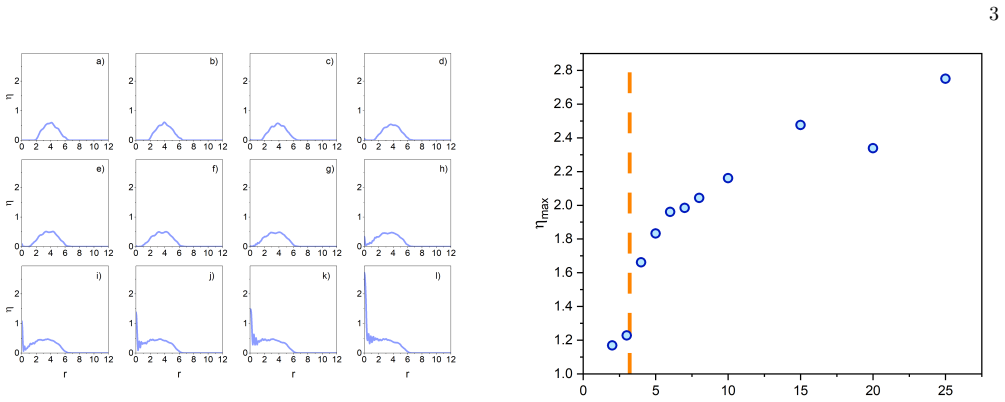
By realizing giant vortices through quasi-adiabatic phase imprinting and then performing a sudden anti-imprint to cancel the accumulated winding, a repulsive Bose-Einstein condensate is switched from a highly charged vortex state to the trivial sector. This phase-density mismatch produces a rapid inward radial flow and a strong central density buildup despite the repulsive interactions, with a clear threshold in the initial winding for the onset of this focusing. The subsequent evolution generates circular nonlinear wave fronts that break azimuthal symmetry down to a polygonal one, with the shape set by the method of giant vortex preparation.
What carries the argument
The sudden anti-imprint that cancels the accumulated winding of the giant vortex, creating a phase-density mismatch that launches the inward flow.
Load-bearing premise
The quasi-adiabatic phase imprinting and instantaneous anti-imprint can be realized without introducing uncontrolled excitations, heating, or particle loss that would invalidate the mean-field description during the rapid radial flow.
What would settle it
An experiment in which the anti-imprint is applied to a giant vortex but produces no central density buildup or inward radial flow once the winding exceeds the reported threshold.
Figures


read the original abstract
We show numerically that a repulsive Bose-Einstein condensate can be driven into implosive dynamics by a direct topological quench. We first realize giant vortices by quasi-adiabatic phase imprinting, and then perform a sudden anti-imprint that cancels the accumulated winding in a single step, abruptly switching the condensate from a highly charged vortex state to the trivial sector. The resulting phase-density mismatch launches a rapid inward radial flow and produces a strong central density buildup, despite the repulsive interactions. We find a clear threshold in the initial winding for the onset of this focusing. After the first implosion, the dynamics evolves into circular nonlinear wave fronts that subsequently undergo breaking of azimuthal symmetry (axisymmetry) down to a polygonal one, whose shape is determined by the way the giant vortex is built. These results establish topological engineering as a new tool for studying implosive dynamics and symmetry-breaking instabilities in quantum fluids.
Editorial analysis
A structured set of objections, weighed in public.
Referee Report
Summary. The paper claims that a repulsive Bose-Einstein condensate can be driven into implosive dynamics via a topological quench: giant vortices are first created by quasi-adiabatic phase imprinting, followed by an instantaneous anti-imprint that cancels the winding number in one step. This phase-density mismatch induces rapid inward radial flow and central density buildup despite repulsive interactions, with a clear threshold in initial winding number for the onset of focusing. Post-implosion, the dynamics produces circular nonlinear wave fronts that break azimuthal symmetry to a polygonal shape whose form depends on the preparation of the giant vortex.
Significance. If the numerical results hold, the work establishes topological quenches as a new experimental and theoretical tool for inducing and studying implosive dynamics and modulational instabilities in quantum fluids, without requiring changes to the sign of interactions. The direct numerical time evolution of the Gross-Pitaevskii equation, free of fitted parameters or self-referential definitions, is a strength that makes the threshold prediction falsifiable.
major comments (2)
- [Numerical methods] Numerical methods section: grid resolution, convergence tests, boundary conditions, and the choice of Cartesian versus polar coordinates are not reported for the time-dependent simulations. This is load-bearing for the central claim of post-implosion azimuthal symmetry breaking to polygonal shapes (described after the first focusing event), because Cartesian discretization can introduce preferred axes that mimic physical modulational instability.
- [Post-implosion dynamics] Results on post-quench evolution: the reported dependence of the polygonal symmetry on the preparation method of the giant vortex requires explicit checks (e.g., rotated grids or comparison runs in polar coordinates) to rule out numerical artifacts; without these, the symmetry-breaking portion of the result cannot be distinguished from discretization effects.
minor comments (2)
- [Abstract and introduction] The abstract states that details of the quasi-adiabatic imprinting and anti-imprint are provided, but the main text should include a brief quantitative estimate of the time scales involved to confirm they remain within the mean-field regime.
- [Figures] Figure captions for the density and phase plots should explicitly state the grid size and time-stepping method used to generate each panel.
Simulated Author's Rebuttal
We thank the referee for their careful reading of the manuscript and for highlighting the importance of detailed numerical validation, particularly given the central role of post-implosion symmetry breaking. We address each major comment below and will revise the manuscript to incorporate the requested information and checks.
read point-by-point responses
-
Referee: [Numerical methods] Numerical methods section: grid resolution, convergence tests, boundary conditions, and the choice of Cartesian versus polar coordinates are not reported for the time-dependent simulations. This is load-bearing for the central claim of post-implosion azimuthal symmetry breaking to polygonal shapes (described after the first focusing event), because Cartesian discretization can introduce preferred axes that mimic physical modulational instability.
Authors: We agree that the numerical methods were insufficiently detailed in the original submission. In the revised manuscript we will add a dedicated subsection (or appendix) specifying the grid resolution (typically 1024×1024 points over a 100 μm domain), time-step size, convergence tests performed by doubling/halving the spatial resolution, boundary conditions (absorbing layers to suppress reflections), and the choice of Cartesian coordinates for ease of implementing arbitrary phase imprints. We will also report additional runs on rotated initial conditions to test for grid anisotropy. revision: yes
-
Referee: [Post-implosion dynamics] Results on post-quench evolution: the reported dependence of the polygonal symmetry on the preparation method of the giant vortex requires explicit checks (e.g., rotated grids or comparison runs in polar coordinates) to rule out numerical artifacts; without these, the symmetry-breaking portion of the result cannot be distinguished from discretization effects.
Authors: The observed dependence of the final polygonal symmetry on the specific preparation protocol of the giant vortex (different quasi-adiabatic imprinting histories yielding distinct polygons) already argues against a fixed-grid artifact, which would not vary with initial conditions. Nevertheless, we accept that explicit verification is required. In the revision we will include (i) simulations with the entire initial state rotated by 15–30 degrees and (ii) selected comparison runs in polar coordinates for the post-implosion stage. These results will be added to the manuscript; if they reveal any discretization influence we will qualify the claims accordingly. revision: yes
Circularity Check
No circularity: results from direct numerical time evolution of the GPE
full rationale
The paper's central claims rest on numerical integration of the time-dependent Gross-Pitaevskii equation after a topological quench (phase imprint then anti-imprint). The implosion threshold, radial flow, and subsequent azimuthal symmetry breaking are reported as simulation outputs, not as quantities fitted to data or defined in terms of themselves. No self-citations, ansatzes, or uniqueness theorems are invoked in the abstract or described procedure to justify the results. The derivation chain is therefore the standard numerical solution of the underlying PDE and does not reduce to its inputs by construction.
Axiom & Free-Parameter Ledger
axioms (1)
- domain assumption The condensate is accurately described by the time-dependent Gross-Pitaevskii equation in the mean-field limit.
Reference graph
Works this paper leans on
-
[1]
This gives the condi- tionr 0 ≳ √
+ℓ 2 0/2∼1. This gives the condi- tionr 0 ≳ √
-
[2]
Using the scalingr 0 ∼ξS 0, we obtain S0,c ∼ √ 2/ξ≃3.2, which is in reasonable agreement with the simulations, as shown in Fig. 3. After the first implosion, the condensate enters a post- quench oscillatory regime characterized by repeated re- focusing and re-expansion. During this stage, a large fraction of the excess energy released by the topological q...
-
[3]
Chandrasekhar, The maximum mass of ideal white dwarfs, The Astrophysical Journal74, 81 (1931)
S. Chandrasekhar, The maximum mass of ideal white dwarfs, The Astrophysical Journal74, 81 (1931)
1931
-
[4]
H. A. Bethe, Supernova mechanisms, Reviews of Modern Physics62, 801 (1990)
1990
-
[5]
Dimmelmeier, C
H. Dimmelmeier, C. D. Ott, A. Marek, and H.-T. Janka, Gravitational wave burst signal from core collapse of ro- tating stars, Physical Review D78, 064056 (2008)
2008
-
[6]
J. W. M. Bush, J. M. Aristoff, and A. E. Hosoi, An exper- imental investigation of the stability of the circular hy- draulic jump, Journal of Fluid Mechanics558, 33 (2006)
2006
-
[7]
T. R. N. Jansson, M. P. Haspang, K. H. Jensen, P. Hersen, and T. Bohr, Polygons on a rotating fluid sur- face, Physical Review Letters96, 174502 (2006)
2006
-
[8]
S´ anchez-Lavega, T
A. S´ anchez-Lavega, T. del R´ ıo-Gaztelurrutia, R. Hueso, E. Garc´ ıa-Melendo, P. V. Sada, and P. Helfenstein, The long-term steady motion of saturn’s hexagon and the sta- bility of its enclosed jet stream under seasonal changes, Geophysical Research Letters41, 1425 (2014)
2014
-
[9]
Izumiet al., Low mode implosion symmetry sensitiv- ity in low gas-fill NIF cylindrical hohlraums, Physics of Plasmas28, 022706 (2021)
N. Izumiet al., Low mode implosion symmetry sensitiv- ity in low gas-fill NIF cylindrical hohlraums, Physics of Plasmas28, 022706 (2021)
2021
-
[10]
Dalfovo, S
F. Dalfovo, S. Giorgini, L. P. Pitaevskii, and S. Stringari, Theory of bose-einstein condensation in trapped gases, Reviews of Modern Physics71, 463 (1999)
1999
-
[11]
Dutton, M
Z. Dutton, M. Budde, C. Slowe, and L. V. Hau, Ob- servation of quantum shock waves created with ultra- compressed slow light pulses in a Bose-Einstein conden- sate, Science293, 663 (2001)
2001
-
[12]
M. A. Hoefer, M. J. Ablowitz, I. Coddington, E. A. Cor- nell, P. Engels, and V. Schweikhard, Dispersive and clas- sical shock waves in Bose-Einstein condensates and gas dynamics, Physical Review A74, 023623 (2006)
2006
-
[13]
Theocharis, D
G. Theocharis, D. J. Frantzeskakis, P. G. Kevrekidis, B. A. Malomed, and Y. S. Kivshar, Ring dark solitons and vortex necklaces in Bose-Einstein condensates, Phys- ical Review Letters90, 120403 (2003)
2003
-
[14]
L. A. Toikka and K.-A. Suominen, Snake instability of ring dark solitons in toroidally trapped Bose-Einstein condensates, Physical Review A87, 043601 (2013)
2013
-
[15]
Kuopanportti and M
P. Kuopanportti and M. M¨ ott¨ onen, Splitting dynamics of giant vortices in dilute bose-einstein condensates, Physi- cal Review A81, 033627 (2010)
2010
-
[16]
A. L. Fetter, Rotating trapped bose–einstein conden- sates, Reviews of Modern Physics81, 647 (2009)
2009
-
[17]
Y. Shin, M. Saba, M. Vengalattore, T. A. Pasquini, C. Sanner, A. E. Leanhardt, M. Prentiss, D. E. Pritchard, and W. Ketterle, Dynamical instability of a doubly quan- tized vortex in a bose-einstein condensate, Physical Re- view Letters93, 160406 (2004)
2004
-
[18]
Engels, I
P. Engels, I. Coddington, P. C. Haljan, V. Schweikhard, and E. A. Cornell, Observation of long-lived vortex aggre- gates in rapidly rotating bose-einstein condensates, Phys- ical Review Letters90, 170405 (2003)
2003
-
[19]
Kasamatsu, M
K. Kasamatsu, M. Tsubota, and M. Ueda, Giant hole and circular superflow in a fast rotating bose-einstein conden- sate, Physical Review A66, 053606 (2002)
2002
-
[20]
Lundh, Multiply quantized vortices in trapped bose- einstein condensates, Physical Review A65, 043604 (2002)
E. Lundh, Multiply quantized vortices in trapped bose- einstein condensates, Physical Review A65, 043604 (2002)
2002
-
[21]
T. P. Simula, A. A. Penckwitt, and R. J. Ballagh, Gi- ant vortex lattice deformations in rapidly rotating bose- einstein condensates, Physical Review Letters92, 060401 (2004)
2004
-
[22]
Easton, M
T. Easton, M. Kokmotos, and G. Barontini, Vortex clus- tering in trapped bose-einstein condensates, Scientific Reports13, 19432 (2023)
2023
-
[23]
A. E. Leanhardt, Y. Shin, A. P. Chikkatur, D. Kielpinski, W. Ketterle, and D. E. Pritchard, Imprinting vortices in a bose–einstein condensate using topological phases, Physical Review Letters89, 190403 (2002)
2002
-
[24]
Meyer, H
N. Meyer, H. Proud, M. Perea-Ortiz, C. O’Neale, M. Baumert, M. Holynski, J. Kronj¨ ager, G. Barontini, and K. Bongs, Observation of two-dimensional localized jones-roberts solitons in bose-einstein condensates, Phys. Rev. Lett.119, 150403 (2017)
2017
discussion (0)
Sign in with ORCID, Apple, or X to comment. Anyone can read and Pith papers without signing in.