Recognition: unknown
Advances in photocathode development for PICOSEC Micromegas precise-timing detectors
Pith reviewed 2026-05-10 03:51 UTC · model grok-4.3
The pith
A 5 nm Cesium Iodide photocathode achieves 10.9 picosecond time resolution in the PICOSEC Micromegas detector.
A machine-rendered reading of the paper's core claim, the machinery that carries it, and where it could break.
Core claim
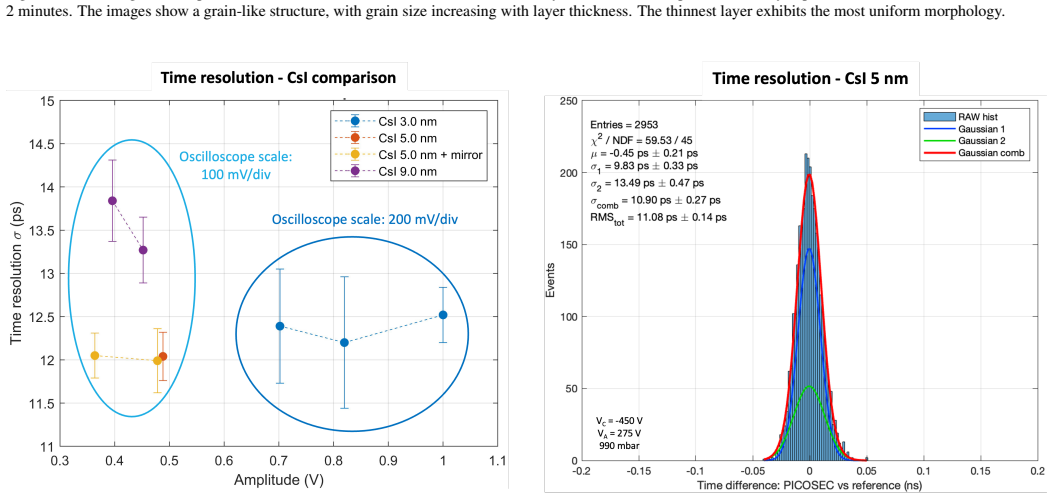
A 5 nm Cesium Iodide photocathode delivered the highest performance, reaching a time resolution of 10.9 ± 0.3 ps with more than 30 extracted photoelectrons per muon, the most precise result reported for PICOSEC Micromegas. Titanium and boron carbide photocathodes achieved approximately 30 ps resolution with about 5 photoelectrons and are presented as more robust alternatives.
What carries the argument
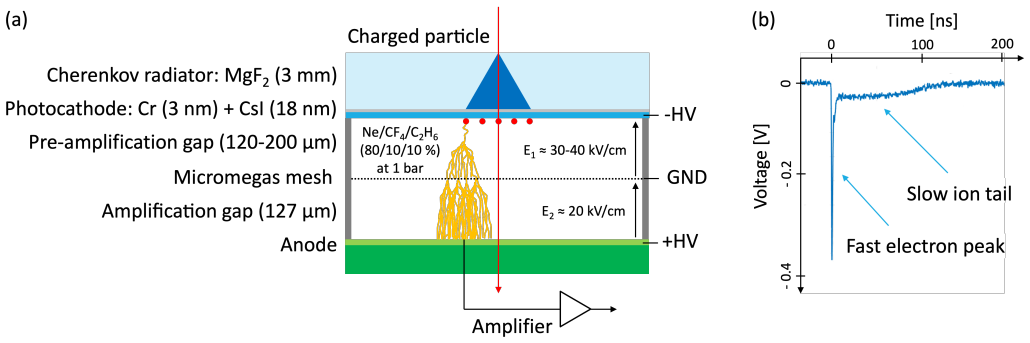
The semi-transparent photocathode that converts Cherenkov light into photoelectrons before Micromegas amplification, where material choice and thickness set the photoelectron yield and the spread in arrival times.
If this is right
- The detector concept becomes viable for experiments needing sub-20 ps timing to resolve close particle tracks.
- Robust photocathode options open the door to higher-rate operation without rapid performance loss.
- Scaling to multi-pad or large-area PICOSEC modules gains support from the measured yields.
- The same photocathode approach could extend to other gaseous Cherenkov timing detectors.
Where Pith is reading between the lines
- Protective overcoatings on the best CsI layer could combine its precision with the durability of the alternatives.
- Beam tests at different gas pressures or with different amplification gases might further improve yield.
- Direct comparison with non-gaseous timing technologies would clarify where PICOSEC fits in overall detector design.
- Radiation-hardness measurements on the promising titanium and boron carbide layers are the next required step.
Load-bearing premise
Brief lab optical checks and short muon beam runs will accurately predict how the photocathodes behave over long periods under real collider radiation, gas and rate conditions.
What would settle it
If a 5 nm CsI photocathode operated for months in a high-rate experiment shows time resolution degrading past 15 ps or a sustained drop in photoelectron yield, the claim that laboratory results translate to practical collider use would be disproved.
Figures




read the original abstract
The PICOSEC Micromegas detector is a precise-timing gaseous detector that combines a Cherenkov radiator, a semi-transparent photocathode and a Micromegas amplification stage, targeting time resolutions of tens of picoseconds for minimum ionising particles (MIPs). Initial single-pad prototypes achieved $\sigma<25$ ps, demonstrating strong potential for High Energy Physics (HEP) applications. The objective of this paper is a~comprehensive characterisation of photocathodes, with a strong focus on robust materials while preserving excellent timing performance. The study includes laboratory measurements of optical and resistive properties together with beam tests using 150 GeV/$c$ muons to evaluate time resolution and photoelectron yield for various photocathodes. The best performance was delivered by a~5\,nm Cesium Iodide (CsI) photocathode, reaching $\sigma = 10.9 \pm 0.3$ ps with more than 30 extracted photoelectrons, representing the most precise time resolution achieved by PICOSEC Micromegas to date. Metallic and carbon-based photocathodes, including Titanium (Ti), Boron Carbide (B$_4$C) and Diamond-Like Carbon (DLC), were also tested, with Ti and B$_4$C emerging as the most promising alternatives, achieving $\sigma \approx 30$ ps with about 5 extracted photoelectrons. These results demonstrate that improved robustness can be achieved while maintaining excellent time resolution, supporting the feasibility of using the PICOSEC Micromegas concept in future experiments.
Editorial analysis
A structured set of objections, weighed in public.
Referee Report
Summary. The manuscript reports laboratory optical and resistive characterization plus beam tests with 150 GeV/c muons of several photocathode materials for PICOSEC Micromegas detectors. The central result is that a 5 nm CsI photocathode delivers the best performance to date, with σ = 10.9 ± 0.3 ps and >30 extracted photoelectrons; Ti and B4C are identified as promising robust alternatives that reach ~30 ps with ~5 photoelectrons. The work concludes that these results support the feasibility of the PICOSEC concept for future collider experiments.
Significance. If the reported beam-test performance holds, the paper makes a useful contribution to precise-timing gaseous detectors by quantifying trade-offs between timing resolution and material robustness. Explicit reporting of uncertainties and direct photoelectron counts from the 150 GeV muon data strengthens the central performance claims and provides a clear benchmark for the field.
major comments (2)
- [Beam tests and conclusion] Beam-test section and conclusion: the assertion that the results 'support the feasibility of using the PICOSEC Micromegas concept in future experiments' rests on short-duration exposures; no aging, integrated-dose, high-rate, or long-term gas-stability data are presented, so the extrapolation to collider conditions remains unverified and weakens the broader claim.
- [Abstract and beam-test results] Abstract and beam-test results: the quoted time resolution of 10.9 ± 0.3 ps and the photoelectron yield (>30) are presented without any description of how systematic uncertainties were evaluated or how the photoelectron count was extracted from the waveforms, making it difficult to assess the robustness of the headline numbers.
minor comments (2)
- [Abstract] The abstract would be clearer if it briefly stated the gas mixture and the duration or integrated charge of the beam exposures.
- [Figures] Figure captions for timing distributions should explicitly note the fitted resolution and the corresponding photoelectron yield for each photocathode.
Simulated Author's Rebuttal
We thank the referee for the careful reading and constructive feedback. The comments have prompted us to strengthen the presentation of our analysis methods and to qualify our conclusions more precisely. We address each major point below.
read point-by-point responses
-
Referee: Beam-test section and conclusion: the assertion that the results 'support the feasibility of using the PICOSEC Micromegas concept in future experiments' rests on short-duration exposures; no aging, integrated-dose, high-rate, or long-term gas-stability data are presented, so the extrapolation to collider conditions remains unverified and weakens the broader claim.
Authors: We agree that the beam-test data are limited to short-duration exposures and do not include aging, integrated dose, high-rate, or long-term stability measurements. The original phrasing was meant to indicate that the demonstrated performance constitutes a necessary milestone toward collider use. To address the concern directly, we have revised the final sentence of the abstract and the conclusion to read: 'These results demonstrate the potential of the PICOSEC Micromegas concept for achieving precise timing, while underscoring the need for dedicated studies of radiation hardness and long-term operation under collider conditions.' A short paragraph has also been added to the discussion section acknowledging these limitations. revision: yes
-
Referee: Abstract and beam-test results: the quoted time resolution of 10.9 ± 0.3 ps and the photoelectron yield (>30) are presented without any description of how systematic uncertainties were evaluated or how the photoelectron count was extracted from the waveforms, making it difficult to assess the robustness of the headline numbers.
Authors: We acknowledge that the manuscript did not provide sufficient detail on the analysis procedures. In the revised version we have inserted a dedicated subsection (now Section 4.3) that describes: (i) the waveform digitization and baseline subtraction, (ii) the constant-fraction discriminator timing algorithm, (iii) the Gaussian fit to the time-difference distribution yielding 10.9 ± 0.3 ps, and (iv) the systematic uncertainty evaluation performed by varying fit ranges, calibration constants, and beam-spot cuts. The photoelectron yield is obtained by integrating the charge in a fixed time window and normalizing to the single-photoelectron charge measured in separate laboratory laser runs; the >30 value is the mean of the resulting charge distribution for the 5 nm CsI cathode. These additions allow the reader to assess the robustness of the quoted figures. revision: yes
Circularity Check
No circularity: purely empirical measurements with no derivation chain
full rationale
The paper consists exclusively of laboratory optical and resistive property measurements plus direct beam-test data using 150 GeV/c muons. Time resolutions (e.g., σ = 10.9 ± 0.3 ps) and photoelectron yields are reported as observed outcomes from these experiments, with no equations, fitted parameters, ansatzes, or self-citations invoked to derive or predict the results. The central claims are therefore self-contained empirical findings rather than reductions of outputs to inputs by construction.
Axiom & Free-Parameter Ledger
axioms (2)
- standard math Cherenkov radiation is produced when charged particles traverse the radiator at speeds above the phase velocity of light in the medium.
- domain assumption Photoelectron yield scales with photocathode quantum efficiency and thickness under the tested photon spectrum.
Reference graph
Works this paper leans on
- [1]
-
[2]
J. Bortfeldt, et al., for the PICOSEC Micromegas Collaboration,PI- COSEC: Charged particle timing at sub-25 picosecond precision with a Micromegas based detector, Nuclear Instruments and Methods in Physics Research A903(2018) 317–325
2018
-
[3]
A. Utrobicic, et al., for the PICOSEC Micromegas Collaboration,Single channel PICOSEC Micromegas detector with improved time resolution, Nuclear Instruments and Methods in Physics Research A1072(2025) 170127
2025
-
[5]
Sohl,Development of PICOSEC-Micromegas for fast timing in high rate environments, PhD dissertation, Université Paris-Saclay, 2020; available athttps://hal-universite-paris-saclay
L. Sohl,Development of PICOSEC-Micromegas for fast timing in high rate environments, PhD dissertation, Université Paris-Saclay, 2020; available athttps://hal-universite-paris-saclay. archives-ouvertes.fr/tel-03167728/
2020
- [6]
-
[7]
Wang, et al., for the PICOSEC Micromegas Collaboration,A Novel Diamond-like Carbon based photocathode for PICOSEC Micromegas de- tector, Journal of Instrumentation19(2024) P08010
X. Wang, et al., for the PICOSEC Micromegas Collaboration,A Novel Diamond-like Carbon based photocathode for PICOSEC Micromegas de- tector, Journal of Instrumentation19(2024) P08010
2024
-
[8]
M. Lisowska,Exploring the potential of Micro-Pattern Gaseous Detec- tors technologies in High Energy Physics applications and beyond, PhD dissertation, Université Paris-Saclay, Paris, 2024; available at:https: //theses.hal.science/tel-04867992
2024
-
[9]
M. Lisowska, et al., for the PICOSEC Micromegas Collaboration,Pho- tocathode characterisation for robust PICOSEC Micromegas precise- timing detectors, Nuclear Instruments and Methods in Physics Research A1072(2025) 170151
2025
-
[10]
F. Guerra,PICOSEC Micromegas gaseous detectors for precise timing and developments towards applicable detector, Summer Student Report, CERN, 2025; available at:https://repository.cern/records/ 34sy2-hns09
2025
-
[11]
S. Aune, et al., for the PICOSEC Micromegas Collaboration,Timing per- formance of a multi-pad PICOSEC-Micromegas detector prototype, Nu- clear Instruments and Methods in Physics Research A993(2021) 165076
2021
-
[12]
M. Lisowska, et al., for the PICOSEC Micromegas Collaboration,Sub- 25 ps timing measurements with 10×10 cm 2 PICOSEC Micromegas de- tectors, Nuclear Instruments and Methods in Physics Research A1046 (2023) 167687
2023
-
[13]
A. Utrobicic, et al., for the PICOSEC Micromegas Collaboration,A large area 100-channel PICOSEC Micromegas detector with time resolution at the 20 ps level, Journal of Instrumentation18(2023) C07012
2023
-
[14]
A. Kallitsopoulou,Development of a PICOSEC-Micromegas Detector for ENUBET, PhD dissertation, Université Paris-Saclay, Paris, 2025; avail- able at:https://theses.hal.science/tel-05267379v1
2025
- [16]
-
[17]
Abbon et al.,The COMPASS Experiment at CERN, CERN–PH–EP/2007-001, 2007; available at:https://wwwcompass
P. Abbon et al.,The COMPASS Experiment at CERN, CERN–PH–EP/2007-001, 2007; available at:https://wwwcompass. cern.ch/compass/publications/papers/cern-ph-ep_ 2007-001/compass_spec_070330.pdf
2007
-
[18]
The ALICE Collaboration,ALICE Technical Design Re- port of the High Momentum Particle Identification Detec- tor, CERN-LHCC-98–19, ALICE-TDR-1, 1998; available at: https://alice-collaboration.web.cern.ch/sites/default/ files/Documents/PROJECTS/HMPID/HMPID_TDR.pdf
1998
-
[19]
H. Hödlmoser,Development of Large Area CsI Photocathodes for the AL- ICE/HMPID RICH Detector, PhD dissertation, Technischen Universität Wien, 2005; available athttps://cds.cern.ch/record/924378/. [20]McPherson deuterium lamp, Model 632,http://www.mcphersoninc. com/systems/vuvMIS.html. Accessed on: 20.02.2026. [21]VUV McPherson monochromator, Monarch,https...
2005
-
[20]
Jones,APV25-S1: User guide version 2.2, RAL Microelectronics De- sign Group (2001)
L. Jones,APV25-S1: User guide version 2.2, RAL Microelectronics De- sign Group (2001)
2001
-
[21]
Martoiu, et al.,Development of the scalable readout system for micro- pattern gas detectors and other applications, Journal of Instrumentation 18(2013) C03015
S. Martoiu, et al.,Development of the scalable readout system for micro- pattern gas detectors and other applications, Journal of Instrumentation 18(2013) C03015. [26]MCP-PMT, Hamamatsu, R3809U-50,https: //seltokphotonics.com/upload/iblock/843/ 84341cf19eac7539608b443c8d7a1447.pdf. Accessed on: 20.02.2026
2013
-
[22]
Hoarau, et al.,RF pulse amplifier for CVD-diamond particle detectors, Journal of Instrumentation16(2021) T04005
C. Hoarau, et al.,RF pulse amplifier for CVD-diamond particle detectors, Journal of Instrumentation16(2021) T04005. [28]LeCroy WR8104 oscilloscope,https://www.teledynelecroy. com/oscilloscope/oscilloscopemodel.aspx?modelid=9720. Accessed on: 20.02.2026
2021
-
[23]
Dalla Torre,Gaseous counters with CsI photocathodes: The COM- PASS RICH, Nuclear Instruments and Methods in Physics Research A970 (2020) 163768
S. Dalla Torre,Gaseous counters with CsI photocathodes: The COM- PASS RICH, Nuclear Instruments and Methods in Physics Research A970 (2020) 163768
2020
- [24]
discussion (0)
Sign in with ORCID, Apple, or X to comment. Anyone can read and Pith papers without signing in.