Recognition: unknown
Propagation, generation, and utilization of topologically trivial magnetic solitons in magnetic nanowires
Pith reviewed 2026-05-10 04:08 UTC · model grok-4.3
The pith
Topologically trivial magnetic solitons in nanowires can be generated by pulses and drive domain walls in discrete steps set by soliton magnitude.
A machine-rendered reading of the paper's core claim, the machinery that carries it, and where it could break.
Core claim
An approximate analytical soliton solution parameterized by two free parameters describes topologically trivial magnetic solitons in nanowires and matches micromagnetic results. The solitons display nonlinear refraction and reflection at anisotropy interfaces. Counter-propagating pairs are generated by timed opposite pulses in adjacent regions. These solitons interact with domain walls to displace them by an amount fixed by soliton strength, supporting discrete manipulation of domain walls that aligns with digital information processing.
What carries the argument
The two-parameter approximate analytical soliton profile, which encodes the nonlinear local excitation and governs its propagation, interface crossing, and interaction with domain walls.
If this is right
- Solitons generated by pulse sequences remain within the analytical family and can be tuned by pulse parameters.
- Nonlinear refraction at interfaces differs from linear spin-wave behavior and follows deterministic rules.
- Domain-wall displacement is proportional to soliton magnitude, enabling stepwise repositioning.
- The mechanism is compatible with existing nanowire fabrication and pulse-based control in spintronic devices.
Where Pith is reading between the lines
- If thermal stability holds, the solitons could function as low-dissipation carriers for information in extended nanowire networks.
- The nonlinear interface transmission might be exploited to design soliton routing or collision-based operations at wire junctions.
- Adding weak damping or external fields to the two-parameter family could introduce additional tunable degrees of freedom for soliton control.
Load-bearing premise
The two-parameter analytical soliton profile stays sufficiently close to the exact micromagnetic solution throughout propagation, interface crossing, and interaction with domain walls.
What would settle it
A micromagnetic simulation in which a pulse-generated soliton deviates substantially from the two-parameter analytical form after crossing an anisotropy interface or after displacing a domain wall would falsify the controllability and utility claims.
Figures



read the original abstract
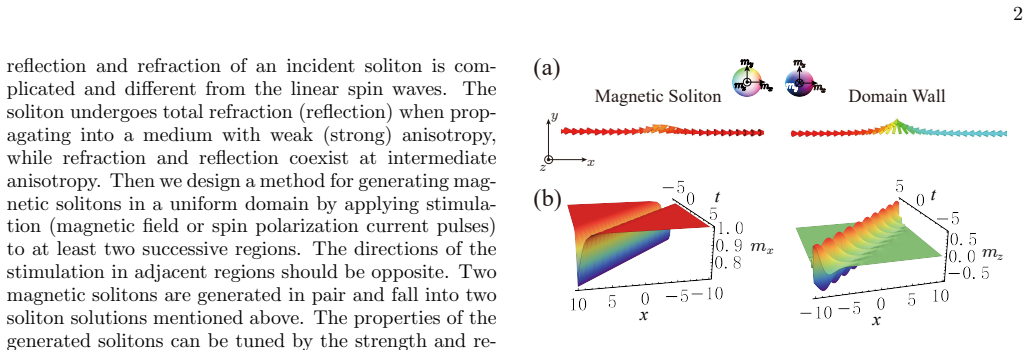
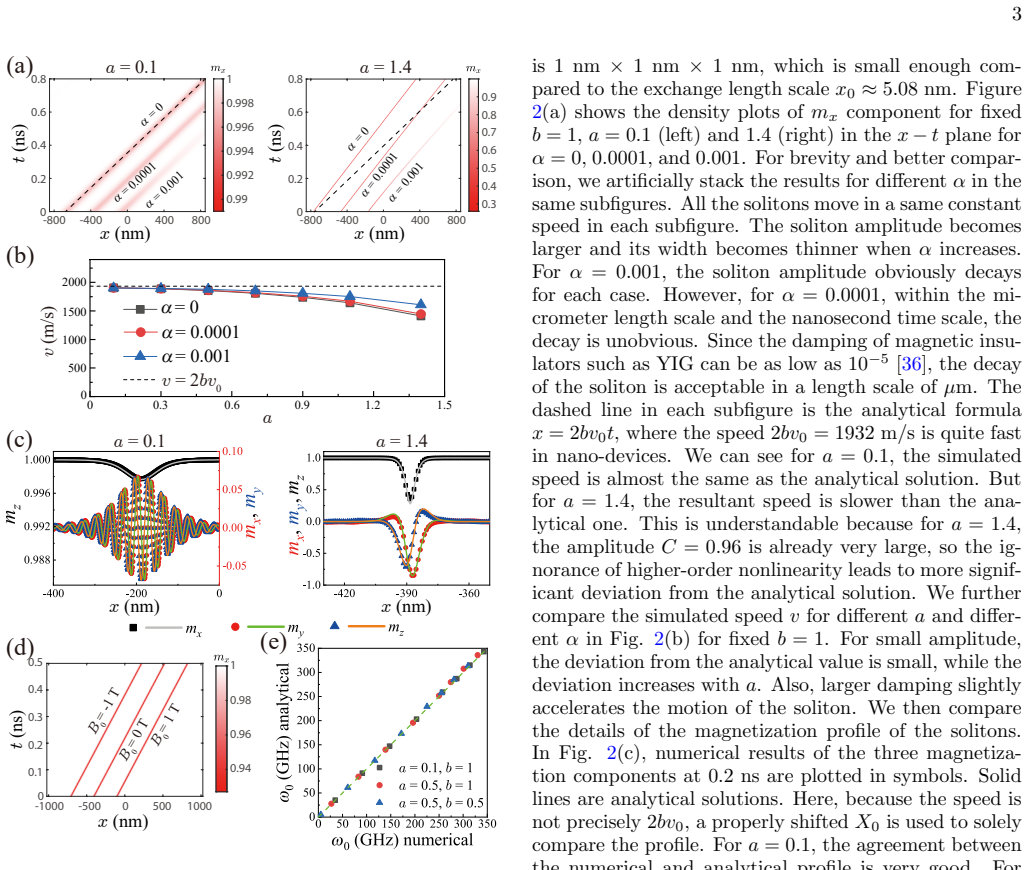
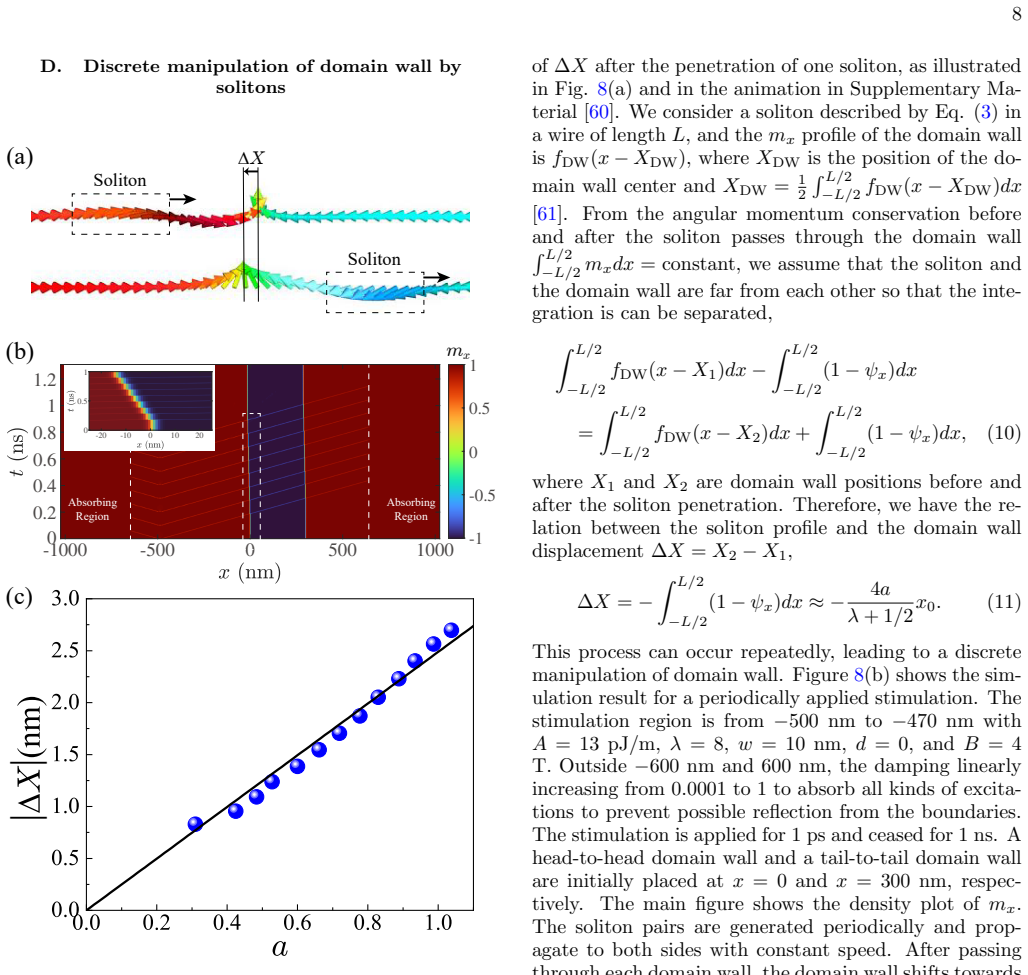
Magnetic solitons are nonlinear, local excitations in magnetic systems. In this study, we theoretically and numerically investigate the properties and generation of one-dimensional (1D) topologically trivial magnetic solitons in ferromagnetic nanowires. An approximate analytical soliton solution described by two free parameters is validated by comparing with the micromagnetic simulation. Across an interface between two media of different anisotropy, the reflection and refraction of a soliton are highly nonlinear that are different from the linear spin waves. A pair of magnetic solitons that propagate in opposite directions can be generated by alternately applying magnetic field or spin-polarized current pulses of opposite directions to at least two successive regions. Each soliton falls into a soliton solution that can be controlled by the generation process. These magnetic solitons can be used to drive domain wall motion over a certain distance determined by the soliton magnitude, allowing for discrete manipulation of domain walls compatible with the digital nature of information technology. Our findings pave the way for the application of topologically trivial solitons in spintronics.
Editorial analysis
A structured set of objections, weighed in public.
Referee Report
Summary. The paper theoretically and numerically investigates topologically trivial 1D magnetic solitons in ferromagnetic nanowires. It introduces an approximate analytical soliton solution parameterized by two free parameters, validates it against micromagnetic simulations for free propagation, analyzes highly nonlinear reflection and refraction at interfaces between regions of differing anisotropy, proposes a generation scheme using alternating magnetic field or spin-polarized current pulses applied to successive regions, and claims that such solitons can drive domain wall motion over a reproducible distance set by the soliton magnitude to enable discrete DW manipulation.
Significance. If the central claims are substantiated, the work offers a potentially useful approach to soliton-based control of domain walls in nanowires, with the pulse-driven generation and nonlinear interface behavior providing concrete mechanisms that could align with digital spintronic applications. The two-parameter approximate solution and its numerical checks for propagation represent a constructive step beyond purely numerical studies, though the lack of detailed quantitative validation and interaction data reduces the immediate strength of the utilization claim.
major comments (2)
- [Abstract] Abstract and validation description: the statement that the two-parameter approximate analytical soliton solution is validated by micromagnetic simulation provides no quantitative error metrics, explicit parameter ranges (e.g., damping, anisotropy values), or direct comparison data such as profile overlap or velocity discrepancies, which is load-bearing for assessing whether the approximation remains faithful under the claimed conditions.
- [Utilization section] Utilization claim (final paragraph): the assertion that solitons drive domain wall motion over a distance determined solely by soliton magnitude presupposes that the approximate profile remains stable, non-radiative, and controllable throughout the collision without significant deviation from Landau-Lifshitz dynamics; however, only free-propagation validation is referenced, with no reported tests on interaction regimes, initial wall velocity, or linearity of displacement versus amplitude.
minor comments (1)
- [Soliton solution] The description of the two free parameters in the soliton solution would benefit from explicit functional forms or boundary conditions to clarify how they are fixed during generation and propagation.
Simulated Author's Rebuttal
We thank the referee for the careful reading and constructive comments. We address each major point below and have revised the manuscript to incorporate quantitative validation details and additional interaction simulations.
read point-by-point responses
-
Referee: [Abstract] Abstract and validation description: the statement that the two-parameter approximate analytical soliton solution is validated by micromagnetic simulation provides no quantitative error metrics, explicit parameter ranges (e.g., damping, anisotropy values), or direct comparison data such as profile overlap or velocity discrepancies, which is load-bearing for assessing whether the approximation remains faithful under the claimed conditions.
Authors: We agree that the original description of the validation was insufficiently quantitative. The revised manuscript now includes explicit parameter ranges (damping α from 0.001 to 0.1 and uniaxial anisotropy K from 5×10³ to 2×10⁵ J/m³), RMS profile errors (typically <4% in the soliton core), velocity discrepancies (<7% across tested speeds), and overlap integrals between analytical and simulated profiles. These metrics are presented in a new validation subsection with accompanying figures. revision: yes
-
Referee: [Utilization section] Utilization claim (final paragraph): the assertion that solitons drive domain wall motion over a distance determined solely by soliton magnitude presupposes that the approximate profile remains stable, non-radiative, and controllable throughout the collision without significant deviation from Landau-Lifshitz dynamics; however, only free-propagation validation is referenced, with no reported tests on interaction regimes, initial wall velocity, or linearity of displacement versus amplitude.
Authors: The referee is correct that interaction-specific tests were absent from the original submission. While the soliton is an approximate solution to the LLG equation and stable in free propagation, the driving claim requires verification during collision. We have added micromagnetic simulations of soliton-domain wall encounters in the revised manuscript. These demonstrate that the soliton profile remains stable with negligible radiation, the domain wall displacement scales linearly with soliton amplitude, and the relation holds across a range of initial wall velocities. The results are now shown in an expanded utilization section. revision: yes
Circularity Check
No significant circularity detected
full rationale
The paper introduces an approximate analytical soliton solution with two free parameters, validates it through direct comparison to micromagnetic simulations for free propagation, and then describes nonlinear interface behavior, pulse-based generation, and domain-wall driving as derived outcomes of the dynamics. No step reduces a prediction or central claim to a fitted input, self-definition, or self-citation chain; the numerical checks are independent of the target utilization claims. The derivation remains self-contained against external benchmarks.
Axiom & Free-Parameter Ledger
free parameters (1)
- two free parameters of the soliton solution
axioms (1)
- domain assumption Standard micromagnetic dynamics govern the magnetization evolution in the nanowires
Reference graph
Works this paper leans on
-
[1]
Lin X, Yang W, Wang K L and Zhao W 2019 Nature Electronics2274–283 ISSN 2520-1131 URLhttps:// doi.org/10.1038/s41928-019-0273-7
-
[2]
com/science/article/pii/S0304885320302353
Hirohata A, Yamada K, Nakatani Y, Prejbeanu I L, Di´ eny B, Pirro P and Hillebrands B 2020 Journal of Magnetism and Magnetic Materials509166711 ISSN 0304-8853 URLhttps://www.sciencedirect. com/science/article/pii/S0304885320302353
2020
-
[3]
No¨ el P, Trier F, Vicente Arche L M, Br´ ehin J, Vaz D C, Garcia V, Fusil S, Barth´ el´ emy A, Vila L, Bibes M and Attan´ e J P 2020 Nature580483–486 ISSN 1476-4687 URLhttps://doi.org/10.1038/s41586-020-2197-9
-
[4]
Parkin S S P, Hayashi M and Thomas L 2008 Science 320190–194 URLhttps://www.science.org/doi/abs/ 10.1126/science.1145799
-
[5]
Zhang X, Zhao G P, Fangohr H, Liu J P, Xia W X, Xia J and Morvan F J 2015 Scientific Reports57643 ISSN 2045-2322 URLhttps://doi.org/10.1038/srep07643
-
[6]
Allwood D A, Xiong G, Faulkner C C, Atkinson D, Petit D and Cowburn R P 2005 Science309 1688–1692 URLhttps://www.science.org/doi/abs/ 10.1126/science.1108813
-
[7]
Luo S, Song M, Li X, Zhang Y, Hong J, Yang X, Zou X, Xu N and You L 2018 Nano Letters181180–1184 ISSN 1530-6984 URLhttps://doi.org/10.1021/acs. nanolett.7b04722
work page doi:10.1021/acs 2018
-
[8]
Luo Z, Hrabec A, Dao T P, Sala G, Finizio S, Feng J, Mayr S, Raabe J, Gambardella P and Heyderman L J 2020 Nature579214–218 ISSN 1476-4687 URLhttps: //doi.org/10.1038/s41586-020-2061-y 2 FIG. 10. Motion of a soliton ofa= 0.3,b= 1 driven by adiabatic spin transfer torque turned on at 0.5 ns withα= 0. The solid line is the numerical result, and the dashed l...
-
[9]
Jiao X, Wang X S and Lan J 2024 Phys. Rev. B 109(9) 094428 URLhttps://link.aps.org/doi/10. 1103/PhysRevB.109.094428
2024
-
[10]
11 1007/978-3-030-62844-4_14
Wang X S and Wang X R 2021 Topology in Magnetism (Cham: Springer International Publishing) pp 357– 403 ISBN 978-3-030-62844-4 URLhttps://doi.org/10. 11 1007/978-3-030-62844-4_14
2021
-
[11]
1038/nnano.2013.243
Nagaosa N and Tokura Y 2013 Nature Nanotechnology 8899–911 ISSN 1748-3395 URLhttps://doi.org/10. 1038/nnano.2013.243
2013
-
[12]
Thiaville A and Miltat J 2018 Topology and Magnetic Domain Walls (Cham: Springer International Publish- ing) pp 41–73 ISBN 978-3-319-97334-0 URLhttps:// doi.org/10.1007/978-3-319-97334-0_2
-
[13]
Ma X P, Ai X, Yang X X, Cai M X, Shim J H and Piao H G 2023 Journal of Magnetism and Magnetic Materials581170665 ISSN 0304- 8853 URLhttps://www.sciencedirect.com/science/ article/pii/S0304885323003141
2023
-
[14]
Wang X S, Qaiumzadeh A and Brataas A 2019 Phys. Rev. Lett.123(14) 147203 URLhttps://link.aps.org/ doi/10.1103/PhysRevLett.123.147203
-
[15]
Jing K Y, Sun Z Z and Wang X R 2024 Phys. Rev. B110(5) 054414 URLhttps://link.aps.org/doi/10. 1103/PhysRevB.110.054414
2024
-
[16]
de Assis I R, Mertig I and G¨ obel B 2024 Phys. Rev. B110(6) 064404 URLhttps://link.aps.org/doi/10. 1103/PhysRevB.110.064404
2024
-
[17]
Liu Y and Nagaosa N 2024 Phys. Rev. Lett. 132(12) 126701 URLhttps://link.aps.org/doi/10. 1103/PhysRevLett.132.126701
2024
-
[18]
Zang J, Mostovoy M, Han J H and Nagaosa N 2011Phys. Rev. Lett.107(13) 136804 URLhttps://link.aps.org/ doi/10.1103/PhysRevLett.107.136804
-
[19]
Hayashi M, Thomas L, Rettner C, Moriya R, Baza- liy Y B and Parkin S S P 2007 Phys. Rev. Lett. 98(3) 037204 URLhttps://link.aps.org/doi/10. 1103/PhysRevLett.98.037204
2007
-
[20]
Jiang W, Upadhyaya P, Zhang W, Yu G, Jungfleisch M B, Fradin F Y, Pearson J E, Tserkovnyak Y, Wang K L, Heinonen O, te Velthuis S G E and Hoffmann A 2015 Science349283–286 URLhttps://www.science.org/ doi/abs/10.1126/science.aaa1442
- [21]
-
[22]
Jiang S, Chung S, Ahlberg M, Frisk A, Khymyn R, Le Q T, Mazraati H, Houshang A, Heinonen O and˚Akerman J 2024 Nature Communications152118 ISSN 2041-1723 URLhttps://doi.org/10.1038/s41467-024-46404-7
-
[23]
Li Z D, He P B and Liu W M 2014 Chinese Physics B23 117502 URLhttps://dx.doi.org/10.1088/1674-1056/ 23/11/117502
-
[24]
Mohseni S M, Sani S R, Persson J, Nguyen T N A, Chung S, Pogoryelov Y, Muduli P K, Iacocca E, Eklund A, Dumas R K, Bonetti S, Deac A, Hoefer M A and ˚Akerman J 2013 Science3391295–1298 URLhttps:// www.science.org/doi/abs/10.1126/science.1230155
-
[25]
Backes D, Maci` a F, Bonetti S, Kukreja R, Ohldag H and Kent A D 2015 Phys. Rev. Lett.115(12) 127205 URL https://link.aps.org/doi/10.1103/PhysRevLett. 115.127205
-
[26]
Maci` a F, Backes D and Kent A D 2014 Nature Nanotechnology9992–996 ISSN 1748-3395 URLhttps: //doi.org/10.1038/nnano.2014.255
-
[27]
Giridharan D, Sabareesan P and Daniel M 2016 Phys. Rev. E94(3) 032222 URLhttps://link.aps.org/doi/ 10.1103/PhysRevE.94.032222
-
[29]
Li Z D, Cui H, Li Q Y and He P B 2018 Annals of Physics388390–397 ISSN 0003-4916 URL https://www.sciencedirect.com/science/article/ pii/S0003491617303366
2018
-
[30]
com/science/article/pii/S0304885320305801
Li Z D, Bao Q L, He P B, Xu T F and Wu B 2020Journal of Magnetism and Magnetic Materials512166981 ISSN 0304-8853 URLhttps://www.sciencedirect. com/science/article/pii/S0304885320305801
-
[31]
Zhao Y M, Jin X W and Yang Z Y 2023 New Journal of Physics25113029 URLhttps://dx.doi.org/10.1088/ 1367-2630/ad0a4d
2023
-
[32]
Jin X W, Yang Z Y, Liao Z M, Jing G and Yang W L 2024 Phys. Rev. B109(1) 014414 URLhttps://link. aps.org/doi/10.1103/PhysRevB.109.014414
-
[33]
Yan P, Wang X S and Wang X R 2011 Phys. Rev. Lett. 107(17) 177207 URLhttps://link.aps.org/doi/10. 1103/PhysRevLett.107.177207
2011
-
[34]
Ma W X 2022 Partial Differential Equations in Applied Mathematics5100220 ISSN 2666-8181 URL https://www.sciencedirect.com/science/article/ pii/S2666818121001145
2022
-
[35]
AIP Advances4(10) (2014) https://doi.org/10.1063/1.4899186
Vansteenkiste A, Leliaert J, Dvornik M, Helsen M, Garcia-Sanchez F and Van Waeyenberge B 2014 AIP Advances4107133 ISSN 2158-3226 URLhttps://doi. org/10.1063/1.4899186
-
[36]
Hauser C, Richter T, Homonnay N, Eisenschmidt C, Qaid M, Deniz H, Hesse D, Sawicki M, Ebbinghaus S G and Schmidt G 2016 Scientific Reports620827 ISSN 2045- 2322 URLhttps://doi.org/10.1038/srep20827
-
[37]
Stigloher J, Decker M, K¨ orner H S, Tanabe K, Moriyama T, Taniguchi T, Hata H, Madami M, Gubbiotti G, Kobayashi K, Ono T and Back C H 2016 Phys. Rev. Lett.117(3) 037204 URLhttps://link.aps.org/doi/ 10.1103/PhysRevLett.117.037204
-
[38]
Mulkers J, Van Waeyenberge B and Miloˇ sevi´ c M V 2018 Phys. Rev. B97(10) 104422 URLhttps://link.aps. org/doi/10.1103/PhysRevB.97.104422
-
[39]
Yu W, Lan J, Wu R and Xiao J 2016 Phys. Rev. B94(14) 140410 URLhttps://link.aps.org/doi/10. 1103/PhysRevB.94.140410
2016
-
[40]
Hasegawa A and Tappert F 1973 Applied Physics Letters23142–144 ISSN 0003-6951 (Preprinthttps://pubs.aip.org/aip/apl/article- pdf/23/3/142/18428001/142 1 online.pdf) URL https://doi.org/10.1063/1.1654836
-
[41]
Hasegawa A and Tappert F 1973 Applied Physics Letters23171–172 ISSN 0003-6951 (Preprinthttps://pubs.aip.org/aip/apl/article- pdf/23/4/171/18428166/171 1 online.pdf) URL https://doi.org/10.1063/1.1654847
-
[42]
Lett.28825–827 URLhttps://opg.optica.org/ol/ abstract.cfm?URI=ol-28-10-825
Chamorro-Posada P and McDonald G S 2003 Opt. Lett.28825–827 URLhttps://opg.optica.org/ol/ abstract.cfm?URI=ol-28-10-825
2003
-
[43]
Christian J M, McDonald G S, Potton R J and Chamorro-Posada P 2007 Phys. Rev. A76(3) 033834 URLhttps://link.aps.org/doi/10.1103/PhysRevA. 76.033834
-
[44]
1088/0305-4470/5/11/015 12
Gibbon J D and Eilbeck J C 1972 Journal of Physics A: General Physics5L122 URLhttps://dx.doi.org/10. 1088/0305-4470/5/11/015 12
1972
-
[45]
Caudrey P J, Eilbeck J C, Gibbon J D and Bullough R K 1973 Journal of Physics A: Mathematical, Nuclear and General6L112 URLhttps://dx.doi.org/10.1088/ 0305-4470/6/8/002
1973
-
[46]
Boardman A 1997 Nature387854–855 ISSN 1476-4687 URLhttps://doi.org/10.1038/43067
-
[47]
Maimistov A I 2010 Quantum Electronics 40756 URLhttps://dx.doi.org/10.1070/ QE2010v040n09ABEH014396
2010
-
[48]
LIN X G, LIU W J and LEI M 2016 Pramana86575– 580 ISSN 0973-7111 URLhttps://doi.org/10.1007/ s12043-015-1020-x
2016
-
[49]
Lett.321126–1128 URLhttps://opg
S´ anchez-Curto J, Chamorro-Posada P and McDonald G S 2007 Opt. Lett.321126–1128 URLhttps://opg. optica.org/ol/abstract.cfm?URI=ol-32-9-1126
2007
-
[50]
Lett.351347–1349 URLhttps://opg
S´ anchez-Curto J, Chamorro-Posada P and McDonald G S 2010 Opt. Lett.351347–1349 URLhttps://opg. optica.org/ol/abstract.cfm?URI=ol-35-9-1347
2010
-
[51]
Kominis Y and Hizanidis K 2009 Phys. Rev. Lett. 102(13) 133903 URLhttps://link.aps.org/doi/10. 1103/PhysRevLett.102.133903
2009
-
[52]
Hyun J K, Zhang S and Lauhon L J 2013 Annual Review of Materials Research43451–479 ISSN 1545- 4118 URLhttps://www.annualreviews.org/content/ journals/10.1146/annurev-matsci-071312-121659
-
[53]
Wang C T, Liang X F, Zhang Y, Liang X, Zhu Y P, Qin J, Gao Y, Peng B, Sun N X and Bi L 2017 Phys. Rev. B96(22) 224403 URLhttps://link.aps.org/doi/10. 1103/PhysRevB.96.224403
2017
-
[54]
Deka A, Rana B, Anami R, Miura K, Takahashi H, Otani Y and Fukuma Y 2020 Phys. Rev. B 101(17) 174405 URLhttps://link.aps.org/doi/10. 1103/PhysRevB.101.174405
2020
-
[55]
Matsukura F, Tokura Y and Ohno H 2015 Nature Nanotechnology10209–220 ISSN 1748-3395 URL https://doi.org/10.1038/nnano.2015.22
- [56]
-
[57]
Berger L 1996 Phys. Rev. B54(13) 9353–9358 URLhttps://link.aps.org/doi/10.1103/PhysRevB. 54.9353
-
[58]
org/doi/abs/10.1126/science.aau2610
Han J, Zhang P, Hou J T, Siddiqui S A and Liu L 2019 Science3661121–1125 URLhttps://www.science. org/doi/abs/10.1126/science.aau2610
-
[59]
Wang Y, Zhu D, Yang Y, Lee K, Mishra R, Go G, Oh S H, Kim D H, Cai K, Liu E, Pollard S D, Shi S, Lee J, Teo K L, Wu Y, Lee K J and Yang H 2019 Science 3661125–1128 URLhttps://www.science.org/doi/ abs/10.1126/science.aav8076
-
[60]
See supplementary material for an animation of a soliton passing through a domain wall
-
[61]
Porter D G and Donahue M J 2004 Journal of Applied Physics956729–6731 ISSN 0021-8979 URLhttps:// doi.org/10.1063/1.1688673
-
[62]
Yuan H Y and Wang X R 2014 Phys. Rev. B 89(5) 054423 URLhttps://link.aps.org/doi/10. 1103/PhysRevB.89.054423
2014
-
[63]
Thiele A A 1973 Phys. Rev. Lett.30(6) 230–233 URL https://link.aps.org/doi/10.1103/PhysRevLett.30. 230
-
[64]
Zhang S and Li Z 2004 Phys. Rev. Lett.93(12) 127204 URLhttps://link.aps.org/doi/10.1103/ PhysRevLett.93.127204
2004
-
[65]
V´ azquez M 2020 Magnetic Nano- and Microwires: Design, Synthesis, Properties and Applications Wood- head Publishing Series in Electronic and Optical Materi- als (Elsevier Science) ISBN 9780081028322 URLhttps: //books.google.com.hk/books?id=c67ZDwAAQBAJ
2020
-
[66]
Bonetti S, Kukreja R, Chen Z, Maci` a F, Hern` andez J M, Eklund A, Backes D, Frisch J, Katine J, Malm G, Urazhdin S, Kent A D, St¨ ohr J, Ohldag H and D¨ urr H A 2015 Nature Communications68889 ISSN 2041- 1723 URLhttps://doi.org/10.1038/ncomms9889
-
[67]
van der Sar T, Casola F, Walsworth R and Yacoby A 2015 Nature Communications67886 ISSN 2041-1723 URLhttps://doi.org/10.1038/ncomms8886
-
[68]
Dovzhenko Y, Casola F, Schlotter S, Zhou T X, B¨ uttner F, Walsworth R L, Beach G S D and Yacoby A 2018 Nature Communications92712 ISSN 2041-1723 URL https://doi.org/10.1038/s41467-018-05158-9
-
[69]
Turenne D, Yaroslavtsev A, Wang X, Unikandanuni V, Vaskivskyi I, Schneider M, Jal E, Carley R, Mercurio G, Gort R, Agarwal N, Kuiken B V, Mercadier L, Schlappa J, Guyader L L, Gerasimova N, Teichmann M, Lomidze D, Castoldi A, Potorochin D, Mukkattukavil D, Brock J, Hagstr¨ om N Z, Reid A H, Shen X, Wang X J, Maldonado P, Kvashnin Y, Carva K, Wang J, Takah...
discussion (0)
Sign in with ORCID, Apple, or X to comment. Anyone can read and Pith papers without signing in.