Recognition: unknown
Yukawa scalar self energy at two loop and langle φ² rangle in the inflationary de Sitter spacetime
Pith reviewed 2026-05-10 04:43 UTC · model grok-4.3
The pith
Two-loop Yukawa corrections in de Sitter space generate ln^4 a secular growth in scalar variance, which resums to a bounded value that decreases with coupling strength.
A machine-rendered reading of the paper's core claim, the machinery that carries it, and where it could break.
Core claim
In Yukawa theory with massless minimally coupled scalar and massless fermion in inflationary de Sitter spacetime, the two-loop self-energy diagrams each contain one internal scalar line and thereby generate infrared secular logarithms. The renormalized late-time leading secular contribution to <phi^2> is ln^4 a, a hybrid of ultraviolet and infrared logarithms. The resummed <phi^2> remains bounded and decreases monotonically with increasing Yukawa coupling, so the dynamically generated scalar mass increases with the coupling.
What carries the argument
The local ultraviolet self-energy contributions that dominate the non-local infrared ones at late times purely through higher powers of logarithms of the scale factor, enabling resummation of the secular series in <phi^2>.
If this is right
- The coincident two-point function <phi^2> grows as ln^3 a at one loop and ln^4 a at two loops.
- Resummation keeps <phi^2> finite at late times instead of letting it diverge.
- The variance <phi^2> decreases as the Yukawa coupling increases.
- The effective mass dynamically generated for the scalar rises with the Yukawa coupling.
- Fermion lines remain subdominant because they are conformally invariant and produce no secular infrared logs.
Where Pith is reading between the lines
- Stronger Yukawa coupling could prevent scalar fluctuations from growing large enough to back-react on the inflationary background.
- The same log-power dominance argument may apply to other interactions involving non-conformally invariant fields in de Sitter space.
- Extending the calculation to three loops would test whether the pattern of increasing log powers continues or eventually saturates.
Load-bearing premise
Local ultraviolet self-energy terms dominate non-local infrared terms at late times solely because they contain higher powers of logarithms of the scale factor.
What would settle it
An explicit two-loop or higher computation of the non-local infrared pieces of the self-energy that produces equal or higher powers of ln a than the local ultraviolet pieces would falsify the dominance assumption and the resulting resummed expression.
Figures




read the original abstract
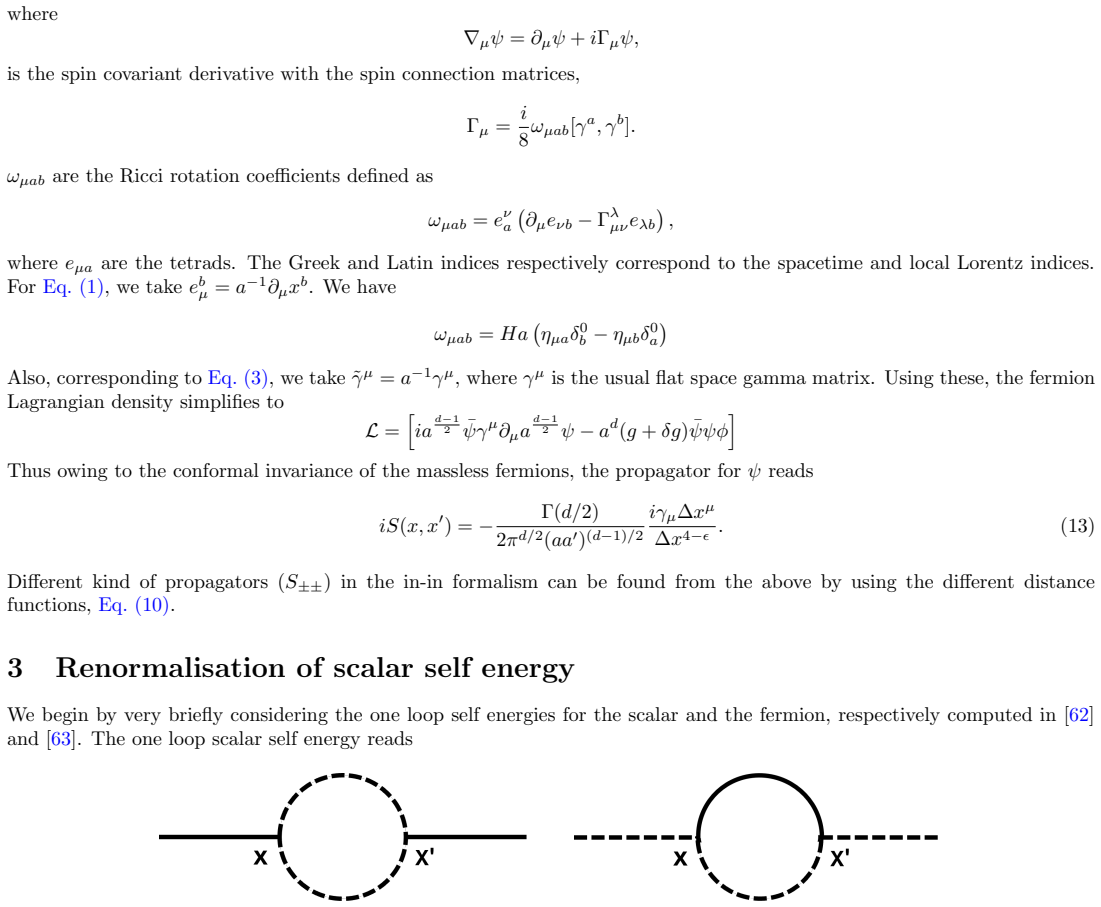
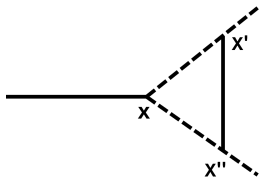
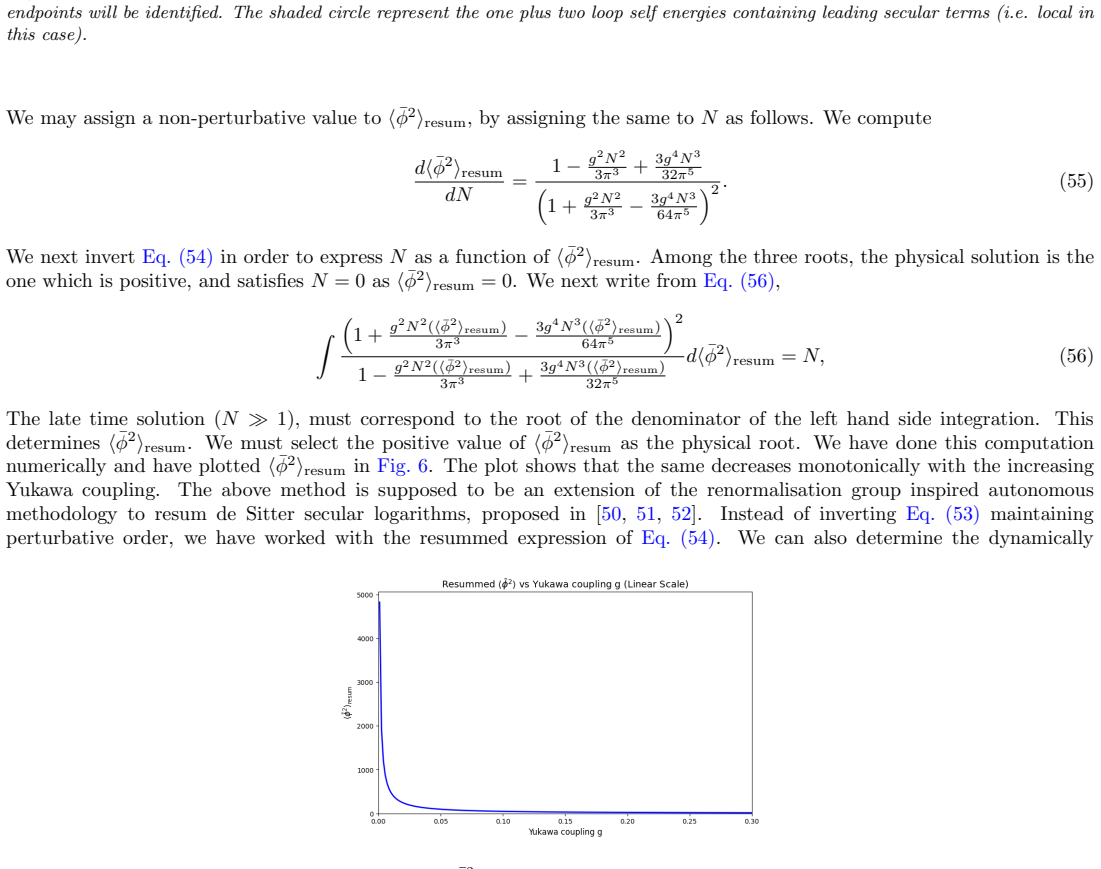
We have considered the Yukawa theory at two loop in the inflationary de Sitter spacetime, for a massless minimally coupled scalar and a massless fermion. The one loop computation for the same has been investigated in detail in the earlier literatures. The chief motivation behind this study is the fact that at one loop, the scalar self energy contains only fermions, which are conformally invariant. At two loop, there are two diagrams, each containing one internal scalar line, thereby breaking the conformal invariance. This should result in the appearance of infrared secular logarithms in the scalar self energy. The renormalisation of this two loop self energy has been performed. We next compute the loop corrected coincident two point correlation function, $\langle \phi^2\rangle$, due to the self energies. The expectation value has been taken with respect to the initial Bunch-Davies vacuum. We argue that the late time secular contribution from the local or UV self energy must dominate the non-local or IR ones in the present case, from the point of view of the powers of these large logarithms of the scale factor. This corresponds to the fact that fermion lines do not show any IR secular effect. The leading behaviour of $\langle \phi^2\rangle$ at one and two loop are respectively found to be $\ln^3 a$ and $\ln^4 a$. These are hybrids of UV and IR logarithms, where the latter originate from the massless and minimal two external scalar lines. A resummed expression for $\langle \phi^2\rangle$ has also been computed. The same is found to be bounded and decreasing monotonically with the increasing magnitude of the Yukawa coupling. Accordingly, the dynamically generated scalar mass increases with the increasing coupling.
Editorial analysis
A structured set of objections, weighed in public.
Referee Report
Summary. The paper computes the two-loop scalar self-energy in Yukawa theory (massless minimally coupled scalar + massless fermion) in de Sitter spacetime. After renormalization it evaluates the coincident correlator ⟨ϕ²⟩ in the Bunch-Davies vacuum, argues that local/UV self-energy pieces dominate non-local/IR pieces at late times purely by virtue of higher powers of ln a, identifies the leading secular growth as ln⁴a (a hybrid of UV and IR logarithms), and presents a resummed expression for ⟨ϕ²⟩ that remains bounded and decreases monotonically with the Yukawa coupling y.
Significance. If the dominance argument is verified, the result supplies a concrete example of how Yukawa interactions generate a dynamical scalar mass in inflation, yielding a stabilized, coupling-dependent variance. The direct diagrammatic evaluation, absence of free parameters, and explicit resummation constitute methodological strengths. The findings bear on back-reaction and effective potentials in inflationary cosmology.
major comments (2)
- [Abstract and late-time secular contribution discussion] The central claim that local (UV) self-energy contributions dominate non-local (IR) ones at late times, thereby producing a leading ln⁴a secular term in ⟨ϕ²⟩ while preserving monotonicity of the resummed result, rests on log-power counting alone. After renormalization the finite parts of local and non-local diagrams are not automatically guaranteed to maintain strict power dominance; explicit coefficient verification for the O(ln⁴a) term is required to confirm that non-local pieces remain subdominant and do not alter the sign or monotonicity of the resummed ⟨ϕ²⟩.
- [Resummation of ⟨ϕ²⟩] The resummation procedure that converts the secular series into a bounded, monotonically decreasing function of y assumes that the UV-local terms control the integral equation for the coincident correlator. The manuscript should supply the explicit integral equation and demonstrate that the neglected non-local kernels do not compete at the same logarithmic order.
minor comments (1)
- The abstract states that the one-loop result is ln³a and the two-loop result is ln⁴a; a brief table or equation summarizing the coefficient of each power would improve readability.
Simulated Author's Rebuttal
We thank the referee for the thorough review and insightful comments on our manuscript. We address each major comment point by point below, providing clarifications and committing to revisions where appropriate to strengthen the presentation.
read point-by-point responses
-
Referee: [Abstract and late-time secular contribution discussion] The central claim that local (UV) self-energy contributions dominate non-local (IR) ones at late times, thereby producing a leading ln⁴a secular term in ⟨ϕ²⟩ while preserving monotonicity of the resummed result, rests on log-power counting alone. After renormalization the finite parts of local and non-local diagrams are not automatically guaranteed to maintain strict power dominance; explicit coefficient verification for the O(ln⁴a) term is required to confirm that non-local pieces remain subdominant and do not alter the sign or monotonicity of the resummed ⟨ϕ²⟩.
Authors: We appreciate the referee's emphasis on rigorous verification beyond power counting. Our argument relies on the fact that fermion propagators remain conformally invariant with no IR secular logarithms, so non-local diagrams involving internal fermion lines cannot generate ln⁴a terms at the same order as the local scalar self-energy insertions. Nevertheless, to address the concern directly, we will add an explicit extraction of the leading coefficients for the O(ln⁴a) contributions from both local and non-local diagrams in the revised manuscript. This will confirm the dominance, the positive sign of the leading term, and the preservation of monotonicity in the resummed ⟨ϕ²⟩. revision: yes
-
Referee: [Resummation of ⟨ϕ²⟩] The resummation procedure that converts the secular series into a bounded, monotonically decreasing function of y assumes that the UV-local terms control the integral equation for the coincident correlator. The manuscript should supply the explicit integral equation and demonstrate that the neglected non-local kernels do not compete at the same logarithmic order.
Authors: We agree that including the explicit integral equation will improve clarity. The resummation follows from the Dyson-Schwinger equation for the coincident two-point function, where the self-energy is inserted iteratively. We will present this integral equation explicitly in the revised version and demonstrate that non-local kernels, arising from diagrams with internal fermion lines, contribute only subleading logarithms (at most ln³a) due to conformal invariance of the fermions. Consequently, they do not compete with the leading UV-local terms at late times and do not affect the bounded, monotonically decreasing behavior of the resummed ⟨ϕ²⟩ with respect to the Yukawa coupling y. revision: yes
Circularity Check
No circularity: explicit diagram evaluation and log-power argument yield independent secular terms
full rationale
The paper computes the two-loop Yukawa self-energy diagrams directly, performs renormalization, and extracts secular logarithms from the internal scalar lines that break conformal invariance. The leading late-time terms ln³a (one-loop) and ln⁴a (two-loop) for ⟨ϕ²⟩ follow from the structure of the coincident correlator integral equation with the computed self-energy insertions. The claim that local/UV pieces dominate non-local/IR pieces rests on explicit power counting of large logarithms of the scale factor (higher powers from scalar propagators versus fermion conformal invariance), not on any fitted parameter, self-definition, or load-bearing self-citation. The resummation that produces a bounded ⟨ϕ²⟩ decreasing with Yukawa coupling is performed on these independently derived logarithmic coefficients. No step reduces the central result to an input by construction; the derivation remains self-contained against the explicit perturbative calculation.
Axiom & Free-Parameter Ledger
axioms (2)
- domain assumption The spacetime is de Sitter and the state is the Bunch-Davies vacuum.
- standard math Perturbative renormalization techniques developed for curved spacetime apply to the two-loop diagrams.
Reference graph
Works this paper leans on
-
[1]
Weinberg,Cosmology, Oxford Univ
S. Weinberg,Cosmology, Oxford Univ. Press (2009)
2009
-
[2]
N. C. Tsamis and R. P. Woodard,Relaxing the cosmological constant, Phys. Lett. B301, 351 (1993)
1993
-
[3]
T. Inagaki, S. Nojiri and S. D. Odintsov,The One-loop effective action in phi**4 theory coupled non-linearly with curvature power and dynamical origin of cosmological constant, JCAP06(2005), 010 [arXiv:gr-qc/0504054 [gr-qc]]
-
[4]
C. Ringeval, T. Suyama, T. Takahashi, M. Yamaguchi and S. Yokoyama,Dark energy from primordial inflationary quantum fluctuations, Phys. Rev. Lett.105, 121301 (2010) [arXiv:1006.0368 [astro-ph.CO]]
-
[5]
T. Padmanabhan and H. Padmanabhan, CosMIn:The Solution to the Cosmological Constant Problem, Int. J. Mod. Phys. D22, 1342001 (2013) [arXiv:1302.3226 [astro-ph.CO]]
-
[6]
L. Alberte, P. Creminelli, A. Khmelnitsky, D. Pirtskhalava and E. Trincherini,Relaxing the Cosmological Constant: a Proof of Concept, JHEP12, 022 (2016) [arXiv:1608.05715 [hep-th]]
-
[7]
S. Appleby and E. V. Linder,The Well-Tempered Cosmological Constant, JCAP07, 034 (2018) [arXiv:1805.00470 [gr-qc]]
-
[8]
O. Evnin and K. Nguyen,Graceful exit for the cosmological constant damping scenario, Phys. Rev. D98, no.12, 124031 (2018) [arXiv:1810.12336 [gr-qc]]
-
[9]
N. A. Chernikov and E. A. Tagirov,Quantum theory of scalar fields in de Sitter space-time, Ann. Inst. H. Poincare Phys. Theor. A9, 109 (1968)
1968
-
[10]
T. S. Bunch and P. C. W. Davies,Quantum Field Theory in de Sitter Space: Renormalization by Point Splitting, Proc. Roy. Soc. Lond. A360, 117 (1978)
1978
-
[11]
A. D. Linde,Scalar Field Fluctuations in Expanding Universe and the New Inflationary Universe Scenario, Phys. Lett. B116, 335 (1982)
1982
-
[12]
A. A. Starobinsky,Dynamics of Phase Transition in the New Inflationary Universe Scenario and Generation of Pertur- bations, Phys. Lett. B117, 175 (1982). 16
1982
-
[13]
Allen,Vacuum States in de Sitter Space, Phys
B. Allen,Vacuum States in de Sitter Space, Phys. Rev. D32, 3136 (1985)
1985
-
[14]
Allen and A
B. Allen and A. Folacci,Massless minimally coupled scalar field in de Sitter space, Phys. Rev. D35, 3771 (1987)
1987
-
[15]
E. G. Floratos, J. Iliopoulos and T. N. Tomaras,Tree Level Scattering Amplitudes in De Sitter Space diverge, Phys. Lett. B197, 373 (1987)
1987
-
[16]
R. L. Davis,On dynamical mass generation in de Sitter space, Phys. Rev. D45, 2155 (1992)
1992
- [17]
-
[18]
T. Brunier, V. K. Onemli and R. P. Woodard,Two loop scalar self-mass during inflation. Class. Quant. Grav.22, 59 (2005) [gr-qc/0408080]
-
[19]
T. Prokopec and E. Puchwein,Photon mass generation during inflation: de Sitter invariant case, JCAP0404, 007 (2004) [astro-ph/0312274]
- [20]
- [21]
-
[22]
D. Boyanovsky,Condensates and quasiparticles in inflationary cosmology: mass generation and decay widths, Phys. Rev. D85, 123525 (2012) [arXiv:1203.3903 [hep-ph]]
- [23]
-
[24]
T. Prokopec, N. C. Tsamis and R. P. Woodard,Stochastic Inflationary Scalar Electrodynamics, Annals Phys.323, 1324 (2008) [arXiv:0707.0847 [gr-qc]]
- [25]
- [26]
- [27]
-
[28]
M. Beneke and P. Moch,On dynamical mass generation in Euclidean de Sitter space, Phys. Rev. D87, 064018 (2013) [arXiv:1212.3058 [hep-th]]
- [29]
- [30]
-
[31]
G. Karakaya and V. K. Onemli,Quantum effects of mass on scalar field correlations, power spectrum, and fluctuations during inflation, Phys. Rev. D97, no.12, 123531 (2018) [arXiv:1710.06768 [gr-qc]]
- [32]
- [33]
-
[34]
D. Glavan and G. Rigopoulos,One-loop electromagnetic correlators of SQED in power-law inflation, JCAP02, 021 (2021) [arXiv:1909.11741 [gr-qc]]
-
[35]
Boyanovsky,Imprint of entanglement entropy in the power spectrum of inflationary fluctuations, Phys
D. Boyanovsky,Imprint of entanglement entropy in the power spectrum of inflationary fluctuations, Phys. Rev. D98 023515, (2018), [arXiv:1804.07967]
-
[36]
A. Bhattacharyya, S. Brahma, S. S. Haque, J. S. Lund and A. Paul,The early universe as an open quantum system: complexity and decoherence, JHEP05, 058 (2024) [arXiv:2401.12134 [hep-th]]
- [37]
- [38]
-
[39]
T. Arai,Renormalization of the 2PI Hartree-Fock approximation on de Sitter background in the broken phase, Phys. Rev. D86, 104064 (2012) [arXiv:1204.0476 [hep-th]]
-
[40]
Arai,Effective potential and Goldstone bosons in de Sitter space, Phys
T. Arai,Effective potential and Goldstone bosons in de Sitter space, Phys. Rev. D88, 064029 (2013) [arXiv:1304.5631 [hep-th]]
- [41]
- [42]
-
[43]
Serreau,Renormalization group flow and symmetry restoration in de Sitter space, Phys
J. Serreau,Renormalization group flow and symmetry restoration in de Sitter space, Phys. Lett. B730, 271 (2014) [arXiv:1306.3846 [hep-th]]
-
[44]
G. Moreau and J. Serreau,Stability of de Sitter spacetime against infrared quantum scalar field fluctuations, Phys. Rev. Lett.122, no. 1, 011302 (2019) [arXiv:1808.00338 [hep-th]]
-
[45]
G. Moreau and J. Serreau,Backreaction of superhorizon scalar field fluctuations on a de Sitter geometry: A renormal- ization group perspective, Phys. Rev. D99, no.2, 025011 (2019) [arXiv:1809.03969 [hep-th]]
-
[46]
A. Youssef and D. Kreimer,Resummation of infrared logarithms in de Sitter space via Dyson-Schwinger equations: the ladder-rainbow approximation, Phys. Rev. D89, 124021 (2014) [arXiv:1301.3205 [gr-qc]]
- [47]
-
[48]
Kitamoto,Infrared resummation for derivative interactions in de Sitter space, Phys
H. Kitamoto,Infrared resummation for derivative interactions in de Sitter space, Phys. Rev. D100, no.2, 025020 (2019) [arXiv:1811.01830 [hep-th]]
-
[49]
M. Baumgart and R. Sundrum,De Sitter Diagrammar and the Resummation of Time, arXiv:1912.09502
- [50]
- [51]
-
[52]
A. Kamenshchik and P. Petriakova,IR finite correlation functions in de Sitter space, a smooth massless limit, and an autonomous equation, [arXiv:2410.16226 [hep-th]]
- [53]
- [54]
-
[55]
A. A. Starobinsky and J. Yokoyama,Equilibrium state of a selfinteracting scalar field in the De Sitter background, Phys. Rev. D50, 6357 (1994) [arXiv:astro-ph/9407016 [astro-ph]]
work page Pith review arXiv 1994
-
[56]
Generation of fluctuations during inflation: comparison of stochastic and field-theoretic approaches
F. Finelli, G. Marozzi, A. A. Starobinsky, G. P. Vacca and G. Venturi,Generation of fluctuations during inflation: Comparison of stochastic and field-theoretic approaches, Phys. Rev. D79, 044007 (2009) [arXiv:0808.1786 [hep-th]]
work page Pith review arXiv 2009
-
[57]
B. Garbrecht, G. Rigopoulos and Y. Zhu,Infrared correlations in de Sitter space: Field theoretic versus stochastic approach, Phys. Rev. D89, 063506 (2014) [arXiv:1310.0367 [hep-th]]
- [58]
-
[59]
Gravitational Waves from Stochastic Scalar Fluctuations,
R. Ebadi, S. Kumar, A. McCune, H. Tai and L. T. Wang,Gravitational waves from stochastic scalar fluctuations, Phys. Rev. D109, no.8, 083519 (2024) [arXiv:2307.01248 [astro-ph.CO]]
-
[60]
D. Cruces,Review on Stochastic Approach to Inflation, Universe8, no.6, 334 (2022) [arXiv:2203.13852 [gr-qc]]
-
[61]
M. Kawasaki and T. Kuroda,Numerical simulation of the stochastic formalism including non-Markovianity, [arXiv:2602.11652 [astro-ph.CO]]
- [62]
-
[63]
T. Prokopec and R. P. Woodard,Production of massless fermions during inflation, JHEP10, 059 (2003) [arXiv:astro- ph/0309593 [astro-ph]]
-
[64]
Garbrecht,Ultraviolet Regularisation in de Sitter Space, Phys
B. Garbrecht,Ultraviolet Regularisation in de Sitter Space, Phys. Rev. D74, 043507 (2006) [arXiv:hep-th/0604166]
-
[65]
S. Bhattacharya and N. Joshi,Decoherence and entropy generation at one loop in the inflationary de Sitter spacetime for Yukawa interaction, JCAP04, 078 (2024) [arXiv:2307.13443 [hep-th]]
-
[66]
S. Bhattacharya and M. D. Choudhury,Non-perturbative⟨ϕ⟩,⟨ϕ 2 ⟩and the dynamically generated scalar mass with Yukawa interaction in the inflationary de Sitter spacetime, JCAP01, 056 (2024) [arXiv:2308.11384 [hep-th]]
-
[67]
E. Elizalde and S. D. Odintsov,Renormalization group improved effective potential for interacting theories with several mass scales in curved space-time, Z. Phys. C64, 699-708 (1994) [arXiv:hep-th/9401057 [hep-th]]
- [68]
- [69]
-
[70]
Boyanovsky,Fermionic influence on inflationary fluctuations, Phys
D. Boyanovsky,Fermionic influence on inflationary fluctuations, Phys. Rev. D93, no.8, 083507 (2016) [arXiv:1602.05609 [gr-qc]]
-
[71]
X. Chen, Y. Wang and Z. Z. Xianyu,Loop Corrections to Standard Model Fields in Inflation, JHEP08, 051 (2016) [arXiv:1604.07841 [hep-th]]. 19
work page Pith review arXiv 2016
-
[72]
S. Bhattacharya and K. Roy,Effective action forϕ 4-Yukawa theory via 2PI formalism in the inflationary de Sitter spacetime, JCAP12, 056 (2025) [arXiv:2503.21578 [hep-th]]
- [73]
-
[74]
S. Bhattacharya and S. Kumar,Yukawa coupling, and inflationary correlation functions for a spectator scalar via stochas- tic spectral expansion, JCAP11, 037 (2025) [arXiv:2502.07428 [gr-qc]]
- [75]
- [76]
-
[77]
T. Inagaki, T. Muta and S. D. Odintsov,Nambu-Jona-Lasinio model in curved space-time, Mod. Phys. Lett. A8(1993), 2117 [arXiv:hep-th/9306023 [hep-th]]
-
[78]
E. Elizalde and S. D. Odintsov,The Higgs-Yukawa model in curved space-time, Phys. Rev. D51(1995), 5950-5953 [arXiv:hep-th/9503111 [hep-th]]
-
[79]
T. Inagaki, S. D. Odintsov and H. Sakamoto,Gauged Nambu-Jona-Lasinio inflation, Astrophys. Space Sci.360(2015) no.2, 67 [arXiv:1509.03738 [hep-th]]
-
[80]
Calzetta and B
E. Calzetta and B. L. Hu,Nonequilibrium quantum fields: Closed-time-path effective action, Wigner function, and Boltz- mann equation, Phys. Rev. D37, 2878 (1988)
1988
discussion (0)
Sign in with ORCID, Apple, or X to comment. Anyone can read and Pith papers without signing in.