Recognition: unknown
Observation of low-lying impurity states in Bose-Einstein condensates
Pith reviewed 2026-05-10 03:32 UTC · model grok-4.3
The pith
Pump-probe spectroscopy detects low-energy impurity states below the usual Bose polaron for strong interactions in a BEC.
A machine-rendered reading of the paper's core claim, the machinery that carries it, and where it could break.
Core claim
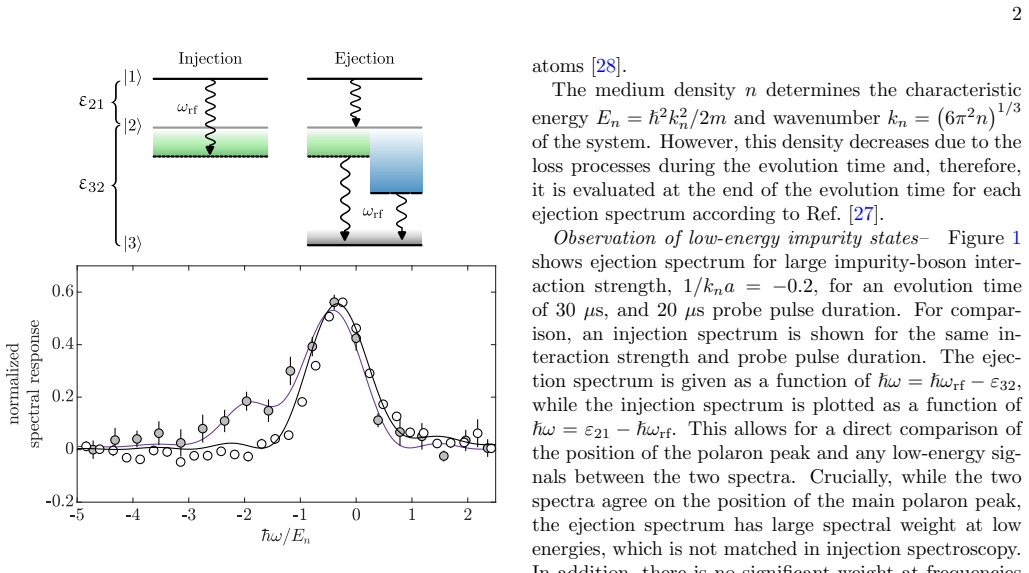
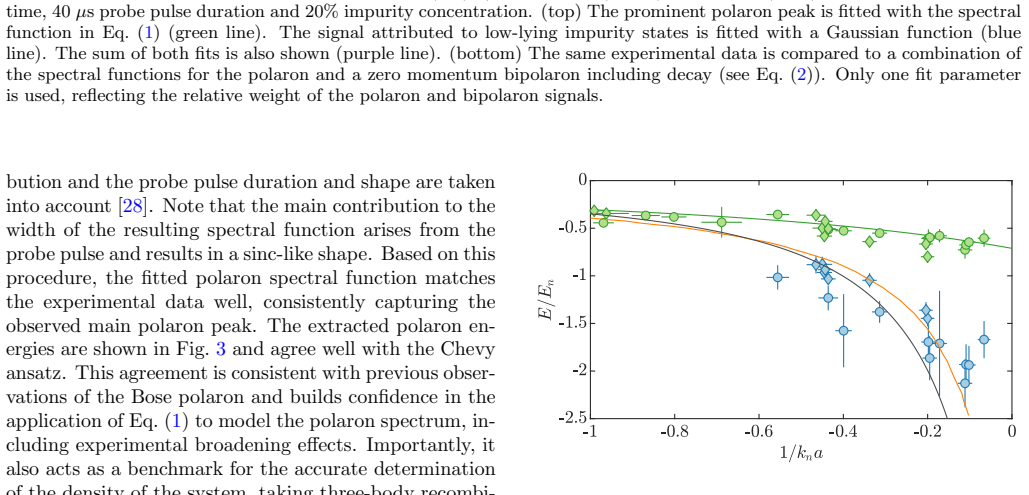
The spectroscopic signal exhibits a strong feature corresponding to a Bose polaron in agreement with prior injection spectroscopy and theory. In addition, significant spectral weight at energies well below the energy of the polaron is observed, which is absent in injection spectroscopy. The energy and spectral weight of this signal are measured as a function of interaction strength and evolution time between the pump and probe pulses. Both a low-energy impurity state dressed by many bosonic excitations and a bipolaron state formed by two polarons predict ejection spectra consistent with the low-energy signal, but only the bipolaron model is compatible with its spectral weight.
What carries the argument
Pump-probe ejection spectroscopy on impurities in the BEC, which accesses low-energy spectral weight and allows comparison to a dressed-impurity model versus a bipolaron model.
Load-bearing premise
The observed low-energy spectral weight originates from either the proposed dressed-impurity state or the bipolaron rather than from an experimental artifact, background, or unmodeled process.
What would settle it
A direct measurement of impurity pair correlations that shows no evidence of binding at the observed low energies, or a scan in condensate density where the low-energy signal vanishes while the polaron peak remains, would falsify the claim.
Figures




read the original abstract
Impurities embedded in a Bose-Einstein Condensate (BEC) of 39K atoms are investigated with a pump-probe ejection spectroscopy sequence. The spectroscopic signal exhibits a strong feature corresponding to a Bose polaron in agreement with prior injection spectroscopy and theory. In addition, significant spectral weight at energies well below the energy of the polaron is observed, which is absent in injection spectroscopy. The energy and spectral weight of this signal are measured as a function of interaction strength and evolution time between the pump and probe pulses. We tentatively compare these results to two different theoretical models: a low-energy impurity state dressed by many bosonic excitations and a bipolaron state formed by two polarons due to attractive interactions mediated by the BEC. Such states can exist due to the large compressibility of the weakly interacting BEC. Both theories predict ejection spectra consistent with the low-energy signal, but only the bipolaron model is compatible with its spectral weight. These results indicate that lowenergy states below the usual polaron exist for strong interactions, calling for further experimental investigations
Editorial analysis
A structured set of objections, weighed in public.
Referee Report
Summary. The manuscript reports pump-probe ejection spectroscopy measurements on impurities in a 39K BEC, observing the expected Bose polaron resonance in agreement with prior injection spectroscopy and theory, plus additional low-energy spectral weight below the polaron that is absent in injection spectroscopy. The energy and spectral weight of the low-energy feature are tracked versus interaction strength and pump-probe evolution time. These data are tentatively compared to two literature models (a low-energy impurity state dressed by bosonic excitations and a bipolaron state), both of which produce consistent ejection spectra but only the bipolaron matches the measured spectral weight. The work concludes that low-energy states below the usual polaron exist at strong interactions and calls for further experiments.
Significance. If the low-energy feature is robustly shown to arise from a new state enabled by BEC compressibility rather than an experimental artifact, the result would be significant for polaron physics in quantum gases, as it suggests the existence of additional many-body bound states at strong coupling that are not captured by standard polaron theory. The time-dependent pump-probe approach provides new experimental handles on formation dynamics. However, the current evidence rests on qualitative trends and a tentative model distinction without quantitative fits or detailed artifact exclusion, limiting the strength of the central claim.
major comments (3)
- [Abstract] Abstract: the assertion that 'only the bipolaron model is compatible with its spectral weight' while both models give consistent ejection spectra is load-bearing for the interpretation but is presented without quantitative support. No calculated spectral weights, overlap integrals, chi-squared values, or residual comparisons between data and each model (including uncertainties from background subtraction and normalization) are provided, so the claimed distinction cannot be evaluated.
- [Results] Results and data analysis: the low-energy spectral weight is the key new observation, yet the manuscript does not detail the background subtraction procedure, normalization of the pump-probe signal, or sensitivity tests (e.g., variation of evolution time, probe intensity, or impurity number) that would exclude contributions from heating, atom loss, or unmodeled tails of the polaron resonance. These steps are essential because the central claim requires that the weight is produced by the proposed states rather than residual background or probe-induced processes.
- [Theoretical Comparison] Theoretical comparison: both models are imported from prior literature without new derivations or parameter adjustments in this work. The manuscript should specify how the ejection spectra are obtained from each model (including any assumptions about BEC compressibility or interaction range) and why the dressed-impurity state fails to reproduce the weight while the bipolaron succeeds; without this, the preference for the bipolaron remains qualitative.
minor comments (2)
- [Abstract] The abstract refers to 'prior injection spectroscopy' without citations; the relevant references should be added for context.
- Figure captions and text should explicitly state the number of experimental realizations, error bar definitions (e.g., standard error or fit uncertainty), and any binning or smoothing applied to the spectra.
Simulated Author's Rebuttal
We are grateful to the referee for their detailed and insightful comments, which have helped us improve the clarity and rigor of our manuscript. We address each of the major comments below and indicate the revisions we will make.
read point-by-point responses
-
Referee: [Abstract] Abstract: the assertion that 'only the bipolaron model is compatible with its spectral weight' while both models give consistent ejection spectra is load-bearing for the interpretation but is presented without quantitative support. No calculated spectral weights, overlap integrals, chi-squared values, or residual comparisons between data and each model (including uncertainties from background subtraction and normalization) are provided, so the claimed distinction cannot be evaluated.
Authors: We acknowledge that the current presentation relies on a qualitative comparison. In the revised manuscript, we will include quantitative measures such as integrated spectral weights for both models, with uncertainties from background subtraction and normalization. The bipolaron model will be shown to match the data within experimental error, while the other does not. A supplementary figure with residuals will be added to allow evaluation of the distinction. revision: yes
-
Referee: [Results] Results and data analysis: the low-energy spectral weight is the key new observation, yet the manuscript does not detail the background subtraction procedure, normalization of the pump-probe signal, or sensitivity tests (e.g., variation of evolution time, probe intensity, or impurity number) that would exclude contributions from heating, atom loss, or unmodeled tails of the polaron resonance. These steps are essential because the central claim requires that the weight is produced by the proposed states rather than residual background or probe-induced processes.
Authors: We agree with the referee that additional details on data analysis are necessary. The revised manuscript will include a full description of the background subtraction method, which uses off-resonant probe shots, and the normalization procedure based on the total atom number. We will also report the results of sensitivity tests performed by varying the pump-probe delay, probe power, and impurity density, confirming that the low-energy feature is not due to heating or loss. These will be presented in the main text and supplementary information. revision: yes
-
Referee: [Theoretical Comparison] Theoretical comparison: both models are imported from prior literature without new derivations or parameter adjustments in this work. The manuscript should specify how the ejection spectra are obtained from each model (including any assumptions about BEC compressibility or interaction range) and why the dressed-impurity state fails to reproduce the weight while the bipolaron succeeds; without this, the preference for the bipolaron remains qualitative.
Authors: We will expand the theoretical comparison section to specify the details. The spectra are obtained by calculating the spectral function using the models from the literature, with BEC compressibility accounted for via the Bogoliubov theory and a short-range interaction cutoff. The dressed-impurity model predicts a smaller weight because it lacks the additional binding from the second impurity, whereas the bipolaron model incorporates the mediated attraction, leading to better agreement with the measured weight. Assumptions and parameter values will be explicitly stated. revision: yes
Circularity Check
No circularity: experimental observations compared to independent prior models
full rationale
The paper is an experimental report of pump-probe ejection spectroscopy on impurities in a 39K BEC. It observes a standard polaron feature plus additional low-energy spectral weight, then tentatively compares the new feature to two models (dressed-impurity state and bipolaron) drawn from prior literature. No derivation, equation, or fit inside the paper reduces a claimed prediction to its own inputs by construction; the models are external, the data are measured quantities, and the conclusion is an observational call for further work rather than a self-contained theoretical result. Self-citations, if present, are not load-bearing for the central claim.
Axiom & Free-Parameter Ledger
axioms (1)
- domain assumption Standard theory of Bose polarons and bipolarons in weakly interacting BECs
invented entities (2)
-
bipolaron state
no independent evidence
-
low-energy impurity state dressed by many bosonic excitations
no independent evidence
Reference graph
Works this paper leans on
-
[1]
Polarons in atomic gases and two-dimensional semiconductors
P. Massignan, R. Schmidt, G. E. Astrakharchik, A. ˙Imamoglu, M. Zwierlein, J. J. Arlt, and G. M. Bruun, Polarons in atomic gases and two-dimensional semicon- ductors (2025), arXiv:2501.09618 [cond-mat.quant-gas]
work page internal anchor Pith review Pith/arXiv arXiv 2025
-
[2]
Baym and C
G. Baym and C. Pethick,Landau Fermi-Liquid Theory: Concepts and Applications(Wiley-VCH, 1991)
1991
-
[3]
Schirotzek, C.-H
A. Schirotzek, C.-H. Wu, A. Sommer, and M. W. Zwier- lein, Observation of Fermi polarons in a tunable Fermi liquid of ultracold atoms, Physical Review Letters102, 230402 (2009)
2009
-
[4]
Kohstall, M
C. Kohstall, M. Zaccanti, M. Jag, A. Trenkwalder, P. Massignan, G. M. Bruun, F. Schreck, and R. Grimm, Metastability and coherence of repulsive polarons in a strongly interacting Fermi mixture, Nature485, 615 (2012)
2012
-
[5]
Scazza, G
F. Scazza, G. Valtolina, P. Massignan, A. Recati, A. Am- ico, A. Burchianti, C. Fort, M. Inguscio, M. Zaccanti, and G. Roati, Repulsive Fermi polarons in a resonant mixture of ultracold 6Li atoms, Physical Review Letters 118, 083602 (2017)
2017
-
[6]
N. B. Jørgensen, L. Wacker, K. T. Skalmstang, M. M. Parish, J. Levinsen, R. S. Christensen, G. M. Bruun, and J. J. Arlt, Observation of attractive and repulsive polarons in a Bose-Einstein condensate, Physical Review Letters117, 055302 (2016)
2016
-
[7]
M.-G. Hu, M. J. Van de Graaff, D. Kedar, J. P. Corson, E. A. Cornell, and D. S. Jin, Bose polarons in the strongly interacting regime, Physical Review Letters117, 055301 (2016)
2016
-
[8]
Z. Z. Yan, Y. Ni, C. Robens, and M. W. Zwierlein, Bose polarons near quantum criticality, Science (New York, N.Y.)368, 190 (2020)
2020
-
[9]
L. A. Pe˜ na Ardila, N. B. Jørgensen, T. Pohl, S. Giorgini, G. M. Bruun, and J. J. Arlt, Analyzing a Bose polaron across resonant interactions, Physical Review A: Atomic, Molecular, and Optical Physics99, 063607 (2019)
2019
-
[10]
M. G. Skou, T. G. Skov, N. B. Jørgensen, K. K. Nielsen, A. Camacho-Guardian, T. Pohl, G. M. Bruun, and J. J. Arlt, Non-equilibrium quantum dynamics and formation of the Bose polaron, Nature Physics17, 731 (2021)
2021
-
[11]
M. G. Skou, K. K. Nielsen, T. G. Skov, A. M. Morgen, N. B. Jørgensen, A. Camacho-Guardian, T. Pohl, G. M. Bruun, and J. J. Arlt, Life and death of the bose polaron, Phys. Rev. Res.4, 043093 (2022)
2022
-
[12]
Etrych, G
J. Etrych, G. Martirosyan, A. Cao, C. J. Ho, Z. Hadz- ibabic, and C. Eigen, Universal quantum dynamics of Bose polarons, Phys. Rev. X15, 021070 (2025)
2025
-
[13]
A. M. Morgen, S. S. Balling, K. K. Nielsen, T. Pohl, G. M. Bruun, and J. J. Arlt, Quantum beat spectroscopy of repulsive bose polarons, Phys. Rev. Res.7, L022002 (2025)
2025
-
[14]
Chevy, Universal phase diagram of a strongly interact- 6 ing Fermi gas with unbalanced spin populations, Physical Review A: Atomic, Molecular, and Optical Physics74, 063628 (2006)
F. Chevy, Universal phase diagram of a strongly interact- 6 ing Fermi gas with unbalanced spin populations, Physical Review A: Atomic, Molecular, and Optical Physics74, 063628 (2006)
2006
-
[15]
Massignan, M
P. Massignan, M. Zaccanti, and G. M. Bruun, Polarons, dressed molecules and itinerant ferromagnetism in ultra- cold Fermi gases, Reports on Progress in Physics77, 034401 (2014)
2014
-
[16]
Combescot, A
R. Combescot, A. Recati, C. Lobo, and F. Chevy, Normal state of highly polarized fermi gases: Simple many-body approaches, Phys. Rev. Lett.98, 180402 (2007)
2007
-
[17]
Alhyder, G
R. Alhyder, G. M. Bruun, T. Pohl, M. Lemeshko, and A. G. Volosniev, Phenomenological model of decaying bose polarons, Phys. Rev. Res.8, L012034 (2026)
2026
-
[18]
Levinsen, M
J. Levinsen, M. M. Parish, and G. M. Bruun, Impurity in a Bose-Einstein condensate and the Efimov effect, Phys- ical Review Letters115, 125302 (2015)
2015
-
[19]
S. M. Yoshida, S. Endo, J. Levinsen, and M. M. Parish, Universality of an impurity in a Bose-Einstein conden- sate, Physical Review X8, 011024 (2018)
2018
-
[20]
Christianen, J
A. Christianen, J. I. Cirac, and R. Schmidt, Phase di- agram for strong-coupling Bose polarons, SciPost Phys. 16, 067 (2024)
2024
-
[21]
Camacho-Guardian, L
A. Camacho-Guardian, L. A. Pe˜ na Ardila, T. Pohl, and G. M. Bruun, Bipolarons in a Bose-Einstein condensate, Physical Review Letters121, 013401 (2018)
2018
-
[22]
Naidon, Two impurities in a Bose–Einstein conden- sate: From yukawa to efimov attracted polarons, Journal of the Physical Society of Japan87, 043002 (2018)
P. Naidon, Two impurities in a Bose–Einstein conden- sate: From yukawa to efimov attracted polarons, Journal of the Physical Society of Japan87, 043002 (2018)
2018
-
[23]
Jager and R
J. Jager and R. Barnett, The effect of boson–boson in- teraction on the bipolaron formation, New Journal of Physics24, 103032 (2022)
2022
-
[24]
Wacker, N
L. Wacker, N. B. Jørgensen, D. Birkmose, R. Horchani, W. Ertmer, C. Klempt, N. Winter, J. Sherson, and J. J. Arlt, Tunable dual-species bose-einstein condensates of 39K and 87Rb, Phys. Rev. A92, 053602 (2015)
2015
-
[25]
Lysebo and L
M. Lysebo and L. Veseth, Feshbach resonances and tran- sition rates for cold homonuclear collisions between 39K and 41K atoms, Physical Review A: Atomic, Molecular, and Optical Physics81, 032702 (2010)
2010
-
[26]
Tanzi, C
L. Tanzi, C. R. Cabrera, J. Sanz, P. Cheiney, M. Tomza, and L. Tarruell, Feshbach resonances in potassium Bose- Bose mixtures, Physical Review A: Atomic, Molecular, and Optical Physics98, 062712 (2018)
2018
-
[27]
A. M. Morgen, S. S. Balling, M. T. Strøe, T. G. Skov, M. R. Skou, A. G. Volosniev, and J. J. Arlt, Three-body physics in the impurity limit of 39K bose-einstein con- densates, Phys. Rev. A111, 063314 (2025)
2025
-
[28]
See Supplementary Material [url], for further details
- [29]
-
[30]
Li and S
W. Li and S. Das Sarma, Variational study of polarons in Bose-Einstein condensates, Physical Review A: Atomic, Molecular, and Optical Physics90, 013618 (2014)
2014
-
[31]
S. P. Rath and R. Schmidt, Field-theoretical study of the Bose polaron, Physical Review A: Atomic, Molecular, and Optical Physics88, 053632 (2013)
2013
-
[32]
This is relaxed for data sets at low interaction strength, where the polaron signal adequately describes the whole spectrum
-
[33]
Indeed, even the use of the expected energy dependence of an assumed low-energy state would enter the analysis due to the trap averaging process
-
[34]
Y. E. Shchadilova, R. Schmidt, F. Grusdt, and E. Demler, Quantum dynamics of ultracold Bose polarons, Physical Review Letters117, 113002 (2016)
2016
-
[35]
Guenther, R
N.-E. Guenther, R. Schmidt, G. M. Bruun, V. Gurarie, and P. Massignan, Mobile impurity in a Bose-Einstein condensate and the orthogonality catastrophe, Physical Review A: Atomic, Molecular, and Optical Physics103, 013317 (2021)
2021
-
[36]
Schmidt and T
R. Schmidt and T. Enss, Self-stabilized Bose polarons, SciPost Phys.13, 054 (2022)
2022
-
[37]
Christianen, J
A. Christianen, J. I. Cirac, and R. Schmidt, Chemistry of a light impurity in a bose-einstein condensate, Phys. Rev. Lett.128, 183401 (2022)
2022
-
[38]
Camacho-Guardian and G
A. Camacho-Guardian and G. M. Bruun, Landau effec- tive interaction between quasiparticles in a Bose-Einstein condensate, Physical Review X8, 031042 (2018)
2018
-
[39]
Paredes, G
R. Paredes, G. Bruun, and A. Camacho-Guardian, In- teractions mediated by atoms, photons, electrons, and excitons, Phys. Rev. A110, 030101 (2024)
2024
-
[40]
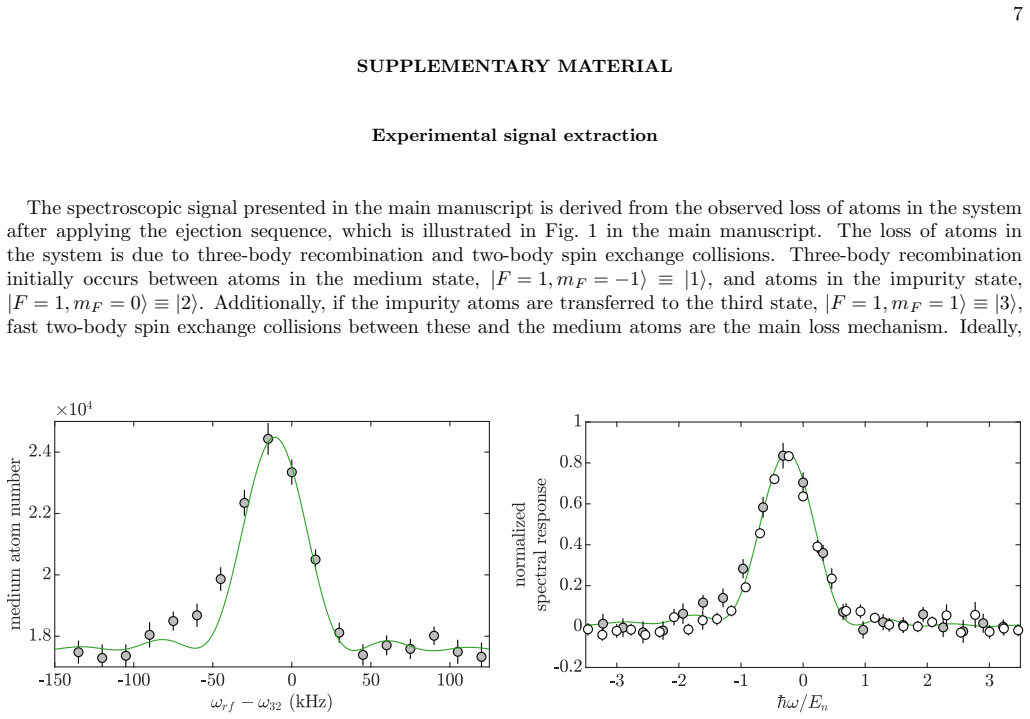
Data points at closely lying interaction strengths were averaged for clarity. 7 SUPPLEMENTARY MATERIAL Experimental signal extraction The spectroscopic signal presented in the main manuscript is derived from the observed loss of atoms in the system after applying the ejection sequence, which is illustrated in Fig. 1 in the main manuscript. The loss of ato...
discussion (0)
Sign in with ORCID, Apple, or X to comment. Anyone can read and Pith papers without signing in.