Recognition: unknown
Preparation of quasi-two-dimensional Bose mixture of ultracold ²³Na and ⁸⁷Rb atoms
Pith reviewed 2026-05-10 03:27 UTC · model grok-4.3
The pith
A dual-species condensate of ultracold Na and Rb atoms is loaded into a single layer of a vertical optical lattice to create a quasi-2D mixture that exhibits quantum immiscibility.
A machine-rendered reading of the paper's core claim, the machinery that carries it, and where it could break.
Core claim
After loading the dual-species condensate into a single layer of a vertical optical lattice, a 2D gas mixture is prepared and quantum immiscibility is observed in the in-situ equilibrium density profiles, with the profiles agreeing well with mean-field theories.
What carries the argument
The vertical optical lattice that confines the mixture to a single layer, enabling the transition from 3D to quasi-2D while preserving the dual-species nature.
If this is right
- Provides a platform for investigating quantum impurities in two dimensions.
- Facilitates studies of quantum droplets in heteronuclear systems.
- Allows exploration of polar molecules in low dimensions.
- Supports research on quantum degenerate mixtures in reduced dimensions.
Where Pith is reading between the lines
- Similar confinement techniques could be applied to other atomic species pairs to test interaction tuning effects.
- High-resolution imaging of immiscibility might reveal interface dynamics not captured in equilibrium mean-field models.
- The compact modular design suggests scalability for more complex lattice geometries or electrode-based controls.
Load-bearing premise
The atoms stay confined to a single lattice layer with negligible population in excited states or other layers, allowing the mean-field theory to describe the observed density profiles accurately.
What would settle it
Direct observation of significant atom population in multiple lattice layers via high-resolution imaging or clear mismatch between measured density profiles and mean-field calculations would falsify the preparation of a true quasi-2D mixture.
Figures
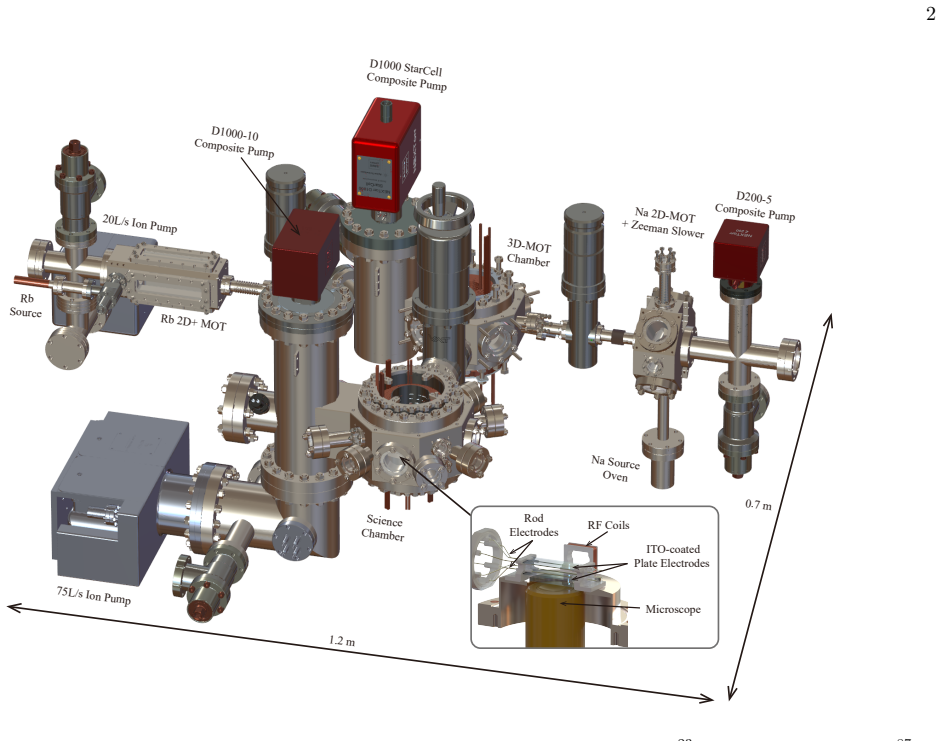


read the original abstract
Quantum gases confined in reduced dimensions have enabled the observation of many exotic quantum phenomena. While existing experiments primarily focus on homonuclear systems, we report here on the efficient preparation of a quasi-two-dimensional (2D) heteronuclear quantum degenerate mixture of ultracold $^{23}$Na and $^{87}$Rb. We describe the design of the vacuum system and detail the experimental procedures for preparing the 2D quantum mixture. The designed apparatus has several unique features, including compact and modular 2D-MOT sources, a science chamber that accommodates various lattice geometries, a precision in-vacuum electrode assembly, and high-resolution imaging for both atomic species. After loading the dual-species condensate into a single layer of a vertical optical lattice, we prepare a 2D gas mixture and observe quantum immiscibility in the in-situ equilibrium density profiles. The observed density profiles agree well with mean-field theories. The apparatus provides a versatile platform for investigating several interesting problems, including quantum impurities, quantum droplets, or polar molecules in low dimensions.
Editorial analysis
A structured set of objections, weighed in public.
Referee Report
Summary. The manuscript describes the design of a compact vacuum system and experimental procedures for preparing a quasi-two-dimensional heteronuclear Bose mixture of ultracold 23Na and 87Rb atoms. After loading a dual-species condensate into a single layer of a vertical optical lattice, the authors report the observation of quantum immiscibility via in-situ equilibrium density profiles and state that these profiles agree well with mean-field theory. The apparatus is presented as a versatile platform for future studies of quantum impurities, droplets, and polar molecules in low dimensions.
Significance. If the single-layer confinement is quantitatively verified and the mean-field agreement is demonstrated with error bars and fitting details, the work would establish a useful heteronuclear 2D platform that extends existing homonuclear quantum-gas experiments and enables new investigations of immiscibility, impurities, and droplets.
major comments (3)
- [Abstract] Abstract: the central claim that 'the observed density profiles agree well with mean-field theories' is presented without any quantitative metrics (R^{2} values, residuals, error bars on extracted densities, or fitting parameters), making it impossible to assess the strength of the agreement or rule out imaging artifacts.
- [Experimental procedures] Lattice-loading procedure: no numerical values are given for the vertical lattice depth (in recoil energies), measured excited-band populations (via spectroscopy or TOF), or upper limits on population in adjacent layers; without these, the quasi-2D label and the applicability of 2D mean-field theory remain unverified.
- [Results] Results on immiscibility: the manuscript provides no discussion of possible beyond-mean-field corrections (e.g., 2D quantum fluctuations or Lee-Huang-Yang terms) or checks against finite imaging resolution, both of which could shift the observed immiscibility threshold and undermine the mean-field comparison.
minor comments (2)
- [Abstract] The abstract would be strengthened by including typical atom numbers, temperatures, and trap frequencies achieved in the 2D mixture.
- [Figures] Figure captions should explicitly state the imaging axis, magnification, and any averaging procedures used for the density profiles.
Simulated Author's Rebuttal
We thank the referee for the careful reading and constructive comments, which have helped us improve the manuscript. We address each major comment point by point below.
read point-by-point responses
-
Referee: [Abstract] Abstract: the central claim that 'the observed density profiles agree well with mean-field theories' is presented without any quantitative metrics (R^{2} values, residuals, error bars on extracted densities, or fitting parameters), making it impossible to assess the strength of the agreement or rule out imaging artifacts.
Authors: We agree that quantitative metrics strengthen the claim. In the revised manuscript we have added error bars to all extracted densities, specified the mean-field fitting parameters (including interaction strengths and chemical potentials), reported R^{2} values (>0.92 for both species), and included residuals plots. We also added a brief discussion of imaging calibration and artifact checks (e.g., via known single-species profiles) to rule out systematic distortions. revision: yes
-
Referee: [Experimental procedures] Lattice-loading procedure: no numerical values are given for the vertical lattice depth (in recoil energies), measured excited-band populations (via spectroscopy or TOF), or upper limits on population in adjacent layers; without these, the quasi-2D label and the applicability of 2D mean-field theory remain unverified.
Authors: We have added the missing quantitative details to the revised manuscript: vertical lattice depth of ~25 E_r (where E_r is the recoil energy for 87Rb), excited-band population <4% measured by TOF expansion and band-mapping spectroscopy, and <1% upper limit on adjacent-layer population from in-situ imaging after selective removal. These values confirm single-layer occupancy and validate the 2D mean-field description. revision: yes
-
Referee: [Results] Results on immiscibility: the manuscript provides no discussion of possible beyond-mean-field corrections (e.g., 2D quantum fluctuations or Lee-Huang-Yang terms) or checks against finite imaging resolution, both of which could shift the observed immiscibility threshold and undermine the mean-field comparison.
Authors: We have expanded the results section with a new paragraph addressing these points. For our parameters the 2D Lee-Huang-Yang correction shifts the effective interaction by <3% and does not change the immiscibility threshold within experimental uncertainty; 2D quantum fluctuations are suppressed by the finite temperature and are estimated to be negligible. We also added a resolution analysis showing that the ~1.2 μm imaging PSF does not alter the observed phase separation length scale (>10 μm). These additions support the mean-field agreement. revision: yes
Circularity Check
Experimental preparation report with no derivations or self-referential steps
full rationale
This is a purely experimental paper describing apparatus design, vacuum system, MOT sources, lattice loading procedures, and direct in-situ imaging of density profiles for a Na-Rb mixture. No mathematical derivations, parameter fits, or predictions are presented; the central observation of quantum immiscibility is reported as an empirical result compared to external mean-field theories. No self-citations, ansatzes, or uniqueness theorems are invoked as load-bearing elements. The derivation chain is empty by construction, making the work self-contained against external benchmarks.
Axiom & Free-Parameter Ledger
axioms (1)
- domain assumption Mean-field theory suffices to describe the equilibrium density profiles of the interacting two-component Bose gas.
Reference graph
Works this paper leans on
-
[1]
Bloch, J
I. Bloch, J. Dalibard, and W. Zwerger, Rev. Mod. Phys. 80, 885 (2008)
2008
-
[2]
C. Chin, R. Grimm, P. Julienne, and E. Tiesinga, Rev. Mod. Phys. 82, 1225 (2010)
2010
-
[3]
Baroni, G
C. Baroni, G. Lamporesi, and M. Zaccanti, Nat. Rev. Phys. 6, 736 (2024)
2024
-
[4]
S. B. Papp, J. M. Pino, and C. E. Wieman, Phys. Rev. Lett. 101, 040402 (2008)
2008
-
[5]
Naidon and D
P. Naidon and D. S. Petrov, Phys. Rev. Lett. 126, 115301 (2021)
2021
-
[6]
F. Jia, Z. Huang, L. Qiu, R. Zhou, Y. Yan, and D. Wang, Phys. Rev. Lett. 129, 243402 (2022)
2022
-
[7]
D. S. Petrov, Phys. Rev. Lett. 115, 155302 (2015)
2015
-
[8]
C. R. Cabrera, L. Tanzi, J. Sanz, B. Naylor, P. Thomas, P. Cheiney, and L. Tarruell, Science 359, 301 (2018)
2018
-
[9]
Semeghini, G
G. Semeghini, G. Ferioli, L. Masi, C. Mazzinghi, L. Wol- swijk, F. Minardi, M. Modugno, G. Modugno, M. Ingus- cio, and M. Fattori, Phys. Rev. Lett. 120, 235301 (2018)
2018
-
[10]
D’Errico, A
C. D’Errico, A. Burchianti, M. Prevedelli, L. Salasnich, F. Ancilotto, M. Modugno, F. Minardi, and C. Fort, Phys. Rev. Res. 1, 033155 (2019)
2019
-
[11]
T. G. Skov, M. G. Skou, N. B. Jørgensen, and J. J. Arlt, Phys. Rev. Lett. 126, 230404 (2021)
2021
-
[12]
Schirotzek, C.-H
A. Schirotzek, C.-H. Wu, A. Sommer, and M. W. Zwier- lein, Phys. Rev. Lett. 102, 230402 (2009)
2009
-
[13]
N. B. Jørgensen, L. Wacker, K. T. Skalmstang, M. M. Parish, J. Levinsen, R. S. Christensen, G. M. Bruun, and J. J. Arlt, Phys. Rev. Lett. 117, 055302 (2016)
2016
-
[14]
M.-G. Hu, M. J. Van De Graaff, D. Kedar, J. P. Corson, E. A. Cornell, and D. S. Jin, Phys. Rev. Lett. 117, 055301 (2016)
2016
-
[15]
Z. Z. Yan, Y. Ni, C. Robens, and M. W. Zwierlein, Sci- ence 368, 190 (2020)
2020
-
[16]
Valtolina, K
G. Valtolina, K. Matsuda, W. G. Tobias, J.-R. Li, L. De Marco, and J. Ye, Nature 588, 239 (2020)
2020
-
[17]
Schindewolf, R
A. Schindewolf, R. Bause, X.-Y. Chen, M. Duda, T. Kar- man, I. Bloch, and X.-Y. Luo, Nature 607, 677 (2022)
2022
-
[18]
Bigagli, W
N. Bigagli, W. Yuan, S. Zhang, B. Bulatovic, T. Karman, I. Stevenson, and S. Will, Nature 631, 289 (2024)
2024
- [19]
-
[20]
Costa, J
L. Costa, J. Brachmann, A.-C. Voigt, C. Hahn, M. Taglieber, T. W. Hänsch, and K. Dieckmann, Phys. Rev. Lett. 105, 123201 (2010)
2010
-
[21]
Pires, J
R. Pires, J. Ulmanis, S. Häfner, M. Repp, A. Arias, E. D. Kuhnle, and M. Weidemüller, Phys. Rev. Lett. 112, 250404 (2014)
2014
-
[22]
J. W. Park, C.-H. Wu, I. Santiago, T. G. Tiecke, S. Will, 12 P. Ahmadi, and M. W. Zwierlein, Phys. Rev. A 85, 051602 (2012)
2012
-
[23]
M.-J. Zhu, H. Yang, L. Liu, D.-C. Zhang, Y.-X. Liu, J. Nan, J. Rui, B. Zhao, J.-W. Pan, and E. Tiemann, Phys. Rev. A 96, 062705 (2017)
2017
-
[24]
T. A. Schulze, T. Hartmann, K. K. Voges, M. W. Gem- pel, E. Tiemann, A. Zenesini, and S. Ospelkaus, Phys. Rev. A 97, 023623 (2018)
2018
-
[25]
Warner, A
C. Warner, A. Z. Lam, N. Bigagli, H. C. Liu, I. Stevenson, and S. Will, Phys. Rev. A 104, 033302 (2021)
2021
-
[26]
Wacker, N
L. Wacker, N. B. Jørgensen, D. Birkmose, R. Horchani, W. Ertmer, C. Klempt, N. Winter, J. Sherson, and J. J. Arlt, Phys. Rev. A 92, 053602 (2015)
2015
-
[27]
Modugno, M
G. Modugno, M. Modugno, F. Riboli, G. Roati, and M. Inguscio, Phys. Rev. Lett. 89, 190404 (2002)
2002
-
[28]
Hadzibabic, P
Z. Hadzibabic, P. Krüger, M. Cheneau, B. Battelier, and J. Dalibard, Nature 441, 1118 (2006)
2006
-
[29]
C.-L. Hung, X. Zhang, N. Gemelke, and C. Chin, Nature 470, 236 (2011)
2011
-
[30]
Bakkali-Hassani, C
B. Bakkali-Hassani, C. Maury, Y.-Q. Zou, E. Le Cerf, R. Saint-Jalm, P. C. M. Castilho, S. Nascimbene, J. Dal- ibard, and J. Beugnon, Phys. Rev. Lett. 127, 023603 (2021)
2021
-
[31]
Mozdzen, Creating degenerate two-dimensional Bose gases with tunable interaction strength , Ph.D
A. Mozdzen, Creating degenerate two-dimensional Bose gases with tunable interaction strength , Ph.D. thesis, Uni- versity of Hamburg (2024)
2024
-
[32]
D. S. Petrov and G. E. Astrakharchik, Phys. Rev. Lett. 117, 100401 (2016)
2016
-
[33]
Spada, S
G. Spada, S. Pilati, and S. Giorgini, Phys. Rev. Lett. 133, 083401 (2024)
2024
-
[34]
Meinert, M
F. Meinert, M. Knap, E. Kirilov, K. Jag-Lauber, M. B. Zvonarev, E. Demler, and H.-C. Nägerl, Science 356, 945 (2017)
2017
-
[35]
Petković and Z
A. Petković and Z. Ristivojevic, Phys. Rev. Lett. 117, 105301 (2016)
2016
-
[36]
C. J. M. Mathy, M. B. Zvonarev, and E. Demler, Nat. Phys. 8, 881 (2012)
2012
-
[37]
Schecter and A
M. Schecter and A. Kamenev, Phys. Rev. Lett. 112, 155301 (2014)
2014
-
[38]
A. S. Dehkharghani, A. G. Volosniev, and N. T. Zinner, Phys. Rev. Lett. 121, 080405 (2018)
2018
-
[39]
Levinsen, O
J. Levinsen, O. Bleu, and M. M. Parish, Phys. Rev. Lett. 135, 113402 (2025)
2025
-
[40]
Micheli, G
A. Micheli, G. Pupillo, H. P. Büchler, and P. Zoller, Phys. Rev. A 76, 043604 (2007)
2007
-
[41]
A. V. Gorshkov, P. Rabl, G. Pupillo, A. Micheli, P. Zoller, M. D. Lukin, and H. P. Büchler, Phys. Rev. Lett. 101, 073201 (2008)
2008
-
[42]
H. P. Büchler, E. Demler, M. Lukin, A. Micheli, N. Prokof’ev, G. Pupillo, and P. Zoller, Phys. Rev. Lett. 98, 060404 (2007)
2007
-
[43]
Capogrosso-Sansone, C
B. Capogrosso-Sansone, C. Trefzger, M. Lewenstein, P. Zoller, and G. Pupillo, Phys. Rev. Lett. 104, 125301 (2010)
2010
-
[44]
W. S. Bakr, J. I. Gillen, A. Peng, S. Fölling, and M. Greiner, Nature 462, 74 (2009)
2009
-
[45]
J. F. Sherson, C. Weitenberg, M. Endres, M. Cheneau, I. Bloch, and S. Kuhr, Nature 467, 68 (2010)
2010
-
[46]
J. S. Rosenberg, L. Christakis, E. Guardado-Sanchez, Z. Z. Yan, and W. S. Bakr, Nat. Phys. 18, 1062 (2022)
2022
-
[47]
Lamporesi, S
G. Lamporesi, S. Donadello, S. Serafini, and G. Ferrari, Rev. Sci. Instrum. 84, 063102 (2013)
2013
-
[48]
Dieckmann, R
K. Dieckmann, R. J. C. Spreeuw, M. Weidemüller, and J. T. M. Walraven, Phys. Rev. A 58, 3891 (1998)
1998
-
[49]
J. P. Covey,Enhanced optical and electric manipulation of a quantum gas of KRb molecules , Ph.D. thesis, University of Colorado (2017)
2017
-
[50]
Ketterle, K
W. Ketterle, K. B. Davis, M. A. Joffe, A. Martin, and D. E. Pritchard, Phys. Rev. Lett. 70, 2253 (1993)
1993
-
[51]
Z. Shi, Z. Li, P. Wang, Z. Meng, L. Huang, and J. Zhang, Chinese Physics Letters 35, 123701 (2018)
2018
-
[52]
F. Wang, X. Li, D. Xiong, and D. Wang, J. Phys. B: At. Mol. Opt. Phys. 49, 015302 (2015)
2015
-
[53]
Y.-J. Lin, A. R. Perry, R. L. Compton, I. B. Spielman, and J. V. Porto, Phys. Rev. A 79, 063631 (2009)
2009
-
[54]
Gross, H
C. Gross, H. C. J. Gan, and K. Dieckmann, Phys. Rev. A 93, 053424 (2016)
2016
-
[55]
H. N. Dai, B. Yang, A. Reingruber, X. F. Xu, X. Jiang, Y. A. Chen, Z. S. Yuan, and J. W. Pan, Nat. Phys. 12, 783 (2016)
2016
-
[56]
M. R. Andrews, C. G. Townsend, H.-J. Miesner, D. S. Durfee, D. M. Kurn, and W. Ketterle, Science 275, 637 (1997)
1997
-
[57]
Yefsah, R
T. Yefsah, R. Desbuquois, L. Chomaz, K. J. Günter, and J. Dalibard, Phys. Rev. Lett. 107, 130401 (2011)
2011
-
[58]
Holzmann, M
M. Holzmann, M. Chevallier, and W. Krauth, Euro- physics Letters 82, 30001 (2008)
2008
-
[59]
R. N. Bisset, D. Baillie, and P. B. Blakie, Phys. Rev. A 79, 013602 (2009)
2009
-
[60]
A. Roy, M. Ota, A. Recati, and F. Dalfovo, Phys. Rev. Res. 3, 013161 (2021)
2021
-
[61]
Riboli and M
F. Riboli and M. Modugno, Phys. Rev. A 65, 063614 (2002)
2002
-
[62]
Knoop, T
S. Knoop, T. Schuster, R. Scelle, A. Trautmann, J. App- meier, M. K. Oberthaler, E. Tiesinga, and E. Tiemann, Phys. Rev. A 83, 042704 (2011)
2011
-
[63]
Marte, T
A. Marte, T. Volz, J. Schuster, S. Dürr, G. Rempe, E. G. M. van Kempen, and B. J. Verhaar, Phys. Rev. Lett. 89, 283202 (2002)
2002
-
[64]
Z. Guo, F. Jia, B. Zhu, L. Li, J. M. Hutson, and D. Wang, Phys. Rev. A 105, 023313 (2022)
2022
-
[65]
Prokof’ev and B
N. Prokof’ev and B. Svistunov, Phys. Rev. A 66, 043608 (2002)
2002
-
[66]
Prokof’ev, O
N. Prokof’ev, O. Ruebenacker, and B. Svistunov, Phys. Rev. Lett. 87, 270402 (2001)
2001
-
[67]
Karle, N
V. Karle, N. Defenu, and T. Enss, Phys. Rev. A 99, 063627 (2019)
2019
-
[68]
Hammer and D
H.-W. Hammer and D. T. Son, Phys. Rev. Lett. 93, 250408 (2004)
2004
-
[69]
J. Pan, S. Yi, and T. Shi, Phys. Rev. Res. 4, 043018 (2022)
2022
-
[70]
L. A. P. n. Ardila, G. E. Astrakharchik, and S. Giorgini, Phys. Rev. Res. 2, 023405 (2020)
2020
-
[71]
V. E. Colussi, F. Caleffi, C. Menotti, and A. Recati, Phys. Rev. Lett. 130, 173002 (2023)
2023
-
[72]
Comaron, N
P. Comaron, N. Goldman, A. Imamoglu, and I. Amelio, Phys. Rev. Lett. 135, 253401 (2025)
2025
-
[73]
M. Guo, B. Zhu, B. Lu, X. Ye, F. Wang, R. Vex- iau, N. Bouloufa-Maafa, G. Quéméner, O. Dulieu, and D. Wang, Phys. Rev. Lett. 116, 205303 (2016)
2016
-
[74]
Micheli, Z
A. Micheli, Z. Idziaszek, G. Pupillo, M. A. Baranov, P. Zoller, and P. S. Julienne, Phys. Rev. Lett. 105, 073202 (2010)
2010
discussion (0)
Sign in with ORCID, Apple, or X to comment. Anyone can read and Pith papers without signing in.